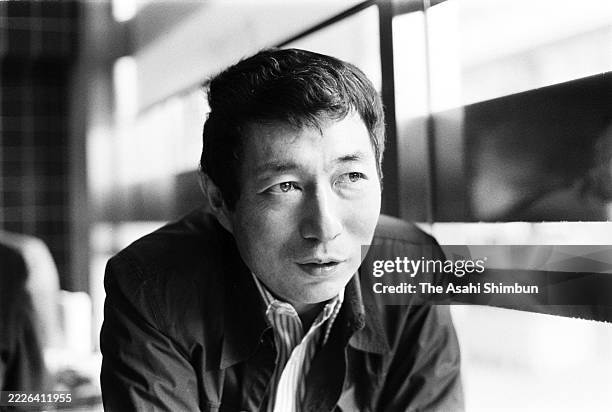
Shūji Terayama
 Japan
JapanBirthday
December 10, 1935
Birth Sign
Sagittarius
Birthplace
Hirosaki, Aomori Prefecture, Japan
Age
Died at 47
Height
5 ft 7 in (170 cm)
About
Shūji Terayama was a Japanese avant-garde poet, playwright, and filmmaker whose work defied easy categorization. Over a career that spanned just 25 years before his death in 1983, he produced a staggering body of work: hundreds of poems, dozens of plays, ten feature films, and countless essays and radio dramas. Many critics regard him as one of the most provocative creative forces to emerge from postwar Japan, and his influence echoes through filmmakers, theatre directors, and poets from the 1970s onward. Today, his estate is valued at roughly $3 million, with posthumous film restorations, book translations, and a Criterion Collection box set keeping his work alive for new generations.
Early Life & Background
Terayama was born in Hirosaki to Hachirō Terayama, a police officer, and Hatsu Terayama. When he was nine, his father died in World War II. His mother, struggling financially, worked as a live-in housekeeper, and young Shūji was sent to live with relatives in Misawa, Aomori. This displacement and early loss would fuel themes of rootlessness and memory throughout his career.
He attended Misawa Elementary and Junior High, where he was a voracious reader of Japanese classics and Western literature. At Aomori Prefectural Misawa High School, he began writing haiku and tanka, submitting to national competitions. At seventeen, he won the Tanka Poetry Prize from the magazine Tanka Kenkyū, an early validation of his talent. He moved to Tokyo in 1954 and briefly studied at Waseda University's School of Education but dropped out after one year, finding academia too constraining. Immersing himself in the city's avant-garde literary scene, he befriended poets Tadahiko Ueda and Makoto Ōoka. His first published collection, Chōjin Sanka (Song of the Blind Man), appeared in 1957, establishing him as a rising voice in experimental poetry.
Career Growth
Terayama's breakthrough came in 1967 when he founded the Tenjō Sajiki theatre troupe in Tokyo, which quickly became the epicenter of Japanese underground performance. The troupe staged provocative, audience-immersive works that broke the fourth wall and blurred reality with fiction. In 1971, he released his breakthrough film Throw Away Your Books, Rally in the Streets, a chaotic, autobiographical collage of memory, politics, and rebellion that won the Critics' Prize at the Cannes Film Festival. His most acclaimed film, Pastoral: To Die in the Country, followed in 1974, winning the Special Jury Prize at Locarno. Over the next decade, he released eight more features, including Boxer (1975) and Farewell to the Ark (1979), his final film. He also published The Complete Works of Shūji Terayama in 16 volumes in 1981, solidifying his literary legacy. His career was cut short by his death from cirrhosis in 1983, but his work continues to be rediscovered through retrospectives and restorations.
Career Timeline
Public Image & Style
Terayama's public persona was that of a relentless provocateur. His work is characterized by surreal, dreamlike imagery, nonlinear narratives, and a constant blurring of reality and fiction. His films often feature desolate landscapes, abandoned buildings, and characters trapped in cycles of memory. His theatre was confrontational, breaking the fourth wall and involving the audience directly. Critics have called him 'Japan's Godard' or 'the Japanese Fellini,' though his work is more anarchic and less politically dogmatic. He is revered in avant-garde circles but remains obscure to mainstream audiences outside Japan. Fans, sometimes calling themselves 'Terayama-ists' or 'Sajiki-ites,' organize annual screenings on the anniversary of his death, known as Terayama Day. The official social media accounts, managed by the archive at Waseda University, maintain a scholarly and archival voice, posting rare photographs and film clips.
Fame & Fandom
Shūji Terayama commands a focused, global attention that resonates deeply within avant-garde circles, film archives, and academic institutions rather than the mainstream pop consciousness. His work remains a touchstone for those exploring the boundaries of surrealism and underground theater, though his reach is defined by enduring influence rather than mass-market saturation. iFANN has evaluated this figure's standing in the cultural landscape, and the Global Fame Engine currently determines that Shūji Terayama does not hold a placement in the published rankings, including the Global Top 1,000 or any Top-100 scope list. This absence from the ranked lists reflects his status as a niche historical icon whose legacy is preserved through specialized study rather than contemporary viral metrics. The appreciation for his life and art is sustained by a fragmented community of scholars, cinephiles, and artists who operate without a formalized fanbase structure. There is no documented fandom name associated with Terayama; instead, his supporters are scattered across university departments, film festival attendees, and the underground art scene. Unlike modern celebrities who cultivate organized clubs or digital armies, the Terayama community engages through scholarly analysis, preservation efforts, and curated retrospectives hosted by institutions like the Harvard Film Archive. While social media accounts exist to archive his work, they function as historical repositories rather than hubs for interactive fan campaigns or grassroots organizing. His relationship with audiences was historically confrontational and non-reciprocal, designed to disrupt passive consumption rather than foster a traditional celebrity following.
Interesting Facts and Legends
Terayama was a compulsive gambler who once wagered his entire advance for a poetry collection on a horse race; he lost the bet but later channeled the experience into a poem. A lifelong baseball enthusiast, he frequently wrote essays drawing parallels between the sport and theatrical performance. His Tenjō Sajiki troupe famously staged a play inside a moving train, turning passengers into an unwilling audience. Although he composed over 1,000 haiku during his lifetime, only 200 were published before his death, with the remainder discovered posthumously. His film Farewell to the Ark drew direct inspiration from a dream he experienced after reading Gabriel García Márquez's One Hundred Years of Solitude. Beyond these personal anecdotes, Terayama left behind legendary moments that define his mythos. The 1970 street performance titled Throw Away Your Books, Rally in the Streets stands as a defining event where hundreds of participants disrupted public space to challenge the established literary order. Another iconic work, The Boxer (1977), subverted the sports drama genre with its raw aesthetic and philosophical questioning of violence, featuring the now-famous line, Can you hate people? I can! His short film The War of Jan Ken Pon transformed the children's game Rock-Paper-Scissors into a grotesque allegory for war, spreading as a shocking visual incident through word-of-mouth in avant-garde circles long before the internet age.
Notable Quotes
“The past is not dead. It is not even past.”
“I make films because I cannot remember my childhood. The camera is my memory machine.”
“Theatre is not a place to escape reality. It is a place to confront it, naked and screaming.”
“Poetry is the only language that can speak of death without lying.”
Family & Personal Life
Terayama's father, Hachirō Terayama, was a police officer who died in World War II when Shūji was nine. His mother, Hatsu, worked as a live-in housekeeper, and he was raised by relatives in Misawa. In 1961, he married poet and novelist Kyōko Kujō, a prominent literary figure in her own right known for confessional poetry and feminist essays. They had one son, Tōru Terayama, born in 1962, who became a photographer and writer and now manages the estate. The marriage was unconventional, both were fiercely independent artists, and Kyōko later wrote candidly about Terayama's affairs and struggles with alcoholism. She survived him by many years, passing away in 2021.
Notable Connections
Terayama was a close friend of filmmaker Nagisa Ōshima, and they frequently debated the role of art in politics. His wife, Kyōko Kujō, was a significant poetic influence and collaborator. He collaborated with cinematographer Yoshio Ōtani on several films, and composer Jōji Yuasa scored many of his works. His early mentor was poet Makoto Ōoka. His son, Tōru Terayama, now manages his estate.
Relationships & Dating History
Terayama married poet and novelist Kyōko Kujō in 1961. Their marriage was unconventional, both were fiercely independent artists, and they had one son, Tōru. Kyōko later wrote candidly about Terayama's affairs and his struggles with alcoholism. In the late 1960s, he had a well-known extramarital affair with a woman named Reiko, a member of the Tenjō Sajiki troupe, which Kyōko acknowledged in her memoirs. In the late 1970s, he had a rumored affair with a younger actress in his theatre company, referenced in multiple biographies. Terayama remained married to Kyōko until his death in 1983.
- MarriedKyōko Kujō1961 - 1983Met in Tokyo literary circles; had one son, Tōru; she wrote about his affairs and alcoholism.
- DatedReiko1968 - 1972Extramarital affair with a Tenjō Sajiki troupe member; acknowledged by Kyōko Kujō.
- RumouredYoshiko1978 - 1982Rumored affair with a younger actress in his theatre company; mentioned in biographies.
Death & Aftermath
Died
May 4, 1983 (aged 47)
Death Place
Unknown
Cause of Death
Unknown
The release of Farewell to the Ark in 1979 marked his final cinematic statement, a work that would stand as a haunting reflection of his vision before the world lost its most provocative creative force. Shūji Terayama passed away on May 4, 1983, at the age of forty-seven, bringing an abrupt end to a career that had spanned just twenty-five years of intense production. While specific details regarding the location of his passing and the precise medical circumstances remain unrecorded in available archives, it is widely acknowledged within the community that he succumbed to cirrhosis, a condition that had long shadowed his life. His son, Tōru Terayama, assumed the role of managing the estate and overseeing the Shūji Terayama Archive at Waseda University, ensuring that the poet-filmmaker's extensive body of work remained accessible to future generations. Posthumous efforts have since focused on restoring his films and translating his poetry, keeping the flame of his avant-garde influence alive through retrospectives and new editions of his complete works.
Net Worth (Estate Value)
$3 Million
iFANN Editorial Team estimate
Because Terayama died in 1983, his net worth refers to the estate value and posthumous earnings. Per iFANN's editorial analysis, the estate is valued at approximately $3 million as of 2026. The estate is managed by his son, Tōru Terayama, and the Shūji Terayama Archive at Waseda University. Revenue sources include posthumous film releases and licensing fees from retrospectives worldwide, book royalties from poetry collections and essays (increasingly translated into English, French, and other languages), occasional revivals of Tenjō Sajiki plays, merchandise such as T-shirts and art books sold through museum shops, licensing fees for his name and image in documentaries and academic studies, and residuals from digital streaming on platforms like the Criterion Channel. The estate's wealth is almost entirely intellectual property-based, with no real estate or business ventures.
Awards Won (8)
Terayama's awards reflect his avant-garde and countercultural status. He won the Critics' Prize at Cannes in 1971 for Throw Away Your Books, Rally in the Streets and the Special Jury Prize at Locarno in 1974 for Pastoral: To Die in the Country. He received the Best Director award from the Japan Film Directors Association in 1975 for Boxer and the Mainichi Film Award for Best Film in 1981 for Farewell to the Ark. In 1982, he was honored with the Japan Art Academy Prize for lifetime contribution to literature and theatre.
1971 · Feature Film
Throw Away Your Books, Rally in the Streets
1974 · Feature Film
Pastoral: To Die in the Country
Known For
Throw Away Your Books, Rally in the Streets
1971 · Director, Writer
Pastoral: To Die in the Country
1974 · Director, Writer
Farewell to the Ark
1979 · Director, Writer
Boxer
1975 · Director, Writer
Keywords
Quick Facts
- Profession
- poet, playwright, filmmaker
- Born
- +1935-12-10
- Birthplace
- Hirosaki, Aomori Prefecture, Japan
- Died
- +1983-05-04
- Death Place
- Suginami, Tokyo, Japan
- Gender
- Male
- Spouse
- Kyōko Kujō
- Birth Sign
- Sagittarius
Personal Details
- Full Name
- Shūji Terayama
- Height
- 5 ft 7 in (170 cm)
- Spouse
- Kyōko Kujō
- Children
- Tōru Terayama
- Education
- Waseda University (dropped out after 1 year)
Filmography
10
Total
10
Film
0
TV
Frequently Asked Questions
What is Shūji Terayama known for?
How did Shūji Terayama die?
What is Shūji Terayama's net worth in 2026?
Is Shūji Terayama still influential today?
Who was Shūji Terayama married to?
Social Media
Similar People
Join the community
fans discussing