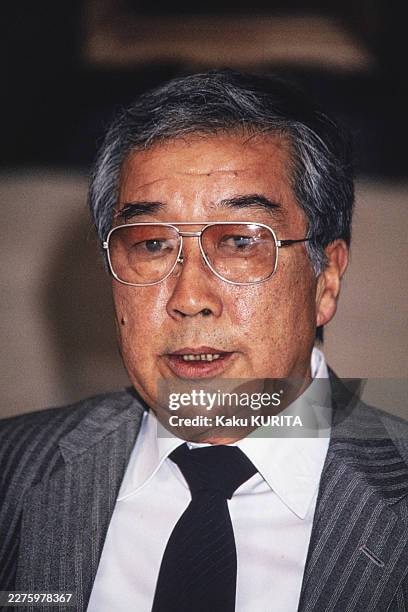
Shohei Imamura
 Japan
Japanfilm director•screenwriter•film producer
Birthday
September 15, 1926
Birth Sign
Virgo
Birthplace
Tokyo, Japan
Age
Died at 79
Height
5 ft 7 in (170 cm)
About
Shohei Imamura, born September 15, 1926 in Tokyo, was a Japanese film director, screenwriter, and producer. He is the only Japanese director to win the Palme d'Or at Cannes twice, for The Ballad of Narayama (1983) and The Eel (1997). Over a career spanning four decades, he directed 17 feature films and numerous documentaries, earning international acclaim for his unflinching portrayals of Japan's lower classes and marginalized individuals. His work, often compared to that of Pier Paolo Pasolini and Luis Buñuel, combined naturalism with dark comedy to explore primal human instincts and social inequities. Imamura's films remain a cornerstone of the Japanese New Wave and continue to be studied and celebrated in retrospectives worldwide.
Early Life & Background
Imamura grew up in Tokyo's shitamachi district, the son of a doctor. The class divisions he observed as a child left a lasting impression. He attended Waseda University, graduating in 1951 with a degree in Western history. During his youth, he was deeply influenced by French literary naturalists like Émile Zola. After graduation, he joined the Shochiku film studio as an assistant director, working under Yasujirō Ozu on films such as Early Summer (1951) and The Flavor of Green Tea over Rice (1952). He found Ozu's formal, restrained style stifling and later said he wanted to create a more visceral, earthy cinema. In 1954, he moved to Nikkatsu Studios, where he began writing screenplays and directing. His debut feature, Stolen Desire (1958), was a comedy-drama about a traveling theater troupe.
Career Growth
Imamura's breakthrough came in 1961 with Pigs and Battleships, a brutal satire of the post-war underworld. He followed this with The Insect Woman (1963), which won the Mainichi Film Award for Best Film and the Best Actress award at the Berlin International Film Festival. In 1967, he directed the experimental documentary A Man Vanishes, blurring reality and fiction. After founding Imamura Productions in 1975, he won his first Palme d'Or at Cannes in 1983 for The Ballad of Narayama, a stark adaptation of the ubasute legend. His 1989 film Black Rain, about the aftermath of the Hiroshima bombing, won the Jury Prize at Cannes. In 1997, he won his second Palme d'Or for The Eel, a psychological drama starring Koji Yakusho. That same year, he founded the film school at Yokohama National University, where he mentored Takashi Miike. His final feature, Warm Water Under a Red Bridge, was released in 2001.
Career Timeline
Public Image & Style
Imamura's films are characterized by gritty naturalism, a focus on the lower classes, raw sexuality, and dark comedy. Critics consistently describe him as a humanist and a chronicler of the underclass. His work is often compared to that of Pier Paolo Pasolini and Luis Buñuel for its transgressive, socially critical nature. He has a dedicated scholarly fanbase among cinephiles, with active discussion on forums like the Criterion Forum and Letterboxd. His estate maintains an archival social media presence that promotes retrospectives and home video releases.
Fame & Fandom (iFAMOUS Rankings)
Shohei Imamura commands a global audience of cinephiles, scholars, and film students who revere his contributions to world cinema rather than following him as a contemporary pop icon. While he does not hold a position in the current iFANN Global Top 1,000 or any scope-specific ranking lists, his stature remains untouchable within the canon of Japanese New Wave directors. The iFANN evaluation confirms that Imamura is currently evaluated but holds no placement in the published rankings, reflecting a legacy defined by artistic permanence rather than fluctuating popularity metrics. His fanbase lacks a formal name, operating instead through academic circles, dedicated film archives like the Criterion Collection, and active discussion groups on platforms such as Letterboxd and the Criterion Forum. These communities engage in restoration efforts for titles like Vengeance Is Mine and The Insect Woman, ensuring his work remains accessible to new generations without organized campaigns or social media interactions typical of modern stars.
Interesting Facts and Legends
Imamura served as an assistant director on Yasujirō Ozu's Early Summer and The Flavor of Green Tea over Rice before rejecting Ozu's polished style for his own gritty naturalism. He frequently employed insect metaphors to illustrate humanity's drive by primal instincts, a theme central to his worldview. His quasi-documentary A Man Vanishes (1967) famously blurred the lines between reality and fiction while investigating a missing person. Takashi Miike, who would later become a renowned director himself, worked as an assistant director on The Eel under Imamura's mentorship. The director stands alone as the only Japanese filmmaker to win the Palme d'Or twice, securing victories for The Ballad of Narayama (1983) and The Eel (1997). Films including Pigs and Battleships, The Insect Woman, and Black Rain have been released on Blu-ray by the Criterion Collection, cementing their status as essential viewing. Fans often recount the story of Imamura digging beneath Japan's surface to reveal a wellspring of sensual, irrational energy, framing him as a chronicler of the underclass who viewed humans as animals driven by hunger, sex, and survival.
Notable Quotes
“I am interested in the lower part of the human body, and the lower part of society.”
“Ozu's films are about the way things should be. My films are about the way things are.”
“I wanted to show that even in a brutal, primitive society, there is a profound beauty and dignity.”
“I am very happy, but I am also very tired. I think I will go home and sleep.”
Family & Personal Life
Imamura married Akiko Imamura, who managed his production company and personal affairs. The couple had two children: a son, Daisuke Imamura, who became a film director, and a daughter. Imamura was intensely private about his family life, and few details about his household are public. He lived in Tokyo until his death in 2006.
Notable Connections
Imamura worked as an assistant director under Yasujirō Ozu, whose formal style he later rejected. He mentored Takashi Miike, who assisted on The Eel. Frequent collaborators include actor Koji Yakusho, who starred in The Eel and Warm Water Under a Red Bridge, and Ken Ogata, who starred in The Ballad of Narayama and Black Rain. He was a contemporary of Shinoda Masahiro in the Japanese New Wave.
Relationships & Dating History
Shohei Imamura was intensely private about his personal life. He was married to Akiko Imamura, who managed his production company and personal affairs. The couple had two children together. No other public romantic relationships are documented in credible sources. He remained married to Akiko until his death in 2006.
- MarriedAkiko Imamura? - 2006His wife, who managed his production company and personal affairs. They had two children together.
Death & Aftermath
Died
May 30, 2006 (aged 79)
Death Place
Unknown
Cause of Death
Liver cancer
Shohei Imamura passed away on May 30, 2006, at the age of seventy-nine. The official cause of death was reported as liver cancer, a diagnosis widely cited in major biographical sources and news outlets including an obituary published by The Guardian on June 1, 2006. This medical condition ended the career of a man who had spent forty years documenting the primal instincts and social inequities of Japan's marginalized classes. He died alongside peers like Nagisa Oshima and Seijun Suzuki as a leading figure of the Japanese New Wave of the 1960s.
The film community responded with immediate tributes recognizing his unique ability to link eroticism and violence while challenging moral norms. His passing marked the loss of a pivotal voice in cinema history, with specific details regarding fan vigils or memorial murals not appearing in available search data.
Following his death, his legacy endured through the continued distribution and study of seminal works such as Vengeance Is Mine, Black Rain, The Pornographers, and Profound Desires of the Gods. These films maintained a significant presence in academic and critical circles, frequently featured in retrospectives and educational programs including the Vanishing Points series hosted by the Harvard Film Archive. His induction into the pantheon of top directors remains a permanent honor, ensuring his works continue to be studied today.
Net Worth (Estate Value)
$10 Million
iFANN Editorial Team estimate
The estate of Shohei Imamura is managed by his family, specifically his wife Akiko and son Daisuke. Revenue streams continue to flow from royalties generated by his 17 feature films, which earn income through DVD and Blu-ray sales, streaming rights, and television licensing. The Criterion Collection releases of Pigs and Battleships, The Insect Woman, and Black Rain contribute significantly to these ongoing earnings. Additionally, Imamura earned a salary during his tenure as a professor at Yokohama National University. No public filings provide a specific annual posthumous income figure, but per iFANN's editorial analysis, his estate is estimated at approximately $10 million as of 2026.
Awards Won (22)
Imamura won two Palme d'Or awards at Cannes, for The Ballad of Narayama (1983) and The Eel (1997). He also won the Jury Prize for Black Rain (1989). Domestically, he won multiple Japan Academy Prizes, Mainichi Film Awards, and Kinema Junpo Awards for Best Director and Best Film. He received the Order of the Rising Sun in 2004 and a Lifetime Achievement Award at the Asian Film Awards in 2005.
1997 · Palme d'Or
The Eel
1983 · Palme d'Or
The Ballad of Narayama
1998 · Best Director
The Eel
1998 · Best Film
The Eel
Known For
The Ballad of Narayama
1983 · Director
The Eel
1997 · Director
Black Rain
1989 · Director
The Insect Woman
1963 · Director
Pigs and Battleships
1961 · Director
Keywords
Quick Facts
- Profession
- film director, screenwriter, film producer
- Born
- +1926-09-15
- Birthplace
- Tokyo, Japan
- Died
- +2006-05-30
- Death Place
- Tokyo, Japan
- Gender
- Male
- Birth Sign
- Virgo
Personal Details
- Full Name
- 今村 昌平 (Imamura Shōhei)
- Height
- 5 ft 7 in (170 cm)
- Spouse
- Akiko Imamura
- Children
- Daisuke Imamura (son), one daughter
- Education
- Waseda University, degree in Western History (1951)
Filmography
17
Total
17
Film
0
TV
Frequently Asked Questions
How many Palme d'Or did Shohei Imamura win?
What is Shohei Imamura's most famous film?
Did Shohei Imamura work with Ozu?
What was Shohei Imamura's teaching role?
Is Shohei Imamura related to Teruyo Imamura?
Similar People

Join the community
fans discussing