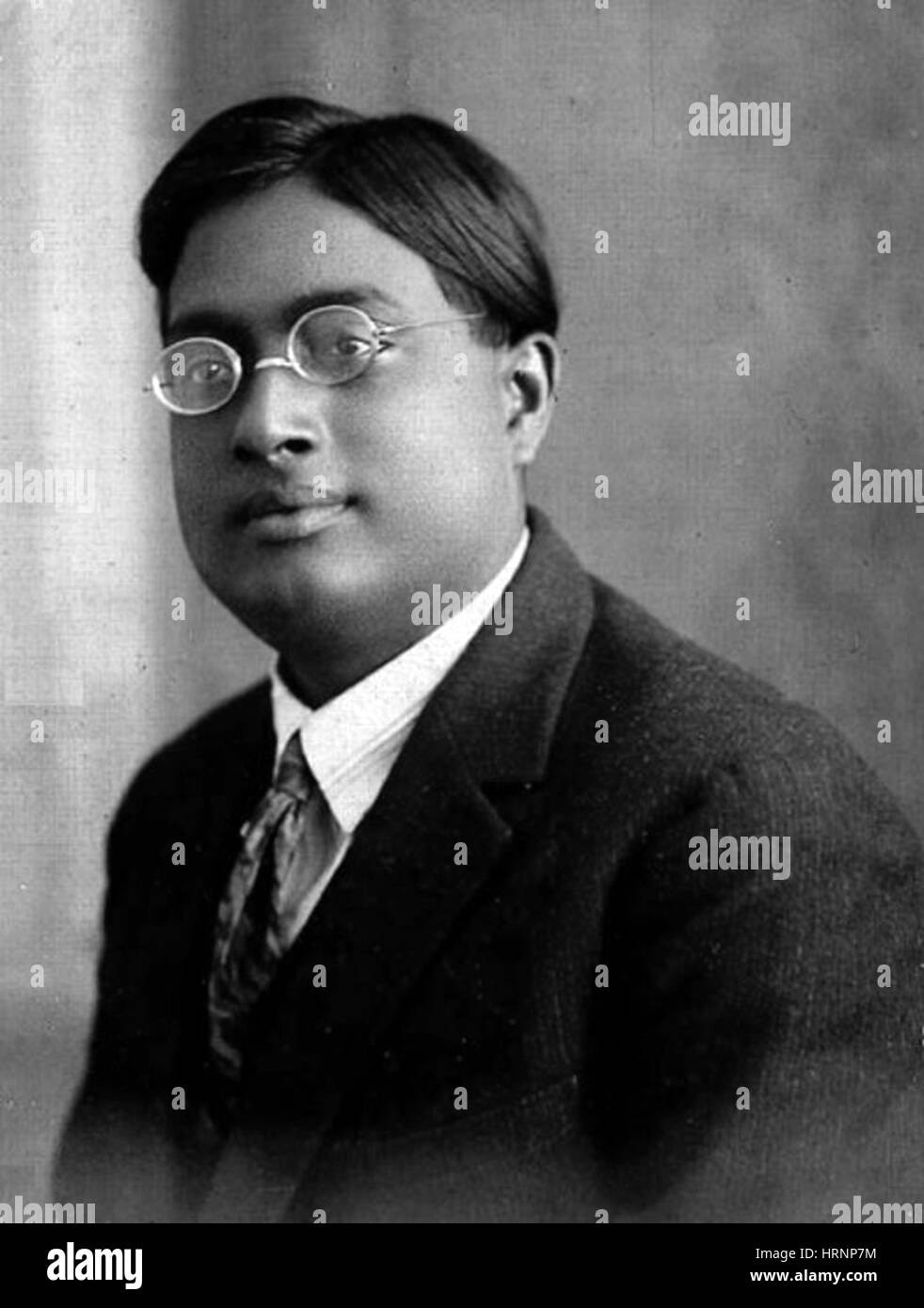
Satyendra Nath Bose
 India
IndiaBirthday
January 1, 1894
Birth Sign
Capricorn
Birthplace
Kolkata, India
Age
Died at 80
About
Satyendra Nath Bose was an Indian theoretical physicist and mathematician whose work in the early 1920s reshaped quantum mechanics. He developed Bose-Einstein statistics, a framework that describes how particles like photons behave, and laid the groundwork for the Bose-Einstein condensate, a state of matter observed at near-absolute-zero temperatures. Physicist Paul Dirac named the class of particles that follow these rules bosons in his honor.
Bose was elected a Fellow of the Royal Society and received the Padma Vibhushan, India's second-highest civilian award, in 1954. A polymath with interests spanning physics, mathematics, chemistry, biology, philosophy, and music, he also served on national research committees after India's independence. He died on February 4, 1974, in Kolkata, leaving a legacy that continues to influence modern physics.
Early Life & Background
Satyendra Nath Bose was born on January 1, 1894, in Calcutta, the eldest of seven children. His father, Surendranath Bose, worked as an accountant for the East Indian Railway before starting his own chemical and pharmaceutical company. His mother, Amodini Devi, managed a middle-class household that valued English education.
Bose's brilliance showed early. At the Hindu School in Calcutta, his mathematics teacher Upendralal Bakshi recognized his genius. Bose once scored 110 out of 100 in a math exam by solving problems using multiple methods. He passed his entrance examination in 1909, ranking fifth among all candidates. At Presidency College, Calcutta, he earned a Bachelor of Science in mixed mathematics in 1913, graduating first in his class. He continued at the University of Calcutta, where his marks in the M.Sc. mixed mathematics examination in 1915 set a record that stood for years.
After completing his master's, Bose began research at the University of Calcutta in 1916, focusing on the theory of relativity. He taught at the University of Dacca starting in 1921, where he would make his breakthrough.
Career Growth
In 1924, while a lecturer at the University of Dacca, Bose wrote a paper titled Planck's Law and the Hypothesis of Light Quanta. He derived Planck's quantum radiation law using a novel method of counting states for identical particles, treating them as indistinguishable. Unable to get it published, he sent the paper to Albert Einstein, who recognized its importance, translated it into German, and submitted it to the journal Zeitschrift für Physik. This work became the foundation of Bose-Einstein statistics.
Einstein extended Bose's ideas to matter, predicting the Bose-Einstein condensate, a state of matter confirmed experimentally in 1995. In 1926, Bose became head of the physics department at Dhaka University. He returned to Calcutta University in 1945, where he taught and researched until his retirement in 1956. He also taught post-graduate classes on relativity in Bengali, promoting scientific education in the local language.
After India's independence, Bose served on various national research and development committees. He was nominated to the Rajya Sabha, the upper house of India's parliament, in 1958.
Career Timeline
Public Image & Style
Bose was widely regarded as a humble and self-effacing genius. He rarely sought credit for his work and was known to downplay his own contributions. Colleagues described him as approachable and generous with his time. He was a strong advocate for science education in Bengali, believing that scientific knowledge should be accessible to all. His image in India is that of a national hero who put Indian science on the global map, and he is remembered as a symbol of intellectual modesty and dedication.
Fame & Fandom
Satyendra Nath Bose commands a global audience defined by academic reverence rather than popular celebrity, with his name recognized primarily within the scientific community and among history enthusiasts. The iFANN Global Fame Engine evaluated this figure in August 2026 and determined that Satyendra Nath Bose is currently unranked on the Global Top 1,000 list or any scope-specific top-100 charts, meaning no placement number applies to his current standing. While he remains a towering historical figure, he does not hold a specific ordinal position in the published rankings at this time. His legacy is sustained through institutional memory and the enduring study of quantum mechanics rather than modern fan metrics. Regarding his audience, there is no documented fandom name; the group of admirers consists of physicists, mathematicians, and students who engage with his work through academic channels rather than as an organized fanbase with a specific moniker. No rituals, campaigns, or social media movements are associated with him, reflecting his status as a scholar from a pre-celebrity era whose influence is measured in citations and scientific breakthroughs rather than public adulation.
Interesting Facts and Legends
Satyendra Nath Bose was a polymath with deep interests in chemistry, biology, mineralogy, philosophy, arts, literature, and music. He could recite poetry in multiple languages and played the violin. He was known for his humility and often said he did not consider himself a genius. Rabindranath Tagore dedicated his only science book, Visva-Parichay, to Bose in 1937. Bose also campaigned for Hindi to replace English as the language of science in India. A central pillar of his legend is the incident where he sent a paper on quantum statistics to Albert Einstein after facing rejection from European journals. Einstein recognized the brilliance of the work, translated it into German himself, and submitted it to Zeitschrift für Physik, an event that led to particles following these rules being named bosons. Another poignant story from his life involves his reaction to Einstein's death; accounts state that Bose was so shattered by grief that he tore up an unpublished research paper. This anecdote highlights the profound personal bond between the two scientists and serves as a narrative illustrating Bose's character and loyalty.
Notable Quotes
“I do not consider myself a genius. I only followed my curiosity.”
“Science should be taught in the language of the people.”
“The joy of discovery is the greatest reward.”
“Einstein's recognition of my work gave me the confidence to continue.”
“I never aimed for fame; I aimed for understanding.”
Family & Personal Life
Bose married Ushabala Bose (also known as Ushabati Ghosh) in a traditional Bengali ceremony. The couple had nine children, though several died in infancy. Bose's father, Surendranath, was an accountant who later ran a chemical business. His mother, Amodini Devi, was a homemaker. Bose grew up in a middle-class household in Calcutta with six siblings. He was known to be a devoted family man who balanced his scientific work with time at home.
Notable Connections
Satyendra Nath Bose is closely associated with Albert Einstein, who championed his 1924 paper and co-developed Bose-Einstein statistics. Paul Dirac coined the term 'bosons' to describe particles obeying those statistics. Rabindranath Tagore, a family friend, dedicated his science book to Bose. His mathematics teacher Upendralal Bakshi recognized his early genius, and Sir Asutosh Mookerjee, as Vice-Chancellor of Calcutta University, supported his research career.
Relationships & Dating History
Satyendra Nath Bose married Ushabala Bose (also known as Ushabati Ghosh) in a traditional ceremony in the early 1910s. The marriage was a stable and supportive partnership. Ushabala managed the household and raised their nine children while Bose pursued his academic career. She was described as a devoted wife who encouraged his scientific work. Bose remained married to her until his death in 1974. There are no records of any other romantic relationships.
- MarriedUshabala Bose1914 - 1974Traditional Bengali marriage; she supported his career and raised their nine children.
Death & Aftermath
Died
February 4, 1974 (aged 80)
Death Place
Calcutta, West Bengal, India
Cause of Death
Natural causes due to old age
Satyendra Nath Bose spent his final years in Calcutta, maintaining his academic interests and family life until the natural decline of advanced age took its toll. He passed away on February 4, 1974, within the city that had been his home for decades, marking the end of a life dedicated to theoretical physics and mathematics. The circumstances surrounding his death were reported as peaceful and natural, with no specific acute illness, accident, or foul play documented by authorities or biographical sources. His passing occurred without a public hospitalization immediately preceding the event, suggesting he died in a private setting consistent with the privacy norms for senior academics in India during that era.
The scientific community and government officials responded to his death with profound tributes rather than legal inquiries or investigations. While the funeral was conducted as a private affair following Hindu cremation rites, the legacy of the physicist was cemented through institutional memorials and continued recognition by the state. The Indian government established the Bose Institute in his honor, and his contributions remain celebrated annually on National Science Day. In recent decades, his name has appeared in educational materials and news regarding quantum physics breakthroughs, including references to the creation of Bose-Einstein condensates in the mid-2020s.
Posthumous honors included the naming of the subatomic particle boson after him and the enduring status of Bose-Einstein statistics as a foundational theory. A new book by his student Partha Ghose released around May 2024 highlighted their relationship and Bose's grief over Einstein's death, adding to the literary legacy. No major commercial films were produced solely about his death, though his name frequently appears in discussions of quantum mechanics.
Net Worth (Estate Value)
$1 Million
iFANN Editorial Team estimate
As a theoretical physicist and academic, Satyendra Nath Bose did not accumulate significant personal wealth. Per iFANN's editorial analysis, his net worth at the time of his death in 1974 is estimated at $1 Million in 2026 terms, primarily consisting of his academic salary, modest savings, and a small pension. He lived a simple life, dedicating his resources to his family and research. Posthumously, his legacy has not generated substantial estate income, though his name is honored through institutions like the S. N. Bose National Centre for Basic Sciences.
Awards Won (2)
Satyendra Nath Bose received the Padma Vibhushan, India's second-highest civilian award, in 1954 for his contributions to science. He was elected a Fellow of the Royal Society in 1958, one of the highest honors for a scientist. He also received honorary doctorates from several universities, including the University of Calcutta and the University of Dhaka.
1954 · Civilian Award
Science
1958 · Election
Science
Known For
Bose–Einstein statistics
1924 · Developer
Bose–Einstein condensate
1925 · Co-theorist
Planck's Law derivation
1924 · Author
Boson particle naming
1925 · Namesake
Keywords
Sources
Quick Facts
- Profession
- physicist, mathematician
- Born
- January 1, 1894
- Birthplace
- Kolkata, India
- Died
- February 4, 1974
- Death Place
- Kolkata, India
- Gender
- Male
- Spouse
- Ushabala Bose
- Birth Sign
- Capricorn
Personal Details
- Full Name
- Satyendra Nath Bose
- Spouse
- Ushabala Bose
- Children
- 9
- Education
- B.Sc. in mixed mathematics, Presidency College, Calcutta (1913); M.Sc. in mixed mathematics, University of Calcutta (1915)
Frequently Asked Questions
Who was Satyendra Nath Bose?
What is Satyendra Nath Bose famous for?
What is Satyendra Nath Bose's net worth in 2026?
Did Satyendra Nath Bose win a Nobel Prize?
What awards did Satyendra Nath Bose receive?
Similar People
Join the community
fans discussing