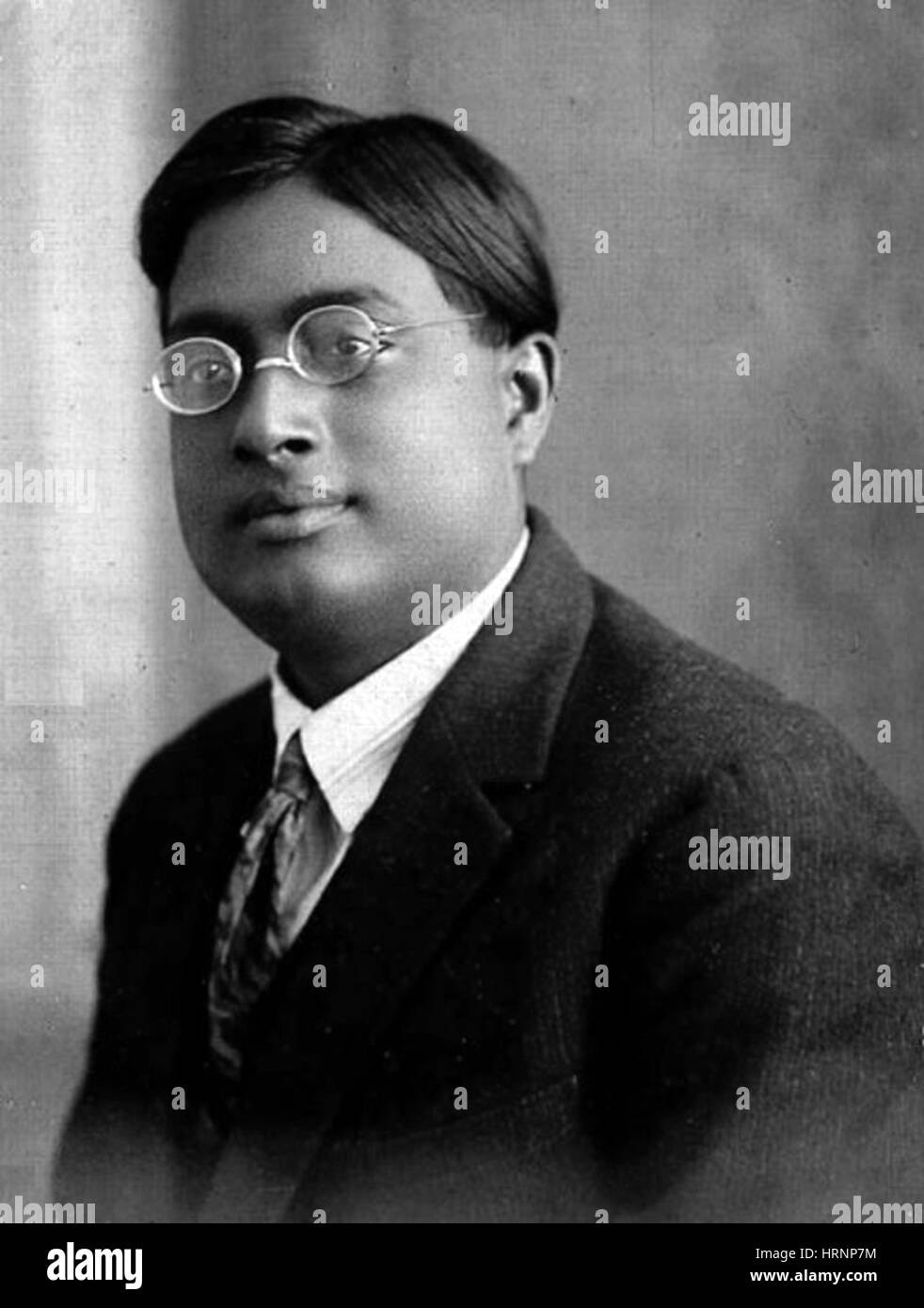
Satyendra Nath Bose
Awards & Honours
2
Awards Won
3
Honours
2
Records
Satyendra Nath Bose's work fundamentally changed quantum mechanics. His 1924 paper, championed by Einstein, introduced a new way to count identical particles, leading to Bose-Einstein statistics. This framework explains the behavior of photons, gluons, and other bosons, and predicted the Bose-Einstein condensate, a state of matter first realized in 1995. The term 'boson' itself, coined by Paul Dirac, is a permanent tribute. Bose was the first Indian theoretical physicist to gain international recognition, and his legacy is honored by institutions like the S. N. Bose National Centre for Basic Sciences.
Awards
Honours & Distinctions
Padma Vibhushan
Second-highest civilian award of India.
Fellow of the Royal Society
Elected as a Fellow for his contributions to physics.
Honorary Doctorate
Honorary D.Sc. degree.
Records & Feats
First to derive Planck's Law using statistical methods for indistinguishable particles
Bose's 1924 paper derived Planck's radiation law without classical assumptions, using a novel counting method for photons as indistinguishable particles.
Namesake of the boson particle class
Paul Dirac coined the term 'boson' to describe particles that obey Bose-Einstein statistics, making Bose's name part of the standard vocabulary of physics.