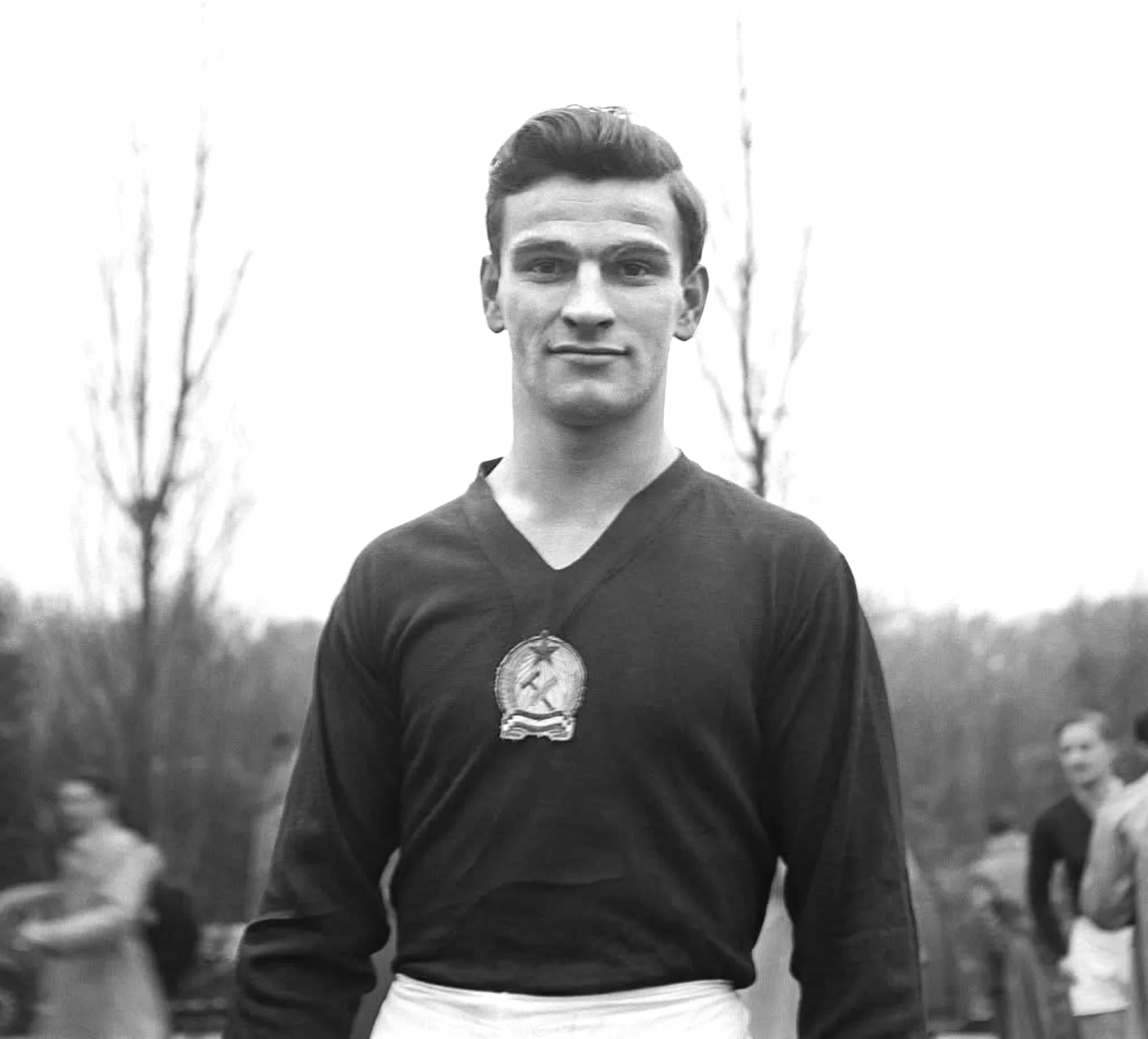
Sándor Kocsis
 Hungary
association football player•association football coach•athlete
Also known as: Sandor Kocsis, Golden Head, Cabeza de Oro
Birthday
September 21, 1929
Birth Sign
Virgo
Birthplace
Budapest, Hungary
Age
Died at 49
About
Sándor Kocsis was a Hungarian centre-forward, the quiet finisher of the Mighty Magyars, and one of the most efficient goalscorers the sport has produced. He died in Barcelona on 22 July 1979 at age 49. His name still sits near the top of every all-time scoring list that matters: 75 goals in 68 caps for Hungary, a 1.10 goals-per-game average at international level second only to Ferenc Puskás, and 11 goals at the 1954 World Cup, a single-tournament record at the time.
Kocsis was a pure centre-forward with a gift for finding space in the air. His heading earned him the nickname Golden Head, and defenders never quite worked out how to stop him. He played for Ferencvárosi TC, Budapest Honvéd, Young Fellows Zürich and FC Barcelona, and in the 1950s he lined up alongside Puskás, Zoltán Czibor, József Bozsik and Nándor Hidegkuti on the Hungary side that changed how the game was played. The statistics site RSSSF credits him with 556 goals in 537 official games, and his 1.103 goals-per-game average is the best among players with more than 43 caps in FIFA class-A competition, just ahead of Gerd Müller at 1.097. He later coached, though his playing record is what made him a fixture in the story of the sport's most prolific scorers.
Early Life & Background
Sándor Péter Kocsis was born on 21 September 1929 in Budapest, the standard date given by most sources including Wikipedia and FC Barcelona, though Transfermarkt lists 23 September 1929. He grew up in Budapest and came through the youth ranks at Ferencvárosi TC, the club he joined as a young player before establishing himself as a first-team striker. English-language records of his childhood, schooling and family background are thin. What is well documented is that he emerged at Ferencváros in the mid-1940s and was part of the great Hungarian football generation that came of age in the post-war years. His first steps toward national prominence came with Ferencváros, from where he moved to Kispest/Honvéd, the army club that became Budapest Honvéd and formed the backbone of the national side. At Honvéd he developed into a centre-forward of rare efficiency, and by the early 1950s he was a fixture in the Hungary attack. The move set up everything that followed: the Olympic gold, the World Cup run, the records.
Career Growth
The breakthrough came with Hungary's Golden Team. Kocsis was part of the side that won gold at the 1952 Helsinki Olympics, where the legend of the Magyars was born, and he topped the scoring charts in any European league in both 1952 and 1954. At the 1954 World Cup in Switzerland he was the tournament's top scorer with 11 goals, a record for a single edition at the time, since surpassed only by Just Fontaine's 13 in 1958. He became the first player to score two hat-tricks in one World Cup, including four goals against West Germany. That calendar year he scored 23 goals for Hungary, the most by any player in a single year. He holds the Hungarian record of seven international hat-tricks. He was also part of the Hungary team that reached the 1954 World Cup final, famously lost 3–2 to West Germany, and won the Central European International Cup with Hungary in the 1948–53 era.
After the 1956 Hungarian Revolution he escaped Hungary and briefly played for Young Fellows Zürich in Switzerland. In 1958 he joined FC Barcelona, where he was part of the Barça side of the late 1950s and scored four goals against Wolves in the 1960 European Cup quarter-final. With Barcelona he added the Copa del Generalísimo and Fairs Cup-era honours per club records. A loan spell at Valencia in 1961/62 is listed by one stats site. After retiring he became a coach, though his playing record is what defines his legacy.
Career Timeline
Public Image & Style
His image is that of the understated, deadly finisher of the Golden Team, less celebrated than Puskás but statistically comparable. Kocsis was a pure centre-forward renowned for his heading, hence Golden Head, with a gift for finding space in the air. Specific height figures are not reliably documented. In the retelling he is the quiet one, the man whose numbers argue louder than his personality ever did. FC Barcelona described him as known as Golden Head due to his amazing abilities in the air and noted that he escaped from Hungary.
Fame & Fandom (iFAMOUS Rankings)
iFANN's Global Fame Engine has evaluated Sándor Kocsis, but he does not currently hold a placement in the published rankings. That is the honest position for a player whose fame is historical rather than contemporary. He is not on the September 2026 iFAMOUS Rankings flagship list either. There is no organised modern fandom with a name or campaigns. Interest is historical and nostalgic, sustained by YouTube goal compilations such as The Golden Head and The Man with the Golden Head, and by Reddit football communities sharing footage of his four goals against Wolves in 1960. The audience is made up of football historians, Hungarian fans and collectors of old match film, not a formal fanbase.
Interesting Facts and Legends
Kocsis was known as a quiet, reserved man, which is how the feature writers of his day framed him: the quiet Hungarian who was as clinical as Puskás. His 2.2 goals-per-game average in World Cup finals is second only to Ernst Wilimowski. He appears in all-time World Cup top-scorer lists, including Gazzetta's 2026 top-ten list at 11 goals, and in most goals in a single World Cup rankings alongside Fontaine, Müller, Klose and Messi. He was never awarded a Ballon d'Or, as the prize began in 1956 and was Europe-only. No Walk of Fame star, knighthood or similar national honour is documented. The Barça Academy Hungary Cup and Hungarian football heritage programmes keep the Golden Team's name alive. Contemporary retrospectives have asked whether he was the greatest goalscorer of all time.
Family & Personal Life
Reliable sources on Kocsis's family life are essentially absent. No credible documentation of a spouse, children or a public romantic relationship appears in the available material. He was known as a quiet, reserved man, and his private life stayed private. Searches for Sándor Kocsis Jr. reflect a later footballer of the same name rather than a documented son. He was not related to the Hungarian water polo player who shared his name. He was 49 at his death.
Notable Connections
Relationships & Dating History
Death & Aftermath
Died
July 22, 1979 (aged 49)
Death Place
Barcelona, Spain
Cause of Death
Reported suicide following serious illness (unconfirmed)
On 22 July 1979, Sándor Kocsis died in Barcelona at the age of 49. The date, place and age are firmly documented. The cause is less clear: a widely shared Hungarian-language account, translated and passed around fan communities, says he took his own life while seriously ill and recovering from a leg amputation. That version has never been officially confirmed, and no clear public statement of the medical cause or manner of death exists in the available record.
What followed was quiet and institutional. The Puskás Academy (Puskás Intézet) holds part of his estate and marks the anniversary of his death every 22 July. The Hungarian Football Federation published a remembrance on the 40th anniversary in 2019. FC Barcelona keeps his memory in its club history, and FIFA's club football channel noted the anniversary that same year. No significant posthumous releases, estate revenue figures or publicly reported estate value exist. His legacy rests on the numbers: 75 goals in 68 caps and 11 World Cup goals, still among the all-time leaders.
Net Worth (Estate Value)
$1 Million
iFANN Editorial Team estimate
No credible net-worth estimate exists for Sándor Kocsis. He died in 1979, and no estate valuation has ever been published. The iFANN Editorial Team's analysis of his career earnings, ventures and assets points to roughly $1 Million, a figure that reflects the modest salaries of 1950s football rather than any modern commercial value. His playing income came from Ferencváros, Honvéd, Young Fellows Zürich, Barcelona and a loan at Valencia, plus a coaching career after retirement. Any 2026 figure would be speculative and should not be reported as fact. No posthumous releases, licensing deals or estate revenue figures are documented.
Awards Won (6)
Kocsis won Olympic gold with Hungary at Helsinki in 1952 and was top scorer at the 1954 World Cup with 11 goals. He won Hungarian league titles with Ferencváros and Honvéd, and Copa del Generalísimo and Fairs Cup-era honours with Barcelona. He was top scorer of the Hungarian league and of European leagues in 1952 and 1954.
1952 · Team
Hungary at Helsinki Games
1954 · Individual
1954 World Cup
Known For
1954 World Cup top scorer
1954 · Hungary striker
1952 Helsinki Olympics gold medal
1952 · Hungary striker
FC Barcelona forward
1958 · Centre-forward
Keywords
Sources
Quick Facts
- Profession
- association football player, association football coach, athlete
- Born
- September 21, 1929
- Birthplace
- Budapest, Hungary
- Died
- July 22, 1979
- Death Place
- Barcelona, Spain
- Gender
- Male
- Birth Sign
- Virgo
Personal Details
- Full Name
- Sándor Péter Kocsis
Frequently Asked Questions
How did Sándor Kocsis die?
How many goals did Kocsis score for Hungary?
Why was he called Golden Head?
How many goals did he score at the 1954 World Cup?
Did Kocsis play for Barcelona?
Similar People
Join the community
fans discussing