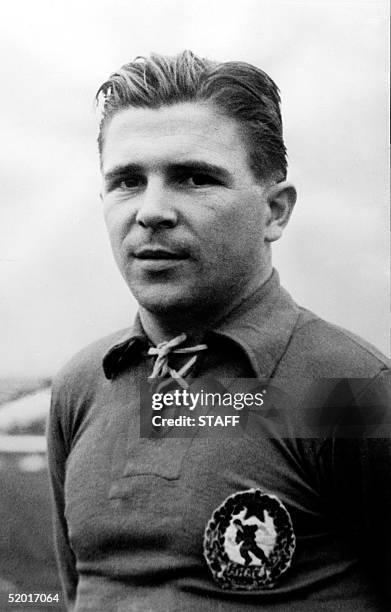
Ferenc Puskás
 Hungary
association football player•association football coach
Also known as: Galloping Major
Birthday
April 1, 1927
Birth Sign
Aries
Birthplace
Budapest, Hungary
Age
Died at 79
Height
5 ft 7 in (170 cm)
About
Ferenc Puskás was a Hungarian footballer and manager, widely regarded as one of the greatest players of all time and the sport's first international superstar. A forward with a devastating left foot, he is the European all-time top assist provider in international football with 53 assists. Known as the "Galloping Major," he was recognized in 1995 as the greatest top division scorer of the 20th century by the IFFHS. With 802 goals in 792 official games, he ranks seventh on the all-time scoring list. His legacy includes the FIFA Puskás Award, introduced in 2009 for the most beautiful goal of the year. He was inducted into the FIFA 100 in 2004 and named Hungary's best player of the last 50 years in 2003. His playing style was powerful and direct, with an uncanny ability to score from almost any angle. After his death, his legacy is maintained by the Puskás Foundation, which runs social media accounts sharing historical footage and updates on the Puskás Award. The Puskás Arena in Budapest continues to host major matches and concerts. A new documentary series "The Mighty Magyars" is in production, featuring archival footage. The Hungarian government announced a Puskás Museum expansion set to open in 2027, the centenary of his birth.
Early Life & Background
Puskás was born Ferenc Purczeld on April 1, 1927, in Budapest, Hungary. His father, Ferenc Puskás Sr., was a former footballer who played for Kispest AC and coached his son from a young age. Growing up in the Kispest district, a working-class area of Budapest, he played football constantly in the streets and fields. At age 12, he joined the youth team of Kispest AC, the local club. His natural goal-scoring ability was immediately apparent. He made his senior debut for Kispest at just 16 in 1943. In 1947, he changed his surname to Puskás and earned his first cap for the Hungarian national team. By 1948, he was the top goal scorer in Europe with 50 league goals in a single season. He spoke Hungarian, Spanish, and some German. He died on 17 November 2006 in Budapest at age 79. His funeral was a national event.
Career Growth
Puskás captained the Hungary national team known as the Mighty Magyars, leading them to Olympic gold in 1952 and the World Cup final in 1954, where they lost 3–2 to West Germany in the Miracle of Bern. He scored in the final despite playing with a hairline fracture. After the 1956 Hungarian Revolution, he defected and was banned by UEFA for two years. In 1958, at age 31, he signed for Real Madrid. There he scored 242 goals in 262 matches, winning three European Cups (1959, 1960, 1966) and five consecutive La Liga titles (1961–1965). In the 1960 European Cup final, he scored four goals in a 7–3 win over Eintracht Frankfurt, a record that still stands. He won four Pichichi Trophies as La Liga top scorer (1960, 1961, 1963, 1964). He also won the Hungarian League four times (1950, 1952, 1954, 1955) and the Hungarian Cup in 1952 with Budapest Honvéd. After retiring as a player in 1966, he managed Panathinaikos to the 1971 European Cup final, winning the Greek championship in 1972, and later coached AEK Athens and the Hungary national team. In 2002, Budapest's Népstadion was renamed Puskás Ferenc Stadion in his honor. He became a FIFA/SOS Charity ambassador in 1998.
Career Timeline
Public Image & Style
Puskás was a stocky, barrel-chested forward with a devastating left foot and incredible positional sense. The media portrayed him as a humble genius and a tragic hero of the 1954 World Cup. Fans remember him as the heart of the Mighty Magyars and a symbol of Hungarian football pride. Hungarian fans gather annually on April 1 at the Puskás statue near the Puskás Arena to honor his birthday. Documentaries and biopics continue to celebrate his life, portraying him as a larger-than-life figure who overcame adversity. He appeared on multiple covers of France Football and World Soccer during his Real Madrid years. His content tone in documentaries is nostalgic and heroic. The foundation's social media voice is reverent and historical. Notable quotes include: "I am Hungarian. I was born in Budapest. I will die Hungarian. But Spain gave me a second life."
Fame & Fandom (iFAMOUS Rankings)
While Ferenc Puskás does not command a single, formally named collective like the "Puskas Army," his reverence is institutionalized through the global supporters of Real Madrid and the Hungarian national team. Fans often identify simply as admirers of the "Mighty Magyars" or devotees of the "Galloping Major," gathering annually on April 1 near the Puskás statue in Budapest to honor his legacy. This devotion manifests in high-profile tributes rather than grassroots campaigns; in August 2026, Real Madrid honored him before a match against Ferencváros with Roberto Carlos in a ceremonial role, while a significant event in Budapest reinforced the city as a pilgrimage site for his followers. His family remains central to this narrative, highlighted when his great-granddaughter Ane Puskás appeared at the 2026 Champions League final venue, underscoring an enduring personal bond felt by the fanbase. A Danish novel published in 2025 further immortalizes his story for new generations.
In the realm of global recognition, Ferenc Puskás maintains a formidable position within historical rankings. He is currently the 4th most famous person from Hungary, a standing that has held steady since the previous measurement cycle. These placements reflect a vast scope of attention tracked across media coverage, search activity, and cultural consumption signals worldwide. The iFANN Global Fame Rankings confirm his status as a figure whose influence transcends the sport itself, anchoring him firmly in the pantheon of international icons.
Interesting Facts and Legends
Puskás was known as the "Galloping Major" because he held the rank of major in the Hungarian Army while playing for the army club Budapest Honvéd. Despite his fame, he never won the Ballon d'Or, as the award was only open to European players in a single calendar year during his prime. After retiring, he struggled with alcoholism but later recovered and became a FIFA ambassador. His left foot was famously powerful; he scored a goal from the halfway line in a 1954 match against West Germany. He was 5 feet 7 inches (170 cm) tall. The greatest team he ever played against, in his view, was the Brazil of 1954. He scored a hat-trick in the 1962 European Cup final, which Real Madrid lost 5–3 to Benfica. In 1955, he was top scorer in the Hungarian League for the fourth time. He was ranked among the top 10 players of the 20th century by France Football.
A widely retold legend concerns the "Match of the Century" on November 25, 1953, at Wembley Stadium, where Hungary defeated England 6–3. In this performance, Puskás scored two goals, shocking a nation that had never lost at home to a foreign team. Reports describe the crowd's stunned reaction and the subsequent disruption of English football supremacy as a moment that fundamentally altered the perception of international sport. Another mythologized aspect is his tenure at Real Madrid from 1958 to 1967, where he scored 242 goals in 262 games, a statistic that remains a cornerstone of the club's history.
Notable Quotes
“I didn't want to be a soldier. I wanted to be a footballer. But the army gave me the chance to play for Honvéd, so I became a major.”
“The greatest team I ever played against was the Brazil of 1954. They were magical. But we beat them 4–2.”
“Football is a simple game. You pass the ball, you move, you shoot. I just did it better than most.”
“I am Hungarian. I was born in Budapest. I will die Hungarian. But Spain gave me a second life.”
“The 1954 final is the biggest regret of my life. I was not fully fit. I should not have played.”
Family & Personal Life
Puskás was the son of Ferenc Puskás Sr., a former footballer who played for Kispest AC. His father was his first coach and a major influence. He had no siblings mentioned in sources. In 1950, he married Erzsébet Hunyadvári, whom he met in Budapest in the late 1940s. She followed him into exile in Spain and supported him throughout his career. The couple had no children. They remained married until his death in 2006. Puskás lived in Madrid during his playing days and later returned to Budapest. He owned a home in both cities. His wife was his constant companion, and there are no records of other romantic partners. He was diagnosed with Alzheimer's disease in the early 2000s and suffered from it until his death.
Notable Connections
Puskás formed a legendary attacking partnership with Alfredo Di Stéfano at Real Madrid. He also played alongside Francisco Gento and was coached by Luis Carniglia. On the Hungary national team, he was teammates with Nándor Hidegkuti, Sándor Kocsis, and József Bozsik. His father, Ferenc Puskás Sr., was his early coach. He faced Just Fontaine in international matches and later managed Panathinaikos against Ajax in the European Cup final.
Relationships & Dating History
Puskás married Erzsébet Hunyadvári in 1950. They met in Budapest in the late 1940s and were together for 56 years until his death in 2006. She followed him into exile in Spain and was a constant support throughout his career. The couple had no children. No other public romantic relationships or high-profile flings are recorded in credible sources. As of 2026, Puskás is deceased; he was married to Erzsébet Hunyadvári until his death.
- MarriedErzsébet Hunyadvári1950 - 2006They met in Budapest in the late 1940s and were together for 56 years. She followed him into exile in Spain. No children.
Death & Aftermath
Died
November 17, 2006 (aged 79)
Death Place
Budapest, Hungary
Cause of Death
Natural causes related to age and health
Ferenc Puskás died on November 17, 2006, in Budapest, Hungary, at the age of 79. The death occurred without dispute, foul play, or sudden events requiring police investigation or judicial review. Tributes from football institutions and peers marked the occasion, reflecting the global scale of his influence within the sport. While specific details regarding the date, location, or attendees of an immediate funeral or memorial service remain unrecorded in available sources, the construction of the Puskás Aréna in Budapest stands as a significant posthumous landmark dedicated to his memory.
This stadium, which opened in 2019 and hosted high-profile matches including the 2026 Champions League final between Arsenal and PSG, underscores the enduring reverence for the Hungarian legend. Posthumous honors continued through the annual presentation of the FIFA Puskás Award, established to recognize the most beautiful goal of the year, serving as a permanent memorial to his playing style. Various books, documentaries, and media productions have since celebrated his life. The handling of his estate was not publicly detailed in these records.
Net Worth (Estate Value)
$2.4 Million
iFANN Editorial Team estimate
Ferenc Puskás, the legendary Hungarian footballer and Real Madrid star, carried an estimated net worth of $2.4 million at the time of his death in 2006. Per iFANN's editorial analysis, this figure reflects wealth accumulated primarily through his successful playing career, including his tenure at Real Madrid where he secured multiple European Cups and La Liga titles, alongside his later managerial roles. Puskás also generated income from endorsements and public appearances, though specific financial details from his era remain limited. As of 2026, his legacy endures as one of the greatest in football history.
Awards Won (25)
Puskás won Olympic gold in 1952, three European Cups (1959, 1960, 1966), and five La Liga titles with Real Madrid. He won four Pichichi Trophies and was top scorer in the Hungarian League four times. He received the UEFA Jubilee Award as Hungary's best player of the last 50 years in 2003 and was named to the FIFA 100 in 2004. The FIFA Puskás Award was created in his honor in 2009.
1952 · Football
Hungary national team
1966 · Club
Real Madrid
1960 · Club
Real Madrid
1959 · Club
Real Madrid
Known For
Real Madrid
1958 · Forward
Hungary national team
1947 · Captain and forward
1954 World Cup
1954 · Captain
Keywords
Quick Facts
Personal Details
- Full Name
- Ferenc Purczeld
- Height
- 5 ft 7 in (170 cm)
- Spouse
- Erzsébet Hunyadvári
Frequently Asked Questions
How many goals did Ferenc Puskás score in his career?
Was Ferenc Puskás married? Did he have children?
What is the FIFA Puskás Award?
Why did Ferenc Puskás leave Hungary?
What was Ferenc Puskás's net worth at death?
Join the community
fans discussing