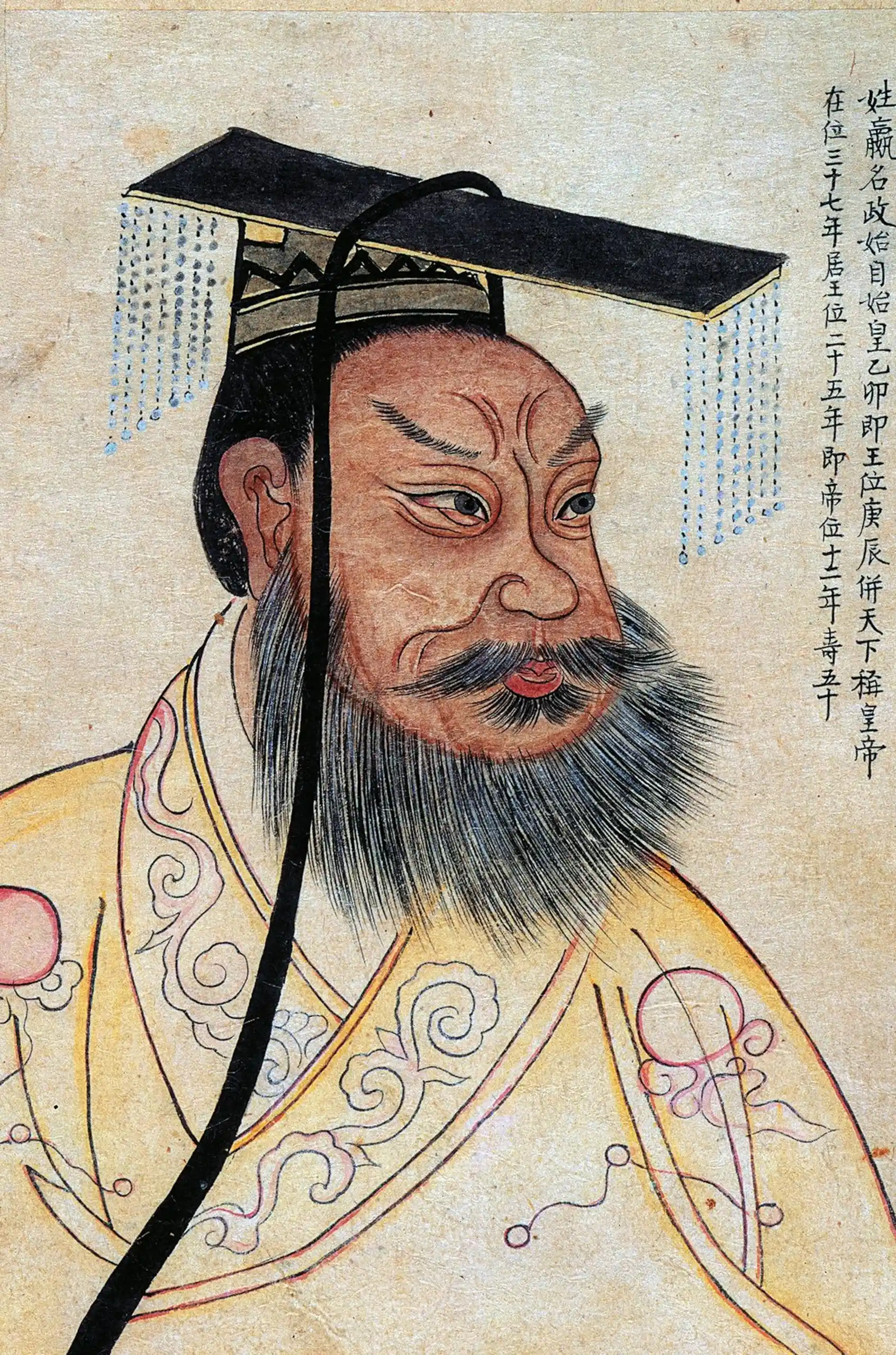
Qin Shi Huang
Also known as: Ying Zheng, Zhao Zheng, Shi Huangdi, First Emperor
Birthday
February 18, 259 BCE
Birth Sign
Pisces
Birthplace
Handan, State of Zhao (modern-day Hebei, China)
Age
Died at 49
About
Qin Shi Huang was the founder of the Qin dynasty and the first emperor of a unified China, one of the most consequential and controversial rulers in world history. After inheriting the throne of the state of Qin, he waged a series of campaigns that conquered the rival warring states and brought all of China under a single ruler for the first time, declaring himself emperor and coining the very title that Chinese monarchs would use for the next two thousand years. His reign was defined by sweeping, ruthless centralization. He and his ministers standardized the written script, currency, weights, measures, and even axle widths across the empire, laying administrative foundations that long outlasted him, and he connected and extended earlier defensive walls into early versions of what became the Great Wall. These achievements came at enormous human cost, through forced labor, harsh laws, and the suppression of dissent, including the notorious burning of texts and persecution of scholars. Obsessed with immortality, he ordered the construction of a vast tomb complex guarded by the famous Terracotta Army, an archaeological wonder rediscovered in the modern era. His dynasty collapsed soon after his death, but the unified state he forged endured in concept. Qin Shi Huang is remembered as both a brilliant unifier and a tyrant, the founding figure of imperial China. The state of Qin followed Legalist philosophy, which emphasized strict laws, harsh punishments, and centralized control. He died on July 12, 210 BCE at age 49 during an eastern inspection tour. His death was kept secret by his chief eunuch Zhao Gao and Prime Minister Li Si, who forged a decree forcing his eldest son Fusu to commit suicide and installed the younger son Huhai as emperor. The Qin dynasty collapsed in 207 BCE, less than four years after his death, but the unified imperial state he created endured as a model for all subsequent Chinese dynasties. He is frequently listed among the most consequential conquerors and unifiers in world history.
Early Life & Background
Ying Zheng was born in 259 BCE in Handan, the capital of the Zhao state, while his father Prince Zichu was held there as a political hostage. His mother was Lady Zhao, a former concubine of the merchant Lü Buwei. A persistent rumor, recorded by the historian Sima Qian, claims Lü Buwei was actually his biological father, though modern scholars dismiss this as a later slander. When Ying Zheng was eight, his father became crown prince of Qin and the family returned to the Qin court. He received a rigorous education in history, military strategy, and Legalist philosophy, which emphasized strict laws and centralized control. At 13, his father died and Ying Zheng became king of Qin. Because of his youth, the kingdom was run by regents: his mother Lady Zhao and the prime minister Lü Buwei. In 238 BCE, at 22, Ying Zheng took full power after discovering that his mother had been having an affair with a supposed eunuch named Lao Ai, who had fathered two sons with her. Ying Zheng executed Lao Ai and his entire clan, then forced Lü Buwei into exile, Lü later committed suicide. These events marked his decisive break from his childhood regents and the beginning of his personal rule. His birthdate is traditionally given as February 18, 259 BCE. He grew up with the expectation that he would one day conquer all the other Chinese states and rule them with a centralized government.
Career Growth
Between 230 and 221 BCE, Ying Zheng conquered the six rival states, Han, Zhao, Wei, Chu, Yan, and Qi, through a series of brilliant military campaigns. In 221 BCE, he declared himself Shi Huangdi, the First Emperor, inventing the title that Chinese monarchs would use for two millennia. He abolished the feudal system, dividing the empire into 36 commanderies run by centrally appointed officials. His standardization program was breathtaking: he imposed a uniform writing system, standardized weights, measures, and currency, and even ordered that cart and chariot axles be built to a single width so vehicles could travel the empire's roads. He connected existing defensive walls into an early Great Wall, stretching thousands of miles along the northern frontier. He also ordered the Ling Canal built, linking the Xiang and Li rivers to connect north and south. Obsessed with immortality, he consumed mercury pills and sent expeditions to find the elixir of life. In 213 BCE, he ordered the burning of historical records and philosophical texts from rival schools, executing Confucian scholars who criticized him. He died in 210 BCE during an eastern tour. His death was kept secret by his chief eunuch Zhao Gao and Prime Minister Li Si, who forged a decree forcing his eldest son Fusu to commit suicide and installed the younger son Huhai as emperor. The Qin dynasty collapsed in 207 BCE, but the unified imperial state he created endured as the model for all subsequent Chinese dynasties. He commissioned the construction of his vast mausoleum complex near Mount Li, guarded by the Terracotta Army. The Terracotta Army was discovered in March 1974 by farmers digging a well near Xi'an, over 8,000 warriors, each with unique facial features. The central tomb chamber has never been excavated; Chinese authorities cite preservation concerns and respect for the dead. Modern soil tests around his tomb reveal mercury levels 100 times above normal, matching ancient accounts of mercury rivers in his mausoleum. He likely consumed mercury pills in his quest for immortality, which may have contributed to his death.
Career Timeline
Public Image & Style
Qin Shi Huang is one of the most polarizing figures in Chinese history. Traditional Confucian historians portrayed him as a villain who destroyed classical learning, while modern Chinese nationalism celebrates him as the father of a unified China. In Chinese textbooks, he is presented as a great unifier whose book-burning and scholar-burying are acknowledged but contextualized. Internationally, the Terracotta Army has made him a globally recognized symbol of ancient Chinese civilization. His image appears in films, TV series, and video games, from Zhang Yimou's Hero to the Civilization game series. The Terracotta Army museum in Xi'an draws millions of visitors annually, making it one of China's most visited attractions. There is no formal fandom name, but he has dedicated followers among Chinese history enthusiasts worldwide. He was featured on the cover of National Geographic in February 2001. The Mausoleum of the First Qin Emperor was inscribed as a UNESCO World Heritage Site in 1987. He is ranked #83 in Michael H. Hart's 1978 book "The 100: A Ranking of the Most Influential Persons in History."
Fame & Fandom (iFAMOUS Rankings)
Qin Shi Huang commands a global attention that transcends the boundaries of time, anchoring ancient history in modern consciousness through the sheer scale of his legacy. While his name is instantly recognizable worldwide, iFANN's Global Fame Engine has evaluated this historical figure and determined he does not currently hold a placement in the published rankings for the Global Top 1,000 or any Top-100 scope list. The absence of a numeric rank reflects his status as an immutable icon rather than a fluctuating celebrity; his fame is static and monumental, immune to the daily volatility that drives contemporary charts. Consequently, there is no documented fandom name for his followers. As a ruler who died over two millennia ago, he possesses no organized fanbase capable of social media campaigns, birthday billboards, or charity drives. The audience surrounding him consists of historians, tourists, and cultural enthusiasts engaged in historical appreciation rather than the ritualistic worship seen in modern pop culture. His presence is felt in museums and textbooks, but never in the chaotic energy of a fan convention. This lack of a formal collective identity underscores the distinction between historical reverence and modern fandom behavior.
Interesting Facts and Legends
The English word 'China' likely traces its roots to the Qin dynasty, pronounced 'Chin.' Historical records confirm the emperor survived at least three assassination attempts, including one by the musician Jing Ke whose dagger snagged on a pillar. A legendary expedition seeking the elixir of life allegedly transported 3,000 boys and girls who vanished, possibly founding settlements in Japan. No reliable physical descriptions from his era exist; later embellished accounts describe a hooked nose, slit eyes, a protruding chest, and a voice resembling a jackal's cry. The Terracotta Army stands as one of the greatest archaeological discoveries of the 20th century. The Emperor Qinshihuang's Mausoleum Site Museum maintains an active digital presence on Weibo, WeChat, and Douyin with millions of followers. In 2024, the major exhibition titled 'The First Emperor: China's Terracotta Warriors' continued its international tour. Ongoing research utilizes remote sensing technology to map the unexcavated tomb mound. Legends persist regarding the sealed tomb, where mercury rivers and mechanical traps are said to protect the interior. Folklore also recounts the burning of books and burying of scholars, painting a picture of a brutal tyrant. Recent reports from 2026 highlight the discovery of well-preserved ancient highways near the site, adding new layers to the narrative of his vast infrastructure projects.
Notable Quotes
“I have collected all the writings of the Empire and burnt those which were of no use.”
“We, the First Emperor, have unified the world. If there is any disorder in the world, it is because of the writings of the scholars.”
“The world is now one family. Let there be no more war.”
“I have swallowed the other six states and now rule the world. I am the First Emperor.”
Family & Personal Life
His father was King Zhuangxiang of Qin (Prince Zichu). His mother was Lady Zhao (Zhao Ji), a former concubine of the merchant Lü Buwei. The historian Sima Qian claimed Lü Buwei was actually Qin Shi Huang's biological father, but this is considered a later slander. He had at least two half-brothers, the sons of Lady Zhao and Lao Ai, whom he had executed in 238 BCE. Qin Shi Huang never appointed an empress, which was highly unusual for a Chinese emperor. He had approximately 50 children from various consorts. His eldest son Fusu was the designated heir but was forced to commit suicide after his father's death through a forged decree. Another son, Huhai, became the Second Emperor. Two other sons, Gao and Jianglü, were executed after the Qin collapse. Lady Zhao was placed under house arrest after the Lao Ai affair but later allowed to return to the palace. She died sometime afterward.
Notable Connections
Lü Buwei was the wealthy merchant who served as prime minister and may have been his biological father. Li Si was his Legalist prime minister who helped implement the standardization reforms. Zhao Gao was his chief eunuch who forged the decree that led to Fusu's death and installed Huhai as emperor.
Relationships & Dating History
Qin Shi Huang's romantic and marital history is sparsely documented. He never appointed an empress, which was highly unusual for a Chinese emperor. His mother, Lady Zhao, served as regent after his father's death and had a relationship with the eunuch Lao Ai, bearing him two children. Ying Zheng had Lao Ai executed and his half-brothers killed in 238 BCE. He had approximately 50 children from various consorts, but historical records do not name most of these women. His eldest son Fusu was the designated heir but was forced to commit suicide through a forged decree after his father's death. Another son, Huhai, became the Second Emperor. Two other sons, Gao and Jianglü, were executed after the Qin collapse. As of 2026, Qin Shi Huang is deceased, having died in 210 BCE. He has no living romantic partners. His estate is managed by the People's Republic of China as a cultural heritage site.
- DatedLady Zhao-260 - -238His mother, who had a relationship with the eunuch Lao Ai, bearing two children; Ying Zheng had Lao Ai executed and his half-brothers killed in 238 BCE.
Death & Aftermath
Died
July 12, 210 BCE (aged 49)
Death Place
Shaqiu, Hebei Province
Cause of Death
Reported consumption of mercury-laden elixirs
The imperial procession halted in Shaqiu, near modern-day Xingtai, where the First Emperor collapsed during his return to the capital of Xianyang. Qin Shi Huang succumbed to illness around July 12, 210 BCE, likely hastened by mercury-laden elixirs consumed in a desperate bid for immortality. His chief eunuch Zhao Gao and Chancellor Li Si concealed the death within a sealed carriage, masking the odor with rotting fish while maintaining the illusion of life until the body reached the capital weeks later. This deception triggered a political crisis that saw the forced suicide of Crown Prince Fusu and the execution of General Meng Tian, clearing the path for the ascension of Huhai as the Second Emperor. The dynasty fractured into rebellion within two years, ending the immediate stability the ruler had forged. State-sponsored rituals replaced public mourning, culminating in a grand funeral at the mausoleum near Lishan, Xi'an, where hundreds of thousands of laborers constructed a subterranean palace complete with mercury rivers and terracotta warriors.
Net Worth (Estate Value)
$10 Billion
iFANN Editorial Team estimate
Per iFANN's editorial analysis, the cultural and tourism value of the Mausoleum of the First Qin Emperor and the Terracotta Army stands at $10 Billion. This estimate relies on the site's designation as a UNESCO World Heritage Site and its status as a premier destination drawing 8–10 million visitors annually before the pandemic. Revenue streams include ticket sales, licensing of imagery for books, documentaries, and merchandise, and substantial fees from international exhibition tours. The estate operates under the management of the Shaanxi Provincial Cultural Relics Bureau and the Emperor Qinshihuang's Mausoleum Site Museum. Artifacts have toured global institutions, such as the 2018 exhibition at the National Museums Liverpool which drew hundreds of thousands of attendees. The central tomb chamber remains unexcavated due to preservation concerns, yet its potential value remains immense. The insurance value of the artifacts is incalculable.
Awards Won (1)
Qin Shi Huang lived more than 2,200 years before modern awards. His mausoleum and the Terracotta Army were inscribed as a UNESCO World Heritage Site in 1987. He was ranked #83 in Michael H. Hart's 1978 book The 100: A Ranking of the Most Influential Persons in History.
1987 · Cultural Heritage
Mausoleum of the First Qin Emperor
Known For
Unification of China
-221 · First Emperor
Standardization of writing, currency, and measures
-221 · Emperor
Construction of the Terracotta Army
-210 · Patron
Great Wall of China (early version)
-220 · Builder
Keywords
Sources
Quick Facts
- Profession
- Emperor, Ruler
- Born
- February 18, 259 BCE
- Birthplace
- Handan, State of Zhao
- Died
- July 12, 210 BCE
- Death Place
- Guangzong County
- Gender
- Male
- Children
- Approximately 50, including Fusu, Huhai, Gao, Jianglü
Personal Details
- Full Name
- Ying Zheng
- Children
- Fusu, Huhai, Gao, Jianglü (and others, approximately 50 total)
Frequently Asked Questions
How old was Qin Shi Huang when he died?
What is Qin Shi Huang's net worth in 2026?
Is Qin Shi Huang still considered a significant figure in modern China?
Why is Qin Shi Huang famous?
How many terracotta warriors are there?
Similar People
Join the community
fans discussing