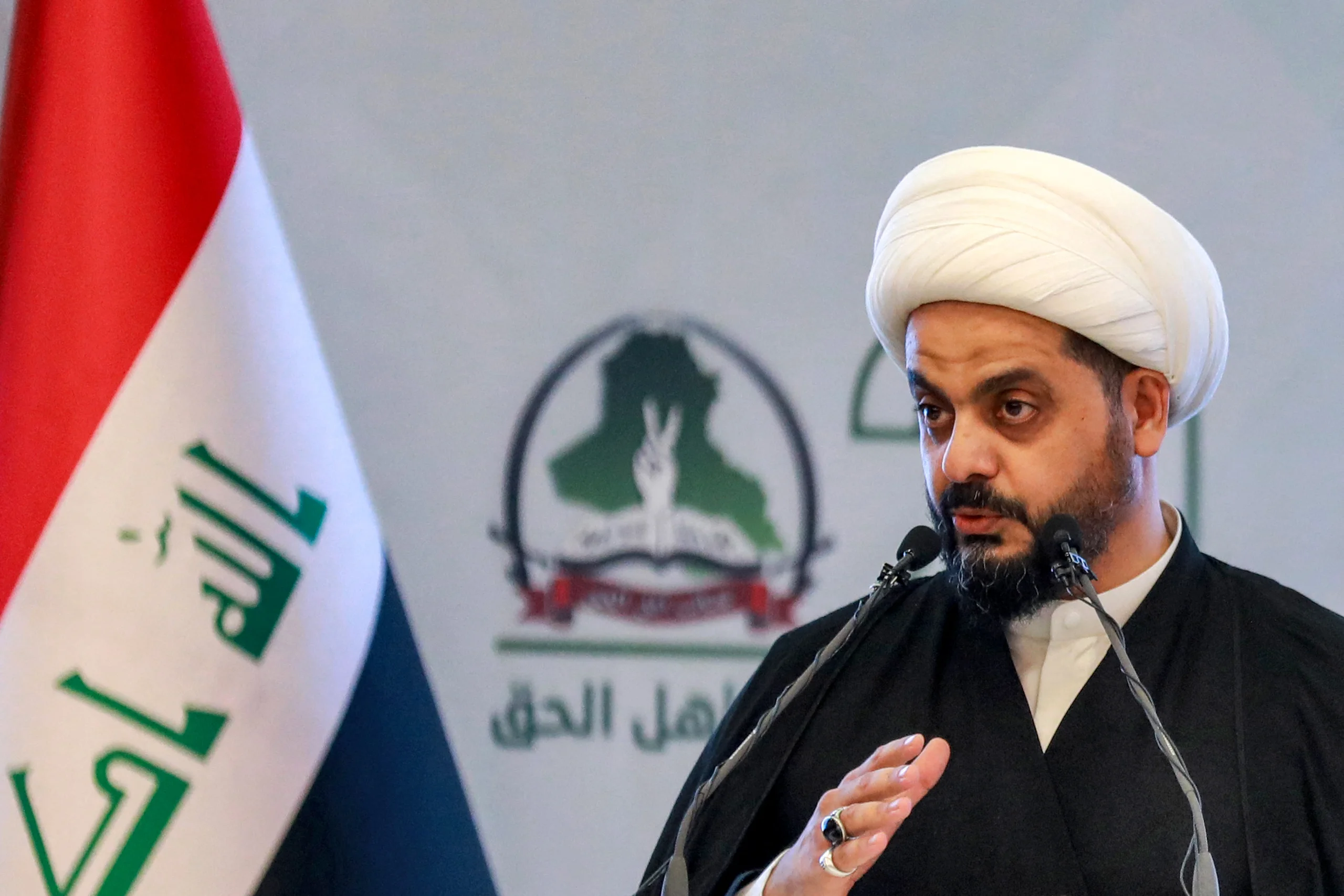
Qais al-Khazali
 Iraq
Iraqpolitician•cleric•military leader
Also known as: Sheikh Qais, Commander Qais, Qais Khazali
Birthday
April 24, 1974
Birth Sign
Taurus
Birthplace
Sadr City, Baghdad, Iraq
Age
52 years old
About
Qais al-Khazali is an Iraqi Shia cleric, politician, and former military commander. He is the founder and Secretary-General of Asa'ib Ahl al-Haq (AAH), a paramilitary organization that has evolved into a significant political party within Iraq's Shia Coordination Framework. Al-Khazali first gained international attention as the leader of the Iran-backed Special Groups during the Iraq War, directing attacks that killed dozens of American soldiers. After his capture in 2007 and release in 2010, he transitioned into politics, and today he is one of Iraq's most influential anti-American figures, known for his sharp rhetoric against foreign intervention and his role in shaping the country's political landscape.
As of 2026, al-Khazali is leading AAH through a strategic rebranding, moving the group away from direct armed conflict and toward full political integration. He has announced plans to disengage from the Popular Mobilization Forces and place weapons under state control, a move aimed at legitimizing the group as a political actor. His influence extends through the Shia Coordination Framework, where he plays a key role in government formation and national stability efforts. Supporters view him as a resistance hero and protector of Shia interests; the United States and its allies consider him a terrorist.
Early Life & Background
Born into poverty in Sadr City, a predominantly Shia district of Baghdad, Qais al-Khazali's early life was shaped by religious study rather than formal secular education. He became a student of theology under the mentorship of Grand Ayatollah Ali al-Sistani, a background that would later provide him with religious legitimacy among the Shia populace. In the late 1990s, he aligned with the radical movement of Muqtada al-Sadr, becoming a close associate and a commander within the Mahdi Army.
His relationship with al-Sadr soured over disagreements about operational autonomy and the direction of the militia. In 2004, after issuing unauthorized orders that contradicted the chain of command, al-Khazali was expelled from the Mahdi Army. This expulsion was pivotal, pushing him to establish an independent power base. He formed the Khazali Network, a splinter faction focused on targeting coalition forces and Iraqi officials deemed collaborators. By 2006, this network had grown into a formidable force, and al-Khazali was appointed leader of the Special Groups, an Iran-backed coalition of militias tasked with fighting U.S. forces and destabilizing the Iraqi government.
Career Growth
Al-Khazali's career took a decisive turn in January 2007 when he orchestrated the deadly attack on American forces in Karbala, an operation that killed 17 U.S. soldiers and cemented his reputation as a mastermind of insurgent warfare. In March of that year, he was captured by British forces in Baghdad. Despite his imprisonment, he maintained command of AAH from inside, directing operations through a decentralized network.
Released in 2010 as part of a prisoner exchange, al-Khazali shifted strategy. He founded AAH as a political party, winning seats in the Iraqi parliament and operating legally while retaining his militia structure. During the fight against ISIS from 2014 onward, he integrated AAH fighters into the Popular Mobilization Forces, strengthening ties with Iran and expanding his political influence. By 2025, facing pressure over the PMF's role, he began a public rebranding. In May 2026, he announced the formation of a committee to disengage AAH from the PMF and place weapons under state control. He has since engaged in high-level meetings with Kurdish leadership and the Iraqi presidency, positioning himself as a statesman committed to national unity.
Career Timeline
Public Image & Style
Al-Khazali's public image is deeply polarized. To his supporters, he is a resistance hero and a defender of Shia interests against foreign domination. To the United States, Iraq's moderate factions, and Western allies, he is a dangerous extremist and designated terrorist. He often appears in clerical attire, a white turban and robes, when engaging in political discourse, a stark contrast to his earlier image as a militant commander. Known for his sharp rhetoric against American and Saudi influence, he projects an intense demeanor that underscores his commitment to his cause.
Fame & Fandom (iFAMOUS Rankings)
Qais al-Khazali remains a towering figure in Middle Eastern geopolitics, though his standing within the global celebrity sphere has not secured a placement in the published iFANN rankings. As of August 2026, the Global Fame Engine evaluated this individual but determined he does not currently hold a position in the Global Top 1,000 or any Top-100 scope list. This absence from the charts reflects a unique trajectory where his influence is measured in strategic shifts and political realignments rather than consumer metrics or pop culture consumption. His support base operates with the discipline of a military organization rather than the adulation of a fan club, lacking any formal collective moniker used in a cultural context. There are no documented fan rituals, birthday campaigns, or viral moments that define a traditional fandom; instead, his followers identify strictly through their affiliation with Asa'ib Ahl al-Haq or the Popular Mobilization Forces. The narrative surrounding him has evolved dramatically, particularly during the mid-2026 period when he orchestrated a historic pivot from armed resistance to state integration. This transition, marked by the decision to place militia weapons under government control, stands as his defining legacy moment, transforming his public image from a designated terrorist commander to a key political architect in Iraq. While he maintains a sharp rhetorical stance against foreign intervention, his recent engagement with high-level officials signals a new chapter focused on national stability. Unlike entertainers who rely on chart pushes or streaming numbers, al-Khazali's fame is rooted in the gravity of his decisions and the geopolitical weight he carries, making his lack of a numerical rank a reflection of his distinct, non-popular profile.
Interesting Facts and Legends
Qais al-Khazali is almost exclusively referred to as Sheikh Qais or Commander Qais; his full name rarely appears in public discourse. Despite being incarcerated in 2007, he managed to lead AAH from prison, a reflection of his ability to command a decentralized network without physical presence. Before his militant career, he was a respected student of Islamic jurisprudence, a background that gave him religious credibility among Shia followers. He has no verified personal social media accounts; his communications are channeled through AAH's official outlets and affiliated media. A defining chapter in his modern legend emerged in May 2026 when he announced the disengagement of Asa'ib Ahl al-Haq from the Popular Mobilization Forces. This bold move, explicitly explained on May 27, 2026, marked a decisive shift from armed resistance to political activity, aiming to preserve Iraq's stability. By June 2026, the formation of a central committee to implement this separation solidified his role as a state integrator. Yet, even amidst this rebranding, his hardline roots remained visible; in July 2026, he publicly condemned an alleged American-Saudi attack, warning of serious repercussions while simultaneously engaging in diplomatic efforts with President Nizar Amedi. These contrasting actions paint a complex picture of a leader navigating the delicate balance between revolutionary history and future governance.
Notable Quotes
“We condemn the American-Saudi attack and warn of its serious repercussions.”
“Barzani plays a constructive role in Iraq's political process.”
“The future of Asa'ib Ahl al-Haq is in flux after its pledge to put its weapons under state control.”
Family & Personal Life
Public information about Qais al-Khazali's family is extremely scarce, reflecting the secretive nature of his operations. Born in Sadr City to a poor family, he has not publicly disclosed details about his parents or siblings. There are no credible reports of a wife or children, and he maintains a low profile regarding his personal life. His household and living arrangements are not documented, and any speculation about family members remains unsubstantiated.
Notable Connections
Al-Khazali's political trajectory is closely tied to several key figures. Muqtada al-Sadr, his former mentor, expelled him from the Mahdi Army in 2004, a split that led to the formation of AAH. Iranian leadership, particularly within the IRGC, provided funding and training for the Special Groups. In 2026, he has engaged with Kurdish President Nechirvan Barzani and Iraqi President Nizar Amedi in efforts to stabilize the political process, signaling a shift toward diplomatic engagement.
Relationships & Dating History
Public information regarding Qais al-Khazali's personal life is extremely scarce. Unlike public figures in entertainment or sports, he maintains a low profile regarding romantic relationships, marriages, and children. There are no credible reports of dating history, engagements, or divorces. He is generally portrayed as a solitary figure dedicated entirely to his political and military ambitions. As of 2026, there is no public record of a current spouse or partner; his personal status remains private, and any speculation is unsubstantiated.
Salary, Net Worth In 2026
There is no verified public net worth for Qais al-Khazali. As a political and military leader, his financial standing is not derived from commercial ventures or salaries. His wealth is tied to militia funding, which historically includes donations from Iran, private benefactors, and illicit activities such as smuggling. No credible financial outlets provide a specific dollar figure for his personal assets. Any reported net worth figures online are speculative and likely conflate the value of AAH's assets with his personal wealth. Consequently, no reliable estimate can be provided.
Awards & Accolades
Known For
Founder and Secretary-General of Asa'ib Ahl al-Haq
2006 · Founder
Leader of the Special Groups
2006 · Leader
Karbala attack on U.S. forces
2007 · Mastermind
Keywords
Sources
Quick Facts
- Profession
- politician, cleric, military leader
- Born
- April 24, 1974
- Birthplace
- Sadr City, Baghdad, Iraq
- Gender
- Male
- Birth Sign
- Taurus
Personal Details
- Full Name
- Qais Hadi Sayed Hasan al-Khazali
Frequently Asked Questions
Who is Qais al-Khazali?
What is Qais al-Khazali's net worth?
Is Qais al-Khazali still married?
What happened to Qais al-Khazali in 2026?
Why was Qais al-Khazali captured?
Similar People
Join the community
fans discussing