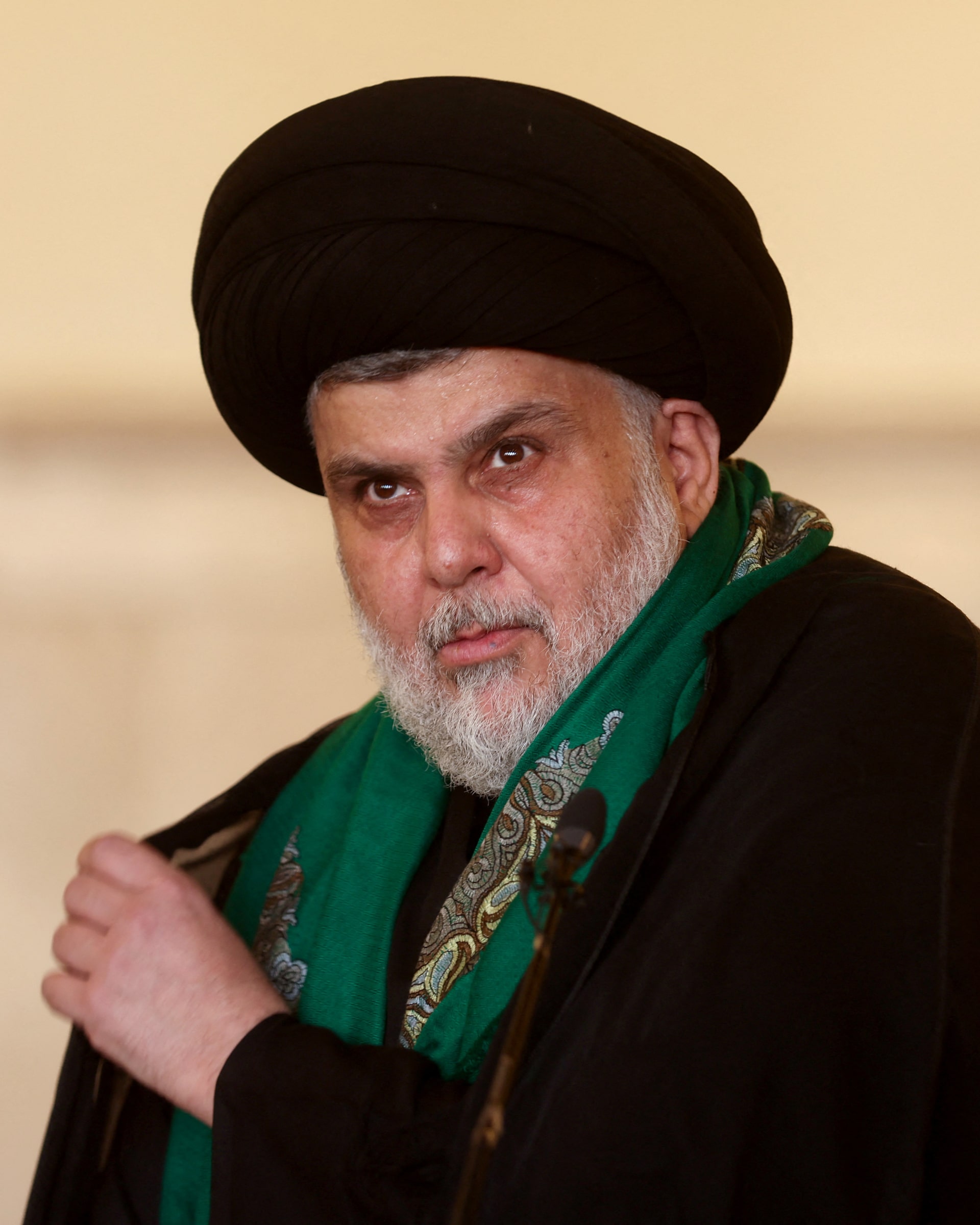
Muqtada al-Sadr
 Iraq
IraqAlso known as: Sayyid Muqtada al-Sadr, Muqtada al-Sadr
Birthday
August 4, 1974
Birth Sign
Leo
Birthplace
Najaf, Iraq
Age
52 years old
About
Muqtada al-Sadr is an influential Iraqi Shia cleric and politician who leads the Sadrist Movement, one of the most powerful political and religious forces in Iraq. Born in Najaf in 1974, he inherited his father's clerical legacy and turned it into a mass following. Al-Sadr first made global headlines in 2003 when he formed the Mahdi Army to resist the U.S. occupation, and he has remained a central figure in Iraqi politics ever since. Today he commands both a loyal grassroots base and a parliamentary bloc that has repeatedly won the largest share of seats in national elections.
His trajectory is unusual: a militia leader who has publicly dismantled his armed wings, a populist cleric who mixes religious authority with street-level activism, and a nationalist who frequently clashes with Iran-backed factions. In 2026, he announced the integration of his latest militia, Saraya al Salam, into the Iraqi state, a move that reinforced his image as a pragmatist seeking to consolidate power through politics rather than arms. Al-Sadr's followers see him as a champion of the poor and a defender of Iraqi sovereignty, while critics point to his history of violence and his shifting alliances.
Early Life & Background
Muqtada al-Sadr was born on August 4, 1974, in the holy city of Najaf, Iraq. He grew up in one of the most prominent clerical families in Shia Islam. His father, Grand Ayatollah Mohammed Sadiq al-Sadr, was a leading religious authority who opposed Saddam Hussein's regime and was assassinated in 1999, along with two of Muqtada's brothers. The family's martyrdom deeply shaped Muqtada's worldview and his claim to religious leadership.
Details of his early education are sparse, but he studied in Najaf's religious seminaries and was groomed for a clerical role. His father's murder forced him into a period of hiding and relative obscurity. During the late 1990s and early 2000s, he worked to preserve his father's network of followers, who were known for their devotion to the Sadrist cause. When the U.S.-led coalition invaded Iraq in 2003 and toppled Saddam, Muqtada emerged as the natural heir to his father's movement, despite being relatively young and lacking the formal religious credentials of more senior clerics.
His first major public act came in April 2003, when he was involved in the killing of rival cleric Abdul-Majid al-Khoei, a move that eliminated a competitor for control of Najaf's Shia institutions. This violent start set the tone for his rise as a militant leader who would challenge both the occupation and the established Shia political establishment.
Career Growth
Al-Sadr's breakthrough came in 2003 when he founded the Mahdi Army, a militia that quickly became the most effective armed resistance to the U.S. occupation. The Mahdi Army fought two major uprisings against American forces in 2004, in Najaf and Sadr City, and later expanded its operations across southern Iraq. At its peak, the militia boasted tens of thousands of fighters and controlled key urban areas, making al-Sadr one of the most powerful figures in the country.
After the Mahdi Army was formally dissolved in 2008, al-Sadr pivoted to politics. He formed the Promised Day Brigade, a smaller insurgent group, and then in 2014 established the Peace Companies, also known as Saraya al Salam, to fight the Islamic State. His political party, the Sadrist Bloc, joined the Saairun alliance, which won the largest number of seats in Iraq's 2018 and 2021 parliamentary elections, cementing his influence over the government formation process.
In recent years, al-Sadr has sought to rebrand himself as a nationalist statesman. In October 2025, he announced his movement would boycott the November elections, hinting at a desire to "change the faces and save Iraq." Then, in June 2026, he announced the integration of Saraya al Salam into the Iraqi state, a move widely seen as an attempt to consolidate state power and distance himself from armed factionalism. He has also been vocal in condemning attacks by pro-Iranian militias and warning the IRGC against using Iraqi territory for regional escalation.
Public Image & Style
Muqtada al-Sadr's public image is a study in contrasts. To his supporters, he is a fearless champion of the poor and a defender of Iraqi sovereignty, a man who speaks the language of the streets and has never been co-opted by foreign powers. His sermons and speeches often mix religious piety with fiery nationalist rhetoric, and he has a knack for tapping into popular grievances, from corruption to unemployment.
To his critics, he is a populist demagogue with a history of violence and a mercurial approach to politics. His militia's brutal tactics during the Iraq War, including death squads and sectarian attacks, have left a stain on his reputation. Media coverage often portrays him as an unpredictable wildcard, capable of both destabilizing and stabilizing Iraq depending on his mood.
His fandom, if it can be called that, is a devoted grassroots base that sees him as a revolutionary figure. They attend his rallies in huge numbers, and his social media posts are widely shared and debated. His image has evolved over the years, from a militia leader in military fatigues to a statesman in clerical robes, but the core appeal remains the same: a defiant voice for the disenfranchised Shia underclass.
Fame & Fandom
Muqtada al-Sadr commands a global attention span that spans decades of geopolitical upheaval, with his influence tracked across media coverage, search trends, and consumption signals worldwide. In the August 2026 cycle of the iFANN Global Fame Rankings, he holds the position of the 1st most famous person from Iraq, a standing he has maintained since the previous assessment. Within the specific domain of religious figures, he is ranked as the 31st most famous person in Religious Leaders, also holding steady from prior data. While his supporters form a vast political constituency rather than a pop culture fandom, there is no formal moniker for his base; they identify primarily through their allegiance to the Sadrist Movement. Unlike celebrity circles where fan clubs organize around birthdays or chart performance, Sadr's followers mobilize through grassroots networks focused on social welfare and nationalist rhetoric. The movement operates without the rituals of entertainment fandoms, substituting them with mass political demonstrations and sermons that function as directives for his millions of adherents.
Interesting Facts and Legends
Muqtada al-Sadr's followers often refer to him as "al-Sayyid," a title of respect for descendants of the Prophet Muhammad. He is known for his simple lifestyle, often wearing traditional clerical robes and a black turban, and he has a reputation for populist rhetoric that resonates with Iraq's poor and disenfranchised. Despite his political power, al-Sadr has never held a formal government position. He has also been known to use social media to make major announcements, often posting cryptic messages that his followers interpret as directives. In 2022, he ordered his parliamentary bloc to resign en masse, leading to a prolonged political crisis. Al-Sadr's religious authority is tied to Ayatollah Kazem al-Haeri, based in Qom, Iran, though he has often positioned himself as a nationalist critic of Iranian influence. He has also been known to visit the shrine of his father in Najaf on significant occasions, drawing large crowds. A defining moment in his legacy occurred in April 2003 when he orchestrated the killing of Grand Ayatollah Abdul-Majid al-Khoei, a strategic move to seize control of Najaf during the early stages of the US occupation. His relationship with armed force is equally legendary, characterized by repeated cycles of forming and dismantling the Mahdi Army. Most recently, in June 2026, he announced the integration of his militia into the Iraqi state, effectively ending the group's existence for the third time in two decades. This decision triggered immediate shockwaves and marked a significant departure from his history of armed resistance.
Family & Personal Life
Muqtada al-Sadr comes from the prominent Sadr family, a lineage that has produced several influential Shia clerics. His father, Grand Ayatollah Mohammed Sadiq al-Sadr, was assassinated in 1999 along with two of Muqtada's brothers, Mustafa and Murtada. His cousin, Muqtada al-Sadr, is also a senior cleric. The family's history of opposition to Saddam Hussein's regime has made them symbols of resistance for many Shia Iraqis.
Al-Sadr is married and has children, but he keeps his personal life intensely private. He rarely appears in public with his family, and little is known about his wife or children. He is known to maintain close ties to his extended family, many of whom are involved in religious and political activities. The Sadr family's influence extends across Iraq, with the movement's headquarters in Najaf and strongholds in Baghdad's Sadr City and southern provinces.
Relationships & Dating History
Muqtada al-Sadr is known to be married, but he has kept his personal life extremely private. There is no public record of his wife's name, their wedding date, or any details about their relationship. He has never spoken about his marriage in interviews or public appearances.
Given the lack of information, his relationship status is classified as unknown. He is not known to have been involved in any public romantic relationships or scandals. His focus has always been on his political and religious career, and he has successfully shielded his family from public attention. As of 2026, he remains married, though the lack of public information makes it difficult to confirm his current marital status.
Salary, Net Worth In 2026
$50 Million
iFANN Editorial Team estimate
Muqtada al-Sadr's net worth is a subject of speculation, as he has never publicly disclosed his finances. Per iFANN's editorial analysis, his estimated wealth stands at $50 Million as of 2026. While he does not hold a formal government salary, his movement controls significant assets, including mosques, schools, and businesses tied to the Sadrist foundation. These entities receive donations from followers and have been linked to various economic activities. Additionally, al-Sadr has been able to leverage his political power to secure lucrative contracts for allies, though he himself maintains a modest public lifestyle. His financial trajectory has risen in recent years as his political influence has grown. The integration of his militia into the state in 2026 may have provided additional financial benefits, as former fighters were absorbed into state security forces. However, the exact figures remain opaque, and the true extent of his wealth is likely higher than publicly reported.
Awards & Accolades
Known For
Mahdi Army
2003 · Founder and leader
Sadrist Movement
2003 · Leader
Saraya al Salam (Peace Companies)
2014 · Founder and leader
Saairun Alliance
2018 · Political leader
Keywords
Sources
Quick Facts
- Profession
- Shia cleric, politician
- Born
- August 4, 1974
- Birthplace
- Najaf, Iraq
- Gender
- Male
- Birth Sign
- Leo
Frequently Asked Questions
Who is Muqtada al-Sadr?
What is Muqtada al-Sadr's net worth in 2026?
What is the Sadrist Movement?
What was the Mahdi Army?
What has Muqtada al-Sadr announced recently?
Social Media
Similar People
Join the community
fans discussing