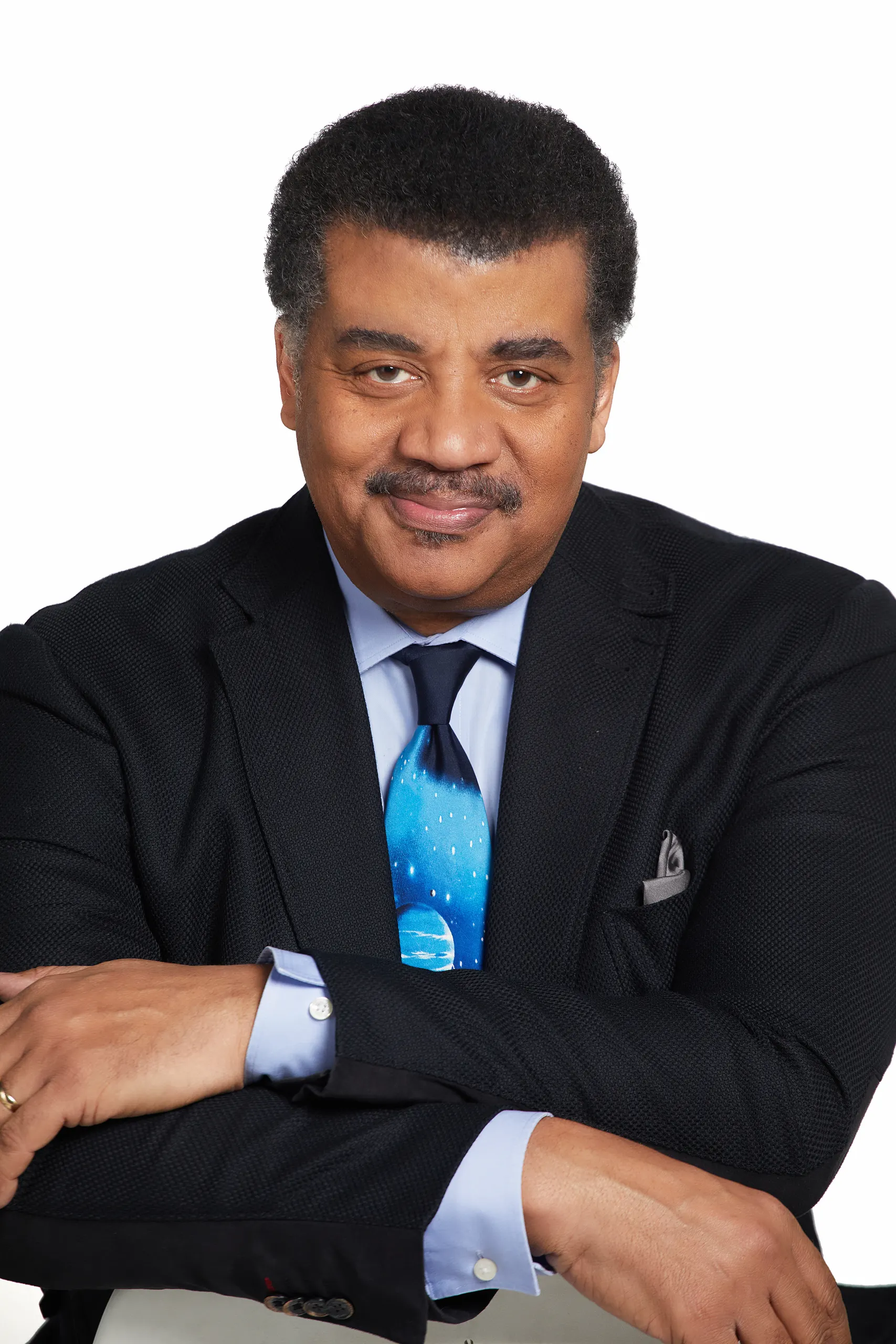
Neil deGrasse Tyson
astrophysicist•science writer•teacher
Birthday
October 5, 1958
Birth Sign
Libra
Birthplace
Manhattan, New York City
Age
68 years old
Height
6 ft 2 in (1.88 m)
About
Neil deGrasse Tyson is an American astrophysicist, author, and science communicator who has become the public face of astronomy for a generation. He serves as director of the Hayden Planetarium at the American Museum of Natural History in New York, a role he has held since 1996. Tyson is best known for hosting the television series Cosmos: A Spacetime Odyssey (2014) and its sequel Cosmos: Possible Worlds (2020), which brought the wonder of the universe to millions. His podcast and National Geographic show StarTalk, launched in 2009, blends science with pop culture and has built a loyal following. As of 2026, his book Astrophysics for People in a Hurry has sold over 2 million copies worldwide, spending months on the New York Times bestseller list. With a commanding stage presence and a knack for explaining complex ideas in plain language, Tyson has earned a reputation as a science evangelist who makes the cosmos feel personal and urgent. He has appeared in over 100 TV episodes and films, and his social media presence includes 14.5 million followers on X, 5.2 million on Instagram, 4.8 million on Facebook, and 4.2 million on YouTube. His influence extends to magazine covers such as TIME, Rolling Stone, and Forbes, and he has been named to the Time 100 Most Influential People list in 2015.
Early Life & Background
Neil deGrasse Tyson grew up in the Bronx, New York City, the son of Cyril deGrasse Tyson, a sociologist and human resources commissioner, and Sunchita Feliciano Tyson, a gerontologist. His first encounter with the cosmos came at age nine during a visit to the Hayden Planetarium, where the starry dome left him awestruck. He later wrote that the experience made him realize the universe was something he could study. He began teaching himself astronomy by reading the New York Times sky charts and bought a pair of binoculars to explore the night sky. At the Bronx High School of Science, he served as captain of the wrestling team and editor-in-chief of the school's science journal. A summer astronomy course at the Hayden Planetarium cemented his path. He earned a Bachelor of Arts in Physics from Harvard University in 1980, then a Master of Arts in Astronomy from the University of Texas at Austin in 1983. He completed a Master of Philosophy and a doctorate in Astrophysics from Columbia University in 1989 and 1991, respectively, with a thesis on the structure of the Milky Way's bulge. After his Ph.D., he spent three years as a postdoctoral research associate at Princeton University before joining the Hayden Planetarium as a staff scientist in 1994. He was born on October 5, 1958, in Manhattan, New York City, and his birth name is Neil deGrasse Tyson. He also wrote under the pen name "Merlin" for StarDate magazine.
Career Growth
Tyson's career breakthrough came in 1994 when he joined the Hayden Planetarium as a staff scientist. Two years later, he was appointed its director, overseeing a $210 million reconstruction that transformed it into the Rose Center for Earth and Space, which opened in 2000. In 1997, he founded the Department of Astrophysics at the American Museum of Natural History. His public-facing career took off with a monthly column in Natural History magazine from 1995 to 2005, later collected into books such as Death by Black Hole (2007). From 2006 to 2011, he hosted NOVA ScienceNow on PBS. In 2014, he hosted Cosmos: A Spacetime Odyssey on Fox and National Geographic, a sequel to Carl Sagan's classic series that won a Peabody Award and an Emmy for its theme music. The following year, he launched the StarTalk TV series on National Geographic, adapting his long-running podcast. He published Astrophysics for People in a Hurry in 2017, which became a number one New York Times bestseller. In 2020, he hosted Cosmos: Possible Worlds. As of 2026, he continues to host StarTalk and maintains a heavy schedule of public lectures and media appearances. He received the NASA Distinguished Public Service Medal in 2004, the Public Welfare Medal from the National Academy of Sciences in 2015, the Stephen Hawking Medal for Science Communication in 2017, and the Isaac Asimov Award in 2009. He was inducted into the International Space Hall of Fame in 2017 and received the Key to the City of New York in 2015.
Career Timeline
Public Image & Style
Tyson cultivates a persona of sharp intellect and dry wit, often seen in tailored suits or bow ties. His deep, resonant voice and rapid-fire delivery make him a commanding presence on stage and screen. Media portrayals cast him as the accessible face of science, a man who can debate astrophysics on late-night talk shows with the same ease as he explains dark matter to a classroom. His fanbase, sometimes called Tysonites or the Cosmos Crew, frequently shares his quotes on social media and cites his Cosmic Perspective speech at life events. On Twitter, he combines authoritative science commentary with humor, often debunking pseudoscience in real time. He is a frequent guest on The Late Show with Stephen Colbert and has appeared on Jimmy Fallon, where his blend of charm and intellect wins over audiences. He has been featured on magazine covers including Rolling Stone (February 2015, headline: "The Man Who Made Science Cool Again"), Wired (November 2014), and Scientific American (September 2017). Notable quotes include "The universe is under no obligation to make sense to you" and "The good thing about science is that it's true whether or not you believe in it."
Fame & Fandom (iFAMOUS Rankings)
Neil deGrasse Tyson has cultivated a devoted following that operates less like a traditional fan club and more like a global network of the cosmically curious. While some enthusiasts affectionately refer to themselves as Tysonites or the Cosmos Crew, research confirms there is no single, officially documented name for his audience. His followers engage primarily through his professional platforms rather than organized subcultures with rituals or coordinated campaigns. He identifies himself as a servant to those seeking cosmic curiosity, fostering an environment where science communication takes precedence over celebrity worship. Unlike pop icons who inspire fan art drives or billboard projects, Tyson's influence stems from decades of consistent educational broadcasting via StarTalk, his books, and his directorship at the Hayden Planetarium. The iFANN Global Fame Engine has evaluated this profile, but Neil deGrasse Tyson is currently not ranked in the published Global Top 1,000 or any scope list. This absence of a numeric placement reflects a unique position where his cultural impact is profound yet distributed across institutional authority rather than concentrated in a single fame metric. Despite lacking a formal rank, his presence remains commanding on late-night stages and in classrooms worldwide. His ability to debate astrophysics with ease while explaining dark matter ensures he remains a central figure in public discourse. The scale of his reach is evident in the millions who tune into his shows and read his works, creating a legacy built on accessibility rather than chaotic fandom energy. No extraordinary crowd reactions or viral disruptions have been documented in recent years, marking his career as one of steady, enduring contribution to the field.
Interesting Facts and Legends
Before his rise as a science communicator, Tyson was a competitive wrestler in high school and college, a discipline that taught him focus. He served on the 2001 Commission on the Future of the United States Aerospace Industry and the 2004 Moon, Mars and Beyond commission to advise national space policy. Tyson once turned down an offer to become president of the Planetary Society. An asteroid, 13123 Tyson, bears his name since 1994. He made memorable cameo appearances in The Big Bang Theory, arguing with Sheldon Cooper about the definition of a planet, as well as in Brooklyn Nine-Nine and Space Jam: A New Legacy. His favorite planet is Saturn, which he calls the gateway to wonder. He was the first person to have a full-dome planetarium show named after him, Cosmic Origins. Tyson once noted that learning about the universe made him feel small and insignificant, but in a good way. Recent legends highlight his active role in explaining the 2026 total solar eclipse and analyzing Queen's Brian May's music through a scientific lens. His advocacy for childhood curiosity, often summarized by the quote about teaching children to sit down and be quiet, has become a widely shared aphorism representing his stance on education. These moments define his legacy as a leader in space tourism discussions and sci-fi film judging alongside figures like Neal Stephenson.
Notable Quotes
“The universe is under no obligation to make sense to you.”
“We are part of this universe; we are in this universe, but perhaps more important than both of those facts is that the universe is in us.”
“I know of no time in human history where ignorance was better than knowledge.”
“When you look at the night sky, you are looking back in time.”
“The good thing about science is that it's true whether or not you believe in it.”
Family & Personal Life
Tyson's father, Cyril deGrasse Tyson, was a sociologist and human resources commissioner for New York City. His mother, Sunchita Feliciano Tyson, was a gerontologist. He has a brother named Stephen. Tyson married Alice Young in 1988; she is a mathematician and operations researcher. They met as graduate students at the University of Texas at Austin. The couple has two children: a daughter, Miranda, and a son, Travis. The family lives in New York City. Tyson has said that his parents encouraged his curiosity and supported his early interest in astronomy. There are no public reports of any other romantic relationships. As of 2026, Tyson remains married to Alice Young.
Notable Connections
Tyson frequently collaborates with fellow science communicator Bill Nye, appearing together on StarTalk and other platforms. He has a close working relationship with comedian Chuck Nice, his co-host on the StarTalk podcast. He cites Carl Sagan as his inspiration and worked with Sagan's widow, Ann Druyan, on Cosmos: A Spacetime Odyssey. Composer Alan Silvestri collaborated with Tyson on the Emmy-winning theme music for Cosmos.
Relationships & Dating History
Tyson married Alice Young in 1988. They met as graduate students at the University of Texas at Austin, where both were studying mathematics and astronomy. Alice Young is a mathematician and operations researcher. The couple has two children: Miranda and Travis. Their marriage has been stable and largely private, with both appearing together at public events occasionally. There are no public reports of any other romantic relationships. As of 2026, Tyson remains married to Alice Young.
- MarriedAlice Young1988 - presentCurrentMet as graduate students at the University of Texas at Austin; have two children together.
Salary, Net Worth In 2026
$6 Million
iFANN Editorial Team estimate
Per iFANN's editorial analysis, Neil deGrasse Tyson's net worth is estimated at $6 Million as of 2026. His primary income sources include book royalties, TV hosting fees, and public speaking engagements. Astrophysics for People in a Hurry has sold over 2 million copies worldwide, generating significant royalty income. His other books, including Death by Black Hole and Merlin's Tour of the Universe, continue to sell steadily. For hosting Cosmos: A Spacetime Odyssey and StarTalk, he earned an estimated $100,000 to $200,000 per episode. Tyson commands $50,000 to $100,000 per public lecture and gives dozens each year. His salary as director of the Hayden Planetarium falls in the $200,000 to $300,000 range. He owns a home in New York City but has no major real estate portfolio. His net worth has grown steadily over the past decade, driven by book sales and the expansion of the StarTalk brand. He has minor endorsements from educational platforms and science brands.
Awards Won (10)
Tyson has won numerous awards for his science communication. He received the NASA Distinguished Public Service Medal in 2004 and the Public Welfare Medal from the National Academy of Sciences in 2015. His work on Cosmos: A Spacetime Odyssey earned a Peabody Award and an Emmy for Outstanding Original Main Title Theme Music. He received the Stephen Hawking Medal for Science Communication in 2017 and the Richard Dawkins Award in 2015.
2015 · Outstanding Original Main Title Theme Music
Cosmos: A Spacetime Odyssey
2004 · Public Service
Science communication and public service
Known For
Cosmos: A Spacetime Odyssey
2014 · Host
StarTalk
2009 · Host
NOVA ScienceNow
2006 · Host
Astrophysics for People in a Hurry
2017 · Author
Keywords
Quick Facts
- Profession
- astrophysicist, science writer, teacher
- Born
- October 5, 1958
- Birthplace
- Manhattan, New York City
- Gender
- Male
- Spouse
- Alice Young
- Birth Sign
- Libra
- Height
- 6 ft 2 in (1.88 m)
- Education
- B.A. Physics (Harvard), M.A. Astronomy (UT Austin), Ph.D. Astrophysics (Columbia)
- Children
- Miranda, Travis
Personal Details
- Full Name
- Neil deGrasse Tyson
- Height
- 6 ft 2 in (1.88 m)
- Spouse
- Alice Young
- Children
- Miranda Tyson, Travis Tyson
- Education
- B.A. in Physics from Harvard University (1980); M.A. in Astronomy from University of Texas at Austin (1983); M.Phil. and Ph.D. in Astrophysics from Columbia University (1989, 1991)
Filmography
100
Total
20
Film
80
TV
Frequently Asked Questions
How old is Neil deGrasse Tyson?
What is Neil deGrasse Tyson's net worth in 2026?
Is Neil deGrasse Tyson still married?
What is Neil deGrasse Tyson best known for?
Does Neil deGrasse Tyson have a Ph.D. in astrophysics?
Similar People
Join the community
fans discussing