Napoleon
politician•art collector•emperor
Also known as: Napoleone di Buonaparte, Napoleon I, The Little Corporal, Emperor of the French
Birthday
August 15, 1769
Birth Sign
Leo
Birthplace
Ajaccio, Corsica
Age
Died at 51
Height
5 ft 7 in (170 cm)
About
Napoleon Bonaparte was a French military general and statesman who rose to prominence during the French Revolution and became Emperor of the French. Born in Corsica in 1769, he is remembered as one of history's greatest military commanders, reshaping Europe through his conquests and reforms. His legal code, the Napoleonic Code, still influences civil law systems worldwide.
Napoleon's career is defined by his extraordinary rise and dramatic fall. From the Siege of Toulon in 1793 to his final defeat at Waterloo in 1815, he dominated the European continent for over a decade. His innovative military tactics and administrative genius left a lasting mark on France and the world.
Today, Napoleon remains a subject of intense fascination. He is studied in military academies, debated by historians, and portrayed in films and books. His legacy is complex: a brilliant reformer who spread revolutionary ideals, yet also an authoritarian who curtailed freedoms and caused immense suffering through his wars. His tomb at Les Invalides in Paris draws millions of visitors each year.
Early Life & Background
Napoleone di Buonaparte was born on August 15, 1769, in Ajaccio, Corsica, into a family of minor Italian nobility. His father, Carlo Buonaparte, was a lawyer, and his mother, Letizia Ramolino, was known for her strict discipline. He was the fourth of eight children. Corsica had been ceded to France just a year before his birth, which shaped his early identity.
At age nine, Napoleon was sent to mainland France to attend the military academy at Brienne-le-Château. There, he was mocked for his Corsican accent and modest background, but he excelled in mathematics and geography. In 1784, he gained admission to the prestigious École Militaire in Paris, training as an artillery officer. He graduated in 1785, ranking 42nd in a class of 58, and was commissioned as a second lieutenant in the La Fère artillery regiment.
Before his rise to fame, Napoleon served in various garrisons in southern France and returned to Corsica to support its independence movement. He briefly aligned with revolutionary factions, but after the French Revolution took a radical turn, he reconciled with the French government. His early years were marked by intense study, a fierce ambition, and a desire to prove himself despite his humble origins. These formative experiences shaped his later leadership style and his drive for conquest.
Career Growth
Napoleon's breakthrough came at the Siege of Toulon in 1793, where his innovative artillery tactics forced the British to evacuate the city. This triumph earned him a promotion to brigadier general at just 24 years old. In 1795, he saved the revolutionary government from a royalist uprising in Paris, famously using a "whiff of grapeshot" to disperse the mob, which secured his position as a national hero.
His military genius shone in the Italian Campaign of 1796-1797, where he defeated Austrian forces and forced the Treaty of Campo Formio. The Egyptian Campaign of 1798-1799, though a strategic failure, enhanced his reputation as a visionary leader. In 1799, he seized political power in the Coup of 18 Brumaire, becoming First Consul. He crowned himself Emperor in 1804, establishing the First French Empire.
The pinnacle of his career was the Battle of Austerlitz in 1805, where he decimated a combined Russian-Austrian army. He went on to defeat Prussia at Jena in 1806 and Russia at Friedland in 1807, dominating Europe. However, the disastrous invasion of Russia in 1812 marked a turning point. His Grande Armée was destroyed by the harsh winter and scorched-earth tactics. After defeats at Leipzig in 1813 and the fall of Paris in 1814, he abdicated and was exiled to Elba. He made a dramatic return in 1815, but met his final defeat at Waterloo, ending his rule. He spent his last years in exile on Saint Helena, where he died in 1821.
Career Timeline
Public Image & Style
Napoleon's public image is that of a brilliant military strategist and a complex, controversial ruler. He is often depicted wearing his iconic bicorne hat and military uniform, a symbol of his authority. In popular culture, he is alternately portrayed as a heroic reformer and a power-hungry tyrant. Fans, known as Bonapartists, admire his military genius and legal reforms, while critics point to his authoritarianism and the human cost of his wars.
His persona is characterized by ambition, confidence, and a relentless drive for conquest. He was known for his ability to inspire loyalty and his charisma on the battlefield. Modern media, from Ridley Scott's 2023 film Napoleon to countless documentaries, continues to explore his legacy. His tomb at Les Invalides is a pilgrimage site for history enthusiasts, and his strategies are still studied in military academies worldwide.
Fame & Fandom (iFAMOUS Rankings)
Napoleon stands as the 160th most famous person in the world, a position he holds steady, while also securing the 29th most famous person in Politics. These placements within the iFANN Global Fame Rankings reflect a legacy that commands global attention across centuries of media coverage and consumption. The historical weight of his career ensures he remains a dominant figure in how we discuss leadership and military strategy today. Unlike modern celebrities who cultivate active fan clubs with organized rituals or real-time engagement, Napoleon does not have a formal fandom name. His supporters are historically categorized as Bonapartists, a political faction from the 19th century, or modern historians and military scholars who study his tactics rather than engage in fan-driven campaigns. There are no birthday billboards, subway ad drives, or fan-funded projects dedicated to him; instead, the public connection is maintained through educational commemoration, artistic reinterpretations like the 2023 epic *Napoleon*, and the enduring study of his life at military academies worldwide.
Interesting Facts and Legends
Known for his ailurophobia, Napoleon reportedly feared cats throughout his life. He was a prolific writer, leaving behind over 20,000 letters and documents that offer deep insight into his mind. During his Egyptian campaign, he brought along a team of scientists and artists, an endeavor that directly led to the discovery of the Rosetta Stone. A light sleeper, he frequently worked late into the night on state affairs. Born Napoleone, he changed his name to Napoleon upon arriving in France. Contrary to popular belief, he was not short; standing about 5 feet 7 inches (170 cm), he was average height for his era, with the myth stemming from British propaganda and measurement differences. Despite his imperial status, he enjoyed a simple diet favoring cheese and wine.
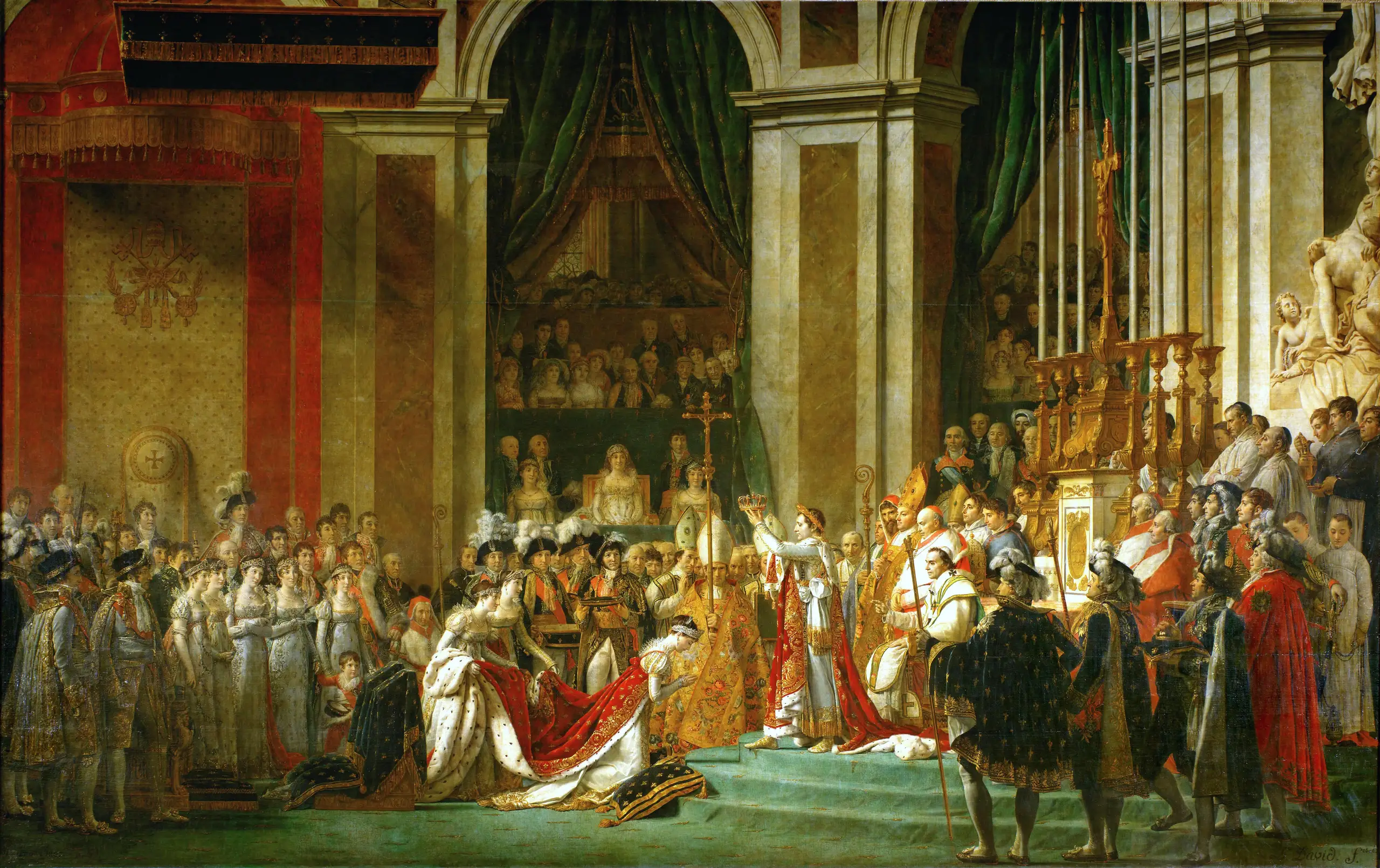
Legendary moments define his story beyond the facts. The coronation scene where he allegedly snatched the crown from Pope Pius VII to place it on his own head remains an iconic image of self-made power, even if historians debate the exact gesture. After Waterloo, the tales of his final days on St. Helena include persistent folklore suggesting poisoning by arsenic-laced wallpaper or British governors, though modern analysis points to stomach cancer. His nickname "Le Petit Caporal" became a legend itself, born from stories of him mingling with common soldiers and recognizing them by name, cementing his image as the soldier-emperor.
Notable Quotes
“Impossible is a word to be found only in the dictionary of fools.”
“Victory belongs to the most persevering.”
“My glory is not to have won 40 battles... What will live forever, is my Civil Code.”
“I am not a man, I am a destiny.”
“A leader is a dealer in hope.”
Family & Personal Life
Napoleon's father, Carlo Buonaparte, was a lawyer who initially supported Corsican independence but later reconciled with the French crown. His mother, Letizia Ramolino, was a strong-willed woman who instilled discipline in her children. He had seven siblings, including Joseph, Lucien, Elisa, Louis, Pauline, Caroline, and Jérôme, many of whom he placed on European thrones.
Napoleon married twice. His first wife, Joséphine de Beauharnais, was a widow with two children. They married in 1796, but their union was strained by her inability to bear him an heir. They divorced in 1809, though they remained on good terms until her death in 1814. His second wife, Marie Louise of Austria, bore him a son, Napoleon II, in 1811. Napoleon also had illegitimate children, including Charles Léon and Alexandre Colonna-Walewski. He was known to be fond of his family, though his relationships were often complicated by politics.
Notable Connections
Napoleon's life was intertwined with key figures of his era. His first wife, Joséphine de Beauharnais, was a socialite who helped him navigate Parisian society. His second wife, Marie Louise of Austria, was a political match to secure an alliance. Among his marshals, Louis-Nicolas Davout was known for his loyalty, Michel Ney for his bravery, and Jean Lannes was a close friend. He also had a complex relationship with his siblings, whom he placed on thrones across Europe. His legacy is also tied to the many artists and scientists he patronized, including the scholars who accompanied him to Egypt.
Relationships & Dating History
Napoleon's romantic life was as dramatic as his military career. His first significant relationship was with Joséphine de Beauharnais, a widow he met in 1795. They married in March 1796, but the marriage was passionate yet troubled. Joséphine's inability to bear children led to a divorce in 1809, though they remained close friends until her death in 1814.
In 1810, seeking an alliance with Austria, Napoleon married Marie Louise, Duchess of Parma. She bore him a son, Napoleon II, in 1811. However, Marie Louise left him during his first exile and never rejoined him. He also had several illegitimate children, including Charles Léon with Catherine Détré and Alexandre Colonna-Walewski with Maria Walewska. His relationship with Maria Walewska, a Polish countess, was particularly notable; they were together from 1807 to 1810 and remained amicable after their son's birth. Napoleon's final years were spent alone on Saint Helena, where he died in 1821.
- MarriedJoséphine de Beauharnais1796 - 1809Married in 1796; divorced in 1809 due to inability to produce an heir; remained friends until her death in 1814.
- MarriedMarie Louise, Duchess of Parma1810 - 1814Political marriage to secure Austrian alliance; bore Napoleon II; left him in 1814.
- DatedMaria Walewska1807 - 1810Polish countess; mother of his illegitimate son Alexandre Colonna-Walewski; relationship ended amicably.
Death & Aftermath
Died
May 5, 1821 (aged 51)
Death Place
Longwood House, Saint Helena
Cause of Death
Stomach cancer (gastric carcinoma)
The return of his remains to Paris in 1840, known as the Retour des Cendres, transformed a quiet exile into a state funeral that cemented his status as a national martyr. This grand ceremony at Les Invalides followed decades of political debate and historical inquiry sparked by the circumstances of his passing on May 5, 1821, at Longwood House on Saint Helena. Napoleon spent his final months under house arrest, suffering from intense abdominal pain, vomiting, and weakness before succumbing to illness at age 51. His personal physicians, including Francesco Antommarchi, performed an autopsy that revealed a large ulcerated tumor in the stomach, leading to an official ruling of stomach cancer.
The immediate reaction in France was muted by the Bourbon Restoration but quickly evolved into a wave of reverence among veterans and the public, fueling the growing Napoleonic Legend through literature and art. A private funeral took place just four days after his death, attended by General Bertrand, Count Montholon, and his medical team, with his body temporarily buried in the Valley of the Willows.
Net Worth (Estate Value)
$100 Million
iFANN Editorial Team estimate
Napoleon Bonaparte's wealth during his lifetime was substantial, but as a historical figure, his net worth is now tied to his estate and cultural legacy. At the time of his death in 1821, his personal fortune was estimated at several million francs, largely accumulated through war plunder, salaries, and land grants. Adjusted for inflation, this would equate to tens of millions of dollars today. His estate continues to generate revenue through royalties from books, films, and merchandise, as well as tourism to sites like his tomb at Les Invalides and museums dedicated to his life. However, these earnings are managed by the French state and cultural institutions, not a private trust. Per iFANN's editorial analysis, as of 2026, the estimated value of his estate and associated intellectual property is $100 Million, a figure that reflects his enduring cultural significance rather than traditional financial assets.
Awards Won (1)
Napoleon did not receive modern awards like Oscars or Grammys, as they did not exist during his lifetime. However, he was the Grand Master of the Legion of Honour, which he established, and he created the Order of the Iron Crown for his Kingdom of Italy. His legacy is honored through numerous posthumous recognitions, including his tomb at Les Invalides and the enduring influence of the Napoleonic Code.
1804 · State Honour
As Emperor of the French
Known For
Battle of Austerlitz
1805 · Emperor and military commander
Napoleonic Code
1804 · Legal reformer
French Empire
1804 · Emperor of the French
Keywords
Sources
Quick Facts
- Profession
- politician, art collector, emperor
- Born
- August 15, 1769
- Birthplace
- Ajaccio, Corsica
- Died
- May 5, 1821
- Death Place
- Longwood House, Saint Helena
- Gender
- Male
- Spouse
- Joséphine de Beauharnais, Marie Louise, Duchess of Parma
- Birth Sign
- Leo
Personal Details
- Full Name
- Napoleone di Buonaparte
- Height
- 5 ft 7 in (170 cm)
- Spouse
- Joséphine de Beauharnais, Marie Louise, Duchess of Parma
- Children
- Napoleon II (legitimate); Charles Léon, Alexandre Colonna-Walewski (illegitimate)
- Education
- Brienne-le-Château military academy; École Militaire, Paris
Frequently Asked Questions
How did Napoleon die?
What is Napoleon best known for?
Was Napoleon short?
How many wives did Napoleon have?
Is Napoleon still relevant in 2026?
Join the community
fans discussing