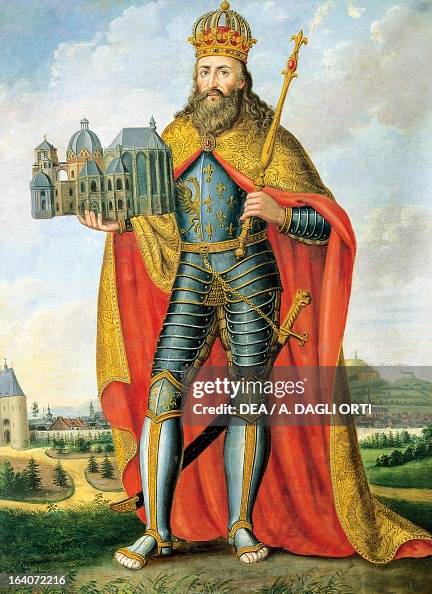
Charlemagne
 France
Also known as: Charles the Great, Carolus Magnus, Karl der Große
Birthday
April 2, 748
Birth Sign
Aries
Birthplace
Francia (modern-day Belgium or Germany)
Age
Died at 65
Height
6 ft 4 in (193 cm)
About
Charlemagne, born Charles on April 2, 748, stands as one of history's most formidable monarchs. He ruled the Franks starting in 768 and later took the title of King of the Lombards in 774 before becoming Emperor of the Carolingian Empire in 800. His reign united much of Western and Central Europe, making him the first recognized emperor to rule from the west since the fall of the Roman Empire centuries prior. The eldest son of Pepin the Short and Bertrada of Laon, he inherited power alongside his brother Carloman I. After Carloman died in 771, Charlemagne became the sole ruler of the Frankish kingdom.
His military campaigns reshaped the map of medieval Europe. Charlemagne continued his father's policy of protecting the papacy, which led him to remove the Lombards from northern Italy in 774. He pushed his borders further by conquering Bavaria, Saxony, and parts of northern Spain. These expansions often involved forced conversion to Christianity, such as the Massacre of Verden against the Saxons. Diplomatic efforts also played a role; he sent envoys to Harun al-Rashid, the Abbasid caliph, during the 790s to discuss affairs in Iberia. In 800, Pope Leo III crowned him emperor in Rome, a move that placed him in direct conflict with the Eastern Roman Empire in Constantinople.
As both king and emperor, Charlemagne implemented sweeping reforms in administration, law, education, and the military. These changes sparked a period of cultural revival known as the Carolingian Renaissance. His death occurred on January 28, 814, and he rests in the Palatine Chapel in Aachen, his imperial capital. Historians frequently call him the "Father of Europe" because his influence shaped the continent for centuries. Multiple European royal houses trace their lineage back to him, and his legacy endures through monuments, literature, and art created long after his death.
Early Life & Background
Born into the Frankish nobility in either modern-day Belgium or Germany, Charles grew up in an environment defined by martial tradition and dynastic ambition. His father, Pepin the Short, had recently usurped the Merovingian throne to establish the Carolingian dynasty, setting a precedent for military strength and papal alliance. As the eldest son, Charles received a rigorous education typical for a Frankish noble, focusing heavily on horsemanship, hunting, and military strategy. Unlike many of his contemporaries, he struggled significantly with formal literacy in his youth, learning to read Latin only later in life under the guidance of scholars like Alcuin of York.
Despite his early academic hurdles, Charles displayed a natural aptitude for leadership and warfare. By the time he reached adulthood, he had already participated in several military campaigns alongside his father. When Pepin died in 768, Charles inherited the Frankish kingdom jointly with his younger brother Carloman I. This period was marked by tension between the two brothers, but Charles quickly moved to consolidate his authority. Following Carloman's sudden death in 771, Charles became the sole ruler of the Franks without significant conflict, positioning himself to launch the expansive campaigns that would define his reign.
Career Growth
Charlemagne's career was defined by nearly constant warfare and administrative reform. In 773, he invaded Italy at the request of Pope Adrian I to protect the papacy from the Lombards. He conquered Pavia, took the title "King of the Lombards," and imprisoned the Lombard king Desiderius. From 777 to 804, he engaged in a brutal, decades-long campaign against the Saxons, which included the infamous Massacre of Verden in 782 where 4,500 Saxon prisoners were executed for rebelling. This campaign ended with the forced conversion of the Saxons and their integration into the Frankish realm.
In 793, he ordered the construction of the Canal of Fossa Carolina, an ambitious engineering project intended to link the Rhine and Danube rivers. In 800, following a political crisis in Rome involving Pope Leo III, Charlemagne traveled to Rome for Christmas Day. On December 25, 800, he was crowned "Emperor of the Romans" by Pope Leo III in St. Peter's Basilica. This event marked the revival of the imperial title in the West and established the foundation for the Holy Roman Empire. He later implemented the Missi Dominici system in 802, sending pairs of royal officials to enforce laws and collect taxes across the provinces. In 813, he successfully crowned his son Louis the Pious as co-emperor to ensure succession before his own death.
Career Timeline
Public Image & Style
Charlemagne projected an image of divine authority and martial prowess. He was known for his imposing physical presence, standing tall above his contemporaries and wearing a tunic and trousers with a sword at his side. His court emphasized the importance of learning and culture, attracting scholars from across Europe to Aachen. He cultivated an image of piety, often seen praying in the Palatine Chapel and enforcing Christian conversion policies. Despite his reputation for brutality in war, he was also remembered as a patron of the arts and education, sparking a cultural revival that bore his name.
Fame & Fandom (iFAMOUS Rankings)
Charlemagne is universally recognized as one of the most influential figures in human history. His fame transcends time, with his name synonymous with the concept of European unity. While there is no formal fanbase with rituals or names in the modern sense, his legacy is kept alive through historical societies, reenactment groups, and academic institutions dedicated to the Middle Ages. The Charlemagne Prize, awarded annually in Aachen, brings together world leaders and dignitaries who share his vision of unity. He appears frequently in educational media, documentaries, and historical analyses discussing the origins of the EU. He is not featured on the September 2026 iFAMOUS Rankings flagship list, as his fame is rooted in history rather than contemporary celebrity metrics.
Interesting Facts and Legends
Charlemagne was known to bathe frequently, which was highly unusual for a man of his era. He kept a pet bear brought from Scandinavia as a companion animal. Although he spoke Latin fluently, he struggled to write it; historical accounts suggest he tried to learn but found it too difficult to master fully. He once banned the wearing of fur coats made from expensive animals to save money and reduce luxury, preferring simple wool and linen instead. The epic poem The Song of Roland, written centuries after his death, cemented his legendary status and introduced the character of his nephew Roland. His physical stature was exceptional for the time; chroniclers described him as tall and robust, standing approximately six feet four inches tall.
Notable Quotes
“I would rather be a good king than a bad emperor.”
“If you do not accept the faith, you will lose your lives.”
“I have gathered together all the books I could find... so that we might learn what our ancestors did.”
Family & Personal Life
Charlemagne came from a powerful Frankish family. His father was Pepin the Short, the first Carolingian king, and his mother was Bertrada of Laon. He had a younger brother named Carloman I, who died in 771. Charlemagne had at least 18 known children, though only about half survived to adulthood. His most significant marriage was to Hildegard of Vinzgouw, which produced 11 children including his successor Louis the Pious. Other notable children include Pepin the Hunchback, Charles the Younger, and Pippin of Italy. His relationship with his children varied; while some succeeded him or ruled territories, others like Pepin attempted to usurp the throne and were later confined to monasteries.
Notable Connections
Alcuin of York, Einhard, Pope Leo III, Harun al-Rashid, Louis the Pious
Relationships & Dating History
Charlemagne's personal life was defined by dynastic marriages and concubinage arranged for political alliance. His first partner was Himiltrude around 768, who bore him a son, Pepin the Hunchback. Their relationship likely ended when he sought a more politically advantageous marriage. In 771, he married Desiderata, daughter of the Lombard king, but this union lasted only a few months before being annulled due to political shifts. That same year, he married Hildegard of Vinzgouw, a Bavarian noblewoman. This was his most stable marriage, producing 11 children including his successor Louis the Pious. She died in childbirth in 783, devastating Charlemagne.
After Hildegard's death, he married Fastrada in 784. Her reign as queen was marked by accusations of cruelty, and she died in 794, possibly poisoned. He then had a brief relationship with Liutperga around 794, followed by a marriage to Luitgard in 794, who died childless in 800. Later in life, he had a relationship with Ethelind Adelinde, a Saxon noblewoman, who bore him a daughter named Rotrude. He died in 814, leaving behind a large family and a legacy of dynastic expansion.
- MarriedHimiltrude768 - 771Bore son Pepin the Hunchback; relationship ended for political reasons.
- MarriedDesiderata771 - 771Short-lived political alliance; annulled due to infidelity rumors.
- MarriedHildegard of Vinzgouw771 - 783Most significant marriage; produced 11 children including Louis the Pious.
- MarriedFastrada784 - 794Accused of cruelty; died possibly poisoned.
- MarriedLiutperga794 - 794Brief relationship; possibly sister of Fastrada.
- MarriedLuitgard794 - 800Died childless; deeply mourned by Charlemagne.
- MarriedEthelind Adelinde800 - 814Saxon noblewoman; bore daughter Rotrude.
Death & Aftermath
Died
January 28, 814 (aged 65)
Death Place
Aachen, Carolingian Empire
Cause of Death
Pneumonia and high fever
Charlemagne passed away on January 28, 814, at the age of sixty-five within his favored palace in Aachen. Chroniclers like Einhard recorded that he had suffered from a high fever for nine days before succumbing to what modern historians often interpret as severe pneumonia or heart failure. He remained conscious until the very end, receiving the last rites while praying inside the Palatine Chapel he had commissioned. His funeral was a grand state affair attended by his son Louis the Pious, his daughters, and high-ranking clergy who gathered to honor the man who had unified much of Western Europe.
Initially interred in the Palatine Chapel, his remains were exhumed and placed in a golden casket by Emperor Frederick Barbarossa in 1165, turning his tomb into a site of veneration for centuries. While his vast empire was eventually partitioned among his grandsons via the Treaty of Verdun in 843, his cultural legacy endured through the Carolingian Renaissance and works like The Song of Roland. The European Union later honored his memory by establishing the Charlemagne Prize, awarded annually to those who promote European unity. His inclusion among the Nine Worthies cemented his status as one of history's greatest leaders, with his influence shaping the political landscape of France, Germany, and the Holy Roman Empire long after his death.
Net Worth (Estate Value)
$0
iFANN Editorial Team estimate
Awards & Accolades
View 9 records, honours and achievementsKnown For
Coronation of Charlemagne
800 · Emperor
Carolingian Renaissance
780 · Patron
Conquest of the Lombards
774 · King
Keywords
Sources
Quick Facts
- Profession
- monarch, sovereign
- Born
- April 2, 748
- Birthplace
- Francia
- Died
- January 28, 814
- Death Place
- Aachen
- Gender
- Male
- Spouse
- Desiderata of the Lombards, Hildegard of Vinzgouw, Fastrada, Luitgard, Himiltrude, Liutperga, Ethelind Adelinde
- Birth Sign
- Aries
Personal Details
- Full Name
- Charles the Great (Carolus Magnus)
- Height
- 6 ft 4 in (193 cm)
- Spouse
- Himiltrude, Desiderata, Hildegard of Vinzgouw, Fastrada, Liutperga, Luitgard, Ethelind Adelinde
- Children
- Louis the Pious, Pepin the Hunchback, Charles the Younger, Pippin of Italy, Lothair I, Carloman, Gisela, Bertha, Rotrude, and others
- Education
- Palace School at Aachen (patron), tutelage under Alcuin of York
Frequently Asked Questions
Who was Charlemagne?
How many wives did Charlemagne have?
What caused Charlemagne's death?
Did Charlemagne have children?
Why is Charlemagne called the Father of Europe?
Similar People
Join the community
fans discussing