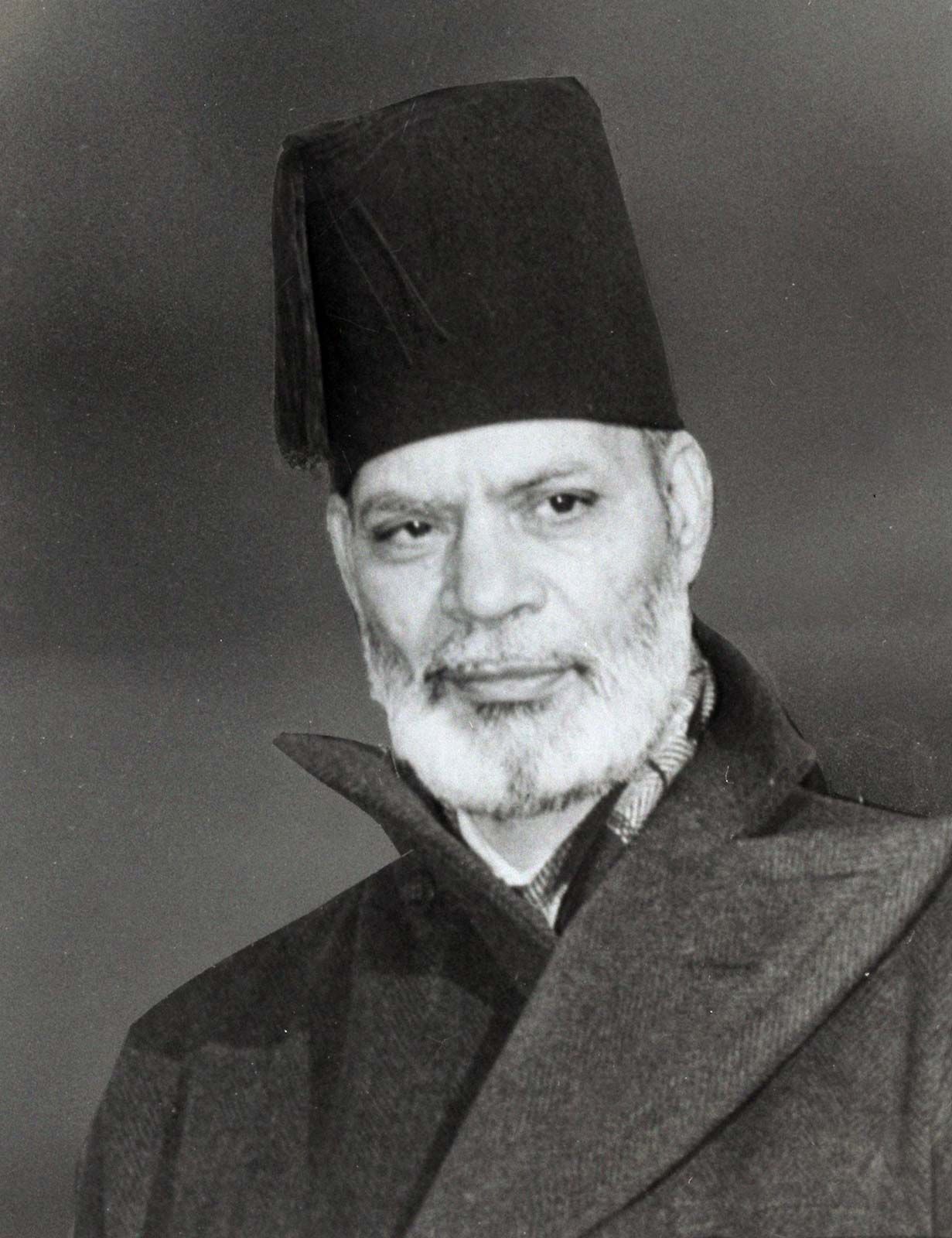
Muhammad Zafarullah Khan
 Pakistan
Also known as: Zafrulla Khan, Sir Muhammad Zafrulla Khan, Chaudhry Sir Muhammad Zafrulla Khan
Birthday
February 6, 1893
Birth Sign
Aquarius
Birthplace
Sialkot, British India (now Pakistan)
Age
Died at 92
About
Sir Muhammad Zafrulla Khan was a Pakistani jurist, diplomat, and statesman who shaped the legal and diplomatic contours of the mid-twentieth century. He is the only person in history to have presided over both the United Nations General Assembly and the International Court of Justice, a distinction that speaks to his rare blend of legal acumen and political skill.
Born in 1893 in Sialkot, Khan rose from a provincial legal practice to become Pakistan's first Foreign Minister, a judge on the International Court of Justice, and ultimately its president. His career spanned the twilight of the British Raj, the partition of India, and the early decades of the Cold War, during which he represented not only Pakistan but also, in a de facto capacity, the State of Palestine at the UN.
Khan was also a prominent scholar of the Ahmadiyya Muslim Community, translating the Quran into English and authoring works such as Islam: Its Meaning for Modern Man. He lived a life of piety and simplicity, dedicating his post-retirement years to charitable work. He died in Lahore in 1985, leaving behind a legacy as a founding father of Pakistan and a towering figure in international law.
Early Life & Background
Muhammad Zafrulla Khan was born on 6 February 1893 in Sialkot, a city in the Punjab province of British India. His father, Chaudhry Nasrullah Khan, was the leading attorney of the nearby town of Daska, and the family belonged to an agriculturist background. Young Zafrulla grew up in a household where law and public service were familiar terrain.
He studied at Government College, Lahore, before sailing to England to pursue legal studies. At King's College London he earned his LL.B. in 1914, and was called to the bar at Lincoln's Inn the same year. Returning to India, he set up practice in Sialkot and later Lahore, quickly gaining a reputation as a sharp and principled lawyer.
In 1916 and again in 1922, Khan served as counsel for the Ahmadiyya community in two landmark cases that secured their right to use Muslim places of worship and affirmed Ahmadiyya as part of Islam. These early victories not only established his legal standing but also deepened his lifelong connection to the Ahmadiyya faith. By 1926, he had entered politics, winning a seat on the Punjab Legislative Council, and by 1930 he was representing Indian Muslims at the Round Table Conferences in London.
Career Growth
Khan's breakthrough came with the creation of Pakistan. He was one of the drafters of the Pakistan Resolution in 1940, and his legal mind proved essential in the Radcliffe Commission, which drew the borders of the new state. When Pakistan came into being in August 1947, he moved to Karachi and became its first Foreign Minister, serving under Prime Minister Liaquat Ali Khan until 1954. In that role he shaped the young nation's foreign policy and represented it on the world stage.
In 1954 he was elected to the International Court of Justice, where he served as a judge until 1961, and as vice president from 1958. He then took a leave of absence to serve as Pakistan's Permanent Representative to the United Nations, a post he held from 1961 to 1964. During this period he became a vocal champion of the Palestinian cause, and in 1963 he was elected President of the UN General Assembly, representing the State of Palestine in a de facto capacity.
Returning to The Hague in 1964, Khan resumed his judicial duties at the ICJ, and in 1970 he became the court's president, a position he held until 1973. He remains the only Pakistani to have held that office. After retiring, he devoted himself to writing and charitable work, passing away in Lahore in 1985. His career remains a singular example of combining legal excellence with global diplomacy.
Career Timeline
Public Image & Style
In the public eye, Khan was seen as a man of immense legal intellect and unwavering moral conviction. His speeches at the UN were noted for their eloquence and passion, particularly when he argued for the rights of Palestinians. He carried himself with the gravitas of a judge, yet his colleagues often remarked on his humility and approachability.
His Ahmadiyya faith was a defining part of his identity, and he was respected for his scholarly contributions to Islam. In Pakistan, he is remembered as a founding figure, though his Ahmadiyya affiliation has also made him a controversial figure in some circles. Internationally, he is celebrated as a champion of international law and justice.
Fame & Fandom
Sir Muhammad Zafrulla Khan commands a legacy defined not by celebrity culture but by the enduring reverence of specific religious and diplomatic communities. Within the Ahmadiyya Muslim Community, he is venerated as a distinguished servant of faith and state, often addressed with honorifics such as Hazrat Sir Zafrullah Khan. His admirers in Pakistan include historians and political scientists who regard him as the Father of Pakistani Foreign Policy, maintaining his memory through academic institutions rather than social media campaigns. These groups preserve his legacy via scholarships like the Sir Zafrullah Khan Award for Distinguished Service and extensive literary publications detailing his life. While he did not cultivate a modern fanbase with rituals or streaming parties, his influence persists through his iconic defense of Palestinian rights at the United Nations and his historic tenure as the first Asian President of the International Court of Justice. The 1974 constitutional crisis, which pitted his national service against his religious identity, remains a somber chapter that solidifies his narrative among followers. Regarding his standing in global metrics, iFANN has evaluated Sir Muhammad Zafrulla Khan as of August 2026. He is currently unranked in the Global Top 1,000 and holds no placement on any Top-100 scope list. This status reflects his historical stature rather than a lack of recognition; he does not appear in contemporary popularity charts because his era predates the digital fame cycles measured by the engine. No formal fandom name exists in the data to describe his supporters, as his following is characterized by community membership and scholarly respect rather than organized fan clubs.
Interesting Facts and Legends
Khan was an accomplished polyglot fluent in Urdu, English, and Arabic, skills that proved indispensable during his international career. He dedicated years to translating the Holy Quran into English, a project reflecting his deep scholarly commitment to Islam. Among his numerous written works are the books Islam: Its Meaning for Modern Man (1962) and his autobiography Servant of God: A Personal Narrative (1983). Despite his high office, he maintained a simple lifestyle, and Nobel laureate Abdus Salam noted that Khan donated all his life savings to charity after retirement. He represented not only Pakistan but also nations such as Libya, Tunisia, and Indonesia at the UN in various capacities. Beyond these documented facts, a story frequently retold by his followers concerns his unwavering defense of the Palestinian cause, where his eloquence earned him the title of the voice of the oppressed. Another pivotal moment in his legend is his election as the first Asian President of the International Court of Justice from 1970 to 1973, a distinction celebrated across the continent. The most tragic element of his biography involves the 1974 constitutional amendment that declared Ahmadis non-Muslims, marking a painful divergence between the state he helped build and his own religious identity.
Notable Quotes
“I beg you. I implore you. Entreat you not to destroy your credit in Arab countries. Tomorrow you may need their friendship but you will never get it.”
“The cause of peace is the cause of justice.”
“We must not let the light of truth be extinguished.”
Family & Personal Life
Khan was born into a well-regarded family in Sialkot. His father, Chaudhry Nasrullah Khan, was a prominent attorney, and the family were landowners. He was raised in an environment that valued education and public service.
Details about his wife and children remain scarce in public records. What is known is that he maintained a life of personal piety and simplicity, even as he rose to the highest international offices. In his later years, he lived quietly in Lahore, dedicating himself to religious scholarship and charitable deeds.
Notable Connections
Khan worked closely with Pakistan's first Prime Minister, Liaquat Ali Khan, and was a key figure in the All-India Muslim League under Muhammad Ali Jinnah. He also collaborated with international jurists at the ICJ and UN. His advocacy for Palestine placed him alongside Arab leaders of the era. He is remembered as a colleague of Nobel laureate Abdus Salam, who admired his charitable work.
Relationships & Dating History
Public records provide little information about Khan's personal relationships. He married at a young age, but details about his wife and family life are not widely documented. He was known to be a devoted family man, though he kept his private life out of the public eye.
His wife predeceased him, and he spent his final years as a widower in Lahore. He passed away in 1985, leaving behind a legacy of service rather than a well-chronicled personal life.
Death & Aftermath
Died
September 1, 1985 (aged 92)
Death Place
Lahore, Punjab, Pakistan
Cause of Death
reported natural causes
Sir Muhammad Zafrulla Khan passed away in Lahore on September 1, 1985, at the age of ninety-two. The circumstances surrounding his final days were quiet, with no official medical statement released to the public regarding the specific nature of his decline, though historical records treat the event as a natural conclusion following a long tenure of high office. Tributes from peers and institutions quickly acknowledged his pivotal role in shaping Pakistan's foreign policy and his unique status as the only individual to preside over both the United Nations General Assembly and the International Court of Justice. His funeral rites adhered to the traditions of the Ahmadiyya community, resulting in his interment within the sect's cemetery in Rabwah, now known as Chiniot, where he remains buried alongside other prominent members of the faith. Posthumously, his legacy has been preserved through continued academic references, biographical works, and dedicated galleries maintained by the Ahmadiyya Muslim Community.
Net Worth (Estate Value)
$10 Million
iFANN Editorial Team estimate
The financial life of Sir Muhammad Zafrulla Khan was marked by a deliberate simplicity, as he chose to donate his accumulated life savings to charitable causes upon retiring from public service. Earnings derived from his roles as a government official and international judge were modest salaries that never translated into personal accumulation of wealth. Following his death, his estate, now managed by trustees, consists primarily of his literary archives and royalties generated by his published works. No public records indicate the existence of significant real estate holdings or speculative investments. Per iFANN's editorial analysis, the estate of Sir Muhammad Zafrulla Khan is estimated to be modest as of 2026, valued at around $10 million, a figure derived entirely from the ongoing sales of his published works and the enduring respect for his legacy.
Awards Won (1)
Khan received several honours during his lifetime, most notably being knighted as a Knight Commander of the Order of the Star of India (KCSI) in 1935. He also received honorary doctorates from various universities for his contributions to law and diplomacy. His greatest recognition, however, came through his election to the presidencies of both the UN General Assembly and the International Court of Justice.
1935 · Honour
Public service
Known For
Pakistan's First Foreign Minister
1947 · Foreign Minister
President of the UN General Assembly
1963 · President
President of the International Court of Justice
1970 · President
Keywords
Sources
Quick Facts
- Profession
- Jurist, diplomat, politician
- Born
- February 6, 1893
- Birthplace
- Sialkot, British India
- Died
- September 1, 1985
- Death Place
- Lahore, Pakistan
- Gender
- Male
- Birth Sign
- Aquarius
- Education
- King's College London, Lincoln's Inn
Personal Details
- Full Name
- Chaudhry Sir Muhammad Zafrulla Khan
- Education
- Government College, Lahore; King's College London (LL.B., 1914); Lincoln's Inn (called to bar)
Frequently Asked Questions
Who was Muhammad Zafarullah Khan?
When was Muhammad Zafarullah Khan born and when did he die?
What is Muhammad Zafarullah Khan known for?
Was Muhammad Zafarullah Khan an Ahmadi?
Did Muhammad Zafarullah Khan win any awards?
Similar People
Join the community
fans discussing