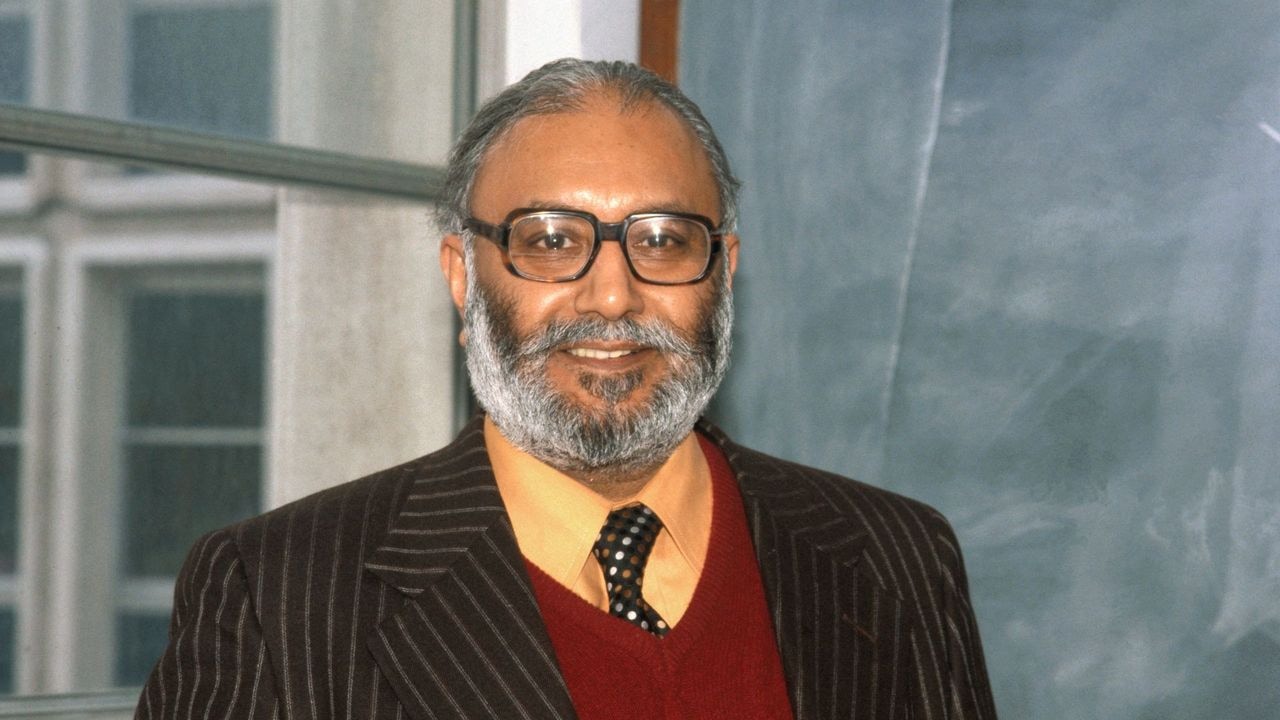
Abdus Salam
 Pakistan
Birthday
January 29, 1926
Birth Sign
Aquarius
Birthplace
Jhang, Punjab, British India (now Pakistan)
Age
Died at 70
About
Abdus Salam was a Pakistani theoretical physicist who reshaped modern physics. He shared the 1979 Nobel Prize in Physics with Steven Weinberg and Sheldon Glashow for the electroweak theory, which unifies electromagnetism and the weak nuclear force. Salam was the first Pakistani and the first Muslim scientist to win a Nobel Prize. He served as scientific advisor to Pakistan from 1960 to 1974, founding SUPARCO and the Theoretical Physics Group, and is often called the father of Pakistan's science infrastructure. At Imperial College London, he advanced quantum field theory and mentored physicists like Riazuddin. Despite leaving Pakistan in 1974 after the government declared his Ahmadiyya community non-Muslim, he continued his research, proposing the Pati-Salam model and contributing to supersymmetry. Salam died in Oxford on November 21, 1996, at age 70.
Early Life & Background
Abdus Salam was born on January 29, 1926, in Jhang, a small town in Punjab, British India (now Pakistan). His father, a schoolteacher in the Department of Education, recognized his son's intellectual gifts early. By age 14, Salam had scored the highest marks ever recorded in the matriculation examination at the University of Punjab. He won a scholarship to Government College University in Lahore, where he earned his M.Sc. in mathematics in 1946, graduating with a gold medal. His brilliance caught the attention of his professors, who encouraged him to pursue physics abroad.
In 1946, Salam traveled to St John's College, Cambridge, on a scholarship. He completed a degree in mathematics in 1949, then a Ph.D. in theoretical physics in 1952. His doctoral thesis, on the theory of the positron, was supervised by Nicholas Kemmer and earned high praise. During his Cambridge years, Salam was deeply influenced by the work of Paul Dirac and the emerging field of quantum electrodynamics. After a brief return to Pakistan in 1951, where he taught at Government College and served as a professor of mathematics, he found the scientific infrastructure too limited. He moved back to Cambridge for research, publishing influential papers on quantum field theory that caught the attention of the international physics community.
Career Growth
Salam's breakthrough came in the 1960s. In 1961, he proposed a theory of the weak interaction, and by 1967, he and Steven Weinberg independently developed the electroweak theory, unifying the electromagnetic and weak forces. This work, alongside Sheldon Glashow's contributions, earned them the 1979 Nobel Prize in Physics. Salam was the first Pakistani and the first Muslim to win a Nobel science prize.
In 1957, he became a professor of theoretical physics at Imperial College London, a position he held for decades. There, he built a world-class research group, mentoring scientists from developing countries. In 1964, he co-founded the International Centre for Theoretical Physics (ICTP) in Trieste, Italy, an institution dedicated to supporting physicists from the Global South. Salam also served as Pakistan's scientific advisor from 1960 to 1974, establishing the Pakistan Atomic Energy Commission's Theoretical Physics Group and the Space and Upper Atmosphere Research Commission (SUPARCO). After leaving Pakistan in 1974, he continued his research, contributing to grand unification theories and supersymmetry. He remained at Imperial College and the ICTP until his death.
Career Timeline
Public Image & Style
Abdus Salam was widely regarded as a gentle giant of physics. In Pakistan, he is celebrated as a national hero and a symbol of scientific excellence, though his Ahmadiyya faith made him a controversial figure in some circles. Internationally, he was admired for his advocacy of science in developing countries. Media often portrayed him as the "Muslim Einstein," highlighting his humility and dedication. His students remember him as a patient mentor who insisted on rigorous thinking. The ICTP, now named the Abdus Salam International Centre for Theoretical Physics, stands as a living monument to his vision. Salam's legacy inspires young scientists in Pakistan and across the Muslim world, who see him as proof that groundbreaking science can come from anywhere.
Fame & Fandom
Abdus Salam remains a figure of profound global resonance, his reputation sustained by the enduring weight of his scientific contributions rather than the fleeting noise of contemporary celebrity. His standing is quantified by the iFANN Global Fame Rankings, which place him as the 7th most famous person from Pakistan, a position he has held steady through successive measurement cycles. This ranking reflects a legacy that transcends borders, anchoring his name in the collective memory of the international scientific community and advocates for religious minorities alike. While he commands respect across the globe, his fanbase does not coalesce under a formal title or organized club structure. Instead, the circle of admirers consists of physicists, students of theoretical science, and members of the Ahmadiyya Muslim community who revere him as an intellectual icon. Their engagement manifests not in digital campaigns or chart pushes, but through institutional continuity; the International Centre for Theoretical Physics operates as a central hub for his followers, while annual memorial lectures at institutions like LUMS serve as recurring gatherings for those dedicated to preserving his work. The narrative surrounding him often highlights the tension between his monumental achievements and the political erasure he faced in his homeland, a story that galvanizes supporters seeking to restore his historical standing.
Interesting Facts and Legends
Abdus Salam was fluent in Urdu, English, and Punjabi, and maintained a deep devotion to his faith within the Ahmadiyya Muslim community, frequently articulating the harmony between scientific inquiry and spiritual belief. Known for his quiet humility, he often assisted young researchers directly with their work and found solace in reading poetry, particularly the verses of Allama Iqbal. He never learned to drive, preferring to walk or utilize public transport throughout his life. A crater on the Moon bears his name in recognition of his impact on physics. Beyond these personal details, his legacy is defined by specific historical milestones: he became the first Pakistani and the first Muslim scientist to win the Nobel Prize in Physics in 1979 for unifying electromagnetism and the weak nuclear force. In 1964, he founded the International Centre for Theoretical Physics in Trieste to support scientists from developing nations, creating a vital bridge for global collaboration. A persistent narrative in his biography recounts the tragedy following the 1974 constitutional amendment in Pakistan, which led to his official exclusion from national recognition and reports of grave desecration after his death in 1996, fueling ongoing efforts to reclaim his memory against state-sponsored erasure.
Notable Quotes
“The best way to make a contribution to the world is to do good science.”
“The work of a scientist is not a solitary pursuit. It is a collective endeavor.”
“I have no doubt that science will one day be the common language of all humanity.”
Family & Personal Life
Abdus Salam married twice. His first wife was Amina Muhammad, with whom he had four daughters and one son. After Amina's death, he married Louise Johnson, a molecular biologist, in 1972. Johnson was a fellow at the Royal Society and a professor at the University of Oxford. Salam and Johnson lived in Oxford and Trieste. His children include his son, Muhammad Salam, who pursued a career in engineering. Salam's family faced discrimination in Pakistan due to his Ahmadiyya faith, but they remained supportive of his work. He kept a small home in Jhang, which he visited whenever possible.
Notable Connections
Sheldon Glashow and Steven Weinberg, co-recipients of the 1979 Nobel Prize, collaborated indirectly with Salam on the electroweak theory. Riazuddin, a Pakistani physicist, was Salam's student and close collaborator, working on neutrinos and neutron stars. Salam also mentored many scientists from developing countries at the ICTP.
Relationships & Dating History
Abdus Salam was married twice. His first marriage to Amina Muhammad produced four daughters and one son. After Amina's death, he married Louise Johnson, a British molecular biologist, in 1972. Johnson was a fellow of the Royal Society and a professor at Oxford. The couple lived in Oxford and Trieste until Salam's death in 1996. Their marriage was reportedly happy and supportive.
- MarriedAmina Muhammad1945 - 1969First marriage, four daughters and one son.
- MarriedLouise Johnson1972 - 1996Second marriage, molecular biologist; remained married until Salam's death.
Death & Aftermath
Died
November 21, 1996 (aged 70)
Death Place
Unknown
Cause of Death
Unknown
Awards Won (3)
Abdus Salam won the 1979 Nobel Prize in Physics for the electroweak theory. He was elected a Fellow of the Royal Society in 1959 and received the Copley Medal in 1990. He was knighted in 1979 and awarded the Order of the Star of Pakistan, the country's highest civil award.
1979 · Physics
Electroweak theory
1990 · Physics
Outstanding achievements in physics
Known For
Electroweak theory
1967 · Co-developer
Nobel Prize in Physics
1979 · Recipient
Keywords
Quick Facts
- Profession
- university teacher, theoretical physicist, physicist
- Born
- +1926-01-29
- Birthplace
- Jhang
- Died
- +1996-11-21
- Death Place
- Oxford
- Gender
- Male
- Spouse
- Louise Johnson
- Birth Sign
- Aquarius
Personal Details
- Full Name
- Abdus Salam
- Spouse
- Louise Johnson
- Children
- 4 daughters, 1 son
- Education
- St John's College, Cambridge (PhD, 1952); Government College University, Lahore (MSc, 1946)
Frequently Asked Questions
Who is Abdus Salam?
What is Abdus Salam famous for?
When did Abdus Salam win the Nobel Prize?
Where was Abdus Salam born?
What was Abdus Salam's contribution to Pakistan?
Join the community
fans discussing