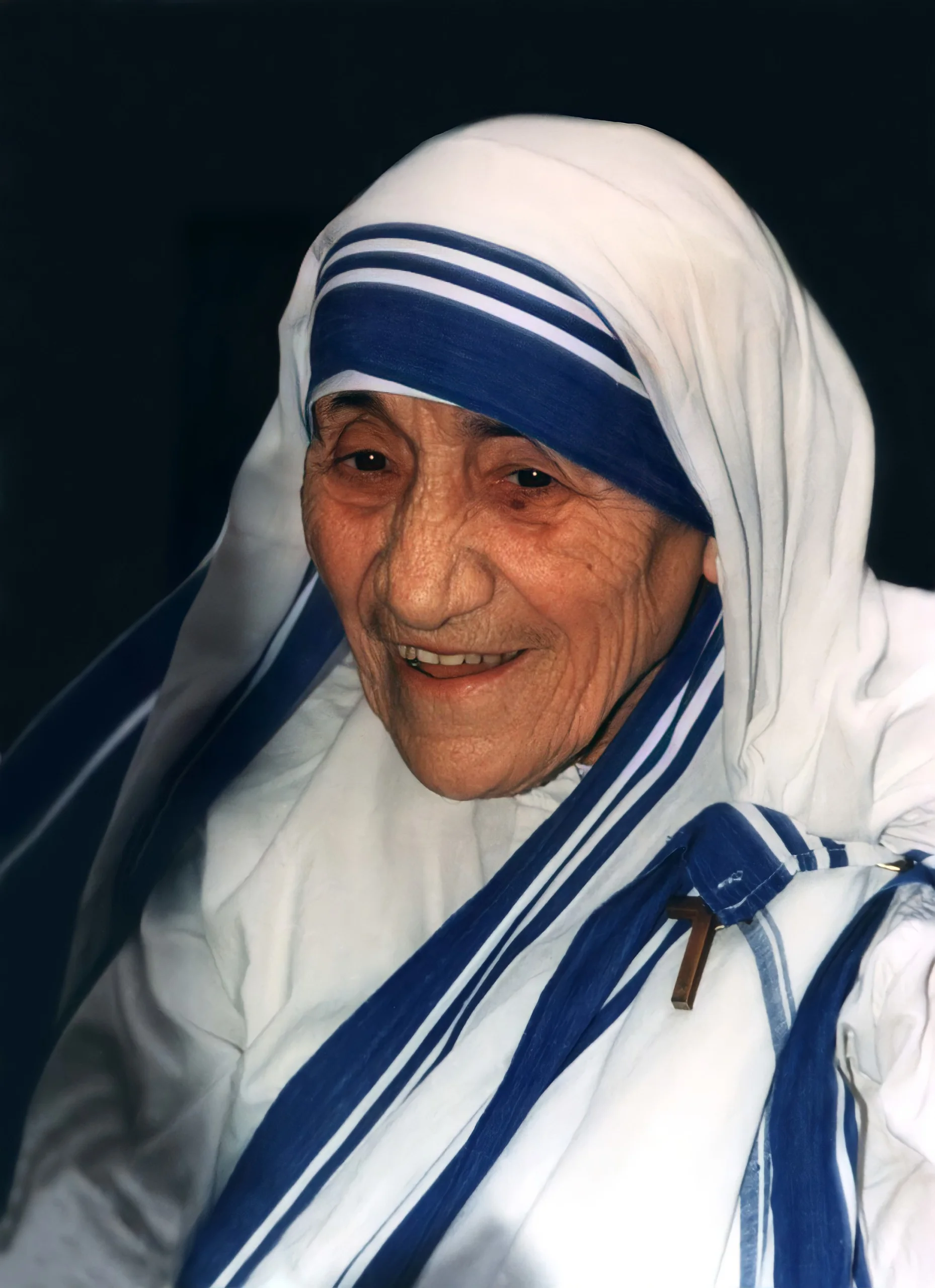
Mother Teresa
 India
religious sister•missionary•nun
Also known as: Saint Teresa of Calcutta, Blessed Teresa of Calcutta, Agnes Gonxha Bojaxhiu
Birthday
August 26, 1910
Birth Sign
Sagittarius
Birthplace
Skopje, Ottoman Empire (now North Macedonia)
Age
Died at 87
About
Agnes Gonxha Bojaxhiu, known universally as Mother Teresa, was a Roman Catholic nun and missionary who dedicated her life to serving the poorest of the poor. Born in Skopje in 1910, she left her home at age 18 to join the Sisters of Loreto in Ireland before moving to India. There, she founded the Missionaries of Charity, an order that grew to operate in over 133 countries with thousands of nuns running homes for the terminally ill, soup kitchens, and clinics. She received the Nobel Peace Prize in 1979 for her humanitarian work.
Mother Teresa remained a central figure in global religious and charitable life until her death in 1997. Her life was defined by a vow of celibacy and poverty, leaving no room for romantic relationships or personal wealth accumulation. She is widely regarded as one of the most influential figures of the 20th century, with her teachings continuing to inspire millions around the world. Her canonization as a saint in 2016 cemented her status within the Catholic Church.
Early Life & Background
Agnes Gonxha Bojaxhiu entered the world on August 26, 1910, in Skopje, then part of the Ottoman Empire and now the capital of North Macedonia. She was born into a devout Albanian-Catholic family, the youngest of three children. Her father, Nikollë Bojaxhiu, was a successful businessman involved in local politics, while her mother, Anjezë Gonxha Shatri, instilled in her a deep sense of faith and charity from an early age. Agnes experienced her first profound spiritual calling at the age of twelve when she felt a pull toward missionary work in Africa.
At eighteen, she answered this call by leaving her family and homeland to join the Sisters of Loreto in Dublin, Ireland. After two years of novitiate training, she took her first vows in 1929 and assumed the name Sister Mary Teresa after Saint Thérèse of Lisieux. She was soon dispatched to India, arriving in Calcutta later that year to teach at St. Mary's School run by the Loreto order. For nearly two decades, she taught geography and history to young girls, eventually becoming the school's principal. It was during this time that she developed a reputation for her kindness and dedication to her students.
The pivotal moment of her life arrived in 1946 during a train journey to Darjeeling. While traveling through the countryside, she reported receiving a "call within a call" from Jesus to leave the convent and serve the destitute living in the slums of Calcutta. This vision compelled her to abandon her comfortable position as a teacher and nun. She obtained permission to leave the order and began wearing a simple white sari with a blue border, marking the start of her new mission to minister to the sick and dying on the streets.
Career Growth
In 1950, Mother Teresa officially founded the Missionaries of Charity, a religious congregation dedicated to caring for the "poorest of the poor." The order initially focused on opening a home for the dying in Calcutta, where they could receive love and dignity in their final days. The congregation grew rapidly, expanding its reach to over 133 countries by 2012. At its peak, more than 4,500 nuns operated homes for the terminally ill, soup kitchens, mobile clinics, orphanages, and schools under the order's banner.
Her work garnered international attention, leading to numerous accolades. In 1962, she received the Ramon Magsaysay Peace Prize for her efforts in bridging the gap between different communities in India. Eighteen years later, in 1979, she was awarded the Nobel Peace Prize. She declined the monetary award, requesting instead that the funds be distributed to the poor to help feed the hungry. This decision highlighted her commitment to selfless service over personal gain.
Throughout the 1980s and 1990s, she continued to expand her network of charities, establishing new facilities in war-torn regions and areas affected by natural disasters. Despite facing criticism regarding the medical standards in some of her homes, her influence remained immense. She traveled extensively, meeting with world leaders and advocating for the rights of the marginalized. Her legacy endured long after her death, with the Missionaries of Charity continuing to operate hundreds of homes globally.
Career Timeline
Public Image & Style
Mother Teresa projected an image of simplicity and humility that resonated deeply with people worldwide. She was instantly recognizable in her iconic white sari with a blue border, a uniform that symbolized her vow of poverty and her identification with the poor. Her demeanor was gentle yet firm, often described as radiating a quiet strength that commanded respect without intimidation.
Media coverage of her life portrayed her as a selfless servant of God, focusing on her interactions with the sick and dying. She avoided the trappings of celebrity, refusing to live in luxury or seek personal fame. Instead, she used her platform to advocate for the marginalized, speaking out against poverty and injustice. Her public persona was one of unwavering faith and compassion, making her a beloved figure across diverse cultures and religions.
Fame & Fandom (iFAMOUS Rankings)
According to the latest metrics from the iFANN Global Fame Rankings, Mother Teresa stands as the 276th most famous person in the world, the 80th most famous person in India, the 5th most famous person from India, the 20th most famous person in South Asia, and the 5th most famous person in Religious Leaders. These placements reflect a legacy that continues to draw attention through media coverage, search activity, and cultural consumption worldwide.
Unlike modern pop icons, Mother Teresa never cultivated a formal fandom with a collective name or organized fan clubs. There were no fan-funded billboard campaigns, birthday drives, or subreddits dedicated to her image. The closest equivalent to a fanbase consists of the Missionaries of Charity order she founded and the countless institutions named in her honor. Her audience was not composed of adoring fans seeking celebrity interaction but rather beneficiaries of her work and admirers of her faith who engaged with her through prayer, service, and institutional support. While some stories circulate about personal encounters or moments of laughter shared with strangers, these remain part of a broader cultural mythology rather than documented fan rituals.
Interesting Facts and Legends
Mother Teresa's humility was legendary. When she received the Nobel Peace Prize in 1979, she famously declined the monetary award, asking that the money be given to the poor instead. This act reinforced her image as a universal symbol of charity beyond religious boundaries. Another well-known story involves a moment when someone managed to make her laugh during her time in the slums, highlighting her approachability despite her immense stature.
A lesser-known fact is that she faced significant scrutiny in later years regarding the medical care provided in her facilities. Critics questioned the quality of treatment in her hospices, though supporters argued that her primary goal was providing comfort rather than curative medicine. Despite these controversies, her words continue to inspire new generations of volunteers and donors.
Political figures have also paid homage to her memory. Senator Marco Rubio visited her tomb in Kolkata, bringing joy to her nuns and demonstrating her enduring spiritual influence across political divides. Her authorized biography, published in 1992, became a bestseller and further solidified her place in cultural history.
Notable Quotes
“Do not wait for leaders; do it alone, person to person.”
“Not all of us can do great things. But we can do small things with great love.”
“If you judge people, you have no time to love them.”
“Peace begins with a smile.”
Family & Personal Life
Mother Teresa was born into a close-knit Albanian-Catholic family in Skopje. Her father, Nikollë Bojaxhiu, was a respected businessman and local politician, while her mother, Anjezë Gonxha Shatri, was a deeply religious woman who taught her children about charity and faith. Agnes had an older sister, Drana, and an older brother, Lazar, who both played supportive roles in her early life.
Upon entering religious life at age 18, she took a vow of celibacy and severed ties with her biological family in terms of daily contact, though she maintained a spiritual connection. She never married and had no children of her own. Her entire life was dedicated to her vocation and service to the poor. She lived in the Mother House in Kolkata with her sisters in the Missionaries of Charity, forming a large spiritual family that cared for each other and the people they served.
Notable Connections
Relationships & Dating History
Mother Teresa never had a romantic partner, was never married, and did not have children. As a Catholic nun, she took a vow of celibacy upon entering religious life in 1928, dedicating her entire life to her faith and service to the poor. There is no historical record or credible report of any romantic relationships. Her life was entirely committed to her vocation and the Missionaries of Charity. Consequently, her relationship status as of 2026 remains that she is deceased, having been widowed by her vocation and separated from the world by death since 1997.
Death & Aftermath
Died
September 5, 1997 (aged 87)
Death Place
Kolkata, West Bengal, India
Cause of Death
Heart failure and multiple organ failure
On the morning of September 5, 1997, Mother Teresa passed away at St. John's Hospital in Kolkata while residing at the Mother House of the Missionaries of Charity. Her death followed a series of health crises that had plagued her since January, including a heart attack and subsequent pneumonia, culminating in another cardiac event in August. The official medical report cited heart failure complicated by multiple organ failures as the cause of death.
The news of her passing triggered an immediate outpouring of grief across the globe. Pope John Paul II declared her one of the greatest women of the century and ordered a period of national mourning in India. A moment of silence was observed worldwide as thousands gathered outside Missionaries of Charity homes in cities like New York, London, and Rome to light candles and pray. In Kolkata, an estimated crowd of over 100,000 mourners lined the streets despite heavy monsoon rains to pay their respects during her funeral procession on September 6.
Her funeral service was held at the Mother House presided over by Archbishop Henry Sebastian D'Souza. World leaders attended, including former Indian Prime Minister H.D. Deve Gowda and UN Secretary-General Kofi Annan. Unlike many other prominent figures, she was buried in the convent cemetery adjacent to the Mother House rather than being cremated, adhering to her simple wishes. She was laid to rest in a modest grave marked only by a cross.
Posthumous recognition continued to grow in the decades following her death. On September 4, 2016, Pope Francis canonized her as Saint Teresa of Calcutta, setting her feast day to September 5, the anniversary of her passing. Her legacy persists through the Missionaries of Charity, which operates hundreds of homes globally, and through numerous scholarships, hospitals, and schools dedicated to her name. Even as contemporary discourse occasionally re-examines the medical care provided in her facilities, her impact as a symbol of compassion remains unparalleled.
Net Worth (Estate Value)
$1 Million
iFANN Editorial Team estimate
As a nun who took a vow of poverty, Mother Teresa did not accumulate personal wealth. Her life was dedicated entirely to service, and she lived in the simplest conditions possible. The Missionaries of Charity, the organization she founded, manages significant assets and donations globally, but these belong to the order rather than to her personally. Following her death in 1997, the estate value is estimated based on the ongoing revenue generated by the order's operations, posthumous book sales, and licensing of her image.
Research by the iFANN Editorial Team puts her estate value at around $1 million. This figure reflects the current worth of the intellectual property associated with her name and the financial trajectory of the Missionaries of Charity, which continues to generate income through donations and charitable activities. The estate is managed by the order, ensuring that funds are directed toward their mission of helping the poor.
Awards Won (3)
Mother Teresa received numerous prestigious awards throughout her life, including the Ramon Magsaysay Peace Prize in 1962 and the Nobel Peace Prize in 1979. She was also honored with the Bharat Ratna, India's highest civilian award, in 1980. Her contributions to humanity were recognized globally, making her one of the most decorated individuals of the 20th century.
1979 · Peace
Humanitarian work
1962 · Peace
Humanitarian work
Known For
Mother Teresa: In the Name of God's Poor
1997 · Documentary Subject
The Missionaries of Charity
1950 · Founder
Keywords
Sources
Quick Facts
- Profession
- religious sister, missionary, nun
- Born
- August 26, 1910
- Birthplace
- Skopje
- Died
- September 5, 1997
- Death Place
- Kolkata
- Gender
- Female
- Birth Sign
- Sagittarius
Personal Details
- Full Name
- Agnes Gonxha Bojaxhiu
- Children
- Education
- Loreto Convent School, Darjeeling; Loreto Abbey, Raheny
Filmography
1
Total
1
Film
0
TV
Frequently Asked Questions
How old was Mother Teresa when she died?
What caused Mother Teresa's death?
Is Mother Teresa still alive in 2026?
Why is Mother Teresa famous?
Did Mother Teresa have any children?

Join the community
fans discussing