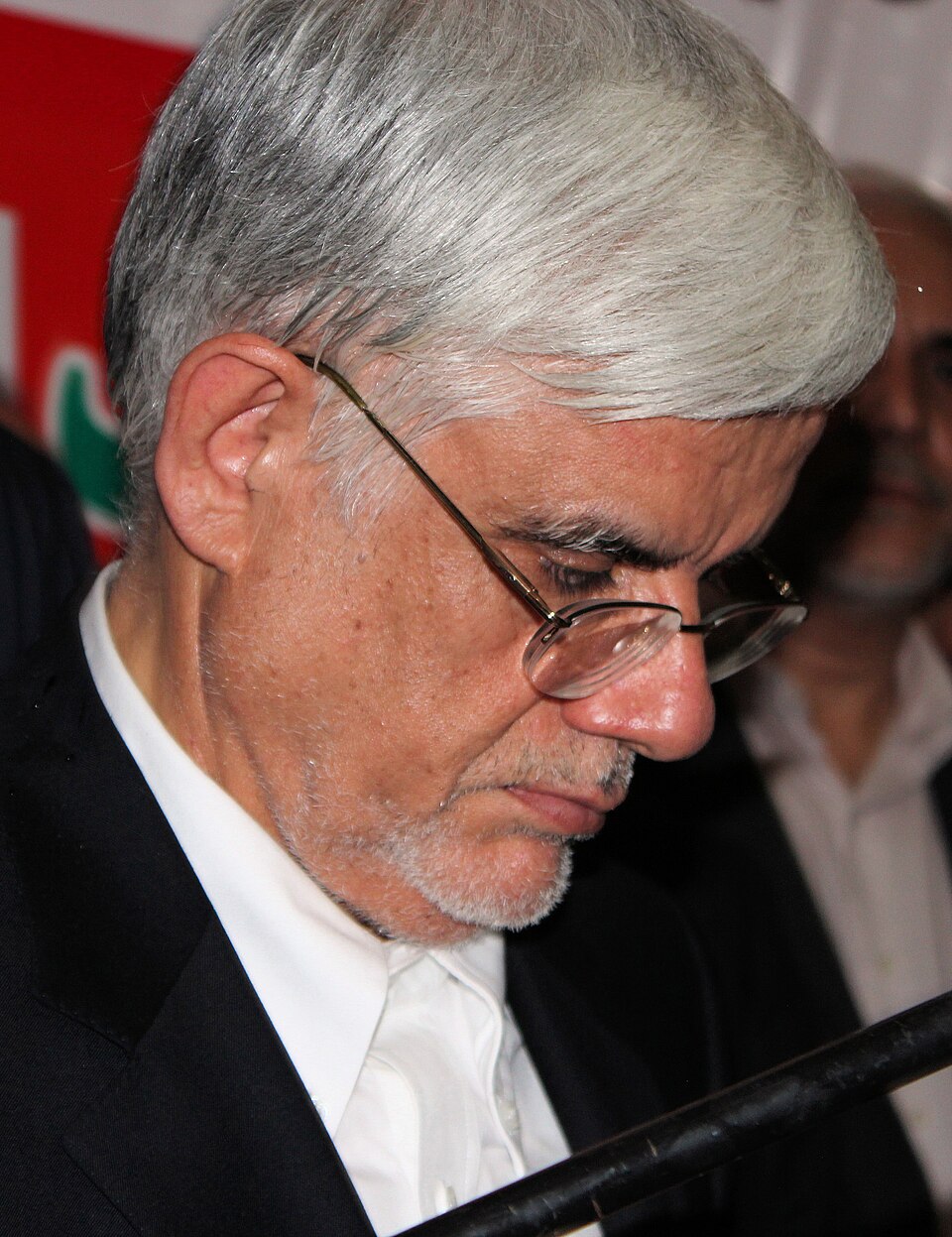
Mohammad Reza Aref
 Iran
Iranpolitician•engineer•university teacher
Birthday
December 19, 1951
Birth Sign
Sagittarius
Birthplace
Yazd, Iran
Age
74 years old
About
Mohammad Reza Aref is an Iranian reformist politician, electrical engineer, and academic who has served as First Vice President of Iran twice. His first term ran from 2001 to 2005 under President Mohammad Khatami, and he returned to the office in 2024 under President Masoud Pezeshkian. Aref earned a PhD in electrical engineering from Stanford University and holds a professorship at Sharif University of Technology, a rare combination of technical expertise and high-level political experience.
As a senior figure in Iran's reformist movement, Aref has been a member of the Expediency Discernment Council since 2002 and led the Reformists' Supreme Council for Policymaking since 2015. In 2013, he withdrew from the presidential race to consolidate support behind Hassan Rouhani. In his current role, he has articulated Iran's positions on regional security, the Strait of Hormuz, and the Gaza crisis, emphasizing dialogue while asserting national readiness for conflict. He has warned that "tomorrow will be too late" regarding Gaza and stated that Iran will be the decision-maker on the end of any potential war. His tenure has been marked by a focus on preparedness and diplomatic engagement.
Early Life & Background
Mohammad Reza Aref was born on December 19, 1951, in Yazd, a city in central Iran known for its Zoroastrian heritage and desert architecture. Growing up in Yazd, he showed an early aptitude for mathematics and science, which led him to pursue electrical engineering. He traveled to the United States for graduate studies, earning a PhD in electrical engineering from Stanford University, a credential that distinguished him among Iranian politicians.
Upon returning to Iran, Aref joined the faculty of Sharif University of Technology in Tehran, where he became a professor of electrical engineering. His academic research focused on telecommunications and information technology, and he published extensively in scholarly journals, with his work indexed on Google Scholar. His expertise in these fields positioned him as a technocrat-reformist, a profile that became influential during the reformist era of the late 1990s.
Before entering government, Aref also taught at the University of Tehran, building a reputation as a rigorous academic and a pragmatic thinker. His academic career provided a foundation for his later roles in modernizing Iran's telecommunications infrastructure and managing the country's planning organization. His birth sign is Sagittarius, and his trajectory from a provincial city to the highest levels of Iranian academia and government marks him as a notable figure of Iran's post-revolutionary technocratic elite.
Career Growth
Aref's political career took off during President Mohammad Khatami's reformist administration. He served as Minister of Information and Communications Technology and headed the Management and Planning Organization, where he modernized Iran's telecom network. On September 11, 2001, he became First Vice President, a position he held until September 11, 2005, succeeding Hassan Habibi and preceding Parviz Davoudi.
In 2002, he joined the Expediency Discernment Council, an advisory body that mediates disputes between parliament and the Guardian Council. He later led the Hope fraction in parliament, representing Tehran, and became head of the Reformists' Supreme Council for Policymaking in 2015. In the 2013 presidential election, he withdrew his candidacy to support a unified reformist front, clearing the way for Hassan Rouhani's victory.
In 2024, Aref returned to the First Vice Presidency under Masoud Pezeshkian. Since then, he has been a key spokesperson for the government's foreign policy, particularly regarding the Strait of Hormuz, the Gaza crisis, and Iran's preparedness for potential conflict. In July 2026, he said it was "natural" for Iran to administer the Strait of Hormuz, and Iran subsequently announced it would no longer permit the transit of "enemy" military equipment through the strait. In April 2026, he launched a sharp critique of Washington's foreign policy, asserting that "The U.S. Has Become Israel's 'Seventh Province'." In August 2026, he stated that "the government has planned for the next 2 years, even for the worst conditions" and that Iran's negotiating team is "defending national interests with courage." He also described transport corridors as a strategic priority for the administration.
Career Timeline
Public Image & Style
Aref is widely seen as a reformist technocrat, combining technical expertise with political pragmatism. His Stanford PhD and academic background set him apart from many Iranian politicians, lending him an air of intellectual authority. In media coverage, he is portrayed as a seasoned establishment figure who has navigated Iran's complex political landscape for decades. Western outlets note his academic credentials, while Iranian state media present him as a senior statesman articulating the government's positions on national security and foreign policy.
His communication style is measured and diplomatic, emphasizing Iran's preference for dialogue while asserting national sovereignty. He does not have a traditional fandom; his constituency is political, comprising reformist voters and the reformist establishment. His public statements often focus on Iran's readiness for worst-case scenarios, reflecting a pragmatic approach to regional tensions. He has emphasized that Iran does not seek war but will determine the outcome if one is initiated.
Fame & Fandom
Mohammad Reza Aref stands as a figure whose influence extends far beyond the corridors of Tehran, currently recognized as the 71st most famous person from Iran in the latest cycle. This placement, holding steady from previous assessments, reflects a sustained global attention that tracks his unique trajectory as both an academic and a statesman within the iFANN Global Fame Rankings. His profile captures a rare convergence of technical mastery and political authority, drawing eyes to his role in navigating complex diplomatic waters while maintaining his stature at Sharif University of Technology.
Despite his high office and international recognition, Aref does not command a formal fandom or celebrity cult in the traditional sense. There are no organized fan clubs, dedicated social media campaigns, or ritualistic gatherings centered on his persona. The public engagement surrounding him remains strictly tied to his policy positions, academic contributions, and official government duties rather than the star-driven dynamics found in entertainment sectors. His supporters are largely defined by ideological alignment with the reformist movement or respect for his engineering background, lacking the specific branding or collective identity typical of pop culture icons.
Interesting Facts and Legends
Mohammad Reza Aref holds a PhD in electrical engineering from Stanford University, a credential that distinguishes him among his political peers. He serves as a professor at Sharif University of Technology, where he maintains an active research portfolio alongside his governmental responsibilities. His digital presence includes his official website, draref.ir, and his activity on X (Twitter) under the handle @ir_aref. A longstanding member of the Expediency Discernment Council since 2002, he has been a central figure in Iran's governance structure for over two decades. In 2025, a controversy emerged regarding his son's alleged German citizenship, though Aref has remained silent on the matter publicly. Born under the sign of Sagittarius, he is 74 years old as of 2026.
One of the most memorable moments in his recent career occurred in April 2026 when he firmly rebutted narratives about Iran's decline, declaring, "Iran is history itself." This statement became a defining rhetorical moment, widely cited in international media as a defense of national sovereignty. Another significant chapter unfolded in August 2026, where he articulated hardline stances on regional security, suggesting that controlling the Strait of Hormuz could neutralize external sanctions. These incidents have cemented his reputation as a defiant voice against Western pressure, adding layers to his political lore beyond standard bureaucratic duties.
Notable Quotes
“The government has planned for the next 2 years, even for the worst conditions.”
“Iran will be the decision maker on the end a potential war.”
“Tomorrow will be too late.”
“Iran seeks dialogue but is ready to defend itself.”
Family & Personal Life
Aref is married to Hamideh Moravvej Farshi, and the couple has children. Details about his children are not publicly documented, except for a son who was the subject of a political controversy in November 2025, when an Iranian lawmaker accused him of holding German citizenship. This raised questions about Aref's eligibility under Iranian law, which restricts certain government positions for individuals with family members holding foreign citizenship. Aref has not publicly addressed the allegation. The family resides in Tehran, where Aref balances his government duties with his academic role at Sharif University of Technology. The controversy has been a notable political vulnerability for him.
Notable Connections
Relationships & Dating History
Mohammad Reza Aref is married to Hamideh Moravvej Farshi. The year of their marriage is not publicly documented, but the couple has been together for many years and has children. Aref's personal life has remained largely private, with no divorces, separations, or other romantic relationships reported. As of 2026, Aref is married to Hamideh Moravvej Farshi. Their relationship has been stable and out of the public eye.
- MarriedHamideh Moravvej FarshiCurrentWife; marriage year not publicly documented.
Salary, Net Worth In 2026
Specific figures for Mohammad Reza Aref's net worth are not publicly available. As a career academic and government official in Iran, his income derives from his government salary as First Vice President and previously as a minister, as well as his academic salary as a professor at Sharif University of Technology. There is no public information about personal business ventures, real estate holdings, or investments. Aref's wealth profile is consistent with that of a senior Iranian government official and academic, rather than a private-sector magnate. Without verifiable financial data, no reliable estimate can be provided. His financial situation is not a focus of public attention, and no credible source offers a figure.
Awards & Accolades
Known For
First Vice President of Iran
2001-2005 · First Vice President
First Vice President of Iran
2024-present · First Vice President
Minister of Information and Communications Technology
1997-2001 · Minister
Keywords
Sources
Quick Facts
- Profession
- politician, engineer, university teacher
- Born
- December 19, 1951
- Birthplace
- Yazd, Iran
- Education
- PhD in Electrical Engineering, Stanford University
- Spouse
- Hamideh Moravvej Farshi
- Political Party
- Reformist
Personal Details
- Spouse
- Hamideh Moravvej Farshi
- Education
- PhD in Electrical Engineering, Stanford University
Frequently Asked Questions
Is Mohammad Reza Aref still the First Vice President of Iran?
Where did Mohammad Reza Aref get his PhD?
How old is Mohammad Reza Aref?
Is Mohammad Reza Aref married?
Why did Mohammad Reza Aref withdraw from the 2013 presidential election?
Social Media
Join the community
fans discussing