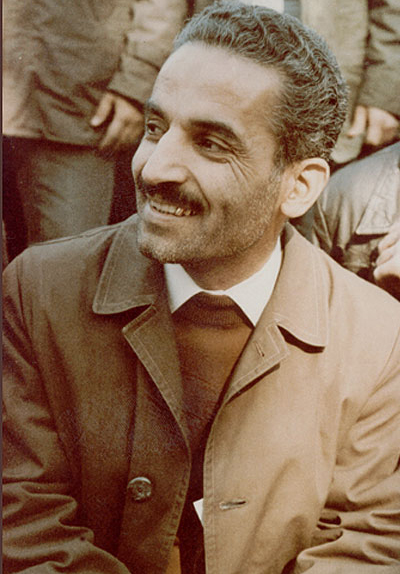
Mohammad-Ali Rajai
 Iran
IranBirthday
+1933-06-15
Birth Sign
Gemini
Birthplace
Qazvin
Age
Died at 48
About
Mohammad-Ali Rajai, born on June 15, 1933, in Qazvin, Iran, was a teacher and politician who became the second president of Iran. His presidency lasted just four weeks, from August 2, 1981, until his assassination on August 30, 1981. Before that, he served as prime minister under Abolhassan Banisadr and briefly held the foreign affairs portfolio. A dedicated educator before entering politics, Rajai's career reflected the turbulent early years of the Islamic Republic. He died alongside Prime Minister Mohammad-Javad Bahonar in a bombing that shook the nation.
Fame & Fandom
Mohammad-Ali Rajai commands a legacy defined not by the roar of crowds or the fervor of organized fan clubs, but by the solemn weight of his brief tenure and martyrdom. While many political figures from his era have faded into obscurity or become mere footnotes in textbooks, Rajai remains a central figure in the narrative of the Islamic Republic's turbulent founding years. His audience is less a fandom with rituals and inside jokes, and more a historical constituency that honors his memory through state-sanctioned commemoration and enduring scholarly interest. There is no formal name for his supporters, nor are there birthday campaigns or social media movements; instead, his presence is felt through the annual observance of National Day of Fight Against Terrorism and the quiet reverence of historians who study the early days of the revolution.
His stature on the global stage has grown steadily as the decades since his death have allowed for a clearer view of his impact. According to the iFANN Global Fame Rankings, which track global attention across media coverage, search, and consumption signals worldwide, Mohammad-Ali Rajai is currently the 52nd most famous person from Iran. This placement holds steady from the previous cycle, reflecting a consistent level of recognition that outpaces many of his contemporaries who served longer terms or held different portfolios. The ranking underscores his unique position as the second president of Iran, a role he held for only four weeks before his assassination alongside Prime Minister Mohammad-Javad Bahonar. That tragic event, documented by major international outlets and remembered annually in Tehran, ensures his story remains a vital part of modern Iranian history rather than a forgotten chapter.
Interesting Facts and Legends
Before entering the high-stakes arena of national politics, Mohammad-Ali Rajai was deeply rooted in education, having worked as a teacher long before he would ever hold a cabinet position. This background in pedagogy often informed his approach to governance, emphasizing moral clarity and service over personal gain. His time as Prime Minister under Abolhassan Banisadr was marked by intense political pressure, yet he maintained a reputation for integrity that drew support from various factions within the revolutionary government.
The defining moment of his life occurred on August 30, 1981, when a bomb detonated in the Prime Minister's office in Tehran, killing both him and Prime Minister Mohammad-Javad Bahonar. This verified historical fact, recorded by sources including The New York Times and Britannica, transformed him into a symbol of resistance against terrorism, leading to the establishment of an annual day of remembrance in Iran. His presidency lasted exactly 28 days, making it one of the shortest in recorded history, a fact that often surprises those unfamiliar with the rapid turnover of leadership during that chaotic period. He succeeded Abolhassan Banisadr and was succeeded by Ali Khamenei, bridging two critical eras in the nation's development.
Death & Aftermath
Died
+1981-08-30 (aged 48)
Death Place
Tehran
Cause of Death
fatal injuries from a powerful bomb explosion
State media confirmed the deaths of President Mohammad-Ali Rajai and Prime Minister Mohammad-Javad Bahonar on August 30, 1981, following a devastating explosion at the Islamic Republican Party headquarters in Tehran. The two leaders had been attending a weekly prayer meeting when Mansour, a group member, detonated a concealed explosive device hidden inside his briefcase. This act instantly claimed their lives along with five other attendees, leaving the nation reeling from the loss of its head of state just four weeks after Rajai assumed the presidency. The official investigation quickly attributed the bombing to the People's Mojahedin Organization of Iran, designating the event as an assassination carried out by terrorists.
The legal aftermath was swift and severe, with Iranian authorities arresting several members of the group involved in the plot. In a widely publicized trial, three individuals identified as the bombers were found guilty of treason and murder, leading to their execution by firing squad on September 28, 1981. The Islamic Republic formally declared the event a martyrdom, framing the tragedy within the context of defending the revolution against internal enemies. Ayatollah Ruhollah Khomeini immediately declared a period of mourning, referring to Rajai and Bahonar as martyrs while organizing nationwide commemorations that included moments of silence and special religious services. Rajai's funeral took place the very next day, August 31, 1981, drawing hundreds of thousands of mourners through the streets of Tehran for what officials described as a funeral of the nation.
The procession culminated in his burial at the Imam Khomeini Cemetery, a site reserved for revolutionary figures. Since then, the date has been observed annually in Iran as the National Day of Fight Against Terrorism, honoring the sacrifice of the second president. While no commercial releases or immediate biographical works emerged during the chaotic political climate, academic analyses continue to reference his brief tenure, and various institutions and streets in Tehran bear his name as part of his enduring posthumous legacy.
Awards & Accolades
Keywords
Quick Facts
- Profession
- politician, teacher
- Born
- +1933-06-15
- Birthplace
- Qazvin
- Died
- +1981-08-30
- Death Place
- Tehran
- Gender
- Male
- Spouse
- Ateghe Sedighi
- Birth Sign
- Gemini
Personal Details
- Spouse
- Ateghe Sedighi
Join the community
fans discussing