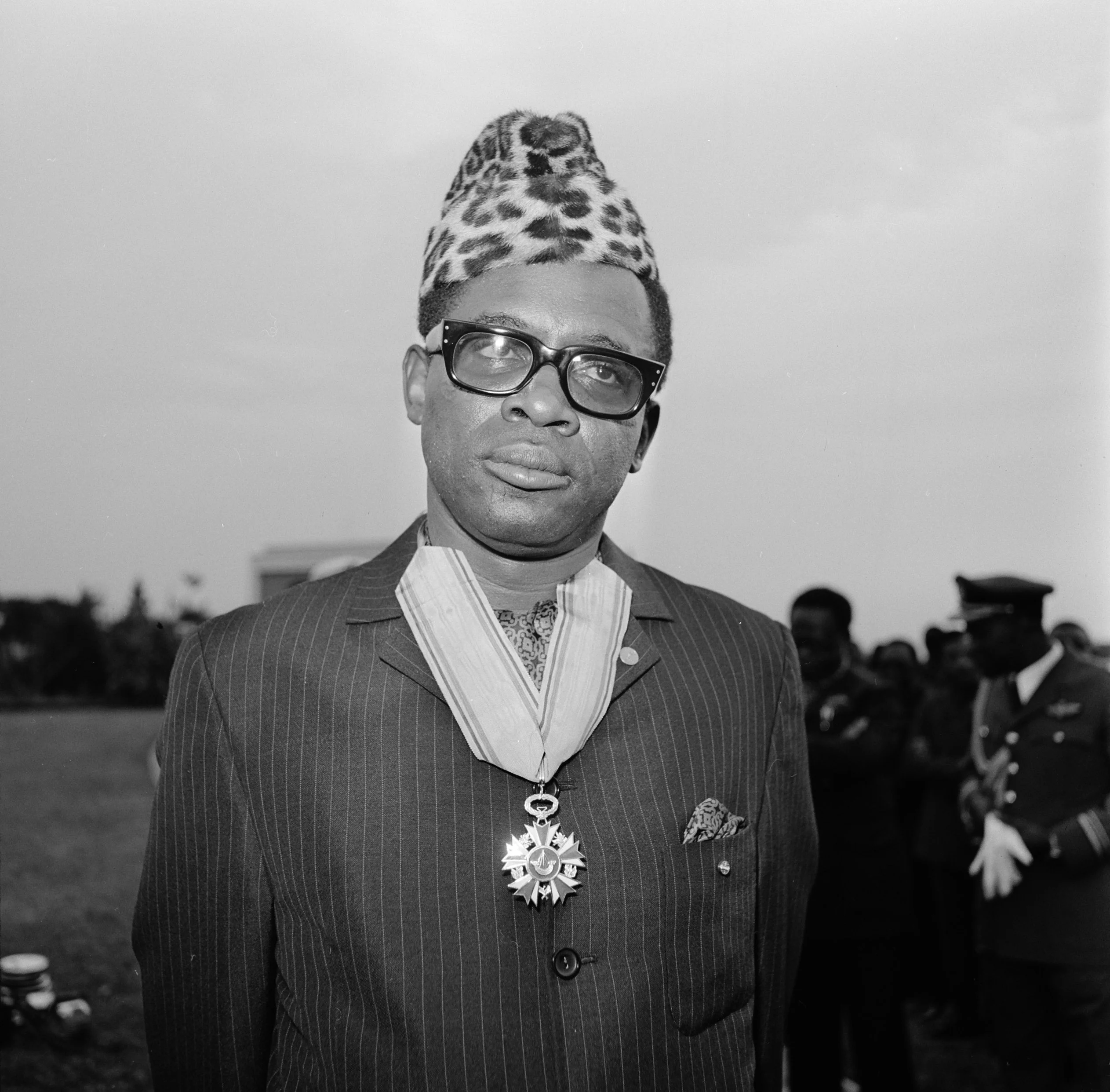
Mobutu Sese Seko
 Republic of the Congo
politician•journalist•military personnel
Also known as: Joseph-Désiré Mobutu, MSS, Mobutu Sese Seko Nkuku Ngbendu wa za Banga
Birthday
October 14, 1930
Birth Sign
Libra
Birthplace
Lisala, Belgian Congo
Age
Died at 66
Height
6 ft 0 in (183 cm)
About
Joseph-Désiré Mobutu, later known as Mobutu Sese Seko Nkuku Ngbendu wa za Banga, rose from a quiet village near Lisala to dominate the political landscape of Central Africa. Born on October 14, 1930, this military officer and politician became the face of Zaire for over thirty years. He first seized power in a 1960 coup that toppled Patrice Lumumba's government with help from Western intelligence agencies. After installing a puppet regime that executed Lumumba in 1961, Mobutu waited five years before launching his second coup in 1965 to take direct control. His rule transformed the nation into a one-party state under the Popular Movement of the Revolution, a system he maintained until his death on September 7, 1997.
Mobutu reshaped the country's identity through aggressive cultural policies. He renamed the Democratic Republic of the Congo to Zaire in 1971 and changed his own name to reflect an African heritage. His program of national authenticity banned European clothing and names, yet he lived like a king while the economy crumbled. The United States, France, and Belgium supported him as a staunch anti-communist ally during the Cold War, ignoring his human rights abuses and the massive corruption that defined his kleptocracy. Estimates suggest he stole between $50 million and $5 billion, funding lavish trips on the Concorde to Paris while citizens faced hyperinflation and debt.
By 1990, economic collapse forced Mobutu to allow a multiparty system, but he resisted change with troops until rebel forces led by Laurent-Désiré Kabila overran the capital in May 1997. Already suffering from advanced prostate cancer, the former president fled into exile in Morocco. He died there just three months after losing power at the age of 66. His legacy remains a stark example of how foreign backing can sustain a brutal regime long after it has destroyed its own nation.
Early Life & Background
Joseph-Désiré Mobutu entered the world on October 14, 1930, in the small village of Lisala within the Équateur province of the Belgian Congo. His mother, Gertrude Mawete, was a Catholic convert, while his father served as a police constable, though some historical accounts describe him as a farmer or laborer. Mobutu grew up in a modest household where he attended a Catholic mission school. This education proved pivotal as he learned French fluently and converted to Christianity, skills that would later define his political career. His academic performance stood out, particularly in languages and history, fueling his ambition to rise above his humble origins.
Before stepping onto the global stage, Mobutu worked as a journalist and radio announcer. These roles gave him a platform to express nationalist sentiments and connect with the local population. In the late 1950s, he became deeply involved in the nationalist movement that sought independence from Belgium. Initially, he aligned himself with Patrice Lumumba, a key figure in the struggle for sovereignty. However, his political trajectory shifted dramatically as tensions rose within the movement. His ability to navigate the complex political landscape of the Congo during its transition to independence set the stage for his future rise.
In 1960, Mobutu joined the army and quickly climbed the ranks. He played a crucial role in the military coup that toppled Lumumba's government in 1961. This event marked his first major step toward power, setting the stage for his eventual dictatorship. His early career was defined by his strategic alliances and his willingness to use force to achieve his political goals. By the time he launched his second coup in 1965, Mobutu had established himself as a formidable figure in Congolese politics.
Career Growth
Mobutu's political ascent began with his role in the 1960 coup that removed Patrice Lumumba from power. He then served as the Minister of Defense under President Joseph Kasa-Vubu before launching his own coup in November 1965, seizing direct control of the country. His rule was marked by the establishment of a one-party state under the Popular Movement of the Revolution (MPR), which he led until his death. Key milestones in his career include: 1960: Joined the army and participated in the coup against Lumumba. 1961: Installed a puppet regime after Lumumba's execution. 1965: Seized power in a coup, becoming the second president of the DRC. 1971: Renamed the country Zaire and changed his name to Mobutu Sese Seko Nkuku Ngbendu wa za Banga. 1970s: Implemented the "Authenticité" campaign, banning European names and clothing. 1980s: Faced increasing economic collapse and international pressure. 1990: Forced to allow a multiparty system amid domestic unrest. 1997: Overthrown by Laurent-Désiré Kabila's rebel forces; fled into exile.
Mobutu's legacy is defined by his kleptocracy, with estimates suggesting he stole between $50 million and $5 billion. Despite the country's vast natural resources, his rule impoverished the nation and left it in ruins. His administration was characterized by extreme corruption, with state funds siphoned off for personal gain. He built opulent palaces, including the "Versailles of the Jungle" in Gbadolite, while the rest of the country suffered from poverty and neglect. His reliance on foreign support, particularly from the United States and France, allowed him to maintain power for decades despite widespread criticism of his human rights record.
Career Timeline
Public Image & Style
Mobutu cultivated an image of a strong, almost divine leader. He often wore traditional African attire, such as the abacost suit, which became a symbol of his "Authenticité" campaign. His public persona was marked by grandiosity and a sense of invincibility. He frequently appeared in media wearing elaborate robes and jewelry, reinforcing his status as a monarch-like figure. Despite the country's economic struggles, Mobutu projected an image of prosperity and strength, often traveling in style and hosting lavish events. His relationship with the media was carefully managed, with state-controlled outlets promoting his achievements while suppressing dissent. This carefully constructed image helped him maintain power for over three decades, even as the reality of his rule became increasingly dire.
Fame & Fandom
iFANN has not yet collected fame data for this person. While Mobutu does not have a dedicated fandom in the modern sense, his legacy continues to be a subject of intense debate and analysis. Public opinion on him is sharply divided, with some viewing him as a necessary anti-communist ally during the Cold War, while others condemn him as a brutal dictator responsible for immense suffering. His public image is often associated with extravagance, corruption, and authoritarianism. Recent cultural references, such as Kylian Mbappé adopting the nickname "Mobutu" during the 2026 World Cup, highlight the enduring impact of his persona on popular culture. Exhibitions and documentaries continue to explore his life and the consequences of his rule, ensuring that his story remains relevant in contemporary discussions about African history and governance.
Interesting Facts and Legends
Mobutu owned a private air force and a fleet of luxury cars, including a Rolls-Royce Phantom V. He renamed himself "Mobutu Sese Seko Nkuku Ngbendu wa za Banga," which translates to "The all-powerful warrior who, because of his endurance and inflexible will to win, will go from conquest to conquest leaving fire in his wake." During his reign, he built a palace in Gbadolite, known as the "Versailles of the Jungle," which cost millions of dollars to construct. One of the most iconic moments in Mobutu's reign was the "Rumble in the Jungle" boxing match between Muhammad Ali and George Foreman in 1974, which was held in Kinshasa. Mobutu's involvement in organizing the event showcased his desire to put Zaire on the global map. Another legendary moment was his "Authenticité" campaign, which saw him ban European names and clothing, forcing citizens to adopt African names and attire.
Notable Quotes
“The all-powerful warrior who, because of his endurance and inflexible will to win, will go from conquest to conquest leaving fire in his wake.”
“I am the only one who can save Zaire.”
Family & Personal Life
Mobutu was married twice. His first wife was Bobi Ladawa Mobutu, whom he married in the 1950s. They had several children together, including Jean-Pierre Mobutu, who later became a prominent businessman. After Bobi's death, Mobutu married Marie-Antoinette Gbiatibwa Gogbe Mobutu, who became the First Lady of Zaire. She was known for her lavish lifestyle and close association with Mobutu's inner circle. There are no widely documented romantic relationships outside of his marriages. Mobutu's personal life was largely shrouded in secrecy, and he was known for his extravagant lifestyle, which included multiple residences and a harem of concubines. However, these relationships were not publicly confirmed and remain part of the folklore surrounding his reign.
Notable Connections
Relationships & Dating History
Mobutu was married twice. His first wife was Bobi Ladawa Mobutu, whom he married in the 1950s. They had several children together, including Jean-Pierre Mobutu, who later became a prominent businessman. After Bobi's death, Mobutu married Marie-Antoinette Gbiatibwa Gogbe Mobutu, who became the First Lady of Zaire. She was known for her lavish lifestyle and close association with Mobutu's inner circle. There are no widely documented romantic relationships outside of his marriages. Mobutu's personal life was largely shrouded in secrecy, and he was known for his extravagant lifestyle, which included multiple residences and a harem of concubines. However, these relationships were not publicly confirmed and remain part of the folklore surrounding his reign.
- MarriedBobi Ladawa Mobutu1950 - 1977First wife; mother of several children including Jean-Pierre Mobutu.
- MarriedMarie-Antoinette Gbiatibwa Gogbe Mobutu1977 - 1997Second wife; became First Lady of Zaire; known for lavish lifestyle.
Death & Aftermath
Died
September 7, 1997 (aged 66)
Death Place
Rabat, Morocco
Cause of Death
Complications from prostate cancer
Mobutu Sese Seko died on September 7, 1997, at the Royal Armed Forces Hospital in Rabat, Morocco. He had been admitted to the facility after fleeing Kinshasa two days earlier as rebel forces led by Laurent-Désiré Kabila approached the capital. The family and Moroccan authorities announced that his death resulted from complications related to prostate cancer, a condition diagnosed years prior with treatment received abroad. His final public appearance occurred shortly before his departure when he addressed the nation on September 4, 1997, announcing his exit without designating a successor.
The new government under Laurent-Désiré Kabila focused on seizing state assets and consolidating power rather than pursuing legal inquiries into the dictator's end. A private funeral took place in Rabat on September 10, 1997, attended by Moroccan officials and a small delegation of family members. The burial occurred in a private cemetery within the city, and the location of his grave remains relatively undisclosed to the general public due to political sensitivities. In the decades since his death, Mobutu has been the subject of critical books, documentaries, and academic analyses focusing on his kleptocracy and the impact of his rule on the Democratic Republic of the Congo. His estate was largely dissolved or seized by the new government, and any remaining personal wealth was never publicly accounted for through a formal estate settlement.
Net Worth (Estate Value)
$6 Billion
iFANN Editorial Team estimate
iFANN currently estimates Mobutu Sese Seko's net worth at approximately $6 Billion. Most of his fortune was derived from the embezzlement of state funds, oil revenues, and diamond mining operations. The sheer scale of his theft remains one of the most significant examples of kleptocracy in modern history. His wealth funded extravagant trips on the Concorde to Paris and the construction of the Versailles of the Jungle. Despite the country's vast natural resources, his rule impoverished the nation and left it in ruins. After his death, his estate was largely dissolved or seized by the new government, and any remaining personal wealth was never publicly accounted for through a formal estate settlement.
Awards Won (5)
Mobutu received numerous honours during his lifetime, many of which were self-conferred or bestowed by foreign allies. These included the Grand Cross of the Order of the Nile from Egypt, the Grand Cordon of the Order of Leopold from Belgium, the Commander of the Legion of Honour from France, the Order of the Star of Ghana, and the Order of the Rising Sun from Japan. Despite these accolades, they are often viewed as symbolic gestures rather than genuine recognition of his achievements.
1970 · International Honor
N/A
1965 · International Honor
N/A
Known For
Zaire
1971 · President
Democratic Republic of the Congo
1965 · President
Keywords
Sources
Quick Facts
- Profession
- politician, journalist, military personnel
- Born
- October 14, 1930
- Birthplace
- Lisala
- Died
- September 7, 1997
- Death Place
- Rabat
- Gender
- Male
- Spouse
- Bobi Ladawa Mobutu, Marie-Antoinette Gbiatibwa Gogbe Mobutu
- Birth Sign
- Libra
Personal Details
- Full Name
- Joseph-Désiré Mobutu Nkuku Ngbendu wa za Banga
- Height
- 6 ft 0 in (183 cm)
- Spouse
- Bobi Ladawa Mobutu, Marie-Antoinette Gbiatibwa Gogbe Mobutu
- Children
- Jean-Pierre Mobutu, Nginzi Mobutu, Mbuyi Mobutu, Koko Mobutu, Gbenze Mobutu, Fifi Mobutu, Ngoma Mobutu, Mubadi Mobutu, Kambale Mobutu, Zina Mobutu
- Education
- Catholic mission school, École des Cadres
Frequently Asked Questions
Who was Mobutu Sese Seko?
How did Mobutu die?
What was Mobutu's net worth?
Why did Mobutu change his name?
What happened to Mobutu's estate after his death?

Join the community
fans discussing