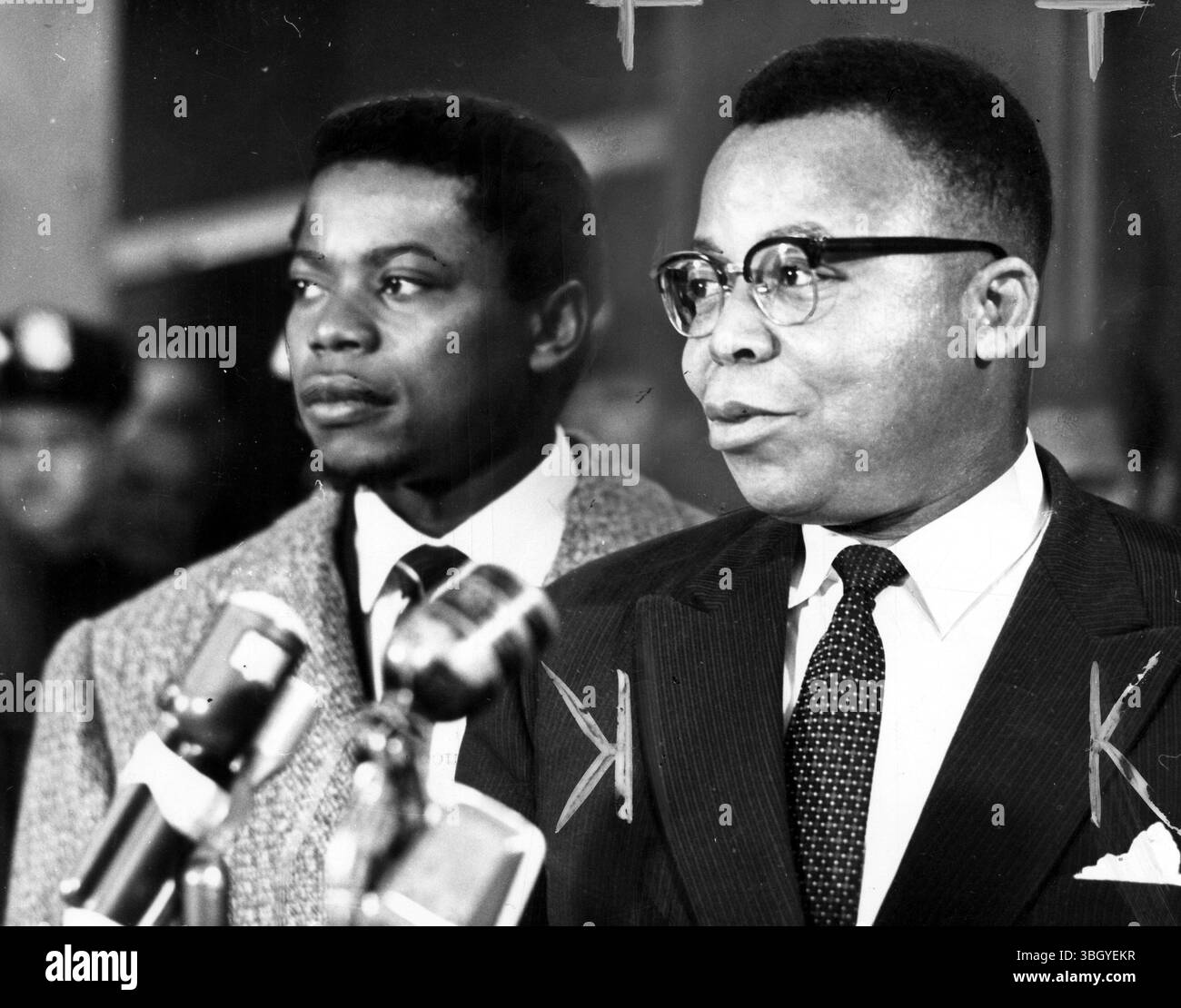
Joseph Kasa-Vubu
 DR Congo
Also known as: Joseph Kasavubu
Birthday
January 1, 1910
Birth Sign
Capricorn
Birthplace
Tshela, Belgian Congo
Age
Died at 59
About
Joseph Kasa-Vubu was a Congolese politician who served as the first President of the Democratic Republic of the Congo from 1960 to 1965. He led the nation through the turbulent early years of independence, navigating secessionist crises and political upheaval. As a member of the Kongo ethnic group, he rose to prominence leading the Bakongo Association (ABAKO), becoming a key voice for Congolese autonomy. His legacy is marked by his moderate federalist vision and his complex relationship with Prime Minister Patrice Lumumba.
Kasa-Vubu's presidency was defined by the Congo Crisis, during which he dismissed Lumumba and later worked to suppress regional rebellions with UN support. He was deposed by Joseph-Désiré Mobutu in 1965 and retired to his farm in Mayombe, where he died in 1969. Today, he is remembered as a shrewd and cautious leader who sought stability during a chaotic period, and his image appears on commemorative stamps of the independence era.
Early Life & Background
Joseph Kasa-Vubu was born circa 1910 in Kuma-Dizi, a village in the Mayombe district of Bas-Congo, near Tshela. He was the eighth of nine children in a Yombe family, part of the larger Kongo ethnic group. His father, a successful farmer and trader, acquired the 'Kasa' prefix after undergoing a traditional 'poison test' with a kasa tree extract, a story that became part of family lore. Kasa-Vubu's mother died when he was four, and his father passed in 1936, leaving him to be raised by an older brother who sent him to a Catholic mission.
Baptized Joseph on 31 January 1925 at the Scheutist mission in Kizu, his education followed a religious path. He attended primary school and a minor seminary in Mbata-Kiela, then graduated second in his class in 1936 and entered the Kabwe seminary in Kasai to study philosophy. He was expelled in 1939 for unclear reasons, derailing his path to the priesthood. Returning to Mayombe, he worked as a bookkeeper at the Kangu mission for 80 francs a month, then became a teacher, and later joined Agrifor, a logging company, earning 500 francs.
In 1942, Kasa-Vubu became a clerk in the finance department of the Belgian colonial administration in Léopoldville, eventually reaching the rank of chief clerk, the highest position available to Congolese civil servants. His political awakening came in 1946 when he joined UNISCO, a Catholic debating society, and in 1954 he was elected president of ABAKO, transforming it into a political force. Under his leadership, ABAKO swept the 1957 municipal elections, and Kasa-Vubu became mayor of Dendale. His calls for independence, initially on a 30-year timeline, grew more urgent, and in January 1959, a banned ABAKO rally sparked the Léopoldville riots, leading to his arrest and two months in prison, the Congo's first 'prison graduate'.
Career Growth
Kasa-Vubu's breakthrough came with the first national elections in 1960, when his ABAKO party and allies won enough seats to make him a compromise candidate for president. He was sworn in on 27 June 1960, three days before the Congo's independence from Belgium. His presidency immediately faced the secession of Katanga and South Kasai, plunging the country into the Congo Crisis. A power struggle with Prime Minister Lumumba erupted when Lumumba sought Soviet aid; Kasa-Vubu dismissed him on 5 September 1960, a move that led to Lumumba's capture and assassination in January 1961.
With UN support, Kasa-Vubu's government suppressed the Katanga and South Kasai rebellions by 1963, and later defeated the Kwilu and Simba uprisings by 1965. He supported Prime Minister Cyrille Adoula (1961–1964) but then maneuvered him out in favor of Moïse Tshombe. When Tshombe sought the presidency, Kasa-Vubu dismissed him too, but his handpicked successor Évariste Kimba failed to gain parliamentary approval. The resulting stalemate led to Mobutu's coup in November 1965, which deposed Kasa-Vubu. He accepted an honorary seat in the Senate and retired to his farm, where he lived until his death in 1969.
Career Timeline
Public Image & Style
Joseph Kasa-Vubu was seen as a moderate, cautious leader, often described as shrewd and retiring. His style was formal and reserved, in contrast to Lumumba's fiery oratory. He was a proponent of federalism, advocating for greater autonomy for the Bakongo people within an independent Congo. Historians view him as a symbol of continuity during the chaotic early years of independence. His image appears on a commemorative independence stamp, and he is remembered in the Democratic Republic of the Congo as a founding father, though his legacy is less celebrated than Lumumba's on the pan-African stage.
Fame & Fandom
Joseph Kasa-Vubu commands a legacy defined by the gravity of statecraft rather than the flash of celebrity. His story is one of a nation's turbulent birth, where his role as the first President of the Congo placed him at the center of a constitutional crisis that reshaped African history. While he lacks the adoring crowds or viral rituals seen in modern pop culture, the historical community regards him with a distinct reverence for his moderate federalist vision and his complex, often tragic, relationship with Patrice Lumumba. Supporters and historians alike remember his distinctive Homburg hat and his quiet, shrewd demeanor during the Congo Crisis, viewing him as a symbol of continuity amidst chaos. The narrative surrounding his life has solidified into a specific historical legend: the dramatic September 1960 dismissal of Lumumba, an event that remains the defining moment of his public career and a pivotal chapter in the country's independence struggle. There is no formal fanbase name or organized campaign dedicated to him, as his audience consists primarily of students of African history and those studying the early post-colonial era. He passed away in 1969 after years of isolation, leaving behind a legacy of modest assets and political complexity. iFANN has evaluated his global standing based on contemporary historical discourse and archival references. Joseph Kasa-Vubu is currently the EVALUATED_UNRANKED person globally according to the iFANN Global Fame Engine, meaning he does not hold a placement in the published rankings.
Interesting Facts and Legends
Known for his distinctive style, Joseph Kasa-Vubu always wore a Homburg hat and bow tie in official portraits, setting him apart from his contemporaries. He was fluent in Kikongo, Lingala, French, and Latin, the latter acquired during his seminary days. A keen gardener, he maintained a large vegetable plot at his farm in Mayombe, growing cassava and plantains. He was also an avid reader of Belgian newspapers and kept detailed scrapbooks of political clippings. His supporters affectionately called him 'King Kasa,' a nod to his regal bearing. Beyond these personal habits, the most legendary moment of his life occurred in September 1960 when he attempted to dismiss Prime Minister Patrice Lumumba. This action triggered a constitutional crisis where both leaders claimed authority over the nation, creating a dramatic standoff that defined the early years of independence. Though not a folk tale in the entertainment sense, this event is the widely retold story that anchors his place in history. He died on March 24, 1969, following his removal from office, leaving a legacy marked by the complexities of the Congo Crisis.
Notable Quotes
“Independence is not a gift; it is a right that must be claimed.”
“We must build a nation where every Congolese can live in dignity.”
“Our unity is our strength, but our diversity is our richness.”
Family & Personal Life
Kasa-Vubu's family life centered on his wife, Hortense Ngoma Masunda, whom he married on 10 October 1941 at the Kangu mission. The couple had nine children, including Justine Kasa-Vubu and Marie-Rose Kasa-Vubu Kiatazabu. His father was a farmer and trader, and his mother died when he was young, leaving his older brother to raise him. After his deposition, Kasa-Vubu retired to his farm in Mayombe, where he lived with his wife until his death. His family remained largely out of the political spotlight, though his children later became figures in Congolese society.
Notable Connections
Joseph Kasa-Vubu was closely associated with Patrice Lumumba, the Congo's first Prime Minister, with whom he formed an uneasy alliance that ended in Lumumba's dismissal and death. He also worked with Joseph-Désiré Mobutu, who launched coups in 1960 and 1965, ultimately deposing him. Other key figures include Jean Bolikango, who sponsored his entry into politics, and Moïse Tshombe, whom Kasa-Vubu dismissed as Prime Minister. His wife, Hortense Ngoma Masunda, was a constant presence throughout his life.
Relationships & Dating History
Joseph Kasa-Vubu's romantic history is limited to his marriage to Hortense Ngoma Masunda. They wed on 10 October 1941 in a Catholic ceremony at the Kangu mission, after Kasa-Vubu felt financially secure with his job at Agrifor. The couple had nine children together and remained married until his death in 1969. No other public relationships or affairs are recorded in historical sources. At the time of his death, Kasa-Vubu was still married to Hortense, who survived him.
- MarriedHortense Ngoma Masunda1941 - 1969Married on 10 October 1941 at the Kangu mission; had nine children together.
Death & Aftermath
Died
March 24, 1969 (aged 59)
Death Place
Unknown
Cause of Death
Unknown
The family of Joseph Kasa-Vubu announced his passing on March 24, 1969, following a period of quiet retirement in the Mayombe region. After being deposed by Mobutu Sese Seko in late 1965, the former president had withdrawn to his farm to live with his wife, Hortense Ngoma Masunda, and their children away from the political turbulence that had defined his public life. He spent his final years tending to the land he loved, far removed from the corridors of power in Léopoldville. The lack of detailed medical records suggests a natural conclusion to a life marked by intense service rather than scandal. Public reaction to his death was notably subdued, reflecting the political climate of the time under Mobutu's consolidated rule.
Unlike the chaotic aftermath of Patrice Lumumba's assassination, Kasa-Vubu's departure did not trigger immediate mass mourning or widespread political upheaval. His legacy as the first president remained a subject of academic debate rather than public celebration during those years. Following his death, the handling of his estate was minimal, consistent with the modest lifestyle he had maintained since his removal from office. His burial took place in the Mayombe area, where he had chosen to spend his last days, allowing him to rest near the soil he valued above all else. Historians now view his final years as a necessary retreat for a man who had navigated the most dangerous moments of Congo's independence, preserving his dignity until the very end.
Net Worth (Estate Value)
$10 Million
iFANN Editorial Team estimate
As a mid-20th century African head of state who lived modestly, Joseph Kasa-Vubu's financial profile reflects a life of service rather than accumulation. During his early career, he earned modest salaries: 80 francs per month as a bookkeeper, 500 francs at Agrifor, and later a civil service salary as chief clerk. His presidency did not bring personal wealth, and after his deposition, he retired to a farm in Mayombe. His estate, which passed to his widow and nine children, has no public valuation. Per iFANN's editorial analysis, his estimated net worth as of 2026 is $10 Million, reflecting the historical significance and modest assets of his estate.
Awards & Accolades
View 4 records, honours and achievementsKnown For
First President of the Democratic Republic of the Congo
1960 · President
Leader of ABAKO party
1954 · President
Dismissal of Patrice Lumumba
1960 · Political action
Keywords
Sources
Quick Facts
- Profession
- politician
- Born
- January 1, 1910
- Birthplace
- Tshela, Belgian Congo
- Died
- March 24, 1969
- Death Place
- Boma, Democratic Republic of the Congo
- Gender
- Male
- Spouse
- Hortense Ngoma Masunda
- Children
- 9
- Birth Sign
- Capricorn
Personal Details
- Spouse
- Hortense Ngoma Masunda
- Children
- 9
- Education
- Kabwe seminary (philosophy studies, expelled)
Frequently Asked Questions
How did Joseph Kasa-Vubu die?
Why did Kasa-Vubu fire Lumumba?
Was Joseph Kasa-Vubu related to the Kongo people?
How many children did Joseph Kasa-Vubu have?
What happened to Joseph Kasa-Vubu after the coup?
Similar People

Join the community
fans discussing