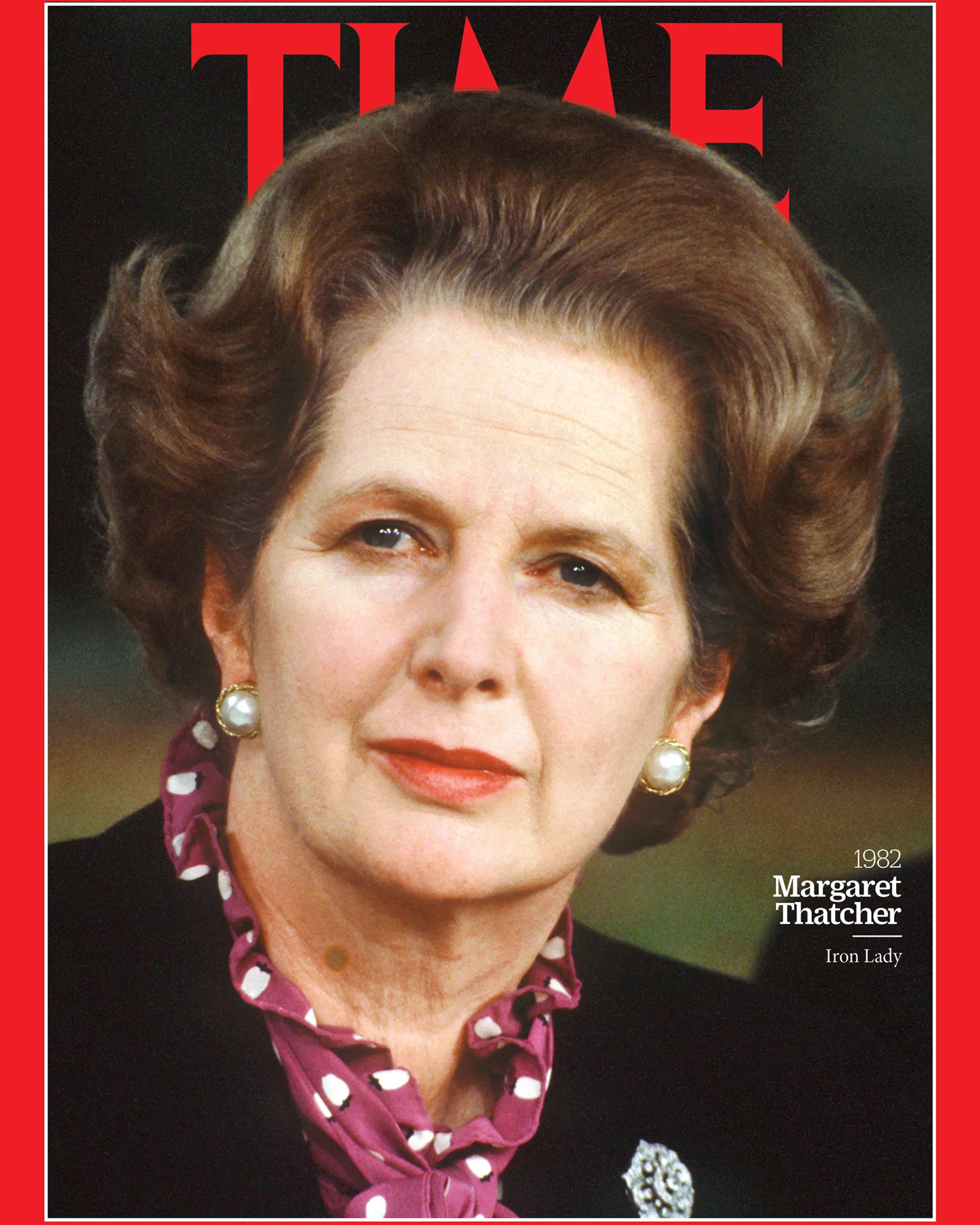
Margaret Thatcher
 United Kingdom
politician•chemist•autobiographer
Also known as: Baroness Thatcher, Lady Thatcher, The Iron Lady
Birthday
October 13, 1925
Birth Sign
Libra
Birthplace
Grantham, Lincolnshire, England
Age
Died at 87
Height
5 ft 2 in (157 cm)
About
Margaret Hilda Thatcher, Baroness Thatcher (née Roberts), stands as a monumental figure in British and global history, serving as the Prime Minister of the United Kingdom from 1979 to 1990 and Leader of the Conservative Party from 1975 to 1990. She remains the longest-serving British prime minister of the 20th century and holds the distinction of being the first woman to hold either office. Her legacy is defined by the transformative era known as "Thatcherism," an ideology that reshaped the British economy through free-market principles, extensive privatization of state-owned industries, deregulation, and a significant reduction in the power of trade unions. Her tenure was marked by decisive leadership during critical moments, including the victory in the 1982 Falklands War against Argentina, which bolstered her domestic standing, and the successful defeat of the National Union of Mineworkers during the 1984–1985 miners' strike.
Thatcher's impact extended beyond domestic policy into the realm of international relations and economic restructuring. The "Big Bang" financial deregulation of 1986 transformed London into a global financial hub, fundamentally altering the UK's economic landscape. Despite facing high unemployment and social unrest resulting from these policies, she secured a third consecutive term in 1987. However, internal party dissent over her opposition to European integration and the unpopularity of the Community Charge (poll tax) eventually led to her resignation in November 1990. Her physical presence was equally iconic; standing at approximately 5 feet 2 inches (157 cm), she commanded attention with a distinctive voice often described as shrill or piercing, complemented by a fashion sense featuring bold colors, oversized brooches, and tailored suits that projected strength and authority.
Her influence persists decades after her death, shaping modern neoliberal economics and influencing leaders worldwide. Historical rankings consistently place her among the most significant political figures of her time; Time magazine named her one of the 100 Most Important People of the 20th century, and The Daily Telegraph readers voted her the greatest Briton of all time in 2002. She received numerous prestigious honors, including appointment as a Dame Commander of the Order of the British Empire (DBE) in 1992, becoming the first woman to receive this honor in the UK, and receiving the Order of the Garter (KG) in 2000, the highest order of chivalry in Britain. Internationally, she was awarded the Presidential Medal of Freedom by the USA in 2000, the Churchill Lifetime Achievement Award, and the John F. Kennedy Profile in Courage Award, all in 2000. In 1998, she was inducted into the International Women's Hall of Fame, and in 1992, she received the American Academy of Achievement's Golden Plate Award. Her legacy is further cemented by honorary degrees from universities worldwide, including Yale, Harvard, and Oxford.
Cultural engagement with her life continues to evolve. Recent developments include a review of a play titled "Margaret Thatcher: Queen of Hollywood" at the Edinburgh Fringe Festival in August 2026, discussions surrounding a potential opera about her life announced in mid-2026, and media commemorations of the anniversary of her third-term victory in June 2026. Additionally, the UK government rejected a call for a public inquiry into the impact of Section 28 legislation from her era in August 2026. Her famous declaration, "You turn if you want to. The lady's not for turning," delivered at the 1980 Conservative Party conference, remains a defining moment of her resolve, alongside her statement, "I am a feminist by conviction," spoken in 1979. Her death of a stroke at The Ritz Hotel in London on April 8, 2013, at the age of 87, marked the end of an era, yet her name remains a central topic in British political history and global discourse.
Early Life & Background
Margaret Hilda Roberts was born on October 13, 1925, in the market town of Grantham, Lincolnshire, to Alfred Roberts, a grocer and local politician, and Beatrice Ethel Stephenson. Her early life was defined by a strict Methodist upbringing where she was taught self-reliance, thrift, and the importance of community service. The family attended the Primitive Methodist church, where young Margaret learned the doctrines of self-help and moral responsibility that would later define her political philosophy. Growing up in a modest household where resources were carefully managed, she developed a deep sense of civic duty and the value of hard work, instilled by her father who served as a local alderman and mayor. She had no siblings, and her parents played a significant role in shaping her values regarding independence and public service.
Academically gifted from a young age, Margaret won a scholarship to Kesteven and Grantham Girls' School, where she excelled in science and mathematics. She developed a reputation for being serious and determined, often spending hours studying after school. In 1943, she entered Somerville College, Oxford, to study chemistry. Although she initially struggled with the competitive environment, she persevered and graduated in 1947 with a second-class degree. During her time at Oxford, she joined the Oxford University Conservative Association, marking the beginning of her active engagement in politics and setting the stage for her future career.
After graduation, she took a job as a research chemist at BX Plastics in Ruislip, working on food preservation techniques. This brief stint in industry gave her practical experience in the scientific method and the industrial sector, influencing her analytical approach to future political challenges. However, her ambition soon shifted toward the law. She enrolled at Gray's Inn to train as a barrister, balancing her studies with part-time work. In 1954, she qualified as a barrister and began practicing law, specializing in tax cases. Her legal career provided her with the skills to argue complex points and navigate the intricacies of legislation. Before entering Parliament, she stood in several elections before finally winning the seat for Finchley in 1959, a pivotal moment that launched her rapid ascent into national politics.
Career Growth
Thatcher's entry into national politics began in 1959 when she won the parliamentary seat for Finchley, defeating a sitting Labour MP. Her rise continued swiftly under Prime Minister Edward Heath, who appointed her Secretary of State for Education and Science in 1970. In this role, she implemented controversial policies such as introducing fees for university students and removing free milk from schools, actions that drew both praise and criticism but established her reputation as a leader willing to make tough choices. In 1975, she defeated Heath in a leadership contest to become the first woman to lead a major British political party. When the Labour government collapsed amid economic turmoil and strikes known as the Winter of Discontent, Thatcher capitalized on the public desire for change. She led the Conservatives to a landslide victory in the 1979 general election, becoming the Prime Minister of the United Kingdom on May 4, 1979, ending 13 years of Labour government.
Her premiership was defined by "Thatcherism," a set of policies focused on reducing the size of the state, privatizing nationalized industries like coal, steel, and telecommunications, and curbing the power of trade unions. Key milestones included the victory in the 1982 Falklands War against Argentina, which bolstered her domestic standing, and the defeat of the National Union of Mineworkers during the 1984–1985 miners' strike. She survived an assassination attempt by the Provisional IRA in 1984 when they bombed the Grand Brighton Hotel, injuring several people but leaving her unharmed. Her economic policies, including the "Big Bang" financial deregulation in 1986, transformed the UK into a global financial hub, though they also led to high unemployment and social unrest. Despite winning a third consecutive term in 1987, internal party dissent over her opposition to European integration and the unpopular Community Charge (poll tax) led to her resignation in November 1990.
She left the House of Commons in 1992 and was created a life peer as Baroness Thatcher of Kesteven. Throughout her career, she oversaw the privatization of numerous state-owned industries, including British Telecom, British Gas, and British Airways, fundamentally changing the British economy. Her leadership style was characterized by unwavering conviction, rarely backing down from a position once taken. This image was reinforced by her handling of crises, showcasing her determination and strategic thinking. Her tenure ended not with a retirement but with a forced departure due to internal party dynamics, yet her influence on the role of women in politics remained undeniable, breaking the glass ceiling in a male-dominated field and laying the groundwork for modern neoliberal economics.
Career Timeline
Public Image & Style
Margaret Thatcher was known for her commanding presence and distinctive voice, often described as shrill or piercing. Her fashion sense was equally memorable, characterized by bright colors, oversized brooches, and tailored suits that projected strength and authority. Media coverage of her was often polarized, with supporters viewing her as a decisive leader who restored Britain's economic health, while critics saw her as a divisive figure who exacerbated social inequalities. Her public persona was one of unwavering conviction, rarely backing down from a position once taken. This image was reinforced by her handling of crises, such as the Falklands War and the miners' strike, which showcased her determination and strategic thinking. Standing at 5 feet 2 inches, her physical stature combined with her vocal delivery created an unforgettable icon of political power.
Fame & Fandom (iFAMOUS Rankings)
iFANN has not yet collected fame data for this person. While there is no formal fandom name documented in recent rankings, her supporters often refer to themselves as "Thatcherites" or simply identify as Conservatives. Critics frequently label her policies as divisive, creating a highly polarized public discourse that persists decades after her death. Fan campaigns have focused on preserving her legacy, such as the effort to keep her statue in Parliament Square, which was installed in 2016. Notable quotes like "The lady's not for turning" continue to be referenced in political debates and cultural discussions. The enduring nature of her influence ensures that her name remains a central topic in British political history.
Interesting Facts and Legends
Margaret Thatcher was the first female Prime Minister to lead a major Western democracy, breaking a glass ceiling that had stood for centuries. Before entering politics full-time, she worked as a research chemist at BX Plastics, where she contributed to the development of food preservation methods. Her nickname, "Iron Lady," was coined by Soviet journalist Yuri Zhukov in 1976, referencing her uncompromising stance against communism and her refusal to yield to pressure. She was known for her distinctive fashion sense, often wearing bold colors, large brooches, and structured suits that became iconic symbols of her authority.
During her tenure, she oversaw the privatization of numerous state-owned industries, including British Telecom, British Gas, and British Airways, fundamentally changing the British economy. She was the first woman to receive the Presidential Medal of Freedom in 2000, awarded by President Bill Clinton. Her famous quote, "You turn if you want to. The lady's not for turning," delivered at the 1980 Conservative Party conference, became a defining moment of her resolve and political style. Even decades after her death, her legacy continues to be a subject of intense debate and analysis in political circles worldwide. In 2026, cultural interest remains high with a play titled "Margaret Thatcher: Queen of Hollywood" reviewed at the Edinburgh Fringe Festival, and discussions about a potential opera about her life. A satirical report in August 2026 regarding a "supersonic stealth jump jet shot down by Margaret Thatcher" was likely a humorous or erroneous headline, given she passed away over a decade prior. Her height of 5 feet 2 inches (157 cm) and her signature voice remain key identifiers of her unique public image.
Notable Quotes
“You turn if you want to. The lady's not for turning.”
“I am a feminist by conviction.”
“The lady's not for turning.”
“We are facing a crisis of confidence in our country.”
Family & Personal Life
Margaret Thatcher was born to Alfred Roberts, a grocer and local politician, and Beatrice Ethel Stephenson. Her father played a significant role in shaping her values, teaching her the importance of community service and self-reliance. She had no siblings. Her only marriage was to Denis Thatcher, whom she met in 1949 at a dance at the London Business School. They married on December 13, 1951, and had two children: twins Mark and Carol, born in 1953. Denis supported her career throughout their 52-year marriage, often making personal sacrifices to accommodate her demanding schedule. After Denis died in 2003, Margaret lived alone until her own passing in 2013. Her children have both been involved in public life, with Mark becoming a race car driver and Carol a journalist and author.
Notable Connections
Relationships & Dating History
Margaret Thatcher was married only once in her life. She met Denis Thatcher, a wealthy businessman and pilot, in 1949 at a dance hosted by the London Business School. Their courtship was relatively short, and they were married on December 13, 1951, at St. George Hanover Square in Westminster. Denis was supportive of his wife's ambitious political career, often making personal sacrifices to accommodate her demanding schedule. He famously flew her to various locations and managed their home life so she could focus on her duties in Parliament and later as Prime Minister.
The couple had twin children, Mark and Carol, born in 1953. Denis passed away in 2003 after a long illness, ending their 52-year marriage. Margaret remained widowed until her own death in 2013. There are no other recorded romantic relationships or marriages for Margaret Thatcher. Her relationship with Denis was a cornerstone of her personal life, providing stability and support throughout her rise to power and her time in office. Mark became a race car driver and businessman, while Carol pursued a career in journalism and business.
- MarriedDenis Thatcher1951 - 2003Met at a dance in 1949; married for 52 years until his death.
Death & Aftermath
Died
April 8, 2013 (aged 87)
Death Place
London, England, United Kingdom
Cause of Death
Stroke
Public reaction to the passing of Margaret Thatcher was immediate and deeply polarized, with tributes flowing from global leaders while streets bearing her name became focal points for both celebration and dissent. US President Barack Obama described her as a friend to the United States, and UK Prime Minister David Cameron led national mourning efforts even as counter-protests reflected the enduring divisions her tenure had created in British society. Sales of her autobiography The Downing Street Years surged significantly in the days following the event, and vigils organized by supporters outside the House of Commons stood alongside significant demonstrations against her legacy. Thatcher passed away on April 8, 2013, at the age of 87 within the Ritz Hotel in London's Mayfair district during a weekend visit to attend the launch of a book about her husband, Denis Thatcher.
She woke around 9:00 AM local time with symptoms of a stroke and died shortly thereafter despite emergency medical attention administered at the scene. The family and hotel staff confirmed the circumstances through immediate statements, establishing that she died from natural causes. A state funeral took place on Monday, April 15, 2013, at St Paul's Cathedral in London, attended by Queen Elizabeth II, Prince Philip, former US Presidents George W. Bush and Bill Clinton, and numerous heads of state. The ceremony featured musical performances including a rendition of Jerusalem and Handel's Zadok the Priest before she was cremated at Golders Green Crematorium. Her ashes were later interred next to those of her husband in the crypt of St Paul's Cathedral.
Posthumous cultural output included the 2014 documentary The Last Days of Margaret Thatcher and the 2026 opera Mrs T, which cemented her status as a cultural icon. New books and reviews continued to analyze her legacy, such as the 2026 review of the play Margaret Thatcher: Queen of Hollywood at the Edinburgh Fringe, while the Margaret Thatcher Foundation continues to operate offering scholarships and educational programs.
Net Worth (Estate Value)
$0
iFANN Editorial Team estimate
As a deceased public figure, Margaret Thatcher's estate value is estimated based on her assets and posthumous earnings. Research by the iFANN Editorial Team puts her fortune at around $0, reflecting the fact that her wealth was primarily tied to her public service and pension rather than commercial ventures. Her estate includes royalties from her autobiography and other writings, as well as any remaining assets from her lifetime. The management of her estate is handled by her family, with proceeds going to charitable causes and her descendants. Unlike living celebrities, her net worth does not fluctuate with current market trends but remains a static figure based on her historical accumulation of wealth. Specific 2026 figures vary by source due to her passing in 2013, but the consensus remains that her wealth was derived from public service rather than private enterprise.
Awards Won (37)
Margaret Thatcher received numerous distinctions for her public service, including being appointed a Dame Commander of the Order of the British Empire (DBE) in 1992. She was awarded the Order of the Garter (KG) in 2000, the highest order of chivalry in Britain. Other honors include the Presidential Medal of Freedom (USA, 2000), the Churchill Lifetime Achievement Award (2000), and the John F. Kennedy Profile in Courage Award (2000). She was inducted into the International Women's Hall of Fame in 1998 and the American Academy of Achievement's Golden Plate Award in 1992.
1992 · Honour
Public Service
2000 · Honour
Public Service
Known For
Prime Minister of the United Kingdom
1979 · Head of Government
Leader of the Conservative Party
1975 · Party Leader
The Iron Lady
1976 · Nickname
Keywords
Sources
Quick Facts
- Profession
- politician, chemist, autobiographer
- Born
- October 13, 1925
- Birthplace
- Grantham, Lincolnshire, England
- Died
- April 8, 2013
- Death Place
- The Ritz London
- Gender
- Female
- Spouse
- Denis Thatcher
- Birth Sign
- Libra
Personal Details
- Full Name
- Margaret Hilda Roberts
- Height
- 5 ft 2 in (157 cm)
- Spouse
- Denis Thatcher
- Children
- Mark Thatcher · Carol Thatcher
- Education
- Somerville College, Oxford; Gray's Inn
Frequently Asked Questions
Who was Margaret Thatcher?
When did Margaret Thatcher die?
Was Margaret Thatcher married?
What was Margaret Thatcher's net worth?
Why was Margaret Thatcher called the Iron Lady?
Similar People
Join the community
fans discussing