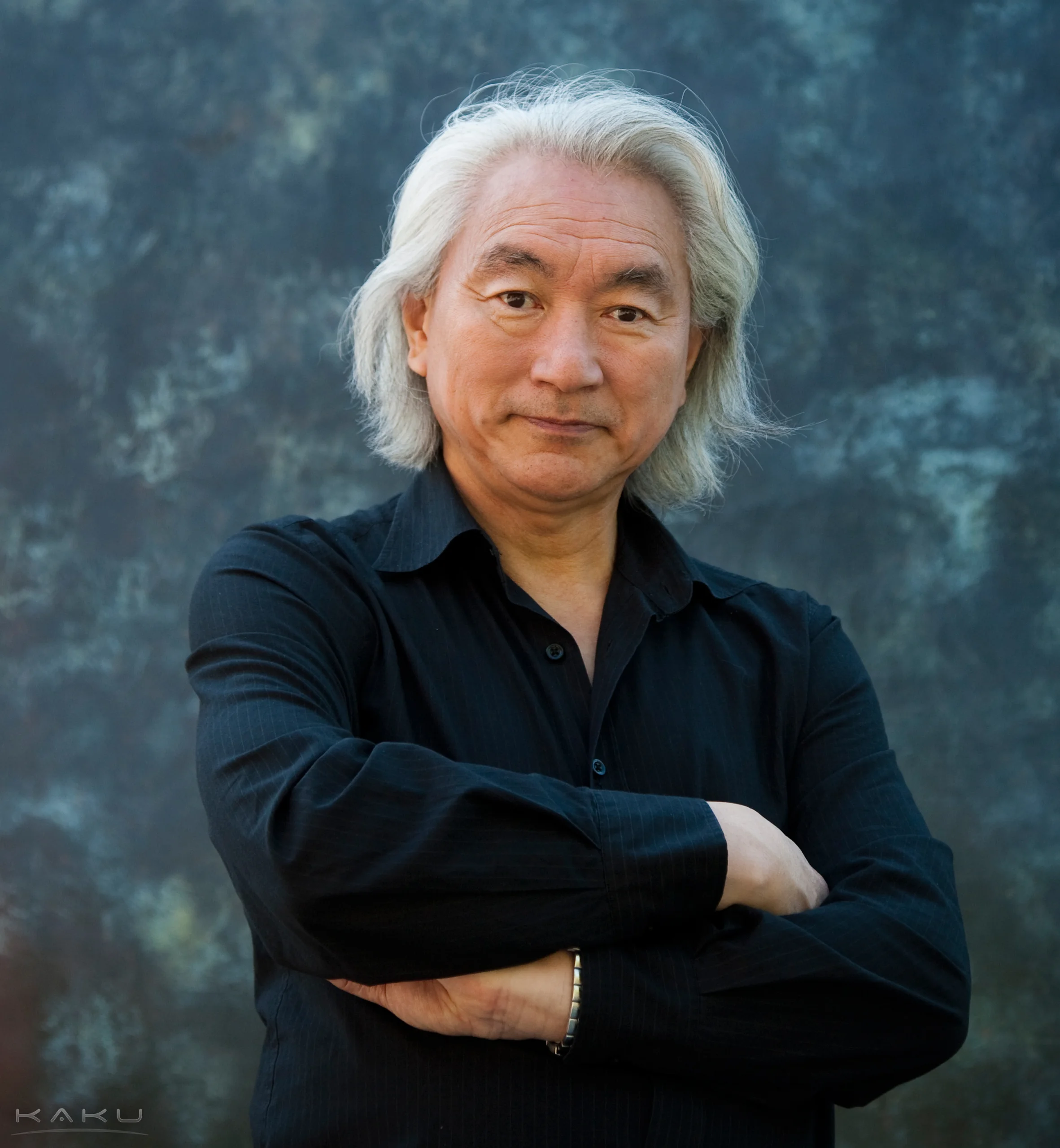
Michio Kaku
 United States
theoretical physicist•science writer•science communicator
Birthday
January 24, 1947
Birth Sign
Aquarius
Birthplace
San Jose, California, USA
Age
79 years old
About
Michio Kaku is an American theoretical physicist, science communicator, and author who has spent decades making the frontiers of physics feel within reach. A professor at the City College of New York and the CUNY Graduate Center, he is best known for co-founding string field theory and for writing bestselling books that translate complex ideas into vivid, everyday language. His titles include Physics of the Impossible, Physics of the Future, and The God Equation, each exploring what science might make possible tomorrow. Kaku's reach extends far beyond the classroom: he hosts radio programs, appears regularly on television, and commands a social media following of over a million people who come for his clear-eyed takes on everything from quantum mechanics to climate tech. In 2021, he received the Sir Arthur Clarke Lifetime Achievement Award for bridging science and science fiction.
Early Life & Background
Michio Kaku was born in San Jose, California, in 1947 to second-generation Japanese-American parents. His grandparents had immigrated from Japan; his grandfather worked on the cleanup after the 1906 San Francisco earthquake. During World War II, his parents were interned at the Tule Lake War Relocation Center, where they met and where Kaku's older brother was born. The family's story of resilience shaped Kaku's worldview, though he rarely dwells on it in public.
As a child, Kaku was captivated by science fiction and the mysteries of the universe. When Albert Einstein died in 1955, an eight-year-old Kaku decided he would finish Einstein's unfinished work: a unified field theory. He read everything he could find on physics and built a particle accelerator in his parents' garage using 22 miles of copper wire and a 2.3-million-volt transformer he scavenged from a junkyard. The device, which he operated in the family driveway, was powerful enough to produce antimatter and earned him a spot at the National Science Fair.
That garage project also landed him a Hertz Engineering Scholarship. Kaku headed to Harvard University, where he graduated summa cum laude in 1968, ranked first in his physics class. He went on to earn his Ph.D. from the University of California, Berkeley, in 1972, studying under Stanley Mandelstam and Robert Pound. His doctoral work focused on string theory, then a niche field that would become his life's work.
Career Growth
Kaku's breakthrough came in 1974 when he co-founded string field theory, a formulation of string theory that uses the mathematics of fields to describe particles. This work, published with Keiji Kikkawa, provided a rigorous foundation for what was then a speculative idea and helped establish string theory as a serious area of research. Kaku continued to develop the theory through the 1980s and 1990s, authoring textbooks and dozens of papers.
In 1994, he published his first popular science book, Hyperspace, which became a bestseller and set the template for his career as a public intellectual. Over the next three decades, he released a string of widely read books: Beyond Einstein (1995), Visions (1998), Parallel Worlds (2004), Physics of the Impossible (2008), Physics of the Future (2011), The Future of the Mind (2014), and The God Equation (2021). Each book translates cutting-edge physics into accessible narratives, often drawing on science fiction to illustrate real scientific principles.
Kaku also became a fixture on television. He has hosted specials for the BBC, Discovery Channel, History Channel, and Science Channel, and appears regularly on news programs to comment on scientific developments. He hosts two radio programs, Science Fantastic and Explorations in Science, and maintains a popular blog. In 2021, he received the Sir Arthur Clarke Lifetime Achievement Award for his work in science communication. As of 2026, he continues to teach, write, and speak globally, with a keynote appearance scheduled at the Technology for Change Asia conference in Hong Kong.
Career Timeline
Public Image & Style
Michio Kaku is one of the most recognizable faces in popular science. His Einstein-like mane of white hair and his enthusiastic, plain-spoken delivery have made him a staple of television documentaries and talk shows. He speaks with a blend of authority and wonder that makes complex topics feel like an adventure.
Media outlets often turn to Kaku for commentary on futuristic technologies, from artificial intelligence to space travel. His ability to connect scientific possibilities to everyday life has earned him a loyal following. On Facebook, he has 1.8 million fans; his Twitter account is similarly active. Fans appreciate not just his expertise but his optimism: he consistently argues that science can solve humanity's biggest problems.
Critics sometimes note that his predictions can be overly optimistic, but Kaku counters that imagining the impossible is the first step to achieving it. His public persona is that of a friendly, accessible genius who happens to spend his days wrestling with the nature of reality.
Fame & Fandom (iFAMOUS Rankings)
Michio Kaku commands a distinctive following defined not by organized chapters or ritualistic gatherings, but by a decentralized network of science enthusiasts, students, and futurists who engage with his work across digital platforms. His audience interacts primarily through high-volume social media engagement and critical discourse on academic forums, where they debate the balance between his accessible popularization of physics and his more speculative predictions about the future. Unlike celebrity fanbases that mobilize for chart pushes or physical campaigns, Kaku's supporters amplify his reach organically through shared interest in string theory and futurism, often citing his appearances on major news networks and university lectures as primary touchpoints. The community lacks a formal collective noun, referring to themselves simply as fans of Dr. Kaku rather than adherents to a specific branded identity. Despite this lack of formal structure, his cultural impact is measurable through massive viewership numbers for recent interviews and the enduring relevance of his books. While some critics label his work as fantasy, the broader public views him as a visionary guide to the unknown universe. iFANN has evaluated Michio Kaku, yet he does not currently hold a placement in the published rankings. He is not ranked within the Global Top 1,000 nor included in any Top-100 scope list.
Interesting Facts and Legends
In high school, Kaku constructed a particle accelerator in his parents' garage using 22 miles of copper wire to generate a magnetic field 20,000 times stronger than Earth's, a device capable of producing antimatter. His signature wild hair is a natural feature he has never styled, though he once joked it resulted from spending too much time near particle accelerators. He has appeared as himself in the 2013 film The Last Days of Planet Earth and voiced his character on The Simpsons. A lifelong admirer of Isaac Asimov's Foundation series, Kaku frequently cites Star Trek technologies as examples of future possibilities. Recent years have added to his modern lore: during a speech at Illinois State University, he made bold predictions regarding the next century of human development. In another instance, he further expanded his mythos by explaining theories about an invisible universe floating beside our own. These events cemented his reputation as a prophetic voice who captures global attention with controversial stances on topics ranging from the existence of God to the possibility of human immortality.
Notable Quotes
“Magic, fantasy, science fiction were all a gigantic playground for my imagination. They began a lifelong love of the impossible.”
“The universe is a symphony of strings, and the mind of God is cosmic music resonating through hyperspace.”
“We are the first generation to have a rough idea of what a theory of everything might look like.”
“In the future, our computers will be everywhere, in our walls, in our furniture, even in our contact lenses.”
Family & Personal Life
Kaku's parents, both second-generation Japanese-Americans, were interned at the Tule Lake War Relocation Center during World War II. They met and married there, and Kaku's older brother was born in the camp. His grandfather immigrated to the United States and worked on the cleanup after the 1906 San Francisco earthquake.
Kaku married Shizue Kaku, and the couple has two daughters. The family lives in New York City, where Kaku teaches. He has spoken about how his parents' experience of internment instilled in him a deep appreciation for education and opportunity. Beyond his immediate family, Kaku has not publicly discussed extended family members or pets.
Notable Connections
Kaku studied under Stanley Mandelstam and Robert Pound at UC Berkeley. He was mentored by Edward Teller, who awarded him the Hertz Engineering Scholarship. He co-authored Beyond Einstein with Jennifer Thompson. His frequent media appearances have made him a familiar face alongside figures like Neil deGrasse Tyson and Brian Greene in the popular-science landscape.
Relationships & Dating History
Michio Kaku married Shizue Kaku in the 1970s. The couple has two daughters and lives in New York City. Shizue has largely stayed out of the public eye, and Kaku rarely discusses their private life in interviews. There are no known previous marriages or public relationships. As of 2026, Kaku remains married to Shizue.
- MarriedShizue Kaku1970 - presentCurrentMarried in the 1970s; they have two daughters together.
Salary, Net Worth In 2026
$5 Million
iFANN Editorial Team estimate
Per iFANN's editorial analysis, Michio Kaku's net worth stands at $5 Million as of 2026. This figure reflects a steady accumulation derived from his diverse professional portfolio. His income streams include his tenured professorship at the City College of New York, advances and royalties from bestselling titles such as Physics of the Impossible and The Future of the Mind, and fees for keynote speeches and consulting engagements. Speaking fees typically range from $25,000 to $50,000 per event, while his radio programs contribute additional revenue through syndication and sponsorships. Television and radio appearances further supplement his earnings, supported by a consistent output of popular literature over the past decade. The growth of his financial standing mirrors his enduring media presence and the continued demand for his translations of complex scientific concepts.
Awards Won (2)
Kaku received the Klopsteg Memorial Award in 2008 for his contributions to the public understanding of science. In 2021, he was honored with the Sir Arthur Clarke Lifetime Achievement Award for his work bridging science and science fiction. These two awards recognize his dual impact as both a working physicist and a communicator.
2021 · Science Communication
Lifetime achievement in bridging science and science fiction
2008 · Public Understanding of Science
Outstanding contributions to the public understanding of science
Known For
String field theory
1974 · Co-founder
Physics of the Impossible
2008 · Author
Physics of the Future
2011 · Author
The Future of the Mind
2014 · Author
The God Equation
2021 · Author
Keywords
Sources
Quick Facts
- Profession
- theoretical physicist, science writer, science communicator
- Born
- +1947-01-24
- Birthplace
- San Jose, California, USA
- Gender
- Male
- Birth Sign
- Aquarius
Personal Details
- Full Name
- Michio Kaku
- Spouse
- Shizue Kaku
- Children
- 2 daughters
- Education
- Ph.D. in Physics, University of California, Berkeley (1972); B.S. in Physics, Harvard University (1968)
Frequently Asked Questions
Who is Michio Kaku?
What is Michio Kaku's net worth in 2026?
Is Michio Kaku still active in 2026?
What is Michio Kaku best known for?
How old is Michio Kaku?
Social Media
Similar People
Join the community
fans discussing