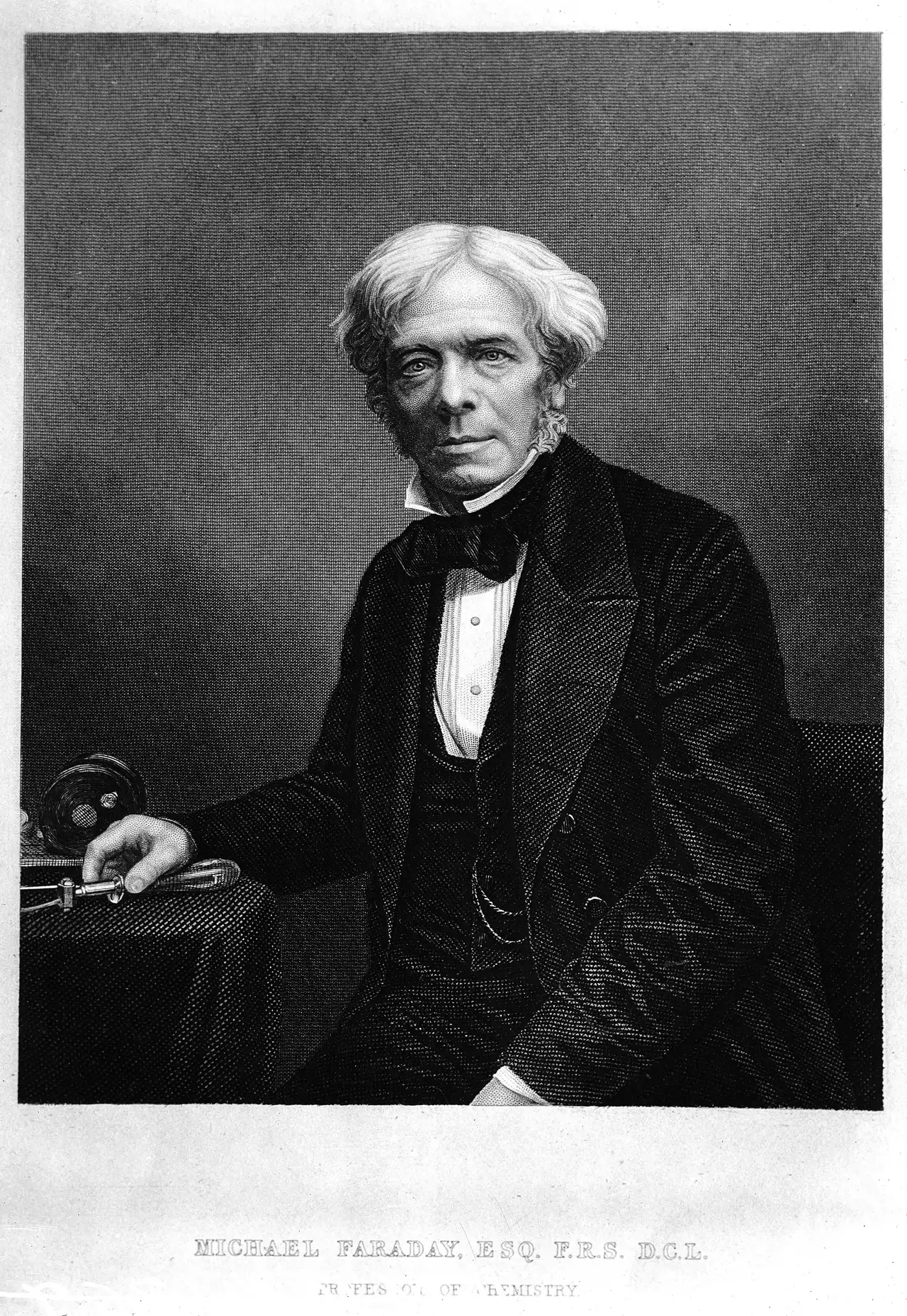
Michael Faraday
 United Kingdom
Also known as: Michael Faraday
Birthday
September 22, 1791
Birth Sign
Virgo
Birthplace
Newington Butts, Surrey, England
Age
Died at 75
About
Michael Faraday was an English chemist and physicist whose experiments on electricity and magnetism reshaped what science understood about force, fields and light. He is the man who discovered electromagnetic induction in 1831, the principle behind every electric generator and transformer built since. He also built the first electric motor, in 1821. The unit of capacitance, the farad, is named for him.
His math never went past simple algebra, yet James Clerk Maxwell built his equations on Faraday's lines of force and called him "a mathematician of a very high order." Einstein kept Faraday's portrait on his study wall beside Newton and Maxwell. Faraday turned down the presidency of the Royal Society and a knighthood. He spent his later years advising on lighthouse optics, investigating the Haswell colliery explosion with Charles Lyell, and writing to The Times about the Great Stink of 1858. He died at Hampton Court Palace on 25 August 1867, aged 75, and is buried at Highgate Cemetery.
Early Life & Background
Faraday was born on 22 September 1791 at Newington Butts, then a village in Surrey just south of London. He was the third of four children of James Faraday, a blacksmith, and his wife Margaret. The family was poor and belonged to a small Christian sect, the Sandemanians, a faith Faraday kept all his life. His formal schooling was minimal. In his own famous phrase, he received "little more than the rudiments of reading, writing, and arithmetic at a common day-school." He was largely self-taught.
At around 14 he was apprenticed for seven years to George Riebau, a London bookbinder and bookseller. The books he bound gave him his scientific education. Among them were Jane Marcet's Conversations on Chemistry and the third edition of the Encyclopædia Britannica, whose entry on electricity he later cited as a spur. He attended public lectures and took careful notes. In 1812 a customer gave him tickets to four lectures by Humphry Davy at the Royal Institution. Faraday bound his notes into a 300-page volume and sent it to Davy, asking for any employment in science.
A laboratory accident that temporarily blinded Davy led to Faraday being taken on briefly as his assistant. In March 1813 the Royal Institution appointed him laboratory assistant at a weekly wage of 25 shillings. His first recorded experiment was building a voltaic pile of seven halfpenny coins stacked with zinc discs and brine-soaked paper. In October 1813 he accompanied Davy and his wife on an eighteen-month European tour, meeting Ampère, Volta and Gay-Lussac. He returned in 1815 to a promoted post as assistant in the laboratory and mineralogical collection.
Career Growth
Faraday produced his first original paper in 1816. The breakthrough year was 1821. After Hans Christian Ørsted discovered electromagnetism, Faraday built two devices that produced continuous rotation from a magnet and a current-carrying wire. These were the first electric motors, and the principle behind every electric motor since. In 1825 he was made director of the Royal Institution laboratory and isolated benzene from whale oil. He also produced tetrachloroethylene and studied chlorine hydrate.
The decisive discovery came on 29 August 1831. Faraday and his colleague George Barlow wound an iron ring with two separate coils. Faraday observed that a changing magnetic field induced a current in the second coil. This was electromagnetic induction, the principle behind the generator and transformer. He followed it with the discovery of diamagnetism in 1845 and, the same year, the magneto-optical effect, showing that a magnetic field could rotate the plane of polarised light. That was the first evidence linking light and electromagnetism. His laws of electrolysis (1833–34) and his coinage of the vocabulary of electrochemistry, including electrode, anode, cathode, ion and electrolyte, date from the same period.
He became the first Fullerian Professor of Chemistry at the Royal Institution in 1833, a post he held for life. From 1836 he served as scientific adviser to Trinity House, working on lighthouse optics. In 1862, with Charles Lyell, he investigated the Haswell colliery explosion and concluded that coal dust had worsened the blast. He also reported on pollution at Swansea and air quality at the Royal Mint, and wrote to The Times about the Great Stink of 1858. He declined to work on chemical weapons for the Crimean War on ethical grounds.
Career Timeline
Public Image & Style
Faraday's public image was that of the self-made experimentalist. He was the blacksmith's son who had educated himself from bound books and risen to the top of British science without a university degree. Contemporaries described him as modest, intensely religious and uninterested in money or honours. He refused a knighthood and the presidency of the Royal Society. His lectures at the Royal Institution, especially the Christmas Lectures, made him a public figure in an age when science was becoming popular entertainment. He was seen as a man of the laboratory rather than the drawing room, and his plainspoken style and ethical refusals, including declining to work on chemical weapons, shaped how later generations remembered him.
Fame & Fandom (iFAMOUS Rankings)
Michael Faraday died in 1867, long before fame could be measured in followers or search interest. iFANN has not yet collected fame data for him, so no current ranking exists. He does not appear on the September 2026 iFAMOUS Rankings flagship list. His fame lives in textbooks, in the name of the farad, and in the institutions that carry his name. There is no formal fanbase and no fandom name. The people who follow him are students, physicists and historians of science who encounter his experiments in lectures and his name on the capacitance unit. No organized campaigns, birthday billboards or streaming pushes exist. The closest thing to a fan ritual is the annual Christmas Lectures at the Royal Institution, which he began and which still run.
Interesting Facts and Legends
Faraday's first experiment used seven halfpenny coins. He turned down the presidency of the Royal Society in 1857 and a knighthood in 1858. He was a devout Sandemanian who twice served as an elder of his congregation. He delivered the Royal Institution's Christmas Lectures, including The Chemical History of a Candle (1848–49), which remain in print. His most quoted line, "Nothing is too wonderful to be true, if it be consistent with the laws of nature," appears in his laboratory diary. A story fans of science still retell: when asked about the practical value of his discoveries, he is said to have replied, "What use is a baby?" The line has never been verified, but it persists.
Notable Quotes
“Nothing is too wonderful to be true, if it be consistent with the laws of nature.”
“I have always loved science more than money and because my occupation is almost entirely personal I cannot afford to get rich.”
“Little more than the rudiments of reading, writing, and arithmetic at a common day-school.”
“What use is a baby?”
Family & Personal Life
Faraday was the third of four children of James Faraday, a blacksmith, and Margaret. The family was poor and belonged to the Sandemanian sect. He married Sarah Barnard on 12 June 1821 at St Faith's Church, Wandsworth. They had met through the Sandemanian congregation, to which both families belonged. The marriage was childless and, by all accounts, devoted. Sarah outlived him by twelve years, dying in 1879. Faraday had no children and no surviving siblings of note in the public record. He lived modestly, mostly in rooms at the Royal Institution, and later at Hampton Court Palace.
Notable Connections
Humphry Davy was Faraday's mentor and employer at the Royal Institution. Sarah Barnard was his wife of 46 years. Charles Lyell worked with him on the Haswell colliery investigation. James Clerk Maxwell formalised Faraday's field concept into equations. George Barlow was his co-experimenter on the 1831 induction ring.
Relationships & Dating History
Michael Faraday married Sarah Barnard on 12 June 1821 at St Faith's Church, Wandsworth. They had met through the Sandemanian congregation, to which both families belonged. The marriage was childless and, by all accounts, devoted. Sarah outlived him by twelve years, dying in 1879. There is no documented romantic relationship in Faraday's life other than his marriage. No rumoured or reported flings, no early engagements, no separation. At the time of his death in 1867 he was still married to Sarah. She was widowed until her own death in 1879.
- MarriedSarah Barnard1821 - 1867Married at St Faith's Church, Wandsworth; childless; Sarah outlived him by twelve years.
Death & Aftermath
Died
August 25, 1867 (aged 75)
Death Place
Hampton Court Palace, London, England
Cause of Death
Natural causes after years of decline, conventionally attributed to mercury poisoning
Michael Faraday died on 25 August 1867 at Hampton Court Palace, in the grace-and-favour apartment Queen Victoria had granted him. He was 75. For years his health had been failing. From around 1839 he suffered bouts of severe nervous exhaustion and memory loss, and he resigned his Royal Institution chair in 1861. The standard biographical account blames mercury poisoning from decades of laboratory work, though no formal public certification of the cause exists. Treat that as the accepted explanation, not a documented finding.
He was buried at Highgate Cemetery in a private ceremony. There was no modern-style public reaction, no streaming surge, no memorial concert. His estate was modest. The value of what he left behind is institutional: the farad carries his name, as do the Faraday Institution, the Faraday Institute for Science and Religion at Cambridge, the Royal Society's Michael Faraday Prize and Lecture, and the Institute of Physics's Michael Faraday Medal and Prize. In 2026 those prizes went to Professor Anjali Goswami and Professor J.C. Séamus Davis respectively. Sarah, his wife of 46 years, died in 1879 and was buried beside him.
Net Worth (Estate Value)
$2 Million
iFANN Editorial Team estimate
Michael Faraday died in 1867 with a modest estate. He was famously uninterested in money. He told a publisher, "I have always loved science more than money and because my occupation is almost entirely personal I cannot afford to get rich." His income came from his Royal Institution posts, his Fullerian professorship, and advisory work for Trinity House. He left no significant investments or property. The modern value of his name is institutional rather than financial: the farad, the Faraday Institution, the Faraday Institute at Cambridge, and the Royal Society and Institute of Physics prizes named for him. iFANN currently estimates the present-day value of his estate and name at approximately $2 Million. This is an editorial estimate based on historical records and the scale of modern Faraday-branded institutions, not a documented fortune.
Awards Won (6)
Faraday won the Royal Society's Copley Medal in 1832 and again in 1835. He received the Royal Medal in 1835 and 1846, and the Rumford Medal in 1846. He was elected a Fellow of the Royal Society in 1824. France awarded him the Legion of Honour and made him one of eight foreign members of the Academy of Sciences.
1835 · Science
Overall scientific achievements
1832 · Science
Overall scientific achievements
1846 · Science
Overall scientific achievements
1835 · Science
Overall scientific achievements
Known For
Electromagnetic induction
1831 · Discoverer
First electric motor
1821 · Inventor
Laws of electrolysis
1834 · Formulator
Benzene isolation
1825 · Chemist
The Chemical History of a Candle
1848 · Lecturer
Keywords
Sources
Quick Facts
- Profession
- physicist, chemist, inventor
- Born
- September 22, 1791
- Birthplace
- Newington Butts, Surrey, England
- Died
- August 25, 1867
- Death Place
- Hampton Court Palace, London, England
- Gender
- Male
- Spouse
- Sarah Barnard
- Birth Sign
- Virgo
Personal Details
- Full Name
- Michael Faraday
- Spouse
- Sarah Barnard
- Children
- None
- Education
- Minimal formal schooling; self-taught through books he bound as an apprentice
Frequently Asked Questions
What is Michael Faraday most famous for?
What was Faraday accused of?
Did Michael Faraday believe in God?
What is Michael Faraday's most famous invention?
How did Michael Faraday die?
Similar People
Join the community
fans discussing