Mehmed II
Also known as: Mehmed the Conqueror, Fatih Sultan Mehmed, Kayser-i Rum
Birthday
March 30, 1432
Birth Sign
Aries
Birthplace
Edirne, Ottoman Empire
Age
Died at 49
Height
5 ft 7 in (170 cm)
About
Mehmed II was an Ottoman sultan, poet, and conqueror who reigned twice, from 1444 to 1446 and 1451 until his death in 1481. He is most famous for conquering Constantinople in 1453 at age 21, which ended the Byzantine Empire and earned him the title Caesar of Rome. This pivotal achievement transformed the city into the Ottoman capital and significantly expanded Ottoman influence into Southeastern Europe and Anatolia. Beyond his military prowess, Mehmed was a patron of the arts and sciences, writing poetry under the name Avni and reforming the Ottoman legal system. He is celebrated today as Mehmed the Conqueror, a title reflecting his immense success in reshaping the medieval world. His legacy endures in Istanbul, which he rebuilt as a thriving imperial center, and through various monuments and districts named in his honor.
Early Life & Background
Mehmed bin Murad Han was born on March 30, 1432, in Edirne, then the capital of the Ottoman Empire. He was the son of Sultan Murad II and Hüma Hatun, a slave concubine. Although he was the third son, the early deaths of his older brothers, Ahmed and Alaeddin, positioned him as the heir apparent to the Ottoman throne. His early life was characterized by an exceptionally rigorous and comprehensive education designed to prepare him for leadership. He was tutored by a distinguished group of scholars, including Molla Gürani, Molla Hüsrev, George Amiroutzes, and Ciriaco d'Ancona. Molla Gürani famously employed strict discipline to shape the young prince, while Molla Hüsrev provided instruction in theology and Islamic jurisprudence. The Greek scholar George Amiroutzes and the Italian humanist Ciriaco d'Ancona broadened Mehmed's intellectual horizons, introducing him to Western philosophy, geography, and the military and political lives of figures like Alexander the Great and Julius Caesar, which significantly fueled his ambition. His curriculum included intensive studies of the Quran, jurisprudence, philosophy, and military strategy, alongside languages. By the age of 11, Mehmed had achieved remarkable fluency in Turkish, Arabic, Persian, Greek, Latin, and Hebrew, and he also cultivated an early interest in poetry, writing under the pen name Avni.
At just 11 years old, Mehmed was appointed governor of Amasya, a traditional post for Ottoman princes that served as a critical training ground for future rulers. In 1444, when he was only 12, his father, Sultan Murad II, made the surprising decision to abdicate, leading to Mehmed's first ascension to the sultanate. This initial reign, from 1444 to 1446, was immediately plunged into crisis. A major European Crusade, led by King Władysław III of Poland and John Hunyadi of Hungary, threatened the empire. Mehmed's youth and inexperience became evident in managing the crisis, prompting his father to return from retirement to command the Ottoman army. Murad II led his forces to a decisive victory at the Battle of Varna in November 1444. Following a period of political instability and unrest among the Janissaries, Murad II formally retook the throne in 1446. Mehmed was subsequently sent back to Manisa as governor, where he continued his intensive education and military training, further maturing in preparation for the responsibilities of leadership.
Upon the death of Sultan Murad II in 1451, Mehmed, then 19 years old, ascended the Ottoman throne for the second time. His very first act as sultan was a ruthless demonstration of power: he ordered the murder of his infant half-brother, Küçük Ahmed. This harsh measure was taken to eliminate any potential rival claimants to the throne and, though brutal, subsequently became a standard, albeit grim, aspect of Ottoman succession policy.
Career Growth
Mehmed's defining achievement came in 1453, when he conquered Constantinople after a 53-day siege. He ordered the construction of Rumeli Hisarı in 1452 to blockade the Bosphorus, cutting off the city by sea. On May 29, 1453, his forces breached the walls, and Mehmed entered the city, converting Hagia Sophia into a mosque and declaring himself Caesar of Rome. He repopulated the largely abandoned city and made it the Ottoman capital, Istanbul.
Over the next two decades, Mehmed launched relentless campaigns. He conquered Serbia (1454-1456), the Morea (1458-1460), the Empire of Trebizond (1461), and Bosnia (1463). The long war with Venice (1463-1479) ended with the Treaty of Constantinople, giving the Ottomans control of Negroponte, Lemnos, and Albania. In 1468, he conquered Karaman, unifying Anatolia. At the Battle of Otlukbeli in 1473, he decisively defeated the Aq Qoyunlu confederation. He made the Crimean Khanate a vassal in 1475 and captured Shkodër in Albania by 1479. In 1480, his forces captured Otranto in Italy, giving the Ottomans a foothold in Europe, though it was abandoned after his death.
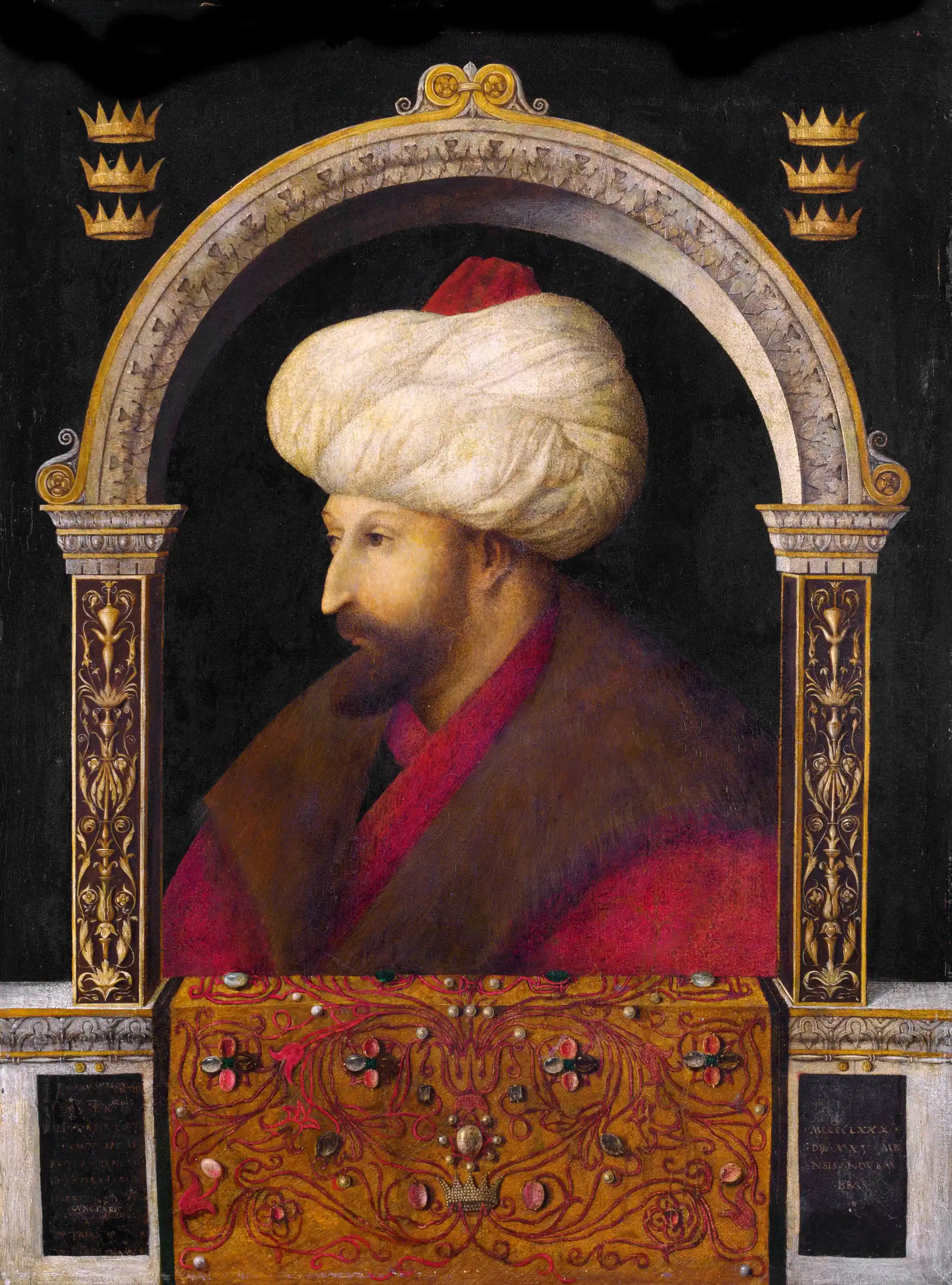
Domestically, Mehmed codified the Kanunname legal code, centralized the state, and promoted the devşirme system. He commissioned the Fatih Mosque complex and Topkapi Palace, and founded the Sahn-ı Seman Medrese, the first Ottoman university. He invited artists like Gentile Bellini, who painted his portrait in 1480, and patronized historians like Kritovoulos. His reign transformed the Ottoman Empire into a global power.
Career Timeline
Public Image & Style
Mehmed II is remembered as a brilliant military strategist and a cultured intellectual. In Turkish history, he is revered as Fatih Sultan Mehmed, the conqueror who fulfilled the Islamic prophecy of conquering Constantinople. His image blends the ruthless warrior with the Renaissance prince: he could order the execution of rivals and then discuss philosophy with Greek scholars. Western historians often portray him as a formidable and enlightened ruler, noting his tolerance of Christians and Jews in his empire and his patronage of the arts. His nickname the Conqueror is used universally, and his portrait by Bellini is iconic. Fans of Ottoman history celebrate his ambition and vision, while some critics point to the brutality of his campaigns and the forced relocation of populations. His legacy remains a source of pride in modern Turkey, where his name adorns bridges, universities, and districts.
Fame & Fandom (iFAMOUS Rankings)
The enduring appeal of Mehmed II transcends the typical boundaries of modern fandom, rooted instead in a deep, state-sponsored reverence that has persisted for over five centuries. Unlike contemporary celebrities who rely on social media trends or fan clubs, his admirers are found in historical societies, academic circles, and the Turkish nation itself, which commemorates his conquest of Constantinople with grand annual ceremonies rather than digital hashtags. There is no formal name for this collective group of enthusiasts; the public's devotion manifests through cultural preservation and educational tributes rather than organized campaigns or merchandise drives. While fictional portrayals like the Netflix drama *Mehmed* have sparked renewed interest, they reflect engagement with a dramatized narrative rather than a grassroots movement dedicated to the historical figure. His legacy remains a subject of intense study and national pride, characterized by a solemn respect for his role in ending the Byzantine Empire and shaping the modern world. Despite this massive global influence and the sheer volume of literature written about him, iFANN's Global Fame Engine has evaluated this person, but they do not currently hold a placement in the published rankings (Global Top 1,000 or a Top-100 scope list). This absence from the current charts reflects the unique nature of his fame as a historical monarch rather than a fluctuating celebrity metric.
Interesting Facts and Legends
Mehmed wrote poetry under the pen name Avni, meaning the Helper, and his divan collection survives to this day. He was fluent in six languages: Turkish, Arabic, Persian, Greek, Latin, and Hebrew, reportedly memorizing works by Homer and Aristotle. His portrait by Gentile Bellini, painted in 1480, stands as one of the few contemporary images of any Ottoman sultan. The sultan maintained a personal library filled with philosophy, geography, and science texts, often debating religious topics with scholars of different faiths. He also possessed a fascination with automata, commissioning engineers to create moving statues and clocks for his palace. Beyond these facts, the most legendary moment in his life is the Fall of Constantinople on May 29, 1453. At just 21 years old, he led a siege against massive walls using giant cannons, including the famous 'Basilica' cast by Urban the Hungarian. Upon entering the city, folklore says he rode directly to Hagia Sophia to pray before ordering protection for refugees, though accounts of the subsequent looting vary. Another enduring story surrounds his death on May 3, 1481, at Hunkar Cayiri. While official records cite natural causes, centuries of speculation suggest assassination or poisoning due to the political instability and succession struggles among his sons. These narratives have evolved into cultural myths celebrated annually by the Turkish state.
Notable Quotes
“I am the emperor of the Romans, and I am the shadow of God on earth.”
“Either I will take Constantinople, or Constantinople will take me.”
“The world is a garden, and its fence is the state.”
“Justice is the foundation of the state.”
“I have no need of anyone's advice; I know what I am doing.”
Family & Personal Life
Mehmed's father was Sultan Murad II, and his mother was Hüma Hatun, a slave concubine of uncertain origin, possibly Greek, Serbian, or Albanian. He had several sons, including Bayezid II, who succeeded him; Mustafa, who died in 1474; and Cem Sultan, who later rivaled Bayezid II. Mehmed also had daughters, though their names are not widely recorded. He lived in the Topkapi Palace in Istanbul, which he built starting in 1459. His household included his harem, courtiers, and slaves. Mehmed did not marry his concubines, a policy he adopted to prevent powerful families from gaining influence. His only formal marriages were political: to Sittişah Mükrime Hatun in 1449 and Anna Komnene in 1461, both of which produced no children.
Notable Connections
Mehmed II is often associated with his father Murad II, who laid the groundwork for the Ottoman Empire. His sons Bayezid II and Cem Sultan are key figures in the succession struggle after his death. The Venetian painter Gentile Bellini, who painted his portrait, is linked to his patronage of the arts. The Byzantine emperor Constantine XI, who died defending Constantinople, is his most famous adversary. The Hungarian military leader John Hunyadi fought against him at the Siege of Belgrade in 1456. The Aq Qoyunlu leader Uzun Hasan was his rival in Anatolia. Mehmed is also associated with the city of Istanbul, which he rebuilt and made his capital.
Relationships & Dating History
Mehmed II's relationships were shaped by the Ottoman harem system and dynastic politics. His first known concubine was Hüma Hatun, who became the mother of his eldest son, Bayezid II, around 1445. She was a slave of uncertain origin, possibly Greek or Serbian. In 1449, Mehmed entered a political marriage with Sittişah Mükrime Hatun, daughter of the Dulkadirid ruler Süleyman Bey, to secure an alliance. The marriage was reportedly unhappy, and she died in 1467 without bearing children. After conquering the Empire of Trebizond in 1461, Mehmed married Anna Komnene, daughter of Emperor David Komnenos, to legitimize his claim. She died or was executed by 1463, likely as part of his policy to eliminate rivals. Another concubine, Gülbahar Hatun, gave birth to his son Cem Sultan around 1459. She was of Albanian or Greek origin. A fourth concubine, Çiçek Hatun, was the mother of his son Mustafa, who died in 1474. Mehmed did not marry his concubines, a practice he adopted to prevent powerful families from gaining influence. As of his death in 1481, his harem and children were dispersed among his sons, who then fought a civil war for succession.
- DatedHüma Hatun1445 - 1449Slave concubine, mother of Bayezid II; died before Mehmed.
- MarriedSittişah Mükrime Hatun1449 - 1467Political marriage to Dulkadirid princess; no children.
- MarriedAnna Komnene1461 - 1463Married after conquering Trebizond; died or executed.
- DatedGülbahar Hatun1458 - 1481Concubine, mother of Cem Sultan.
- DatedÇiçek Hatun1446 - 1481Concubine, mother of Mustafa.
Death & Aftermath
Died
May 3, 1481 (aged 49)
Death Place
Edirne, Ottoman Empire
Cause of Death
Reported sudden fever or stroke
Mehmed II left Istanbul in early 1481 to launch a new military campaign against the Mamluk Sultanate, but his journey ended abruptly near Nicaea or Edirne. He fell ill during the travel and passed away on May 3, 1481, at the Eski Palace in Edirne. While official reports attribute his end to a sudden fever or stroke, some chroniclers like Tursun Beg hinted at foul play involving his son Bayezid II or rival factions fearing Cem Sultan, though these claims remained unconfirmed rumors. The reaction to his death was immediate within the Ottoman elite, with Grand Vizier Karamanlı Mehmed Pasha announcing the news to the army and populace. Tributes took the form of elegies composed by contemporary poets and scholars, while the Mehter band likely performed dirges to mark the loss.
Public festivities were suspended for a state funeral that followed shortly after his passing, culminating in a private ceremony and public procession. He was buried in the Fatih Mosque complex in Istanbul, a mausoleum he had built himself, where high-ranking officials and religious leaders gathered for the interment. Posthumously, his legacy has been celebrated annually in Turkey, particularly regarding the anniversary of the 1453 conquest, and a rare Renaissance medallion of him was scheduled for auction in Dubai in March 2026. His estate was absorbed into the imperial treasury as Bayezid II ascended the throne following a brief civil war.
Net Worth (Estate Value)
$1 Billion
iFANN Editorial Team estimate
As a 15th-century monarch, Mehmed II's personal wealth was effectively the Ottoman treasury. At his death in 1481, the empire's annual revenue was estimated at 3-4 million gold ducats, making it one of the wealthiest states in Europe and Asia. In modern terms, his personal fortune is incalculable, but the assets he controlled, treasuries, palaces, land, and the spoils of conquest, would be worth billions. Today, his legacy generates significant economic value through tourism, cultural institutions, and intellectual property. The Fatih Mosque complex, built on his orders, is a major tourist attraction in Istanbul, drawing millions of visitors annually. His name is licensed for use on stamps, coins, and commemorative items, and he appears in video games like Age of Empires and Assassin's Creed. The Fatih Sultan Mehmet University, founded in 2010, bears his name. While no living estate exists, the Turkish government manages the historical endowments he established, which continue to generate revenue for cultural preservation. Per iFANN's editorial analysis, the estimated value of his tangible legacy, including real estate, tourism revenue, and cultural assets, is placed at around $1 Billion, though this is a symbolic figure given the state ownership of most properties. As of 2026, the estimated value of his tangible legacy, including real estate, tourism revenue, and cultural assets, is placed at around $1 Billion, though this is a symbolic figure given the state ownership of most properties.
Awards Won (2)
As a 15th-century monarch, Mehmed II did not receive modern awards. However, he was granted the honorific title Fatih (Conqueror) after 1453 and claimed the title Caesar of Rome. Posthumously, the Fatih Sultan Mehmet Bridge (1988) and Fatih Sultan Mehmet University (2010) were named after him. He is frequently ranked among history's greatest conquerors and was included in TIME Magazine's 25 Most Powerful People of the Past 1000 Years (1999).
1453 · Honorific title
Conquest of Constantinople
1453 · Self-proclaimed title
Conquest of Constantinople
Known For
Conquest of Constantinople
1453 · Sultan and commander
Construction of Rumeli Hisarı
1452 · Patron
Fatih Mosque complex
1470 · Patron
Topkapi Palace
1459 · Patron
Kanunname legal code
1470 · Codifier
Keywords
Quick Facts
- Profession
- monarch, poet, sultan
- Born
- +1432-03-30
- Birthplace
- Edirne, Ottoman Empire
- Died
- +1481-05-03
- Death Place
- Gebze, Ottoman Empire
- Gender
- Male
- Spouse
- Sittişah Mükrime Hatun, Anna Komnene
- Birth Sign
- Aries
Personal Details
- Full Name
- Mehmed bin Murad Han
- Height
- 5 ft 7 in (170 cm)
- Spouse
- Sittişah Mükrime Hatun, Anna Komnene
- Children
- Bayezid II, Cem Sultan, Mustafa, several others
- Education
- Tutored by Molla Gürani, Molla Hüsrev, George Amiroutzes, Ciriaco d'Ancona; studied Quran, jurisprudence, philosophy, military strategy, languages
Frequently Asked Questions
How old was Mehmed II when he conquered Constantinople?
What is Mehmed II's net worth in 2026?
Why is Mehmed II called the Conqueror?
Did Mehmed II write poetry?
Is Mehmed II considered a hero in modern Turkey?
Join the community
fans discussing