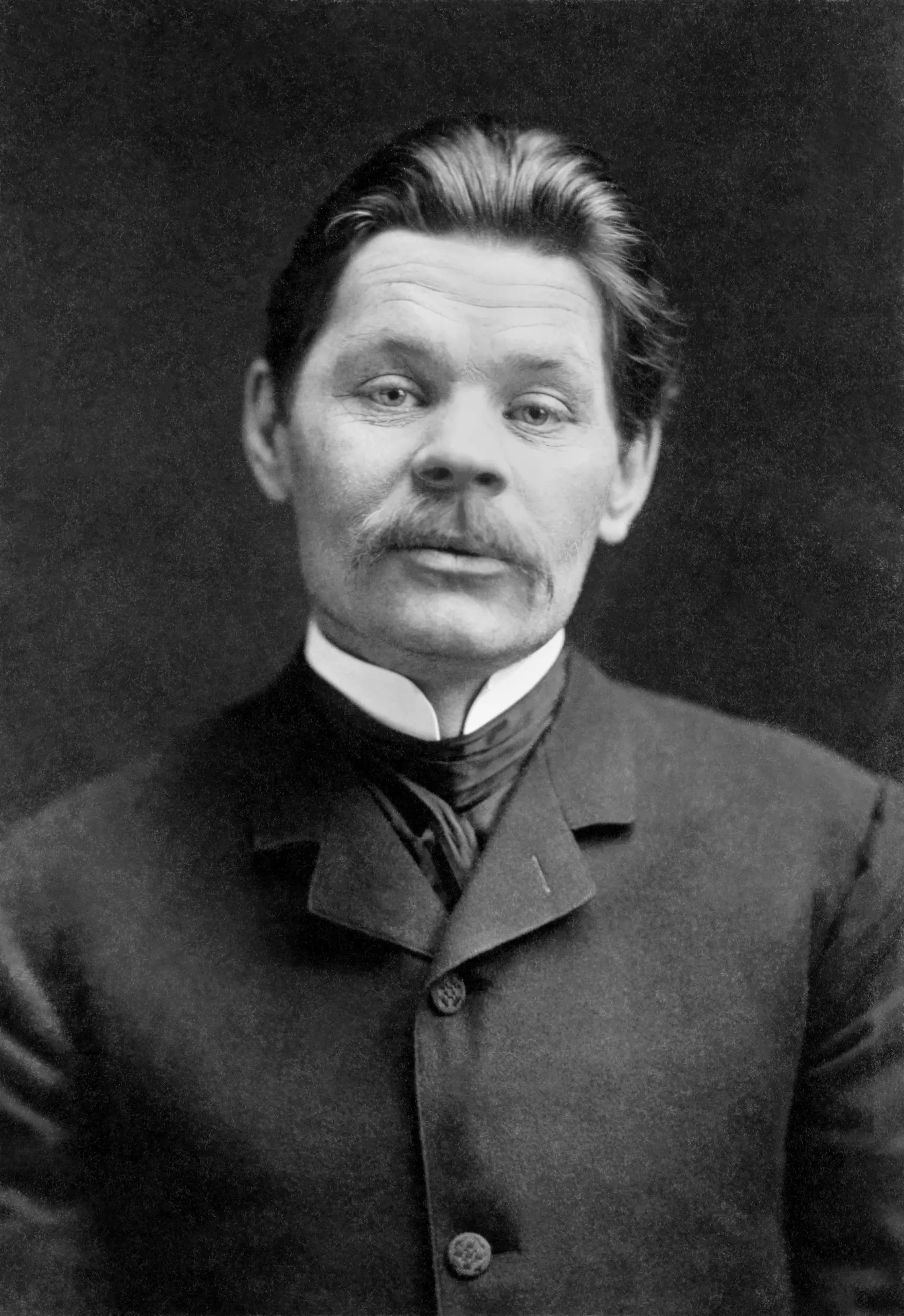
Maxim Gorky
Also known as: Alexei Maximovich Peshkov, Aleksey Maksimovich Peshkov
Birthday
March 28, 1868
Birth Sign
Pisces
Birthplace
Nizhny Novgorod, Russian Empire
Age
Died at 68
About
Alexei Maximovich Peshkov, better known by his pen name Maxim Gorky, was a towering figure in Russian and Soviet literature who shaped the ideological landscape of the early twentieth century. Born into extreme poverty in Nizhny Novgorod, he rose to become the most celebrated writer of his era and the official architect of Socialist Realism. His life story serves as a dramatic bridge between the Tsarist past and the Bolshevik future, marked by a transition from destitute laborer to the patron saint of Soviet culture.
Gorky is best remembered for works like The Lower Depths and Mother, which gave voice to the suffering of the working class and the criminal underworld. Despite his public support for the regime in his final years, his private letters reveal deep anxiety about the brutality of the new government. He died in 1936 under suspicious circumstances, leaving behind a complex legacy that continues to divide critics and historians.
Early Life & Background
Alexei Peshkov entered the world on March 28, 1868, in the bustling port city of Nizhny Novgorod. His start in life was defined by loss and hardship. His father, a tailor named Maxim Peshkov, died when Alexei was only three years old, leaving the family in financial ruin. Shortly after, his mother remarried and subsequently passed away when Alexei was nine. These early tragedies left him to be raised primarily by his grandmother, Akulina Ivanovna Kashirina, a woman whose storytelling would later inspire his own vivid narrative style.
Formal education eluded him almost entirely. He attended school for just two years before dropping out to survive. By age eleven, he was already working as a baker's apprentice, but the job offered little respite from the grueling conditions of the lower classes. He soon moved on to a series of menial jobs that exposed him to the raw reality of Russian society. He worked as a stevedore on the Volga River docks, a railway laborer, and a dockworker. These years of wandering across the Russian Empire provided the essential raw material for his future writing.
He began writing in his late teens, driven by a desire to document the lives of those invisible to the upper classes. In 1892, he published his first story, "Makar Chudra," under the pseudonym "Maxim Gorky," which translates to "The Bitter One." This name reflected his own bitter childhood and his empathy for the suffering masses. Before achieving fame, he lived a peripatetic existence, traveling extensively and meeting fellow writers like Leo Tolstoy and Anton Chekhov, who became significant influences and friends.
Career Growth
Gorky's literary career unfolded in distinct phases, each marking a shift in style and political engagement. His breakthrough came in the 1890s with a series of romanticized short stories like Chelkash, Old Izergil, and Twenty-six Men and a Girl. These works, characterized by their Nietzschean themes and focus on the "superman" or strong individual, established his reputation as a unique voice in Russian literature.
In 1902, his play The Lower Depths premiered in Moscow, offering a grim, naturalistic portrayal of life in a homeless shelter. It solidified his status as a major dramatist and brought his social critique to the forefront. The following year, he wrote the novel Mother, depicting the rise of the revolutionary movement among factory workers. Although he later considered it one of his "failures" due to its didactic nature, it became a cornerstone of Socialist Realism and was widely read internationally.
During the 1905 Revolution, Gorky was arrested multiple times and founded the newspaper Novaya Zhizn (New Life), where he criticized both the Tsarist regime and the Bolsheviks' methods. He spent time in exile in Capri, Italy, and later in the United States. After the Russian Civil War, he returned to Russia but remained critical of the Bolshevik repression. In 1928, he was invited back by Joseph Stalin and settled in the USSR permanently in 1932. He was officially declared the founder of Socialist Realism. His final major project was the four-volume novel The Life of Klim Samgin (1925–1936), an unfinished masterpiece exploring the intellectual history of pre-revolutionary Russia.
Career Timeline
Public Image & Style
Gorky cultivated an image of the rugged, wandering observer of the Russian soul. His public persona was that of a man who spoke truth to power, even when it cost him his safety. He is revered for his ability to give voice to the voiceless, though his later collaboration with Stalin complicates this narrative. He is often described as the "prophet of the revolution," a title that reflects his role in shaping Soviet ideology.
His appearance was distinctive, often portrayed as a tall, imposing figure with a long beard and intense gaze. He dressed in simple, practical clothing, reflecting his connection to the working class. Media perception of him shifted over time, from a romantic rebel in the 1890s to a state-sanctioned icon in the 1930s.
Fame & Fandom (iFAMOUS Rankings)
iFANN has not yet collected fame data for this person. As a historical literary figure from the early twentieth century, Gorky does not fit the modern metrics used for current celebrity rankings. His fame is enduring and institutional rather than trending.
There is no organized "fandom" in the modern pop-culture sense, as Gorky is a historical literary figure. However, his works are studied extensively in Russian schools and universities, and his plays are regularly performed. Fan-like devotion exists among scholars and theater enthusiasts who keep his legacy alive through academic conferences and productions. Recent revivals of his play Summerfolk in 2026 have shown that his themes remain relevant to contemporary audiences.
Interesting Facts and Legends
Gorky chose his pseudonym because he felt his life had been bitter. The word "gorky" literally means "bitter" in Russian, reflecting his upbringing and his empathy for the suffering common people. Unlike many contemporaries, he was initially critical of the Bolsheviks' violent methods, only reluctantly supporting them later in life. He was known for his rapid writing pace, often producing entire novels and plays in a matter of weeks.
His association with giants of Russian literature is legendary. He often recounted how Leo Tolstoy, upon meeting him, said, "You are a true son of the people." His works have been translated into dozens of languages and influenced writers worldwide, including John Steinbeck and Albert Camus. The giant eight-engine flying boat built in 1934 and named in his honor became a symbol of Soviet technological ambition, though it tragically crashed in 1935 during a flight test.
Notable Quotes
“When one loves somebody everything is clear, where to go, what to do, it all takes life lessons on love, relationships, purpose and clarity.”
“A lie is a lie, even if it is repeated a thousand times.”
“The world is full of beauty, but we must learn to see it.”
Family & Personal Life
Maxim Gorky's early family life was defined by the loss of his parents. His father, a tailor, died when Alexei was three, and his mother passed away when he was nine. He was raised by his grandmother, Akulina Ivanovna Kashirina, who told him stories that shaped his imagination. He had a brother, Nikolai, whose daughter, Yelena, he adopted informally, though some sources suggest this was part of a complex family arrangement.
He had two significant marriages. His first wife was Yekaterina Pavlovna Peshkova, a teacher and activist whom he met in Nizhny Novgorod. Their marriage was tumultuous and ended in divorce around 1904 or 1905. They had no children together. His second partner was Maria Fyodorovna Andreyeva, a renowned actress and director whom he met in 1905. She became his lifelong companion, manager, and editor, managing his estate and legacy until her own death in 1971.
Notable Connections
Vladimir Lenin, Joseph Stalin, Leo Tolstoy, Anton Chekhov, Alexander Bogdanov, Lev Kamenev, Nikolai Bukharin.
Relationships & Dating History
Maxim Gorky had two significant marriages and several notable relationships. His first marriage was to Yekaterina Pavlovna Peshkova (née Voloshchenko) in 1896. They met while Gorky was working in Nizhny Novgorod. She was a teacher and activist. Their marriage was tumultuous, marked by financial struggles and Gorky's frequent absences. They had no children together. The divorce was amicable, though strained by his growing political prominence and her own activism, occurring around 1904 or 1905.
In 1905, Gorky met Maria Fyodorovna Andreyeva, a renowned actress and director. They began a relationship shortly after, and she became his lifelong companion, manager, and editor. They never legally married in the modern sense initially but lived as husband and wife for over three decades. They had no biological children together, though Gorky supported her children from previous relationships and adopted a daughter, Yelena, from his brother's family. Andreyeva managed his estate and legacy until her own death in 1971. At the time of his death in 1936, Gorky was living with Andreyeva.
- DivorcedYekaterina Pavlovna Peshkova1896 - 1904Met in Nizhny Novgorod; divorced due to financial struggles and political differences.
- MarriedMaria Fyodorovna Andreyeva1905 - 1936Lifelong companion and manager; lived together until his death.
Death & Aftermath
Died
June 18, 1936 (aged 68)
Death Place
Gorki-10, near Nizhny Novgorod, Russia
Cause of Death
Heart disease from pulmonary congestion following influenza
On June 18, 1936, the sixty-eight-year-old writer passed away at his villa in Gorki-10, a suburb of Nizhny Novgorod. The official medical report issued by the hospital attributed his death to heart disease resulting from pulmonary congestion after he contracted influenza. While the immediate cause appeared natural, the circumstances surrounding his final days quickly became the subject of intense historical dispute and conspiracy theories regarding Joseph Stalin. Many biographers suspect foul play, alleging that the Soviet leader ordered his poisoning to silence Gorky's growing private criticism of the regime's purges. He had spent his last months under a form of house arrest, isolated from former allies, yet no definitive legal or autopsy evidence has ever confirmed an assassination.
Public reaction was immediate and monumental, treating the death as a national tragedy for the Soviet Union. Tributes poured in from state institutions and literary peers, cementing his status as the father of Soviet revolutionary literature. A massive state-sponsored funeral took place two days later in Moscow, attended by high-ranking officials including Stalin and Molotov alongside thousands of citizens. His body was cremated, and his ashes were interred in the Kremlin Wall Necropolis, a burial site reserved for the most distinguished figures of the state. In the posthumous era, Gorky's estate became central to Soviet cultural policy. The Maxim Gorky Literature Institute was founded to perpetuate his methods, while his name adorned the renamed city of Gor'kiy and numerous monuments across the bloc. His widow Maria Andreyeva managed aspects of his legacy until the estate was effectively nationalized under Soviet control.
Net Worth (Estate Value)
$0
iFANN Editorial Team estimate
As a historical figure who died in 1936, Maxim Gorky does not have a modern net worth in the contemporary sense. His estate was effectively nationalized by the Soviet government shortly after his death. The Soviet state controlled all royalties, publications, and intellectual property rights. There is no public record of a private estate value. The "estate" consisted of manuscripts, personal effects, and the right to publish his works, all of which were transferred to the state.
Since 1936, Gorky's works have generated substantial revenue through state-controlled publishing houses, translations, and adaptations. However, these revenues went directly to the Soviet state treasury rather than to heirs. His widow, Maria Andreyeva, managed his papers and correspondence until the state fully absorbed his legacy. Today, the Maxim Gorky Literature Institute in Moscow manages his archives and publishes his works.
Awards Won (2)
Maxim Gorky received numerous state honors and international recognition. He was awarded the Order of Lenin in 1933, one of the highest honors in the Soviet Union. Posthumously, he was named a Hero of Socialist Labour. Although nominated five times for the Nobel Prize in Literature, he never won the award. His role as the ideological architect of Socialist Realism was officially recognized by the Soviet state.
1933 · State Honor
Contributions to literature and culture
1936 · Posthumous Award
Lifetime achievement
Known For
The Lower Depths
1902 · Playwright
Mother
1906 · Novelist
The Life of Klim Samgin
1925 · Novelist
Keywords
Sources
Quick Facts
- Profession
- writer, playwright, novelist
- Born
- March 28, 1868
- Birthplace
- Nizhny Novgorod
- Died
- June 18, 1936
- Death Place
- Gorki-10
- Gender
- Male
- Spouse
- Yekaterina Peshkova, Maria Andreyeva
- Birth Sign
- Pisces
Personal Details
- Full Name
- Alexei Maximovich Peshkov
- Spouse
- Maria Fyodorovna Andreyeva
- Children
- None (adopted Yelena)
- Education
- Formal schooling ended after second grade; self-educated through extensive travel and work experience
Frequently Asked Questions
Who was Maxim Gorky?
Did Maxim Gorky win the Nobel Prize?
How did Maxim Gorky die?
What is Maxim Gorky's most famous work?
Was Maxim Gorky related to the Soviet leader Stalin?
Join the community
fans discussing