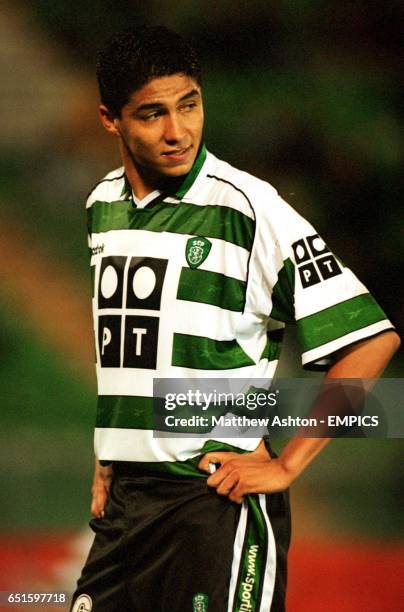
Mário Jardel
 Brazil
Also known as: Super Mário, Jardel
Birthday
September 18, 1973
Birth Sign
Virgo
Birthplace
Fortaleza, Brazil
Age
53 years old
Height
6 ft 2 in (188 cm)
About
Mário Jardel is a Brazilian former footballer who terrorized defenses across Europe with his lethal heading and instinctive positioning. He remains the only Brazilian to win the European Golden Shoe twice. At his peak, he scored at a rate that rivaled the continent's elite, netting 55 goals in a single season for Porto in 1998–99, a club record. His aerial dominance earned him the nickname Super Mário in Portugal and Turkey. He won the Copa Libertadores with Grêmio in 1995, scoring the winning goal in the final. That performance launched him to Europe, where he won league titles in Portugal and Turkey, plus the UEFA Cup and UEFA Super Cup with Galatasaray in 2000. Though his career faded after 2003, his goalscoring record remains extraordinary: over 300 official career goals, with a Champions League hat trick. Today, Jardel lives a quiet life in Brazil, occasionally appearing as a football commentator. He has been open about his post-retirement struggles with depression and finances, a story that has resonated with fans who remember his brilliance. His legacy endures as one of football's most natural finishers.
Early Life & Background
Jardel grew up in Fortaleza, a coastal city in northeastern Brazil, born on 18 September 1973 into a modest family. He learned football on the streets and beaches, honing the heading ability that would become his trademark. His youth career began at local club Ferroviário before he moved to Vasco da Gama's academy in Rio de Janeiro. But he struggled to break through there and returned to the northeast. His big break came in 1995 when Grêmio took him on loan. Manager Luiz Felipe Scolari saw something in the lanky forward. That season, Jardel scored crucial goals in the Copa Libertadores, including the winner in the final against Atlético Nacional. He also won the Bola de Prata as top scorer in the Campeonato Brasileiro Série A. It was the moment that changed everything. European scouts took notice, and within a year he was on his way to Porto.
Career Growth
Jardel joined Porto in 1996 and immediately became a phenomenon. He won the Primeira Liga in each of his first three seasons, scoring 36 league goals in 1998–99 to claim his first European Golden Shoe. His 55 goals across all competitions that season set a club record. At Porto, he formed a deadly partnership with Deco, and the team dominated Portuguese football, also winning the Portuguese Cup in 1998 and the Portuguese Super Cup in 1999. In 2000, Galatasaray paid a club-record fee to bring him to Turkey. That year, he scored in both the UEFA Cup final and the UEFA Super Cup final, helping the Istanbul club win both trophies. He won a second European Golden Shoe in 2002 with 22 goals and added a Turkish Süper Lig title. He also set a Guinness World Record for most goals in a single Champions League season (10 in 1999–2000). He then returned to Portugal with Sporting CP, winning another league title in 2002 and the Portuguese Cup in 2002 and 2003. After 2003, his career unraveled. A move to Bolton Wanderers in 2004 flopped, he scored just one goal in the Premier League. Brief stints at Palmeiras, Anápolis, and Rio Claro followed before he retired in 2011. Despite the decline, his peak years produced numbers few strikers have matched.
Career Timeline
Public Image & Style
During his prime, Jardel was known as Super Mário, a powerful, aerial specialist who could outjump almost any defender. Media in Portugal and Turkey celebrated him as a goalscoring machine, with frequent covers on Placar, A Bola, and Fanatik. After retirement, coverage shifted to his financial troubles and mental health struggles, which he has discussed candidly. Galatasaray fans still sing his chant: "Jardel, Jardel, gol kralı" (goal king). His Instagram (@mariojardelofficial, 150k followers) posts nostalgic football memories. Fans remember him as a striker who, for a few years, was simply unstoppable.
Fame & Fandom (iFAMOUS Rankings)
Mário Jardel occupies a unique space in football lore, remembered less as a global celebrity and more as a tragic figure of immense talent. While he never cultivated a formal, organized fanbase with specific self-designations or campaigns like the CR7s of Ronaldo, his story resonates through the narrative of extreme highs followed by a catastrophic fall. Fans in Portugal and Turkey still honor him with chants celebrating his aerial dominance, yet there is no documented collective identity for his followers today. His legacy is defined by individual career statistics and dramatic personal struggles rather than a unified movement. The media often labels him one of Europe's forgotten giants, a man whose peak performance outscored contemporaries like Thierry Henry and Ruud van Nistelrooy, yet who faded into obscurity due to substance abuse and financial mismanagement. Recent confessions about near-death experiences have added a layer of modern mythos to his life, framing him as a cautionary tale for the fragility of talent without discipline. Despite the lack of a formal fandom name, the sheer volume of retold stories regarding his mentorship of Cristiano Ronaldo, his double Golden Boot victory, and his bizarre later-life incidents keeps his name alive in football conversations. He remains a subject of intense curiosity, discussed in documentaries and articles that explore the contrast between his golden era and his chaotic decline. iFANN has evaluated this profile but currently does not place Mário Jardel in its published Global Top 1,000 rankings or any Top-100 scope list. Consequently, no specific numeric rank or score applies to his current standing in the engine's global fame hierarchy.
Interesting Facts and Legends
Jardel scored the fastest goal in UEFA Champions League history at the time, netting just 10.2 seconds into a match against AC Milan in 2000 while playing for Galatasaray. Despite his club exploits, he managed only one goal in ten caps for Brazil. A tattoo of the Copa Libertadores trophy adorns his arm, marking his triumph with Grêmio in 1995 where he scored the winning goal in the final. Although part of Brazil's 1997 Copa América squad, he did not see playing time. He finished in the top 10 for the Ballon d'Or in both 1999 and 2002. His famous quote remains: "I always said that my head was my best weapon." Legends surrounding his career include the verified fact that he won two consecutive European Golden Shoes, becoming the first player to achieve back-to-back wins with 42 goals in both the 2000–2001 and 2001–2002 seasons. A popular story fans still retell involves his connection to Cristiano Ronaldo; Jardel claimed they could have been brothers-in-law and acted as a mentor teaching the young star how to head the ball effectively before Ronaldo's move to Manchester United. Another verified anecdote from October 2015 details an incident where he was stopped at a border with 10kg of fish, highlighting the erratic nature of his later years. In late 2025, he made powerful public confessions about surviving a week-long cocaine overdose, stating he could be dead by now.
Notable Quotes
“I always said that my head was my best weapon. I could score with my feet, but my head was my secret.”
“I went from heaven to hell. I had everything, and then I had nothing.”
Family & Personal Life
Jardel was married to Kelly Jardel, a Brazilian model, during his peak years. They had two children: son Mário Jardel Júnior and daughter Maria Eduarda. The couple later divorced. He also has a daughter from a previous relationship. After his playing career, Jardel has spoken about the importance of family in helping him through depression. He lives in Brazil, close to his children. He has also been open about his struggles with depression and has worked with a psychologist.
Notable Connections
Jardel played alongside Deco at Porto, and with Hakan Şükür at Galatasaray. He was coached by Bobby Robson at Porto and Mircea Lucescu at Galatasaray. His international teammates included Ronaldo and Rivaldo.
Relationships & Dating History
Jardel had a brief relationship before his marriage that produced his first daughter. He married Kelly Jardel, a Brazilian model, during the 1990s. They had two children together, Mário Jardel Júnior and Maria Eduarda, before divorcing in the 2000s. Since the divorce, Jardel has not been publicly linked to anyone. As of 2026, he is single and focused on his health and family.
- DatedUnknownBrief relationship that produced his first daughter.
- MarriedKelly Jardel1990 - 2000Married to Brazilian model; had two children together; divorced.
Salary, Net Worth In 2026
$2 Million
iFANN Editorial Team estimate
Updated for 2026, iFANN currently estimates Mário Jardel's net worth at $2 Million. During his peak years between 1996 and 2003, he commanded annual salaries ranging from €2 million to €4 million across his stints at Porto, Galatasaray, and Sporting CP. However, poor financial management, failed investments, and a lavish lifestyle led to significant losses over time. He eventually filed for bankruptcy and now lives modestly in Brazil. His current income streams are limited to occasional work in football commentary and charity matches. He owns a small home in Brazil but holds no major business ventures or active endorsements.
Awards Won (16)
Jardel won two European Golden Shoes (1999, 2002), the UEFA Cup and UEFA Super Cup (2000), the Copa Libertadores (1995), and multiple league titles in Portugal and Turkey. He was also the top scorer in the Portuguese league four times and the Turkish league once.
2002 · Top Scorer
Galatasaray
1999 · Top Scorer
Porto
2000 · Team
Galatasaray
Known For
Porto
1996 · Striker
Galatasaray
2000 · Striker
Sporting CP
2002 · Striker
Keywords
Quick Facts
- Profession
- association football player
- Born
- September 18, 1973
- Birthplace
- Fortaleza, Brazil
- Gender
- Male
- Birth Sign
- Virgo
- Height
- 6 ft 2 in (188 cm)
Personal Details
- Full Name
- Mário Jardel de Almeida Ribeiro
- Height
- 6 ft 2 in (188 cm)
- Spouse
- Kelly Jardel (divorced)
- Children
- 3 (Mário Jardel Júnior, Maria Eduarda, and one daughter from a previous relationship)
Frequently Asked Questions
Is Mário Jardel still alive?
What happened to Mário Jardel's money?
Did Mário Jardel win the Ballon d'Or?
How many goals did Mário Jardel score in his career?
Why didn't Mário Jardel play more for Brazil?
Social Media
Similar People
Join the community
fans discussing