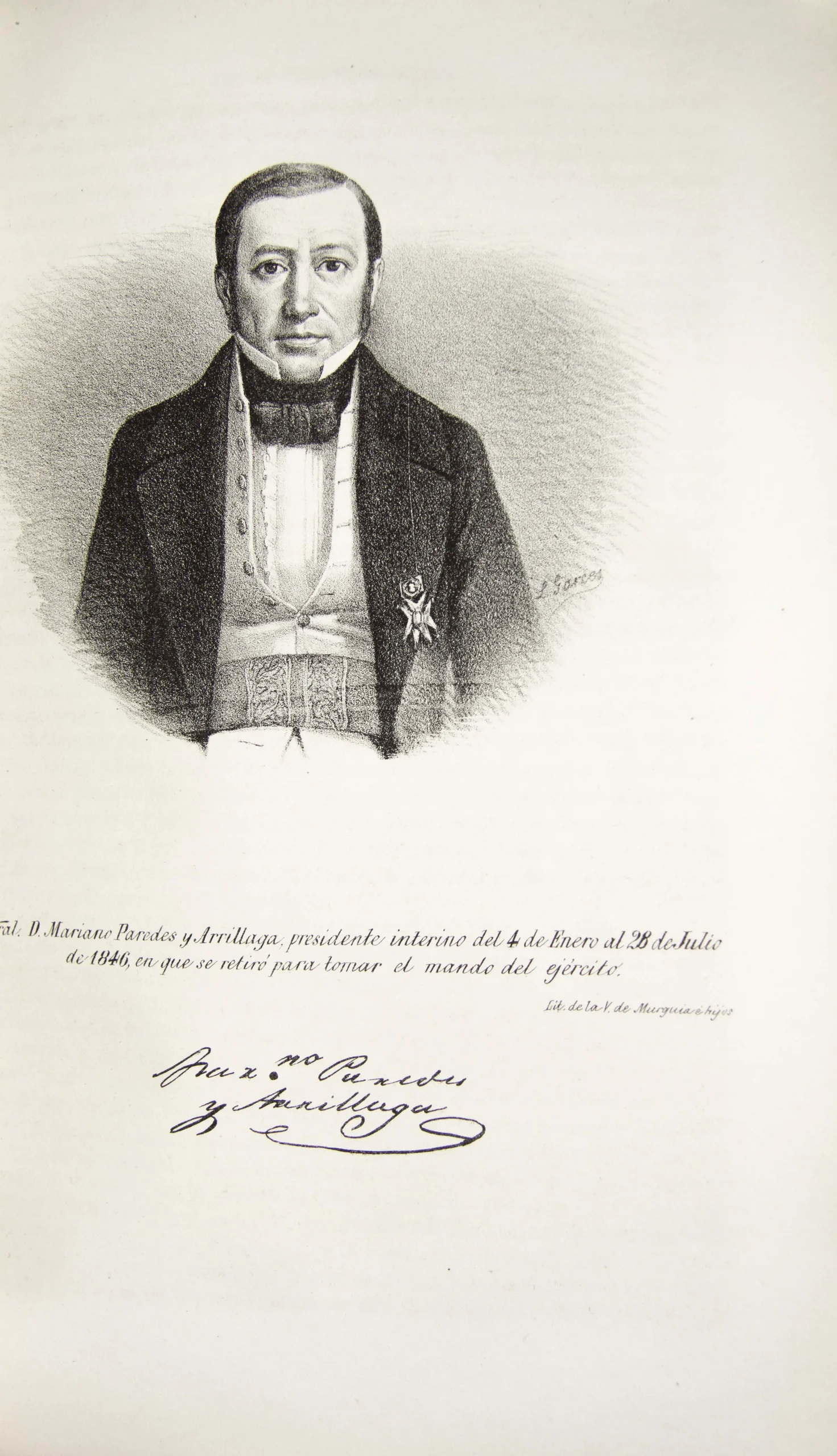
Mariano Paredes
 Mexico
politician•minister•military personnel
Also known as: Mariano Paredes y Arrillaga, José Mariano Epifanio Paredes y Arrillaga
Birthday
January 7, 1797
Birth Sign
Capricorn
Birthplace
Mexico City
Age
Died at 52
About
Mariano Paredes y Arrillaga was a Mexican general and conservative politician who served as president of Mexico from December 1845 to July 1846. A career army officer with monarchist leanings, he believed that a liberal democracy and federal system were unsuited for Mexico at the time, advocating instead for a government where the military and educated elite held power. His brief but consequential presidency came at the start of the Mexican-American War, a conflict that reshaped North America.
Paredes is remembered as a pivotal figure in a turbulent era of Mexican history, marked by internal coups and external threats. His actions directly influenced the political landscape of mid-19th century Mexico. He died in Mexico City on September 7, 1849, at the age of 52.
Early Life & Background
Born in Mexico City on January 7, 1797, Paredes came of age during the final years of Spanish colonial rule. He joined the royalist army as a young man, and after Mexico gained independence in 1821, he continued his military career under the new republic. Details of his early education and family life are scarce, but he rose steadily through the ranks, gaining a reputation as a capable and ambitious officer.
By the 1830s, Paredes had aligned himself with the conservative faction that favored a centralized government over the federal system established by the 1824 constitution. He participated in the overthrow of President Anastasio Bustamante in 1841, helping to install a government that drafted the Bases Orgánicas of 1843, a conservative charter that concentrated power in the executive. This period of political instability, known as the Centralist Republic, provided the backdrop for his rise.
Career Growth
Paredes's rise to power came through a series of coups. In 1844, he joined with Congress to challenge President Antonio López de Santa Anna, forcing him into exile. The following year, he led a coup against President José Joaquín de Herrera, who had been negotiating with the United States over Texas. Paredes opposed recognizing Texan independence and used this stance to justify seizing power. He assumed the presidency on December 31, 1845, and was formally appointed interim president on January 4, 1846.
His presidency was consumed by the growing crisis with the United States. He refused to meet with U.S. envoy John Slidell, who had been sent to negotiate the Texas boundary and purchase California. When the Mexican-American War broke out in April 1846, Paredes initially attempted to rally the nation, but a series of military defeats and political opposition quickly undermined his position. He resigned on July 28, 1846, and fled the capital. Santa Anna returned to power in September, and Paredes went into exile. He returned to Mexico in 1848, but his political career was over.
Career Timeline
Public Image & Style
Paredes is remembered as an arch-conservative and a monarchist at heart, a figure who believed that only a strong, centralized government could hold Mexico together. His reputation among historians is mixed: some view him as a principled nationalist who stood up to American expansionism, while others see him as an ambitious opportunist whose coups destabilized the young republic. He is often portrayed as a symbol of the military's outsized role in Mexican politics during the 19th century.
Fame & Fandom (iFAMOUS Rankings)
Mariano Paredes remains a figure of historical gravity rather than modern celebrity, his name echoing through the corridors of 19th-century Mexican politics without the roar of a contemporary fanbase. The iFANN Global Fame Engine evaluated his standing in August 2026 and determined that he currently holds no placement within the published rankings, including the Global Top 1,000 or any scope-specific top lists. This absence reflects the reality that his legacy is anchored in statecraft and military command rather than the consumption signals that drive today's fame charts. While some historical figures transcend their eras to become cultural icons with dedicated followings, Paredes exists primarily as a subject of academic study and national memory. There is no documented fandom name associated with him, nor are there organized campaigns, birthday tributes, or viral rituals surrounding his life. The concept of a fanbase did not exist in the era of his presidency, and no modern movement has emerged to claim him as a pop culture symbol. His influence is measured in treaties signed, coups executed, and borders redrawn, not in streaming numbers or social media trends. The silence of the digital age regarding his specific fan interactions speaks volumes about the nature of his fame; it is a quiet, enduring respect for a man who shaped a nation during its most turbulent years. Unlike living stars whose every move is tracked by global audiences, Paredes is remembered for the weight of his decisions rather than the volume of his applause. He stands as a solitary monument to a bygone political order, evaluated by historians but unranked by the algorithms that measure current global attention.
Interesting Facts and Legends
Mariano Paredes was the grandfather of Pedro Lascuráin Paredes, who holds the record for the shortest presidency in Mexican history, serving just 45 minutes in 1913. Despite his conservative politics, Paredes briefly considered establishing a monarchy in Mexico, a plan that never came to fruition. He was known for his personal bravery in battle, having been wounded several times during his military career. Paredes's coup against Herrera in 1845 was motivated largely by his refusal to accept the loss of Texas, a position that helped trigger the war with the United States. After his resignation, he was exiled to Cuba and later to Europe before being allowed to return to Mexico. Historical accounts detail how his coup against President José Joaquín de Herrera directly escalated tensions with the United States, serving as the catalyst for the Mexican-American War. By refusing to meet with U.S. envoy John Slidell, Paredes ensured conflict became inevitable, reshaping North America forever. His brief tenure ended when he was overthrown, paving the way for Antonio López de Santa Anna to return to power and altering the course of the war.
Family & Personal Life
Paredes married Josefa Cortés, who stood by him through his political and military career. The couple had several children, including a son who would become the father of Pedro Lascuráin Paredes. Pedro served as Mexico's president for just 45 minutes in 1913, a record that still stands. Little else is known about Paredes's family life, as records from the period are sparse.
Notable Connections
Paredes was closely associated with several key figures of his era: he ousted presidents Anastasio Bustamante and José Joaquín de Herrera, and he repeatedly clashed with Antonio López de Santa Anna, who ultimately succeeded him. He refused to meet with U.S. envoy John Slidell, a decision that helped precipitate the Mexican-American War. His grandson, Pedro Lascuráin Paredes, briefly served as president of Mexico in 1913.
Relationships & Dating History
Mariano Paredes was married to Josefa Cortés, and the couple remained together until his death in 1849. Little is known about their courtship or married life, but they had several children. One of their grandsons, Pedro Lascuráin Paredes, went on to serve as Mexico's president for just 45 minutes in 1913, a historical footnote that links Paredes's family to a unique record in Mexican politics.
- MarriedJosefa Cortés? - 1849Married until his death in 1849.
Death & Aftermath
Died
September 7, 1849 (aged 52)
Death Place
Unknown
Cause of Death
Unknown
Mariano Paredes died on September 7, 1849. Historical records confirm this date and establish that he was fifty-two years old at the time of his passing. The available sources do not specify the location where he died or provide details regarding the immediate circumstances surrounding his final days. He had been overthrown as president in September 1846, and the three years between his removal from office and his death are not detailed in the provided texts.
Following his death, the political landscape shifted rapidly as Antonio López de Santa Anna consolidated power once more. This transition rendered Paredes a footnote in the ongoing struggle for Mexico's governance during the turbulent era of conservative rule.
Modern historical analysis references Paredes primarily within the context of the Mexican-American War and the presidency of Santa Anna. While descendants eventually reached the presidency in the twentieth century, no specific statements were recorded from his family immediately following his death.
Net Worth (Estate Value)
Awards & Accolades
Known For
President of Mexico
1845-1846 · President
Mexican-American War
1846 · President during outbreak
Keywords
Sources
Quick Facts
- Profession
- politician, minister, military personnel
- Born
- January 7, 1797
- Birthplace
- Mexico City
- Died
- September 7, 1849
- Death Place
- Mexico City
- Gender
- Male
- Spouse
- Josefa Cortés
- Birth Sign
- Capricorn
Personal Details
- Full Name
- José Mariano Epifanio Paredes y Arrillaga
- Spouse
- Josefa Cortés
Frequently Asked Questions
Who was Mariano Paredes?
When did Mariano Paredes serve as president?
What was Mariano Paredes known for?
When and where was Mariano Paredes born?
When did Mariano Paredes die?
Join the community
fans discussing