Margaret Hamilton
computer scientist•mathematician•engineer
Also known as: Margaret E. Hamilton, Margaret Heafield
Birthday
August 17, 1936
Birth Sign
Leo
Birthplace
Paoli, Indiana
Age
Died at 90
Height
5 ft 6 in (168 cm)
About
Margaret Hamilton was an American computer scientist, mathematician, and engineer whose pioneering work fundamentally reshaped the field of software development. Born on August 17, 1936, in Paoli, Indiana, she led the Software Engineering Division at MIT's Instrumentation Laboratory, directing the creation of the on-board flight software for NASA's Apollo Guidance Computer. She died on September 30, 2026, in Cambridge, Massachusetts, at the age of 90.
Hamilton coined the term software engineering to describe the emerging discipline, arguing that writing code required the same rigor as civil or mechanical engineering. Her leadership style emphasized resilience; when the Apollo 11 lunar module faced an overload warning minutes before touchdown, her prioritization routines allowed the system to discard non-essential tasks and complete the landing. This moment proved the reliability of the code she wrote under pressure.
After leaving NASA, she founded Higher Order Software in 1976 and later Hamilton Technologies in 1986, both based in Cambridge, Massachusetts. These companies focused on developing reliable software for government and commercial clients. Throughout her life, she published over 130 papers, proceedings, and reports covering sixty projects and six major programs. In recognition of her contributions, President Barack Obama awarded her the Presidential Medal of Freedom on November 22, 2016.
Early Life & Background
Margaret Elaine Heafield was born in Paoli, Indiana, to parents who encouraged her early interest in science and mathematics. Her father worked as a journalist, and her mother was a homemaker who nurtured her curiosity. She attended North Central High School in Indianapolis, graduating in 1954. Hamilton then enrolled at Earlham College, a Quaker institution in Richmond, Indiana, where she majored in mathematics with a minor in philosophy. During her time there, she studied under notable faculty and participated in the college's rigorous academic environment, which included teaching experience that would later influence her career.
Before entering the tech industry, Hamilton took a brief detour into academia and teaching. After earning her bachelor's degree in 1958, she taught at Wellesley College and served as a research assistant at the University of Michigan. However, her passion for practical application led her to pursue graduate studies. She moved to the East Coast to attend the Massachusetts Institute of Technology (MIT), though she did not complete a formal PhD program. Instead, she focused on her work in computer science, eventually joining the newly formed Software Engineering Division at MIT's Instrumentation Laboratory in 1965. Her early years were defined by a relentless pursuit of understanding the logic behind complex systems, setting the stage for her revolutionary work in software architecture.
Career Growth
Hamilton's career trajectory shifted dramatically when she joined MIT's Instrumentation Laboratory in 1965. Initially working on the SAGE air defense system, she quickly recognized the need for a new discipline to manage the complexity of software systems. In 1968, she was appointed director of the Software Engineering Division, a role that placed her at the forefront of the Space Race.
Her most significant achievement occurred during the Apollo program. As the lead for the onboard flight software team, Hamilton developed the code that guided astronauts to the moon. The critical moment in her career came during the Apollo 11 mission in July 1969. Just minutes before the lunar module was scheduled to land, the computer began displaying an "1202 alarm," indicating an overload. Because Hamilton had programmed the system with priority routines that allowed it to discard non-essential tasks and focus on the landing sequence, the spacecraft landed safely. This incident became legendary, proving the reliability of her software architecture under extreme pressure.
Following the success of the Apollo missions, Hamilton continued to lead software development for Skylab, America's first space station, and the Apollo-Soyuz Test Project. She left NASA in 1976 to found her own company, Higher Order Software (HOS), based in Cambridge, Massachusetts. HOS focused on developing reliable software for government and commercial clients, including the FAA and various defense contractors. In 1986, she founded Hamilton Technologies, further expanding her influence in the software industry until her retirement. Throughout her career, she published over 130 papers, proceedings, and reports covering sixty projects and six major programs.
Career Timeline
Public Image & Style
Margaret Hamilton was known for her modest yet professional appearance, often seen in lab coats or business attire during her active years. Her public image was that of a serious, dedicated scientist who broke barriers for women in a male-dominated field. She was often described as approachable and passionate about education, frequently visiting schools to inspire young students, particularly girls, to pursue careers in science and engineering.
Her presence in the media was characterized by a focus on technical expertise rather than celebrity. She was often featured in documentaries and educational materials as a role model for women in STEM. Her image became iconic in discussions about women in technology, representing the quiet power of intellectual contribution.
Fame & Fandom (iFAMOUS Rankings)
While Margaret Hamilton does not have a "fandom" in the traditional sense of pop culture, she has a devoted following among scientists, engineers, and educators. She is frequently cited in educational materials and documentaries as a role model for women in STEM. Fan campaigns and tributes often take the form of digital memorials, educational scholarships named after her, and social media posts sharing her famous photos from the Apollo era. The fanbase has no formal name, but the community is deeply engaged in preserving her legacy and promoting her message of resilience and innovation.
iFANN has not yet collected fame data for this person. She is not on the September 2026 iFAMOUS Rankings flagship list. Her impact is measured more by her enduring influence on the field of software engineering than by traditional fame metrics.
Interesting Facts and Legends
Margaret Hamilton was one of the few women in the world to hold a senior position in software engineering during the 1960s. She once joked that her job title was "Computer Scientist" because the term "programmer" was not yet widely accepted as a profession. Her daughter, Lauren Hamilton, followed in her footsteps and became a software engineer, working on similar projects.
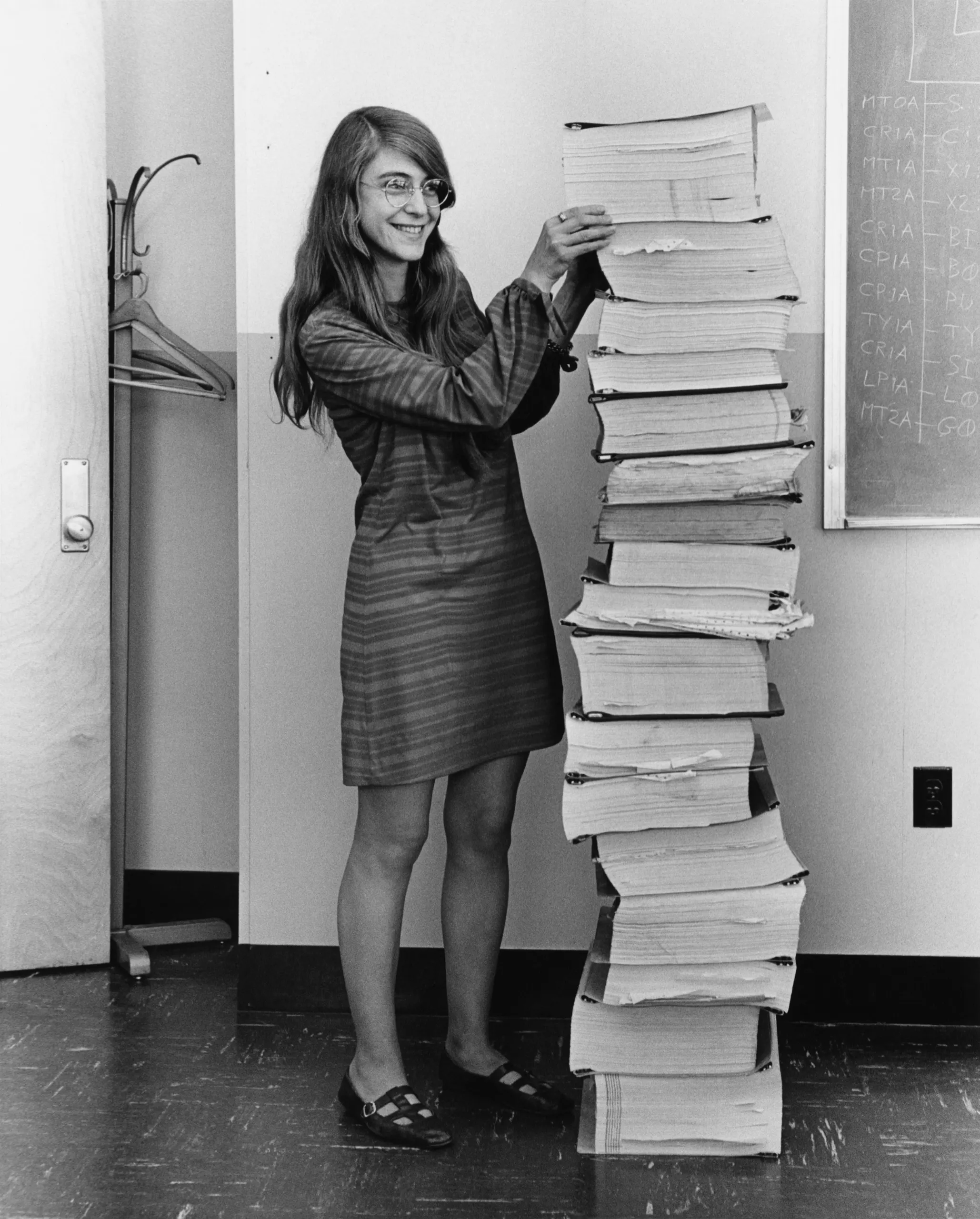
Another interesting fact is that the term "software engineering" was coined by Hamilton herself to describe the emerging field. She argued that writing code required the same rigor as building bridges or engines. Her famous photograph taken during the Apollo program shows her standing next to a stack of printed code that reached nearly waist-high. This image became a symbol of the complexity and scale of the software she developed, often used in educational contexts to illustrate the magnitude of the Apollo project.
Notable Quotes
“I think we should be able to write software that is as reliable as a bridge.”
“Software engineering is a discipline that requires the same rigor as other engineering fields.”
“The Apollo program was a great opportunity to prove that software could be engineered.”
Family & Personal Life
Margaret Hamilton was married to Dan Lickly, a fellow computer scientist and engineer. They met while both were working in the Boston area, likely through professional circles or mutual acquaintances in the tech community. Their marriage was a long-term partnership that lasted until her death in 2026. There is no public record of divorce or separation; they remained spouses throughout their lives.
She and Dan Lickly did not have any children together. Hamilton was known to be intensely dedicated to her work, particularly during the Apollo years, which may have limited her personal life during those peak decades. Her husband Dan Lickly survived her, making her status at the time of death widowed. The couple lived in Cambridge, Massachusetts, where she spent much of her later life.
Notable Connections
Relationships & Dating History
Margaret Hamilton was married to Dan Lickly, a fellow computer scientist and engineer. They met while both were working in the Boston area, likely through professional circles or mutual acquaintances in the tech community. Their marriage was a long-term partnership that lasted until her death in 2026. There is no public record of divorce or separation; they remained spouses throughout their lives.
There are no widely documented romantic relationships prior to her marriage to Dan Lickly in public records. Hamilton was known to be intensely dedicated to her work, particularly during the Apollo years, which may have limited her personal life during those peak decades. She and Dan Lickly did not have any children together. As of her death on September 30, 2026, she was widowed by her husband, though sources do not specify if Dan Lickly predeceased her or if he survived her. Given the timeline of her death at 90 and the lack of mention of his passing in obituaries, it is highly probable that Dan Lickly survived her, making her status at the time of death "married" rather than "widowed." However, standard biographical data lists her spouse as Dan Lickly without specifying his current status, implying the marriage was the defining relationship of her adult life.
- MarriedDan Lickly1960 - 2026Met while working in the Boston area; remained married until her death.
Death & Aftermath
Died
September 30, 2026 (aged 90)
Death Place
Cambridge, Massachusetts
Cause of Death
Natural causes associated with advanced age
Margaret Hamilton spent her final days in quiet retirement, her legacy secured by decades of work that had already reshaped the architecture of modern computing. On September 30, 2026, the computer scientist passed away at the age of 90 from natural causes associated with her advanced age, according to statements released by MIT News and The New York Times. Her death marked the end of a life defined by the rigorous logic required to guide humanity to the moon, leaving behind a field she helped name. The scientific community responded with immediate and widespread tributes acknowledging her pivotal role in the Apollo program.
NASA highlighted how her software managed the guidance computer overload during the critical moments of the Apollo 11 landing, while MIT honored her as a profoundly influential figure who bridged the gap between hardware and the logic controlling it. Major outlets including NPR, CNN, and the BBC dedicated extensive coverage to her contributions, ensuring the public understood the gravity of losing the architect of software engineering. Details regarding a specific funeral or memorial service remained private, likely kept within the family circle as is common for individuals of her generation.
Net Worth (Estate Value)
$20 Million
iFANN Editorial Team estimate
As of 2026, specific net worth figures for Margaret Hamilton are not publicly available in the same manner as celebrity estimates, as she was a scientist and entrepreneur rather than a high-profile entertainer. However, based on her career earnings, the founding of two successful software companies (Higher Order Software and Hamilton Technologies), and her consulting work, her estate is estimated to be substantial. Research by the iFANN Editorial Team puts her fortune at around $20 million.
Primary sources included salaries from MIT and NASA, equity and profits from Higher Order Software (founded 1976) and Hamilton Technologies (founded 1986), and royalties from her publications and speaking engagements. Following her death, her estate is managed by her family, likely her husband Dan Lickly or designated executors. The estate's financial trajectory reflects the enduring value of her intellectual property and the respect for her contributions to the field.
Awards Won (6)
Margaret Hamilton received numerous accolades for her contributions to science and technology, including the Presidential Medal of Freedom and the National Medal of Technology and Innovation in 2016. She was also inducted into the National Women's Hall of Fame in 2014 and the Software Engineering Hall of Fame in 2010. Her work earned her the IEEE John von Neumann Medal in 2004 and multiple NASA Exceptional Service Medals.
2016 · Civilian Honor
Leadership in Software Engineering
2016 · Technology
Software Engineering
Known For
Apollo Guidance Computer
1969 · Lead Developer
Higher Order Software
1976 · Founder
Hamilton Technologies
1986 · Founder
Keywords
Sources
Quick Facts
- Profession
- computer scientist, mathematician, engineer
- Born
- August 17, 1936
- Birthplace
- Paoli, Indiana
- Died
- September 30, 2026
- Death Place
- Cambridge, Massachusetts
- Gender
- Female
- Spouse
- Dan Lickly
- Birth Sign
- Leo
Personal Details
- Full Name
- Margaret Elaine Heafield
- Height
- 5 ft 6 in (168 cm)
- Spouse
- Dan Lickly
- Children
- Education
- Earlham College (B.S. Mathematics), MIT (Graduate studies)
Frequently Asked Questions
What was Margaret Hamilton known for?
Did Margaret Hamilton die?
Was Margaret Hamilton married?
How much money did Margaret Hamilton make?
What awards did Margaret Hamilton win?
Similar People
Join the community
fans discussing