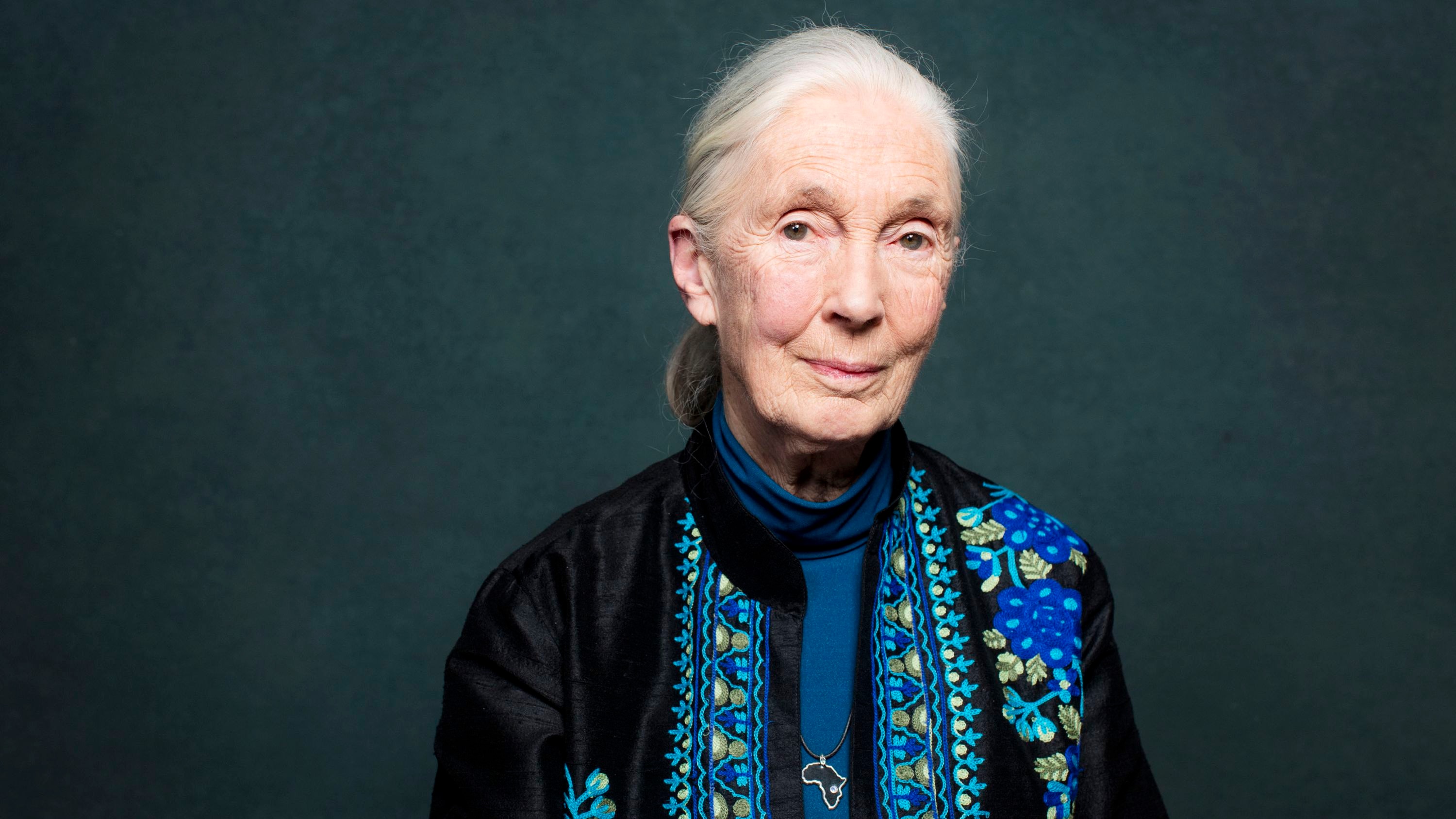
Jane Goodall
 United Kingdom
primatologist•ethologist•conservationist
Also known as: Valerie Jane Morris-Goodall
Birthday
April 3, 1934
Birth Sign
Aries
Birthplace
Hampstead, London, England
Age
Died at 91
Height
5 ft 7 in (170 cm)
About
Jane Goodall was a British primatologist, ethologist, and conservationist whose work redefined the relationship between humans and animals. Over six decades, she revealed that chimpanzees make and use tools, form lifelong family bonds, and experience emotions like joy and grief. Her discoveries, published in In the Shadow of Man and countless National Geographic features, turned science upside down.
Goodall founded the Jane Goodall Institute in 1977 and launched Roots & Shoots in 1991, a youth program active in over 60 countries. She served as a UN Messenger of Peace from 2002 and wrote 32 books, including 15 for children. Her honors include the Presidential Medal of Freedom and a damehood. She died in 2025 at 91, but her message of hope and action lives on through millions of young people carrying her work forward.
Early Life & Background
Born in Hampstead, London, in 1934, Jane Goodall was fascinated by animals from the start. At age one, she brought earthworms into her bed. At four, she hid in a henhouse for hours to watch a chicken lay an egg, emerging triumphant. Her father gave her a stuffed chimpanzee named Jubilee, a toy she kept for decades.
World War II split the family; her father, a businessman, joined the army, and Jane and her mother moved to the countryside. She devoured Tarzan and Doctor Dolittle books, dreaming of Africa. After secretarial school, she worked in Oxford and London, saving money for a trip to Kenya. In 1957, a friend invited her to a farm in the Kenyan highlands. There, she met Louis Leakey, the paleontologist who needed someone patient and untainted by academic theory to study chimpanzees. Leakey hired her as a secretary for a dig at Olduvai Gorge, then proposed the Gombe study. He believed her open mind was more valuable than a degree.
In July 1960, Goodall arrived at Gombe Stream National Park, a steep, forested reserve on Lake Tanganyika. She was 26, with no scientific training, a tent, and a boatman named Dominic. The chimpanzees fled from her for months. She watched from a ridge with binoculars, learning their habits. By November, a chimp she named David Greybeard allowed her close. He would lead her to the breakthrough.
Career Growth
In October 1960, David Greybeard sat at a termite mound, stripped a twig of leaves, and poked it into the nest. Goodall watched him fish out termites. Tool use by a non-human animal. She cabled Leakey: he replied, "Now we must redefine tool, redefine man, or accept chimpanzees as human."
National Geographic funded her work and sent photographer Hugo van Lawick, whom she married in 1964. Their films and articles made Goodall a household name. She earned her Cambridge Ph.D. in 1965 without a bachelor's degree, a rare exception. Her book In the Shadow of Man (1971) became a bestseller in 48 languages.
In the 1970s, she documented a four-year war between two chimpanzee communities at Gombe, showing that violence was not unique to humans. In 1977, she founded the Jane Goodall Institute to protect chimpanzees and their habitats. She stopped living at Gombe in 1986 after a conference revealed the scale of habitat destruction and the bushmeat trade. From then on, she became a full-time activist, traveling 300 days a year to speak, lobby, and fundraise. In 1991, she launched Roots & Shoots, now a global youth network. She continued lecturing into her late 80s, using a walker but never slowing down.
Career Timeline
Public Image & Style
Goodall's public image was defined by her calm, patient presence and a uniform: khaki shirt, shorts, and a ponytail tied with a simple band. In photographs, she is often crouched at eye level with a chimpanzee, her face soft, her hands still. She spoke in a quiet, measured voice that carried moral authority without preaching.
Media coverage shifted from scientific discovery to conservation advocacy. She was criticized by some primatologists for "anthropomorphizing" chimps by naming them instead of numbering them. But the public loved her. Fans sent letters addressed simply to "Jane Goodall, Africa." She answered many by hand.
Her social media presence was managed by the Institute, but her personal voice came through in books and interviews. She often said her greatest hope was in young people. The Roots & Shoots network, which she called her "reason for hope," became her enduring legacy. She never sold out or softened her message: she called out factory farming, deforestation, and animal testing by name.
Fame & Fandom (iFAMOUS Rankings)
Jane Goodall's legacy is sustained not by a branded fanbase but by a global network of conservationists and youth activists mobilized through the Jane Goodall Institute and its Roots & Shoots program. Her supporters, often identified simply as members of this movement rather than adherents to a specific cult of personality, channel their devotion into tangible environmental action and community-led development across more than 60 countries. This unique structure transforms admiration into advocacy, with followers organizing charity drives and participating in memorial tributes that honor her life work rather than seeking celebrity worship. Following her passing in October 2025, the community coalesced around celebrating her enduring influence, viewing her final messages as a call to moral duty and spiritual connection with the natural world. Within this vast ecosystem of influence, her standing remains formidable according to the iFANN Global Fame Rankings. She is currently ranked as the 30th most famous person in Creators & Influencers, a position she has held steady from the previous cycle. This placement reflects a global attention span that tracks media coverage, search activity, and cultural consumption signals worldwide. The ranking confirms her status as a figure whose impact transcends the scientific community to become a universal symbol of hope and ethical responsibility.
Interesting Facts and Legends
Born Valerie Jane, she was known affectionately as Jane to her family. A stuffed chimpanzee named Jubilee, a gift received at age one, remained on her dresser for her entire life. She famously refused to own a television, dismissing it as a waste of time. Her ability to mimic chimpanzee vocalizations, including the pant-grunt greeting, allowed her to soothe anxious subjects during fieldwork. In 1996, she received the Kyoto Prize, awarding $500,000 which she immediately directed to fund the Jane Goodall Institute. During World War II, she actively collected scrap metal and expressed delight when a neighbor donated a used toothpaste tube to her pile. A legendary moment in primatology occurred when she observed chimpanzees modifying twigs to fish for termites, a discovery that shattered the belief that tool use was exclusively human. Another enduring story involves her decision to name the chimpanzees she studied, such as David Greybeard and Flo, rather than assigning them numbers, a practice that revolutionized behavioral studies and sparked controversy before becoming iconic. Posthumous tributes included a 'City of Science' event at CUNY and the release of her final interview, cementing her place in history.
Notable Quotes
“What you do makes a difference, and you have to decide what kind of difference you want to make.”
“Only if we understand, can we care. Only if we care, will we help. Only if we help, shall all be saved.”
“It is the hope of accomplishing something that makes you work, and work, and work.”
“The least I can do is speak out for those who cannot speak for themselves.”
“Every individual matters. Every individual has a role to play. Every individual makes a difference.”
Family & Personal Life
Goodall's mother, Margaret "Vanne" Morris-Goodall, was a secretary who encouraged Jane's curiosity. When Jane brought home a handful of earthworms, Vanne said, "If you're going to study animals, you must be patient and quiet." Her father, Mortimer Morris-Goodall, was a businessman and later a soldier. He and Vanne divorced when Jane was 12.
Her only sibling, a sister named Judy, was four years younger. Judy became a secretary and later worked for the Jane Goodall Institute.
Goodall's son, Louis Henry van Lawick, known as "Goody," was born in 1967. He grew up at Gombe and became a boat builder in Tanzania. He married and had three children, giving Goodall three grandchildren: Nick, Angel, and Merlin.
After her second husband Derek Bryceson died in 1985, Goodall lived alone in Dar es Salaam for a time, then moved to a small house in Bournemouth, England, where her mother lived. In her later years, she split time between the UK and a home in Los Angeles, where she died.
Notable Connections
Louis Leakey mentored Goodall and sent her to Gombe. She married wildlife photographer Hugo van Lawick, who documented her early work for National Geographic. Her second husband, Derek Bryceson, was a Tanzanian politician and conservationist. Her son, Louis "Goody" van Lawick, grew up at Gombe and later worked as a boat builder in Tanzania.
Relationships & Dating History
Jane Goodall married twice. In 1964, she married Hugo van Lawick, a Dutch wildlife photographer sent by National Geographic to film her work. Their son, Louis Henry, was born in 1967. The couple divorced in 1974, partly due to long separations while Goodall stayed at Gombe. In 1975, she married Derek Bryceson, a Tanzanian politician and conservationist. Bryceson supported her research and helped protect Gombe National Park. He died of cancer in 1985. Goodall never remarried. She remained close with her son and grandchildren, and often said she had no regrets about her personal choices. As of 2026, she is widowed.
- MarriedHugo van Lawick1964 - 1974Dutch wildlife photographer; they had one son, Louis Henry; divorced in 1974.
- MarriedDerek Bryceson1975 - 1985Tanzanian politician and conservationist; supported her work at Gombe; died of cancer in 1985.
Death & Aftermath
Died
October 1, 2025 (aged 91)
Death Place
Unknown
Cause of Death
Unknown
Jane Goodall died on October 1, 2025, at the age of 91. The specific location of her passing remains unrecorded in public statements. No official cause of death was released by her family or the Jane Goodall Institute. Tributes followed immediately, with the New York Times publishing an obituary that highlighted her six decades of research into chimpanzee social lives and her role in redefining human identity. In March 2026, the New York State United Teachers issued a poster for Women's History Month, while the City of Science at CUNY hosted a retrospective event titled "Jane Goodall and Her Legacy" in January of that year. A Netflix Tudum feature released in April 2026 presented exclusive final words from the primatologist. August 2026 marked the declaration of April 3 as the first annual "Jane Goodall Day" by the Jane Goodall Institute to honor her birthday. Subsequent initiatives included a quantum computing research program launched in July 2026 to explore ecological roots of conflict.
Net Worth (Estate Value)
$10 Million
iFANN Editorial Team estimate
Per iFANN's editorial analysis, Jane Goodall's estate holds an estimated net worth of $10 million following her death in 2025. Her financial foundation was built upon substantial earnings from book royalties, with titles like In the Shadow of Man and Reason for Hope selling millions of copies globally. At the height of her career, she commanded speaking fees ranging from $50,000 to $100,000 per engagement, delivering over 300 talks annually. While the Jane Goodall Institute provided a modest salary, significant wealth accumulation resulted from major awards, including the $500,000 Kyoto Prize and the Templeton Prize, which exceeded $1 million and were fully donated to the Institute. Even after her passing, her estate continues to generate revenue through ongoing book sales and documentary film rights.
Awards Won (58)
Jane Goodall won the Kyoto Prize in 1996, the Templeton Prize in 2002, and the U.S. Presidential Medal of Freedom in 2025. She was appointed Dame Commander of the Order of the British Empire in 2003. The National Geographic Society awarded her the Hubbard Medal in 1995. She also received the Spanish Prince of Asturias Award for Technical and Scientific Research in 2003.
2025 · Civilian Honor
Lifetime achievement
2003 · National Honor
Services to conservation
Known For
Gombe Stream Research
1960 · Primatologist
In the Shadow of Man
1971 · Author
Jane Goodall Institute
1977 · Founder
Roots & Shoots
1991 · Founder
Keywords
Quick Facts
- Profession
- primatologist, ethologist, conservationist
- Born
- April 3, 1934
- Birthplace
- Hampstead, London, England
- Died
- October 1, 2025
- Death Place
- Los Angeles, California, USA
- Gender
- Female
- Spouse
- Hugo van Lawick (1964–1974), Derek Bryceson (1975–1985)
- Birth Sign
- Aries
Personal Details
- Full Name
- Valerie Jane Morris-Goodall
- Height
- 5 ft 7 in (170 cm)
- Spouse
- Hugo van Lawick (1964–1974), Derek Bryceson (1975–1985)
- Children
- Louis Henry van Lawick
- Education
- Ph.D. in ethology, University of Cambridge (1965)
Filmography
45
Total
15
Film
30
TV
Frequently Asked Questions
What is Jane Goodall famous for?
When did Jane Goodall start studying chimpanzees?
What is Jane Goodall's net worth?
Did Jane Goodall have children?
Is Jane Goodall still alive?
Social Media
Similar People
Join the community
fans discussing