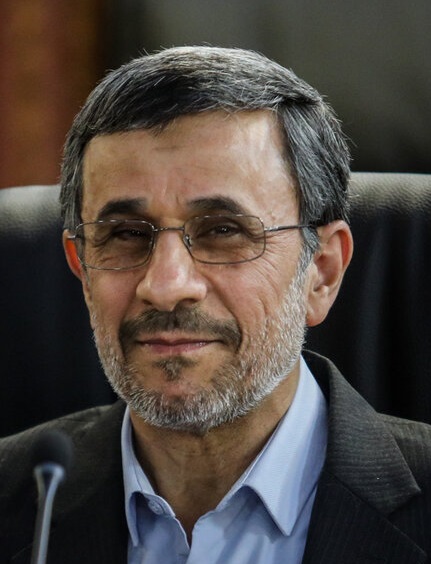
Mahmoud Ahmadinejad
 Iran
Iranuniversity teacher•engineer•head of state
Birthday
+1956-10-28
Birth Sign
Sagittarius
Birthplace
Aradan
Age
69 years old
About
Mahmoud Ahmadinejad, born Sabbaghian on October 28, 1956, in Aradan, Iran, is an engineer and teacher who rose to become the sixth president of Iran, serving from 2005 to 2013. A principlist and nationalist, he was a member of the Expediency Discernment Council and a vocal advocate for Iran's nuclear program. He also led the Alliance of Builders of Islamic Iran, a conservative coalition, and served as Tehran's mayor from 2003 to 2005, where he reversed many of his predecessor's reforms. Raised in a poor family, Ahmadinejad's ideology was shaped by thinkers like Navvab Safavi, Jalal Al-e-Ahmad, and Ahmad Fardid. After the 1979 revolution, he joined the Office for Strengthening Unity. He became a provincial governor in 1993, but lost that post in 1997 when President Mohammad Khatami took office. He returned to teaching until Tehran's council elected him mayor in 2003, where his religious hardline approach undid moderate reforms. His 2005 presidential run, backed by the Alliance of Builders, won 62% of the runoff vote, and he took office on August 3, 2005. Ahmadinejad's presidency was marked by controversy both at home and abroad. Domestically, his economic policies drew criticism, and human rights groups in North America and Europe accused him of abuses. Internationally, his hostile rhetoric toward Israel, Saudi Arabia, the UK, the US, and other Western and Arab states sparked outrage. He called for Israel's destruction, dismissed the Holocaust as a myth, and later boasted that promoting Holocaust denial was one of his presidency's major achievements. In 2007, he introduced gasoline rationing to cut fuel consumption and capped interest rates for banks. His disputed 2009 re-election triggered massive protests in Iran and condemnation from Western nations. During his second term, Ahmadinejad clashed with reformers, traditionalists in Parliament, the Revolutionary Guard, and Supreme Leader Ali Khamenei, notably over his dismissal of intelligence minister Gholam-Hossein Mohseni-Eje'i and his support for close adviser Esfandiar Rahim Mashaei. In March 2012, he became the first Iranian president summoned by Parliament to answer questions. Term-limited, he backed Mashaei in the 2013 election, which Hassan Rouhani won. He attempted a comeback in 2017, but the Guardian Council rejected his nomination. He criticized the government during the 2017-18 protests, and his bids for the 2021 and 2024 elections were also rejected. In July 2026, reports surfaced that the CIA and Mossad had once planned to reinstall him as part of failed regime change operations, though those plans collapsed.
Fame & Fandom
The air in Tehran's parliament often crackled with tension when Mahmoud Ahmadinejad spoke, a man whose rise from a poor family in Aradan to the sixth presidency of Iran left an indelible imprint on the nation's psyche. Today, his global footprint remains substantial, cemented by his status as the 7th most famous person in Iran and the 7th most famous person from Iran, figures that have held steady through shifting political tides. Across the Middle East, he ranks as the 14th most famous person in Middle East, a placement reflecting decades of polarizing diplomacy and fiery rhetoric rather than pop culture whimsy. These metrics, tracked by the iFANN Global Fame Rankings, capture attention spanning media coverage and consumption signals worldwide, proving that controversy can sustain fame just as effectively as celebration. Yet, unlike movie stars or musicians, Ahmadinejad commands no organized fanbase with rituals or official names. His supporters are political constituents bound by ideology, not fandoms who stage birthday billboards or faint at subway appearances. The narrative surrounding him is strictly political, defined by anti-Israel speeches, nuclear program advocacy, and recent dramatic speculation. Reports from 2026 allege he was courted by foreign powers for regime change roles, sparking geopolitical folklore about a hardline leader potentially transforming into a moderate asset. While some rumors claimed his death in an airstrike, later reports describe house arrest by the IRGC, a story denied by his office. This lack of a formal cultural tribe means his legacy is measured in policy debates and diplomatic confrontations rather than viral moments or fan campaigns.
Interesting Facts and Legends
Mahmoud Ahmadinejad began his career as an engineer and teacher before entering politics, eventually serving as Tehran's mayor from 2003 to 2005 where he reversed many of his predecessor's reforms. His ideological foundations were deeply rooted in the works of thinkers like Navvab Safavi, Jalal Al-e-Ahmad, and Ahmad Fardid. A defining moment of his presidency was his fiery anti-Israel rhetoric during the 2009 UN General Assembly speech, which became a staple of international news cycles and solidified his reputation as a populist hardliner. Recent lore from 2026 describes a dramatic geopolitical twist: allegations that he was under house arrest by the Islamic Revolutionary Guard Corps after being courted by Israel and the United States to serve as a post-regime leader. His office explicitly denied these claims of Israeli extraction and espionage, creating a confusing narrative of potential transformation from anti-Zionist to asset. Some unverified rumors even suggested he was killed in an airstrike, though conflicting reports place him alive but detained. This period marked a shift from public policy debates to intense internal power struggles within the Iranian government.
Awards & Accolades
Keywords
Quick Facts
- Profession
- university teacher, engineer, head of state
- Born
- +1956-10-28
- Birthplace
- Aradan
- Gender
- Male
- Spouse
- Azam Farahi
- Birth Sign
- Sagittarius
Personal Details
- Spouse
- Azam Farahi
Join the community
fans discussing