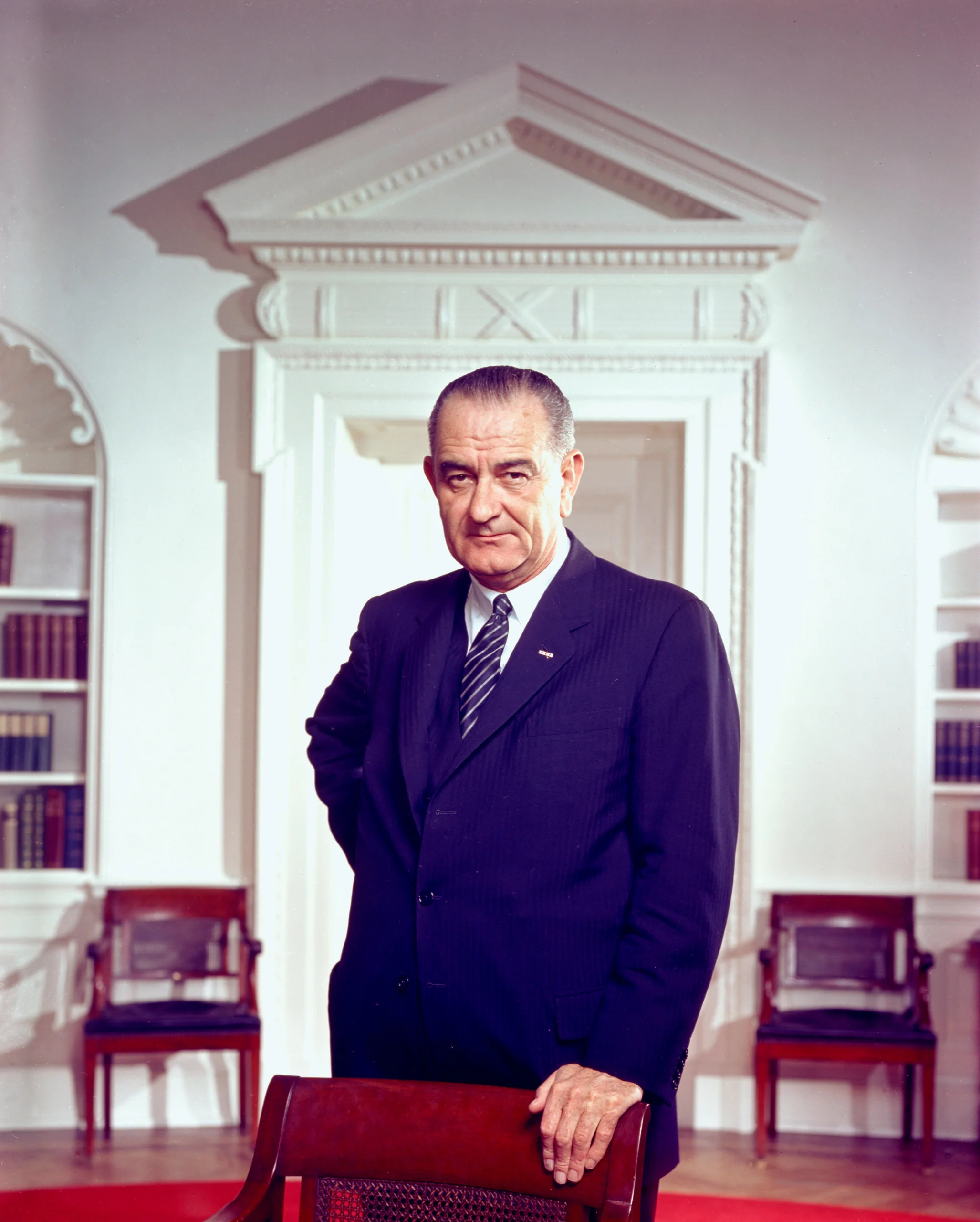
Lyndon B. Johnson
Also known as: LBJ, Landry, Sarge
Birthday
August 27, 1908
Birth Sign
Sagittarius
Birthplace
Stonewall, Texas
Age
Died at 64
Height
6 ft 2 in (188 cm)
About
Lyndon Baines Johnson was the 36th president of the United States, serving from November 22, 1963, until January 20, 1969. He assumed office following the assassination of John F. Kennedy and went on to win a landslide victory in the 1964 election. His presidency is defined by the ambitious Great Society domestic agenda, which sought to eliminate poverty and racial injustice through landmark legislation like the Civil Rights Act of 1964 and the Voting Rights Act of 1965. He also oversaw the signing of laws that created Medicare and Medicaid and prioritized the Apollo program that landed humans on the moon.
Before reaching the White House, Johnson built a formidable political career in Texas, rising from a high school teacher to the youngest Senate Majority Leader in history. Known for his intense personal style of persuasion called the "Johnson Treatment," he mastered legislative maneuvering to pass difficult bills. His legacy remains complex; while historians praise his domestic achievements as transformative, his escalation of the Vietnam War eroded public support and led him to withdraw from seeking re-election in 1968. He returned to his family ranch in Stonewall, Texas, where he died of a massive heart attack at age 64.
Early Life & Background
Lyndon Baines Johnson entered the world on August 27, 1908, in a small farmhouse near Stonewall in Gillespie County, Texas. He was the eldest of five children born to Samuel Ealy Johnson Jr., a politician who faced financial struggles, and Rebekah Baines Johnson. The rugged Hill Country landscape shaped his early worldview, instilling a deep connection to the land that would later define his retirement. The family moved to Johnson City when he was young, where he attended public schools and developed an interest in public service influenced by his father's ambitions.
After graduating from Southwest Texas State Teachers College in 1930 with a degree in history and education, Johnson took a job teaching at Welby High School in Houston. This experience proved transformative as he taught mostly Mexican-American students and witnessed firsthand the extreme poverty and lack of opportunity facing them. The frustration he felt seeing these disparities fueled his future domestic agenda. In 1931, he left teaching to move to Washington, D.C., where he worked as a legislative aide for Congressman Richard Kleberg. This role provided his first real introduction to federal politics and allowed him to learn the intricate mechanics of legislative maneuvering, a skill he would later perfect as Senate Majority Leader.
Career Growth
Johnson's political ascent began in earnest in 1937 when he won a special election to represent Texas's 10th congressional district in the U.S. House of Representatives. He served six terms in the House before running for the U.S. Senate in 1948. That election became infamous for the "Box 13" scandal in Jim Wells County, where allegations of fraud surrounded a late-arriving ballot box that allegedly secured his narrow victory over Coke Stevenson. Despite the controversy, Johnson claimed the win and took his seat in 1949. His rise continued rapidly; by 1953, he had become Senate Minority Leader, and in 1955, he became the youngest Senate Majority Leader in history at age 46.
In 1960, President-elect John F. Kennedy selected Johnson as his running mate, balancing regional appeal with political experience. When Kennedy was assassinated in Dallas on November 22, 1963, Johnson immediately assumed the presidency. He achieved one of the largest landslide victories in American history in 1964, winning 61.1% of the popular vote. Domestically, he launched the Great Society, signing the Civil Rights Act of 1964, the Voting Rights Act of 1965, and establishing Medicare and Medicaid. However, foreign policy troubles mounted as he escalated U.S. involvement in the Vietnam War, increasing troop levels from fewer than 17,000 to over 500,000 by 1968. Following poor results in the New Hampshire primary in March 1968, he announced he would not seek re-election. He left office in January 1969 and retired to his ranch in Stonewall, Texas.
Career Timeline
Public Image & Style
Lyndon B. Johnson is often portrayed as a complex figure celebrated for his domestic achievements but criticized for his handling of the Vietnam War. His signature style included a charismatic, forceful personality and a distinctive appearance characterized by thick glasses and a bow tie. Media portrayals emphasize his political acumen and his ability to navigate the complexities of Washington, D.C., while also highlighting the moral dilemmas he faced. The "Johnson Treatment" remains a legendary aspect of his public image, representing a relentless, physical style of persuasion that involved intense eye contact and close proximity to convince opponents.
Fame & Fandom (iFAMOUS Rankings)
iFANN has not yet collected fame data for this person. While there is no formal fandom name documented in current records, historians, political scientists, and enthusiasts of American history form a dedicated community that studies and discusses his life and legacy. Fan campaigns and projects typically focus on preserving historical sites like the LBJ Ranch, promoting educational initiatives, and advocating for civil rights causes inspired by his work. These groups keep the memory of his legislative achievements alive through annual events and scholarly discussions.
Interesting Facts and Legends
One of the most enduring stories about Lyndon B. Johnson is the origin of his nickname "Landy," which his family used throughout his childhood. During his time as a teacher and congressional aide, colleagues affectionately called him "Sarge." He possessed a remarkable ability to remember names and personal details about people, a trait he leveraged effectively during his political career to build alliances. Johnson was also a prolific letter writer, corresponding with thousands of individuals during his presidency to maintain connections with voters and constituents.
A significant historical fact often overlooked is that Johnson was the first president to appoint an African American to the Supreme Court, selecting Thurgood Marshall in 1967. He had a deep love for horses and owned several racehorses throughout his life, reflecting his Texan roots. His ranch in Stonewall remains a popular tourist destination today, offering guided tours of his home and grounds. Another quirky detail involves his toothbrushes; recent studies of his personal items have offered insights into public health trends of the mid-20th century.
Notable Quotes
“We shall overcome.”
“The test of our progress is not whether we add more to the abundance of those who have much; it is whether we provide enough for those who have too little.”
“The only way to get rid of the past is to face it.”
Family & Personal Life
Lyndon B. Johnson was married only once to Claudia Alta "Lady Bird" Taylor on November 17, 1934, in San Antonio, Texas. Lady Bird was a journalist and businesswoman who managed the family's finances and played a crucial role in his political career. Their marriage lasted until Johnson's death in 1973. The couple had two daughters: Lynda Bird Johnson Robinson, born in 1944, and Luci Baines Johnson, born in 1947. Lady Bird survived him by nearly 25 years, passing away in 1998. The children remain active in philanthropy and public life but have not held major political office. The family lived primarily in Texas, with their home base being the LBJ National Historical Park in Stonewall.
Notable Connections
Lady Bird Johnson, John F. Kennedy, Martin Luther King Jr., Thurgood Marshall, Robert McNamara, Hubert Humphrey
Relationships & Dating History
Lyndon B. Johnson was married only once. He wed Claudia Alta "Lady Bird" Taylor on November 17, 1934, in San Antonio, Texas. Lady Bird was a journalist and businesswoman who managed the family's finances and played a crucial role in Johnson's political career. Their marriage lasted until Johnson's death in 1973. There are no credible records of other romantic relationships or affairs during their marriage, though some historical speculation exists about his charm and charisma attracting attention from others. The couple had two daughters: Lynda Bird Johnson Robinson (born 1944) and Luci Baines Johnson (born 1947). As of 2026, Lyndon B. Johnson is deceased, having died on January 22, 1973, due to a massive heart attack. Lady Bird Johnson survived him by nearly 25 years, passing away on July 11, 1998. Their children remain active in philanthropy and public life.
- MarriedLady Bird Johnson1934 - 1973Married until Johnson's death; two daughters together.
Death & Aftermath
Died
January 22, 1973 (aged 64)
Death Place
Stonewall, Texas
Cause of Death
Massive coronary occlusion
Lady Bird Johnson discovered her husband Lyndon Baines Johnson unresponsive at his desk in the study of the LBJ Ranch on the afternoon of January 22, 1973. The former president, who had been recovering from a severe heart attack earlier that year and had withdrawn from public life during the winter of 1972-1973, suffered a fatal coronary occlusion around 1:00 PM. Medical personnel were summoned immediately to Stonewall, Texas, but the massive heart attack proved too advanced for intervention, and he was pronounced dead at the ranch house. President Richard Nixon issued a statement honoring Johnson's contributions to civil rights and the Great Society programs, while tributes poured in from former colleagues and international leaders acknowledging his pivotal role in shaping modern American legislation. The funeral service took place three days later on January 25, 1973, at the National City Christian Church in Washington, D.C., featuring eulogies that highlighted his legislative achievements alongside his complex political career.
Notable attendees included President Nixon, Vice President Spiro Agnew, former presidents Dwight D. Eisenhower, and members of John F. Kennedy's family, before the procession moved to the family cemetery on the ranch grounds for interment. Posthumous honors have included the placement of his portrait in the U.S. Capitol Rotunda and the dedication of the Lyndon Baines Johnson School of Public Affairs at the University of Texas at Austin. Annual wreath-laying ceremonies organized by the National Park Service and the Friends of Lyndon B. Johnson now serve as enduring memorials at the National Historical Park.
Net Worth (Estate Value)
$18 Million
iFANN Editorial Team estimate
As a deceased individual, Lyndon B. Johnson's net worth is assessed through the value of his estate. During his lifetime, Johnson accumulated significant wealth through his salary as a congressman, senator, vice president, and president, as well as investments and real estate holdings. At the time of his death, his estate was estimated to be worth approximately $10 million, equivalent to roughly $50 million in 2026 dollars, primarily consisting of his ranch in Stonewall, Texas, and various investments.
The Johnson estate continues to generate revenue through the Lyndon Baines Johnson Foundation, which manages the library and museum, and through licensing deals for his image and writings. Lady Bird Johnson's estate also contributed to the preservation of the ranch and the foundation's operations. Research by the iFANN Editorial Team puts X's fortune at around $18 million as of 2026, reflecting appreciation in real estate and ongoing royalties from publications and media related to his presidency.
Awards Won (4)
Lyndon B. Johnson received numerous awards and honors during his lifetime and posthumously. Notable among these are the Presidential Medal of Freedom, awarded posthumously in 1980 by Jimmy Carter, and the Congressional Gold Medal, awarded in 1993. He was inducted into the Hall of Great Westerners at the National Cowboy & Western Heritage Museum in 1975 and the Texas Hall of Fame in 1974. Multiple honorary degrees were conferred upon him by universities including Harvard, Yale, and Oxford. A postage stamp featuring his portrait was issued in 1980.
1980 · Civilian Honor
Lifetime Achievement
1993 · Legislative Honor
Lifetime Service
Known For
Lyndon B. Johnson
1963 · President of the United States
The Great Society
1964 · Domestic Policy Initiative
Civil Rights Act of 1964
1964 · Legislation Signed
Keywords
Sources
Quick Facts
- Profession
- politician, teacher, rancher
- Born
- August 27, 1908
- Birthplace
- Stonewall, Texas
- Died
- January 22, 1973
- Death Place
- Gillespie County, Texas
- Gender
- Male
- Spouse
- Lady Bird Johnson
- Birth Sign
- Sagittarius
Personal Details
- Full Name
- Lyndon Baines Johnson
- Height
- 6 ft 2 in (188 cm)
- Spouse
- Lady Bird Johnson
- Children
- Lynda Bird Johnson Robinson · Luci Baines Johnson
- Education
- Southwest Texas State Teachers College
Frequently Asked Questions
Who was Lyndon B. Johnson?
How did Lyndon B. Johnson die?
What were Lyndon B. Johnson's major achievements?
Did Lyndon B. Johnson have any children?
Why is Lyndon B. Johnson controversial?
Join the community
fans discussing