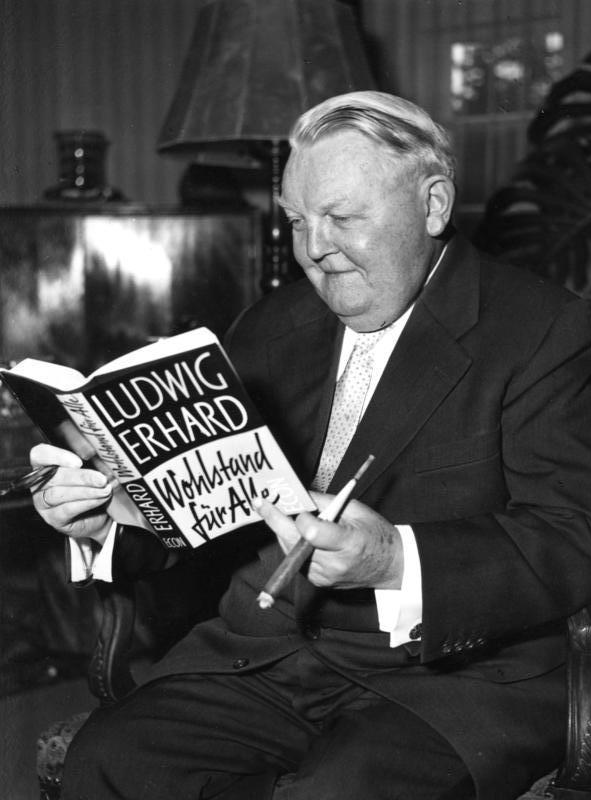
Ludwig Erhard
 Germany
economist•politician•university teacher
Birthday
+1897-02-04
Birth Sign
Aquarius
Birthplace
Fürth
Age
Died at 80
About
Ludwig Wilhelm Erhard, born on February 4, 1897, in Fürth, Germany, was a prominent economist and politician who left an indelible mark on postwar West Germany. As the architect of the country's economic recovery, he served as Minister of Economic Affairs from 1949 to 1963 under Chancellor Konrad Adenauer, then as Chancellor himself from 1963 to 1966. A member of the Christian Democratic Union (CDU), Erhard is best known for championing the social market economy, a model that balanced free-market capitalism with social welfare. This approach fueled the Wirtschaftswunder, the "economic miracle" that transformed West Germany from ruins into Europe's leading economy within a decade. Erhard's academic background in economics, with a doctorate from the University of Frankfurt, prepared him for his pivotal role in shaping policy. His 1949 currency reform and the removal of price controls, implemented despite Allied hesitations, are credited with jump-starting the German economic boom. Throughout his tenure as economics minister, he oversaw a period of unprecedented growth, low unemployment, and rising living standards, making him one of the most respected figures in West German politics. However, his chancellorship proved less successful. Erhard lacked the political backing of Adenauer, who remained CDU chairman until 1966, and struggled with a budget deficit and foreign policy challenges. His popularity declined, and he resigned on November 30, 1966. Despite this, his legacy endures: the social market economy remains the foundation of Germany's economic policy today. Erhard passed away on May 5, 1977, in Bonn, leaving behind a blueprint for postwar recovery that influenced economies worldwide. His works, including "Prosperity Through Competition," continue to be studied by economists and policymakers.
Fame & Fandom
The supporters of Ludwig Erhard do not coalesce into a formal fandom with a specific name, organized clubs, or ritualistic celebrations. His legacy is sustained by political adherents, historians, and economists rather than a fanbase engaging in cultural worship or public spectacle. Unlike entertainers whose careers generate viral moments, Erhard's influence was exercised through parliamentary procedure and economic reform, leaving no record of crowds shutting down streets or fans fainting at his presence. The iFANN Global Fame Engine evaluated this figure in August 2026 and determined that he currently holds no placement in the published rankings, including the Global Top 1,000 or any Top-100 scope list. This absence of a numeric rank reflects his status as a historical statesman rather than a contemporary celebrity subject to real-time popularity metrics. While his policies transformed West Germany from ruins into a leading economy, the data indicates he does not currently command the volume of global search signals or media consumption required for a ranked position in the current cycle. The evaluation confirms that while his historical impact remains profound, his fame does not translate into a quantifiable standing within the modern digital landscape measured by the engine. Consequently, no ordinal number or score can be assigned to his current global visibility, and no hyperlink to a ranking page exists for this entry.
Interesting Facts and Legends
Ludwig Erhard passed away on May 5, 1977, marking the end of an era for the post-war reconstruction period he led. He served as the Minister of Economic Affairs from 1949 to 1963 under Chancellor Konrad Adenauer before becoming Chancellor himself from 1963 to 1966. A widely retold story centers on his tenure as Minister of Economics, where he implemented the liberalization of the German economy in 1948. This policy decision is credited with transforming West Germany from a post-World War II ruin into one of the world's leading economic powers. Unlike pop stars, there were no on-stage moments or disrupted events; instead, his iconic status stems from the tangible economic recovery he engineered. Historical accounts describe him as an architect of recovery who understood the limitations of power. Some modern articles discuss his relevance today or debate the specifics of the economic miracle, such as the role of the Deutschmark, but these are contemporary political analyses rather than folklore. There are no verified stories of him causing chaos or supernatural reactions from the public.
Death & Aftermath
Died
+1977-05-05 (aged 80)
Death Place
Bonn, North Rhine-Westphalia, West Germany
Cause of Death
Natural causes
Ludwig Erhard spent his final years in relative obscurity after retiring from active politics in 1966, residing quietly in Bonn while the nation he helped rebuild moved forward. On May 5, 1977, the former Chancellor and architect of the social market economy passed away at the age of eighty in that same city. Official records confirm the event as a natural passing following a long life of public service, with no specific medical details regarding the immediate cause provided in available documentation. Tributes to Erhard focused on his enduring legacy as the father of Germany's economic miracle rather than immediate mourning events or public vigils.
His name remains invoked in contemporary political discourse regarding economic policy, with ongoing analysis of his role in creating the Deutschmark and transforming West Germany into Europe's leading economy. While specific details regarding the exact date or nature of his funeral arrangements are not widely highlighted in general biographical summaries, his memory has been institutionalized through the Ludwig Erhard Foundation, which promotes free-market economics and social responsibility. The annual Ludwig Erhard Summit continues to serve as a forum for economic dialogue, and various centers including the Ludwig Erhard Center in Fürth preserve his historical contribution.
Awards & Accolades
Keywords
Quick Facts
- Profession
- economist, politician, university teacher
- Born
- +1897-02-04
- Birthplace
- Fürth
- Died
- +1977-05-05
- Death Place
- Bonn
- Gender
- Male
- Spouse
- Luise Erhard
- Birth Sign
- Aquarius
Personal Details
- Spouse
- Luise Erhard
Join the community
fans discussing