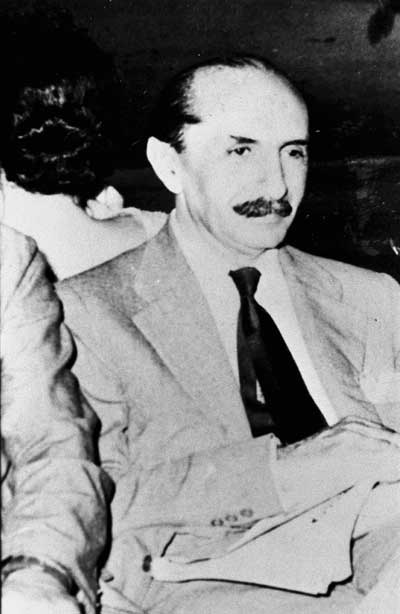
Lúcio Costa
 Brazil
Birthday
+1902-02-27
Birth Sign
Sagittarius
Birthplace
Toulon
Age
Died at 96
About
Lúcio Costa, born Lúcio Marçal Ferreira Ribeiro Lima Costa on 27 February 1902 in Toulon, France, was a Brazilian architect and urban planner whose name is forever tied to the modernist dream of Brasília. He studied at the National School of Fine Arts in Rio de Janeiro and, after a brief flirtation with neoclassicism, embraced the radical simplicity of Le Corbusier, becoming a leading voice in Brazilian modernism. Costa's most famous work is the Pilot Plan of Brasília, the city that became Brazil's capital in 1960. His design, shaped like an airplane or a bird in flight, placed monumental government buildings at the center and residential 'superblocks' along the wings, a bold experiment in urban planning that earned him international acclaim and a UNESCO World Heritage listing. But Costa's influence stretched far beyond the capital. In the 1930s, he worked with a young Oscar Niemeyer on the Ministry of Education and Health building in Rio, a landmark of modernist architecture. He also designed the Parque Guinle residential complex and the Museum of Modern Art in Rio, though the latter was never built. Costa passed away on 13 June 1998 in Rio de Janeiro, at the age of 96, leaving behind a legacy that sparked both admiration and debate, but never indifference.
Fame & Fandom
Lúcio Costa never courted a celebrity following in the manner of pop stars, for his legacy rests not on concerts or chart-topping singles but on the concrete reality of Brasília. His admirers are architects, urban planners, preservationists, and citizens who view him as the father of their capital, yet this community lacks a formal fandom name or consumerist rituals like birthday billboards. Instead of viral campaigns, his supporters engage in defensive intellectual movements to protect his master plan from modernization pressures, while the Espaço Lúcio Costa serves as a physical shrine where students study the superblocks he designed. The discourse surrounding his work remains serious and academic, focused on the social implications of his zoning rather than the lighthearted memes found in entertainment circles. Although a persistent folklore debate exists regarding whether his pilot plan resembles a bird or an airplane, these stories serve as cultural touchstones for historians rather than fan inside jokes. In August 2026, the iFANN Global Fame Engine evaluated his standing among historical figures and determined that he does not currently hold a placement in the published rankings. Consequently, no ordinal rank or score is assigned to his global fame status at this time.
Interesting Facts and Legends
Lúcio Costa was born in Toulon, France, before becoming a leading voice in Brazilian modernism after embracing the radical simplicity of Le Corbusier. A famous piece of folklore surrounding his most famous work involves the shape of the Pilot Plan; while Costa officially described the layout as resembling a bird representing freedom, many critics insist it looks like an airplane symbolizing progress. Another legendary narrative concerns the partnership between Costa and Oscar Niemeyer, portraying them as the yin and yang of Brazilian modernism with Costa designing rigid grids while Niemeyer filled them with fluid curves. Recent retrospectives have also highlighted a legend suggesting that the speculative planning of Rio de Janeiro during the 2016 Olympics resulted from ignoring human-centric plans proposed by pioneers like Costa.
Death & Aftermath
Died
+1998-06-13 (aged 96)
Death Place
Rio de Janeiro, Brazil
Cause of Death
Natural accident while driving due to vision impairment
Lúcio Costa, the architect who shaped the modernist capital of Brasília, died on June 13, 1998, in Rio de Janeiro at the age of 96. The incident was recorded as a natural accident occurring while driving, with reports indicating that Costa fell asleep behind the wheel due to severe vision impairment caused by glaucoma and cataracts that had worsened in his later years. Public reaction to his passing included widespread tributes from architectural peers and institutions, which honored his monumental contribution to urban planning through retrospectives and continued academic study of his work.
In the decades following his death, his legacy has been sustained through the ongoing maintenance of Brasília and the inclusion of his designs in global architectural discourse. Specific details regarding the funeral or memorial service remain unconfirmed in available sources, yet his remains were interred in a manner befitting his stature as a national hero. Posthumously, Costa's estate and legacy have been actively managed through the preservation of his architectural works and the digitization of his archives, ensuring his plans and documents remain accessible to researchers and the public.
A significant step in preserving his memory occurred in 2026 when the Federal District of Brasília and Casa da Arquitectura signed an agreement to expand public access to his digital archive. His designs, such as the Gávea House completed in 1988, continue to be subjects of contemporary architectural analysis and exhibition. The handling of his estate focuses on the protection and dissemination of his intellectual property and physical archives rather than commercial exploitation, cementing his status as a pivotal figure in 20th-century architecture.
Awards & Accolades
Keywords
Quick Facts
- Profession
- architect, urban planner
- Born
- +1902-02-27
- Birthplace
- Toulon
- Died
- +1998-06-13
- Death Place
- Rio de Janeiro
- Gender
- Male
- Birth Sign
- Sagittarius
Join the community
fans discussing