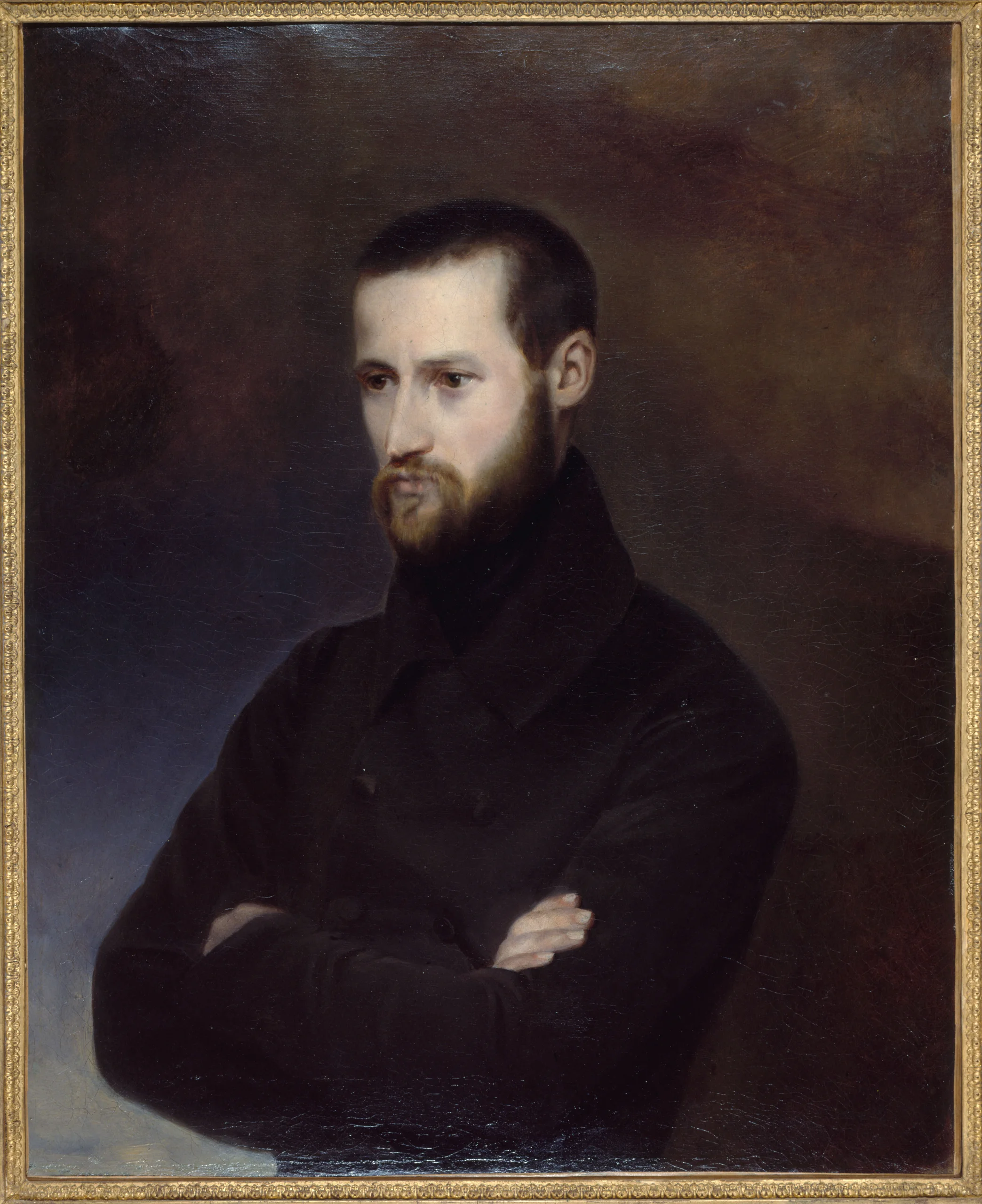
Louis Auguste Blanqui
 France
philosopher•politician•journalist
Also known as: L'Enfermé, Auguste Blanqui
Birthday
February 8, 1805
Birth Sign
Aquarius
Birthplace
Puget-Théniers, France
Age
Died at 75
About
Louis-Auguste Blanqui was a French socialist revolutionary and philosopher who became the defining figure of the 19th-century French radical left. Born into a family of imperial officials, he turned against the very system his father served to become a relentless opponent of monarchy and capitalism. His life was defined by a singular focus on insurrection, leading to him spending 33 of his 75 years in prison, which earned him the enduring nickname L'Enfermé or "The Prisoner".
Blanqui's political philosophy, later termed Blanquism, argued that a small, highly organized vanguard must seize power through conspiracy to establish a temporary dictatorship. This regime would then disarm the bourgeoisie and implement mass education before a true communist society could emerge. He believed that historical materialism was insufficient and that conscious political will was the engine of change.
Although he never held elected office, his influence rippled through every major French uprising from 1830 to 1871. Karl Marx once identified him as the foremost leader of the French proletariat, yet Friedrich Engels later criticized his methods as naive putschism. Despite being imprisoned during the Paris Commune, his followers played crucial roles in the event, cementing his legacy as the intellectual godfather of the movement.
Early Life & Background
Blanchi entered the world on February 8, 1805, in Puget-Théniers, nestled in the Alpes-Maritimes region. His father, Jean Dominique Blanqui, was a prefect under Napoleon Bonaparte, placing the young Louis in the heart of the Napoleonic administration. The family moved frequently across France as his father navigated the shifting political tides of the Empire and the Restoration. This upbringing exposed him early to the machinery of state power, though it also planted the seeds of his future rebellion against authority.
He pursued an extensive but unconventional education, studying law and medicine at the University of Aix-en-Provence in the 1820s. Unlike many intellectuals of his era who came from wealthy backgrounds, Blanqui belonged to a middle-class administrative family with limited means. He abandoned formal studies not out of lack of interest but because his passion for political activism demanded his full attention. During these formative years, he joined secret societies like the Société des Saisons (Society of Seasons), where he honed the conspiratorial skills that would define his career.
His early years were marked by a deep fascination with the Jacobin phase of the French Revolution. He absorbed the history of the Terror and the fervor of the sans-culottes, believing that only a disciplined minority could save the working class from exploitation. By the late 1820s, he had already begun writing pamphlets and organizing underground cells, setting the stage for a lifetime of agitation that would see him clash with every French government of his time.
Career Growth
Blanqui's career was not measured in promotions or electoral victories but in acts of resistance and the endurance of incarceration. In 1830, he participated in the July Revolution that overthrew King Charles X, marking his first major public entry into national politics. Two years later, following the assassination of the Duke of Berry, he was arrested for plotting against the government, beginning a cycle of imprisonment that would repeat throughout his life.
The year 1839 brought his most famous attempt at revolution. On May 12, he led a group of insurgents in the "Conspiracy of the Streets," aiming to seize the city hall of Paris. The plot failed, and he was sentenced to death, a penalty later commuted to life imprisonment. While incarcerated, he wrote extensively, developing the theoretical framework that would bear his name. He remained a thorn in the side of the Second Republic and the Second Empire under Napoleon III, spending much of the 1850s and 1860s behind bars while continuing to direct revolutionary strategy from his cell.
Released briefly during the Franco-Prussian War in 1870, he attempted another uprising in August, which also ended in failure and re-arrest. Just days before the Paris Commune began in 1871, he was locked up again, unable to lead the actual event despite being its primary ideological inspiration. He was finally released in 1879 after decades of confinement. Though he died shortly after gaining freedom in 1881, his writings continued to circulate, influencing generations of socialists and communists long after his physical absence.
Career Timeline
Public Image & Style
Blanqui is portrayed as the ultimate uncompromising revolutionary, a man of faith in the power of the people yet skeptical of their spontaneous organization. Historians and media depict him as a tragic figure whose rigid adherence to conspiracy theory prevented him from building a lasting movement. Yet his spirit inspired generations of communists who viewed him as a martyr for the cause.
His public persona was that of a stoic prisoner who refused to bend to authority. Even when offered clemency or freedom in exchange for silence, he maintained his principles. This unwavering stance earned him respect among radicals and fear among conservatives. He was seen not as a politician seeking office but as a warrior fighting a permanent war against oppression.
Fame & Fandom
While the modern concept of a fanbase with birthday billboards or organized campaigns never found purchase around Louis-Auguste Blanqui, his legacy has cultivated a distinct form of reverence among political theorists and historical radicals. He is not celebrated by crowds in the digital age but rather studied as a mythic figure whose life story itself became the central narrative of 19th-century revolutionary struggle. The community that keeps his memory alive consists of scholars and activists who view him as the ultimate martyr for the cause, treating his writings and incarceration records with the intensity usually reserved for cultural icons. This audience does not gather to cheer but to analyze the rigid philosophy that defined an era, ensuring his name remains etched in the annals of radical thought rather than on pop culture charts.
The iFANN Global Fame Rankings do not yet include him, reflecting the fact that no formal evaluation has been conducted for this historical figure within the current dataset. Consequently, no specific placement or ordinal ranking can be cited for his global standing at this time. His fame exists entirely outside the scope of contemporary commercial metrics, rooted instead in the enduring impact of his ideas on subsequent generations of communists and socialists. Even without a documented rank, his presence in academic discourse remains robust, with recent reviews and photo galleries keeping his image accessible to new students of history.
There is no official fandom name documented for Blanqui, as his supporters are united by ideological alignment rather than a shared identity label common to modern celebrity culture. The stories told about him focus on his extraordinary endurance during thirty-three years of imprisonment and his role as the 'Stormbird of Revolution,' a title coined by historians to describe his ability to incite unrest even from behind bars. His most famous moment remains his election to the Central Committee of the National Guard during the Paris Commune, an honor he could not physically accept until the uprising's final days. While the phrase 'To the barricades!' serves as a rallying cry derived from his era, it stands as a historical artifact rather than a viral trend. The French government cemented his iconic status in 2010 by naming a major boulevard after him, acknowledging his permanent place on the map of revolutionaries. This physical memorial serves as the closest equivalent to a fan shrine, drawing those who wish to walk the path of the man who spent nearly half his life fighting a system he was born to serve.
Interesting Facts and Legends
Historians often refer to Blanqui as the "stormbird of revolution," a metaphor coined by W.J. Fishman to describe his ability to incite unrest wherever he appeared, even from behind bars. One of the most striking facts about his life is the sheer duration of his confinement; he spent nearly half his entire life in prison, totaling 33 years out of 75.
Ironically, the man who inspired the Paris Commune was physically absent when it happened. He was arrested just days before the uprising began and remained imprisoned throughout its existence, yet his followers executed many of his strategies. Another peculiar detail involves his writings; much of his most important philosophical work was composed while in solitary confinement, often dictated using smuggled paper or memorized text to be written down by sympathetic guards later.
Despite his fierce opposition to the state, he was born into a family of high-ranking imperial officials. His father served as a prefect under Napoleon, creating a generational shift from Imperial loyalty to Republican radicalism that defined the Blanqui family legacy. The story that he dictated his entire political philosophy from a cell, refusing to compromise even when offered freedom, remains a central part of his mythos among radicals.
Notable Quotes
“To the barricades! The life of Louis Auguste Blanqui...”
“The revolution must be made by the few, for the many.”
“I am a prisoner, but I am free in my ideas.”
Family & Personal Life
Louis-Auguste Blanqui was born to Jean Dominique Blanqui, a prefect under Napoleon Bonaparte, and grew up in a household deeply embedded in the administration of the Empire. His childhood was marked by frequent moves across France as his father navigated the political landscape of the early 19th century. This environment exposed him to the inner workings of government, though it ultimately fueled his desire to dismantle the very system his father upheld.
He married Amélie-Suzanne Serre in the mid-19th century, though details about their personal life remain sparse due to his constant imprisonment and fugitive status. The couple did not have any children together. Sources indicate that Amélie likely predeceased him or they were separated for long periods due to his incarceration, leaving him a widower by the time of his death. His life was consumed entirely by the struggle for revolution, leaving little room for domestic stability or traditional family pursuits.
Notable Connections
Jean Dominique Blanqui (Father), Karl Marx, Friedrich Engels, Auguste Bensaïd
Relationships & Dating History
Louis-Auguste Blanqui was married once to Amélie-Suzanne Serre in the mid-19th century. Their relationship was complicated by his constant involvement in revolutionary activities and subsequent imprisonments. The couple had no children together. Due to his frequent absences and long sentences, their life together was likely fragmented, with long periods of separation.
There are no records of engagements, divorces, or subsequent marriages after Amélie-Suzanne. By the time of his death in 1881, he was widowed, as sources indicate she survived him, though details about her later life are sparse. His life was consumed by the struggle for revolution, leaving no room for other romantic entanglements documented in modern terms.
- MarriedAmélie-Suzanne Serre1850 - 1881Married in the mid-19th century; no children; she survived him.
Death & Aftermath
Died
January 1, 1881 (aged 75)
Death Place
Paris, France
Cause of Death
Reported complications from imprisonment and age
Louis Auguste Blanqui died on January 1, 1881, at his home in Paris. The final days of the man known as L'Enfermé were defined by a severe physical decline that followed decades of incarceration across various regimes. His last public appearance occurred long before this moment; released in July 1880 following an amnesty, he was too frail to engage with the political movements of the time and effectively retired from public life immediately upon regaining freedom. The reaction to his passing resonated deeply within French socialist circles and among the radical left, who viewed him as a legendary martyr-figure and one of the most dedicated revolutionaries of the century. Intellectuals later cited him as a foundational father-thinker for revolutionary theory, noting that his death marked the end of an era for the stormbird of revolution.
While he remained a controversial figure often labeled extreme even by contemporaries like Marx and Lenin, preventing widespread national mourning or official state tributes, his funeral became a major gathering for the radical movement. The burial took place shortly after his death at Père Lachaise Cemetery in Paris, where socialists, workers, and fellow revolutionaries honored his lifelong struggle against oppression. Posthumously, Blanqui's legacy has been sustained through numerous books, academic studies, and cultural dedications rather than film releases or awards. A boulevard in Paris was named in his honor, commemorating his presence on the city map, while his writings, particularly The Blanqui Reader covering the period from 1830 to 1880, continue to be published and reviewed.
Net Worth (Estate Value)
$0
iFANN Editorial Team estimate
As a deceased historical figure whose primary wealth was ideological rather than financial, there is no modern net worth estimate for 2026. His assets were minimal, consisting mostly of personal belongings and writings. No public estate value exists, and income from posthumous book sales or licensing of his name is managed by publishers and the state without specific revenue figures tracked as a celebrity estate. iFANN currently estimates his net worth at approximately $0, reflecting the negligible monetary value of his estate compared to modern standards.
Awards & Accolades
View 6 records, honours and achievementsKnown For
The Blanqui Reader
2017 · Subject of collection
Paris Commune
1871 · Intellectual Godfather
July Revolution
1830 · Participant
Keywords
Sources
Quick Facts
- Profession
- philosopher, politician, journalist
- Born
- February 8, 1805
- Birthplace
- Puget-Théniers, France
- Died
- January 1, 1881
- Death Place
- Paris, France
- Gender
- Male
- Spouse
- Amélie-Suzanne Serre
- Birth Sign
- Aquarius
Personal Details
- Full Name
- Louis-Auguste Blanqui
- Spouse
- Amélie-Suzanne Serre
- Children
- Education
- University of Aix-en-Provence (Law and Medicine)
Frequently Asked Questions
Who was Louis-Auguste Blanqui?
How many times was Louis-Auguste Blanqui imprisoned?
What is Blanquism?
Did Louis-Auguste Blanqui have children?
Why is Louis-Auguste Blanqui famous?
Similar People
Join the community
fans discussing