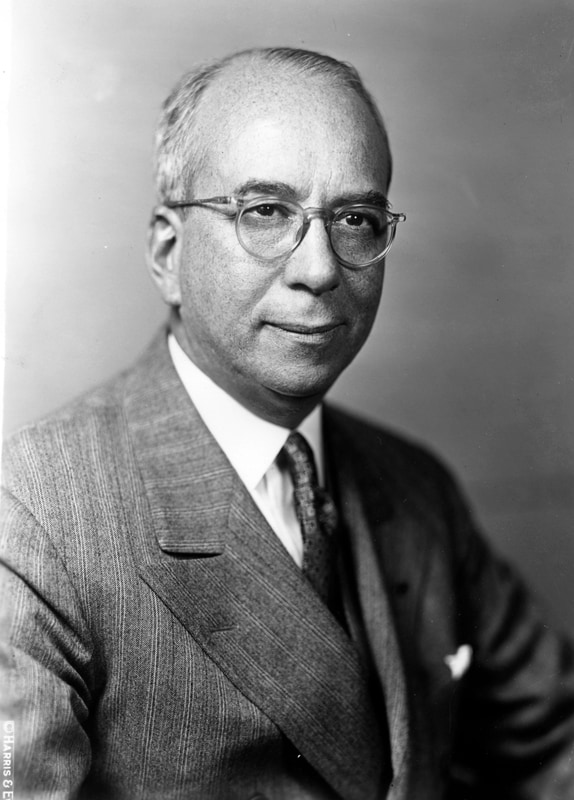
Lewis Strauss
 United States
Government official•businessman•naval officer
Also known as: Lewis L. Strauss
Birthday
January 31, 1896
Birth Sign
Aquarius
Birthplace
Charleston, West Virginia, USA
Age
Died at 77
About
Lewis Strauss was an American government official, businessman, naval officer and philanthropist who shaped U.S. nuclear policy after World War II. He served as one of the original members of the Atomic Energy Commission in 1946 and as its chairman from 1953 to 1958, wielding decisive influence over the nation's atomic energy and weapons programs. Strauss was a forceful advocate for developing the hydrogen bomb and maintained a hardline stance on secrecy around U.S. atomic secrets. He famously predicted atomic power would make electricity "too cheap to meter" while downplaying health risks from radioactive fallout. His role in revoking J. Robert Oppenheimer's security clearance in 1954 made him a deeply controversial figure, often cast as the villain in that story. In 1959, President Eisenhower nominated him for Secretary of Commerce, but the Senate rejected his confirmation after a bitter political battle, the eighth cabinet nominee in U.S. history to be denied. Strauss died of cancer in 1974. Today he is remembered as a pivotal yet polarizing architect of America's nuclear age; his record of public service, advocacy for thermonuclear weapons, and the long-term consequences of his policy decisions continue to be studied and debated by historians, policymakers, and students of the Cold War.
Early Life & Background
Lewis Lichtenstein Strauss was born on January 31, 1896, in Charleston, West Virginia. He was raised in Richmond, Virginia, where his family faced modest beginnings. A significant event in his childhood occurred at age ten when he lost much of the vision in his right eye during a rock fight, an injury that would later disqualify him from normal military service. That same year, a seemingly small incident sparked a profound intellectual curiosity: while waiting for a dentist appointment, Strauss used a vibrating tuning fork to create waves in a bowl of mercury. This simple experiment ignited a lifelong fascination with physics, leading him to devour books on radiation and wave mechanics throughout his high school years.
Strauss excelled academically, graduating as valedictorian of his Richmond high school class. He earned a scholarship to the University of Virginia, but his plans for higher education were derailed when he contracted typhoid fever and was unable to graduate in time, ultimately preventing his college attendance. After his recovery, in 1913, he joined his father's struggling shoe business, taking on the role of a traveling salesman. Through diligent work, Strauss managed to save an impressive $20,000 by his 20th birthday. Although he was still considering college, he ultimately chose a different path that would prove pivotal. In 1917, inspired by his mother's advice, he learned of Herbert Hoover's appointment as U.S. Food Administrator. Seizing the opportunity, Strauss volunteered his services without pay as Hoover's administrative assistant, a decision that decisively launched his career in public service.
Career Growth
Strauss served as assistant to Herbert Hoover with the Commission for Relief in Belgium and the American Relief Administration from 1917 to 1919, working from Paris on the allocation of 27 million tons of food after the Armistice. He turned down an offer to be comptroller for the League of Nations and returned to the U.S., joining Kuhn, Loeb & Co. in 1919 and becoming a partner by 1929. During the 1930s, as a member of the American Jewish Committee, he tried unsuccessfully to change U.S. refugee policy to accept more Jews fleeing Nazi Germany. He also funded early research by physicist Leo Szilard.
In World War II, Strauss volunteered for active duty and was assigned to the Bureau of Ordnance, where he streamlined research programs and improved the Navy's inspection system. He became special assistant to Secretary of the Navy James Forrestal in May 1944, and President Truman promoted him to rear admiral in November 1945. In 1946, he was appointed to the first U.S. Atomic Energy Commission. After the Soviets tested their first atomic bomb in 1949, Strauss pushed hard for development of thermonuclear weapons. Appointed AEC chairman by Eisenhower in 1953, he led the controversial 1954 hearings that revoked J. Robert Oppenheimer's security clearance. He served as acting Secretary of Commerce from November 1958 to June 1959, but the Senate rejected his confirmation. He then retired to Brandy Rock Farm in Virginia and wrote his memoirs.
Career Timeline
Public Image & Style
Strauss was described as "urbane but sometimes thorny," "owlish-faced," and intellectually arrogant. He enjoyed dinner parties and could be warm-hearted yet seem like a "stuffed shirt." Historians note he was intolerant of dissent, unskilled at compromise, and saw things in black and white. His portrayal in Christopher Nolan's 2023 film Oppenheimer, where Robert Downey Jr. played him as a calculating antagonist, cemented his image as a controversial, even villainous, figure in American history. Following the film, he became a subject of intense debate on platforms like Reddit's r/AskHistorians and r/movies, with fans and critics arguing over the accuracy of his depiction. No official fandom name exists, but his legacy is now closely tied to that film.
Fame & Fandom (iFAMOUS Rankings)
For decades, Lewis Strauss existed primarily as a shadowy figure in Cold War history books and the domain of serious political scientists, a man whose name was synonymous with bureaucratic ruthlessness rather than public adoration. He never cultivated a fanbase in the traditional sense; there are no organized groups calling themselves "Strauss fans," nor do birthday billboards or charity drives appear in his honor. The only audience that has ever rallied around him consists of historians, students of the atomic age, and moviegoers captivated by the narrative of his rivalry with J. Robert Oppenheimer. This dynamic shifted dramatically following the release of Christopher Nolan's 2023 film Oppenheimer, which introduced a new generation to the character portrayed by Robert Downey Jr., transforming Strauss from a niche historical subject into a global cultural symbol of political vengeance.
Despite this surge in popular interest driven by cinema, iFANN's Global Fame Engine evaluated Lewis Strauss in August 2026 and determined that he does not currently hold a placement in the published rankings, including the Global Top 1,000 or any Top-100 scope list. While the film generated massive discourse regarding the cast and the broader story of the atomic bomb, the engagement remained focused on the artistry of the production rather than elevating Strauss himself to a ranked celebrity status. Consequently, he remains an EVALUATED_UNRANKED figure within the system, recognized for his historical impact but lacking the specific fame metrics required for a numerical position in the world's most famous people lists.
Interesting Facts and Legends
Lewis Strauss was a self-made man who rose from being a traveling shoe salesman to becoming one of the most powerful figures in American nuclear policy, all without ever attending college. Despite his lack of formal higher education, he maintained a gifted amateur's knowledge of physics that he pursued privately throughout his life. His early career path was altered by a bout of typhoid fever that prevented him from enrolling at the University of Virginia, forcing him into the business world where he eventually made a fortune on the stock market. He was also known for his social skills, performing sleight-of-hand magic at dinner parties and earning a reputation as a warm-hearted yet intellectually arrogant host.
The most enduring legend surrounding Strauss is his orchestration of the 1954 security clearance hearing against J. Robert Oppenheimer, a move widely viewed as a personal vendetta that destroyed the father of the atomic bomb. This act of political revenge culminated in his own downfall when the U.S. Senate rejected his nomination for Secretary of Commerce in 1958, a historic rebuke interpreted as direct retribution from the scientific community. Another lesser-known fact is that his last name is pronounced "Straws," not "Strowss," a detail often missed by those unfamiliar with his background.
Notable Quotes
“The time has now come for a quantum jump in our planning... We should now make an intensive effort to get ahead with the super.”
“Atomic power will make electricity too cheap to meter.”
“No sacrifice was too great to defend his country's safety.”
Family & Personal Life
Strauss was the son of Rosa Lichtenstein and Lewis Strauss, a successful shoe wholesaler. Both parents were Jewish emigrants from Germany and Austria who came to the United States in the 1830s and 1840s and settled in Virginia. The family moved to Richmond, Virginia, where Lewis grew up. He married Alice Hanauer, though few details about their marriage are publicly documented. The couple had no known children. In his later years, Strauss lived at Brandy Rock Farm in Brandy Station, Virginia, where he died.
Notable Connections
Strauss was Herbert Hoover's protégé and remained deeply loyal to him. He appointed J. Robert Oppenheimer as director of the Institute for Advanced Study but later led the effort to revoke his security clearance. He worked closely with Edward Teller and Ernest O. Lawrence in pushing for the hydrogen bomb. His adversaries on the AEC included David Lilienthal and Hans Bethe. He funded early research by physicist Leo Szilard. In popular culture, he is portrayed by Robert Downey Jr. in the 2023 film Oppenheimer.
Relationships & Dating History
Strauss was married to Alice Hanauer. Very little public information exists about their relationship, including when they married. The couple had no known children. Strauss died on January 21, 1974, at age 77. His wife Alice predeceased him or survived him, records are unclear. There are no records of any other romantic relationships or marriages.
- MarriedAlice Hanauer? - 1974Very little public information exists about their relationship. They had no known children.
Death & Aftermath
Died
January 21, 1974 (aged 77)
Death Place
Unknown
Cause of Death
Unknown
Net Worth (Estate Value)
Strauss died in 1974, and specific net worth figures are not widely published by celebrity-net-worth sites. As a self-made investment banker who became a partner at Kuhn, Loeb & Co. and later a high-ranking government official, he accumulated significant wealth. He owned Brandy Rock Farm in Brandy Station, Virginia, where he died. His wealth sources included his investment banking career at Kuhn, Loeb & Co., stock market investments between World War I and World War II, his government salary as AEC chairman and Secretary of Commerce, and the Brandy Rock Farm property. No publicly available information exists on current estate management, posthumous earnings, or licensing deals. The 2023 film Oppenheimer may have generated some licensing or biographical rights income for his estate, but specific figures are not publicly documented.
Awards & Accolades
View 2 records, honours and achievementsKnown For
Chairman of the U.S. Atomic Energy Commission
1953 · Chairman
Oppenheimer security clearance hearings
1954 · Lead prosecutor
Acting Secretary of Commerce
1958 · Acting Secretary
Keywords
Sources
Quick Facts
- Profession
- Government official, businessman, naval officer
- Born
- January 31, 1896
- Birthplace
- Charleston, West Virginia, USA
- Died
- January 21, 1974
- Death Place
- Brandy Station, Virginia, USA
- Gender
- Male
- Birth Sign
- Aquarius
Personal Details
- Full Name
- Lewis Lichtenstein Strauss
- Spouse
- Alice Hanauer
- Education
- High school valedictorian in Richmond, Virginia; did not attend college
Frequently Asked Questions
Why did Lewis Strauss hate Robert Oppenheimer?
How did Lewis Strauss die?
Did Lewis Strauss have children?
Was Lewis Strauss confirmed as Secretary of Commerce?
Is Lewis Strauss a villain in Oppenheimer?
Join the community
fans discussing