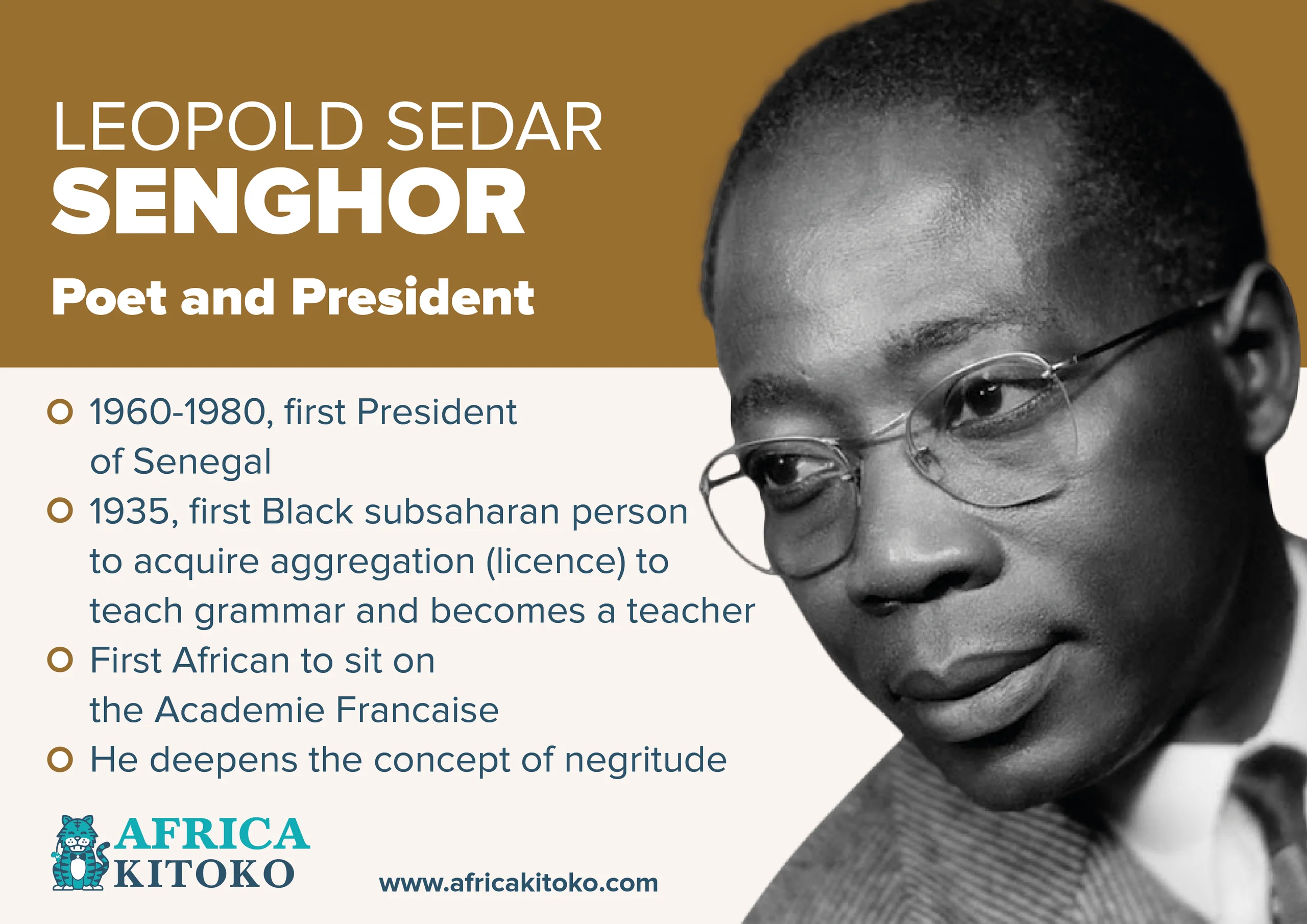
Léopold Sédar Senghor
 Senegal
Also known as: LS Senghor, President Senghor, The Poet-President
Birthday
October 9, 1906
Birth Sign
Libra
Birthplace
Joal-Fadiouth, Senegal
Age
Died at 95
Height
5 ft 9 in (1.75 m)
About
Léopold Sédar Senghor was a Senegalese politician, cultural theorist, and poet who served as the first President of Senegal from its independence in 1960 until his retirement in 1980. A towering figure of the 20th century, he is best known as a co-founder of the Négritude movement alongside Aimé Césaire and Léon-Gontran Damas, and for being the first African elected to the Académie française in 1983. His life bridged the worlds of high literature and high politics, defining the intellectual and political landscape of post-colonial Africa. Senghor passed away on December 20, 2001, in Verson, France, at the age of 95. He left behind a legacy that continues to influence African literature and political thought globally. The Fondation Léopold Sédar Senghor in Dakar manages his archives and promotes his work, ensuring his vision of a "civilization of the universal" remains relevant to scholars and students today.
His stature as a global intellectual is underscored by TIME Magazine naming him one of the "100 Most Important People of the 20th Century" in 1998 and the BBC ranking him among the top 100 Africans of all time in 2004. Beyond his political tenure, he received the UNESCO Grand Prix for Poetry in 1998 and honorary doctorates from prestigious institutions including Harvard University and the University of Paris. His image appeared on the cover of TIME Magazine in 1961 with the headline "The New Africa," highlighting his role as a leader of independent nations. Today, his personal library, containing over 800 works, resides in Dakar following a significant acquisition by the Senegalese government in May 2024, cementing his status as a foundational figure in Francophone culture.
Early Life & Background
Born into a Serer family in the small island town of Joal-Fadiouth near Dakar, Senghor's early life was shaped by the traditions of West Africa and the influence of French colonial education. His father, Djibril Senghor, was a wealthy trader and village chief, while his mother, Gnilane Ndiaye Senghor, was of Fulbe descent. The name "Sédar" is a Wolof term meaning "prince" or "leader," reflecting his father's status within the community. His formal education began at the Ngasobil boarding school run by the Fathers of the Holy Spirit at age eight, where he learned French and Catholicism, which would deeply influence his worldview. He later attended the Lycée Faidherbe in Saint-Louis before winning a scholarship to study in France in 1928. Moving to Paris, he attended the Lycée Louis-le-Grand and subsequently the Sorbonne, earning a degree in Latin grammar and classical literature. During these formative years in the French capital, he met Aimé Césaire and Léon-Gontran Damas, forming the core of what would become the Négritude movement. This intellectual circle sought to affirm black identity and culture against the backdrop of French colonial assimilation policies.
Before entering the political spotlight, Senghor established himself as a respected scholar and teacher. Between 1935 and 1945, he taught Latin and Greek at various lycées in Le Havre, Marseille, and Montpellier. It was during this period that he published his first major poetry collections, including Chants d'ombre in 1945 and Hosties noires in 1948, which garnered critical acclaim and cemented his reputation as a leading voice of African literature. His pivotal moment arrived during World War II when he served as a soldier in the French army. Captured by German forces in 1940, he spent five years as a prisoner of war. It was in a German prison camp that he wrote much of his most famous poetry, blending traditional African rhythms with modern French verse. This experience deepened his resolve to fight for African dignity and autonomy, setting the stage for his transition from poet to statesman upon his release in 1945. Upon returning to Senegal, he founded the Senegalese Democratic Bloc (BDS) in 1948, marking his official entry into the political arena after decades of literary and academic pursuit.
Career Growth
Senghor's political career unfolded through several key milestones that reshaped Senegal and its relationship with France. In 1948, he founded the Senegalese Democratic Bloc (BDS), becoming a prominent opposition figure in the French National Assembly. By 1956, he had been elected as the first African member of the French National Assembly and served as Minister of State under the French government. He played a crucial role in the creation of the French Community in 1957–1958, advocating for a federal structure rather than immediate full independence. Following the referendum for independence, Senegal became independent on August 20, 1960, and Senghor was elected as the first President of the Republic. His tenure saw significant consolidation of power; in 1962, he arrested his former ally and Prime Minister Mamadou Dia on suspicion of a coup attempt, establishing a one-party state. He won re-election in 1963 and led Senegal through the early years of the Cold War, maintaining close ties with France while pursuing African socialism. Although he survived student protests and labor strikes in 1968, he eventually adapted his policies to address social unrest.
In 1976, he legalized opposition parties, moving toward a multi-party system after decades of single-party rule. He was re-elected for a third term in 1978. On January 1, 1980, at the age of 73, Senghor voluntarily retired and peacefully transferred power to his chosen successor, Abdou Diouf, setting a rare precedent for democratic succession in Africa. His literary contributions continued to be recognized internationally; in 1983, he was elected to the Académie française, becoming the first African to hold this distinction. He received the International Nonino Prize in Italy in 1985 and the Goethe Prize in Frankfurt, Germany, in 1992, recognizing his contributions to European-African cultural dialogue. His leadership style, often described as a blend of African aesthetics and French sophistication, earned him the moniker "poet-president" and solidified his place as a bridge between cultures.
Career Timeline
Public Image & Style
Senghor is portrayed as a "poet-president," a man of letters who brought grace and intellectual depth to African leadership. His style blended traditional African aesthetics with French sophistication. He was known for his eloquence, often quoting poetry in political speeches. Media portrayals emphasize his role as a bridge between cultures, promoting a vision of "civilization of the universal" where African and European values could coexist. His dignified presence and composed demeanor were hallmarks of his public persona, reinforcing his image as a statesman of high intellect and moral authority. He stood approximately 1.75 meters tall, often wearing traditional African attire mixed with Western suits during official functions. His ability to speak fluently in Wolof, Serer, French, and Latin allowed him to connect with diverse audiences, incorporating Wolof proverbs into his French poetry and speeches. This multilingualism and cultural synthesis defined his public image as a true cosmopolitan leader of the post-colonial era.
Fame & Fandom (iFAMOUS Rankings)
iFANN has not yet collected fame data for this person. While there is no formal pop-culture fandom ranking, Senghor maintains a dedicated following of academics, students, and cultural enthusiasts often referred to as "Négritude Scholars" or "Senghorians." Fans organize annual poetry recitals, academic symposiums, and street festivals in Joal-Fadiouth and Dakar to celebrate his life and the Négritude movement. The 2024 campaign to repatriate his library from France to Senegal was driven by fan and activist groups, highlighting their deep emotional connection to his legacy. Fans often recite his poems, particularly "Femme noire" (Black Woman), during cultural events. The "Senghor Day" is celebrated annually on his birthday, October 9, with readings and discussions that keep his intellectual contributions alive for new generations. Official pages for the Fondation Léopold Sédar Senghor maintain a digital presence on platforms like Facebook and Instagram, collectively reaching hundreds of thousands of followers, particularly in Francophone Africa and Europe. These digital archives ensure that his speeches and writings remain accessible globally, keeping his legacy vibrant for future generations.
Interesting Facts and Legends
Much of Senghor's most celebrated poetry was written while he was a prisoner of war in a German camp during WWII, using scraps of paper and pencils smuggled in. He broke a centuries-old barrier by becoming the first African to join the Académie française, a body that had previously been exclusively white and French. Unlike many African leaders of his time, Senghor voluntarily stepped down from power at age 73, setting a precedent for democratic succession in Africa. He was fluent in Wolof, Serer, French, and Latin, often incorporating Wolof proverbs into his French poetry. The name "Sédar" is a Wolof title of nobility, signifying his lineage and status within the Serer community. When Senegal gained independence in 1960, his speech declaring "Senegal is a nation of peace" became iconic, famously stating, "We do not want to be a colony of France, but a partner of France." His election to the Académie française in 1983 caused a sensation, with the ceremony attended by French President François Mitterrand and African dignitaries. Additionally, he held the rank of Commander of the Legion of Honour and Grand Cross of the Order of Merit of the Federal Republic of Germany.
Notable Quotes
“I am a Negro, I am a Senegalese, I am a citizen of the world.”
“The civilization of the universal is the meeting point of all civilizations.”
“I am a poet, a politician, and a man.”
“Negritude is the sum total of the values of the civilization of the African world.”
Family & Personal Life
Léopold Senghor was married twice, and his personal life was marked by strong family bonds and a commitment to his public duties. His first marriage was to Ginette Éboué, the daughter of Félix Éboué, a prominent French colonial administrator. They married in 1935 and divorced in the 1950s. The union produced two children: Jean-Paul Senghor and Aminata Senghor. The divorce was attributed to growing political differences and the demands of his career. In 1952, he married Colette Hubert, a French woman whom he met while serving as a minister. She remained his wife until his death in 2001. They had no biological children together, though Senghor was known to be a devoted father to his children from his first marriage. Colette outlived him, passing away in France on November 19, 2019, at the age of 94.
Senghor's household was a center of intellectual activity, often hosting writers and politicians from across the Francophone world. His home in Dakar reflected his dual heritage, blending traditional Serer decor with French furnishings. Despite the pressures of statecraft, he maintained a close relationship with his extended family, frequently visiting his childhood home in Joal-Fadiouth. The stability provided by his second marriage allowed him to focus on his presidential duties without the domestic distractions that plagued some of his contemporaries. His legacy includes not only his political achievements but also the enduring respect commanded by his family, who continue to manage his estate and archives.
Notable Connections
Relationships & Dating History
Léopold Senghor's romantic life was defined by two significant marriages that spanned decades of public service. His first marriage was to Ginette Éboué, the daughter of Félix Éboué, a prominent French colonial administrator. They wed in 1935 while Senghor was teaching in France. The couple had two children, Jean-Paul Senghor and Aminata Senghor. The marriage ended in divorce in the 1950s, a separation attributed to growing political differences and the immense demands of his career. Following his divorce, Senghor married Colette Hubert in 1952. Colette was a French woman he met while serving as a minister. She became a steadfast companion throughout his presidency and retirement. They had no biological children together, though Senghor remained a devoted father to his children from his first marriage. Colette outlived him, passing away in France on November 19, 2019, at the age of 94. At the time of his death in 2001, Senghor was married to Colette Hubert. Their union lasted nearly 50 years, providing a stable foundation for his public life and personal growth.
- MarriedGinette Éboué1935 - 1950Daughter of Félix Éboué; mother of his two children; divorced due to political differences.
- MarriedColette Hubert1952 - 2001Remained married until his death; no biological children together.
Death & Aftermath
Died
December 20, 2001 (aged 95)
Death Place
Viroflay, Île-de-France, France
Cause of Death
Natural causes
Léopold Sédar Senghor died on December 20, 2001, at his residence in Viroflay, a suburb of Paris. The poet-president passed away naturally at the age of ninety-five following a long life that bridged high literature and high politics. His final days were spent in France where he had lived in voluntary exile since stepping down as President of Senegal in 1980.
Tributes poured in immediately from across the globe with the government of Senegal declaring a period of national mourning while leaders from Africa and the Francophone world honored the first African elected to the Académie française. Major international outlets ran extensive retrospectives on his life immediately following the news of his passing. Following his death in France, Senghor's remains were repatriated to Dakar for a state funeral attended by then-President Abdoulaye Wade and other heads of state. The ceremony blended formal protocol with traditional Wolof customs, featuring drumming and poetry recitations that celebrated his role in decolonization. He was buried in his hometown of Joal-Fadiouth near his birthplace.
Decades later, his legacy endures through significant cultural developments including the repatriation of over 800 works from his personal library to Senegal in June 2024. This move fulfilled a long-standing wish to restore his intellectual heritage to his homeland. His estate comprising literary archives, political papers, and personal effects is managed to preserve his legacy as a poet and statesman, with specific efforts made to digitize and relocate his collections to Senegal. Educational institutions continue to recognize his contributions through renewed activity regarding the Senghor University concept and French-Senegalese educational partnerships.
Net Worth (Estate Value)
$5 Million
iFANN Editorial Team estimate
As a deceased historical figure, Léopold Sédar Senghor does not have a current net worth in the traditional sense. However, his estate continues to generate value through royalties and intellectual property. The estate is managed by his family and the Fondation Léopold Sédar Senghor in Dakar, Senegal, which oversees his literary works and archives. Posthumous revenue sources include book royalties from his poetry collections like Chants d'ombre, Hosties noires, and Nocturnes, which remain in print globally. Rights to his speeches, essays, and the Négritude philosophy are licensed for academic and cultural projects.
In May 2024, the Senegalese government purchased Senghor's private library, containing over 800 works, from his heirs for an undisclosed sum, though reports suggest it was a significant cultural investment. iFANN currently estimates Senghor's estate value at approximately $5 million, derived primarily from long-term copyright royalties and cultural asset appreciation. This figure reflects the enduring global demand for his works and the recent acquisition of his library, positioning his estate among the more valuable literary legacies in Francophone Africa. The library sale alone represented a major financial transaction for the heirs, further bolstering the estate's overall valuation and ensuring the preservation of his intellectual property for the benefit of the Senegalese people.
Awards Won (4)
Senghor received numerous prestigious awards throughout his lifetime, recognizing both his literary and political achievements. He was elected to the Académie française in 1983, becoming the first African member. He received the International Nonino Prize in Italy in 1985 and the Goethe Prize in Frankfurt, Germany, in 1992. In 1998, he received the UNESCO Grand Prix for Poetry. He also held honorary doctorates from multiple universities, including Harvard University, the University of Dakar, and the University of Paris. Nationally, he was a Commander of the Legion of Honour in France and a Grand Cross of the Order of Merit of the Federal Republic of Germany.
1983 · Literary Honor
General Literary Contribution
1985 · Literature
Poetry
Known For
Poetry Collections
1945 · Author
Négritude Movement
1935 · Co-founder
President of Senegal
1960 · Head of State
Keywords
Sources
Quick Facts
- Profession
- politician, poet, writer
- Born
- October 9, 1906
- Birthplace
- Joal-Fadiouth, Senegal
- Died
- December 20, 2001
- Death Place
- Verson, France
- Gender
- Male
- Spouse
- Colette Hubert, Ginette Éboué
- Birth Sign
- Libra
Personal Details
- Full Name
- Léopold Sédar Senghor
- Height
- 5 ft 9 in (1.75 m)
- Spouse
- Colette Hubert, Ginette Éboué
- Children
- Jean-Paul Senghor, Aminata Senghor
- Education
- Lycée Faidherbe; Lycée Louis-le-Grand; University of Paris (Sorbonne)
Frequently Asked Questions
How did Léopold Sédar Senghor die?
What is Léopold Sédar Senghor best known for?
Who was Léopold Sédar Senghor married to?
When did Léopold Sédar Senghor retire?
What was the Négritude movement?
Similar People
Join the community
fans discussing