
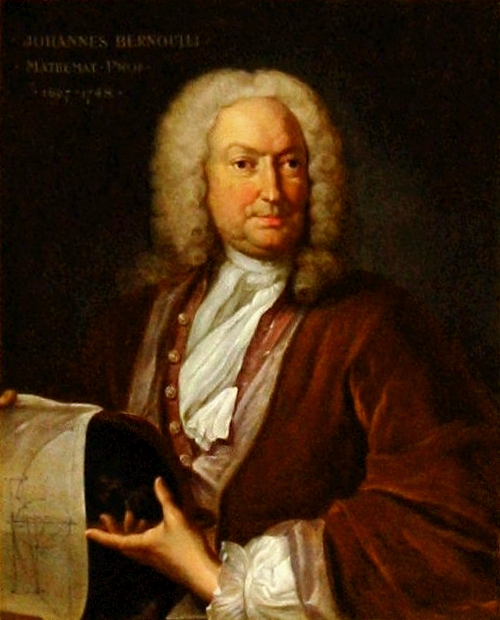
Johann Bernoulli
 Switzerland
mathematician•physicist•physician
Also known as: Jean Bernoulli, John Bernoulli
Birthday
July 27, 1667
Birth Sign
Sagittarius
Birthplace
Basel
Age
Died at 80
About
Johann Bernoulli was a Swiss mathematician, physicist, and physician, born on July 27, 1667, in Basel. He belonged to the prominent Bernoulli family, which produced several generations of mathematicians. Johann is best known for his foundational work in infinitesimal calculus, the calculus of variations, and fluid dynamics. He formulated the brachistochrone problem and derived Bernoulli's principle, which describes the behavior of fluid flow. His correspondence with Leibniz helped spread calculus across Europe. Johann also taught Leonhard Euler, mentoring one of the greatest mathematicians in history. He died on January 1, 1748, at age 80.
Early Life & Background
Johann was born into a prosperous Basel family; his father Nicolaus was an apothecary, and his grandfather had been in the spice trade. His father hoped Johann would take over the family business, but Johann was drawn to intellectual pursuits. He enrolled at the University of Basel to study medicine, a respectable profession that satisfied his father's wishes. While studying medicine, Johann secretly devoted time to mathematics, learning the new calculus directly from Leibniz's writings and from his elder brother Jakob, who held a mathematics chair at the university. His early interests included applying calculus to mechanics, optics, and curves, such as reflection and refraction of light and orthogonal trajectories. These formative years saw him shift from medicine to mathematics, leading to his first serious mathematical work in the 1690s.
Career Growth
Johann's breakthrough came in the 1690s with his work on the brachistochrone problem, the curve of fastest descent under gravity, which he solved in 1696. This problem became a foundation of the calculus of variations. He continued to apply calculus to mechanics, optics, and differential equations. In 1718, he published a systematic treatment of the calculus of variations in Histoire de l'Académie Royale des Sciences, establishing it as a coherent discipline. His collected works, Opera Johannis Bernoullii, were published in four volumes in 1742. As a teacher, he mentored Leonhard Euler in Basel, profoundly influencing Euler's later work. He also taught the Marquis de L'Hôpital, whose textbook on differential calculus drew heavily on Bernoulli's lectures. Johann's efforts helped establish Leibnizian calculus as the standard across Europe.
Career Timeline
Public Image & Style
Johann Bernoulli is remembered as a brilliant but combative scholar, intensely competitive with his brother Jakob. His published work is technical, expressed in Latin and the mathematical notation of early modern analysis. Modern accounts emphasize his role in spreading Leibnizian calculus and his mentorship of Leonhard Euler. There is no organized fandom; interest comes mainly from mathematicians and historians of science. Contemporary commentators sometimes portray him humorously, but this reflects their voice, not his.
Fame & Fandom (iFAMOUS Rankings)
The Swiss mathematician Johann Bernoulli stands as a towering, albeit distant, figure in the annals of science rather than a contemporary celebrity. In August 2026, the iFANN Global Fame Engine evaluated his enduring legacy and confirmed that he currently holds no placement in the published rankings, meaning he does not appear in the Global Top 1,000 or any specific scope list. This absence from the charts reflects his status as an Enlightenment-era academic whose influence is measured in textbooks and historical texts rather than modern social metrics or fan engagement. Unlike pop icons who command organized followings with official names and ritualistic behaviors, Bernoulli has no documented fandom name. His audience consists exclusively of historians, mathematicians, and students who engage with his work through rigorous study rather than fan campaigns, birthday tributes, or digital communities. There are no fan-funded projects, subway ads, or charity drives dedicated to him, as the concept of a mass public interacting with a deceased scholar did not exist in his time. The few mentions of his birth on July 27, 1667, appearing sporadically on social media, serve merely as educational reminders rather than signs of an active cult following. While modern hobbyist writers sometimes dub him 'the drama queen of mathematics' due to his intense rivalry with his brother Jakob, this label describes a historical personality trait rather than a fan-created identity. His relationship with the public was strictly professional, limited to his role as a professor at the University of Basel and his correspondence with peers. Today, his fame remains static, preserved in the quiet reverence of academia where his contributions to calculus and fluid dynamics continue to shape scientific thought without the noise of a modern fanbase.
Interesting Facts and Legends
Johann and his brother Jakob were among the first people to learn calculus directly from Leibniz's original writings. Before Leonhard Euler standardized notation, some mathematicians used the letter 'b' instead of 'e' for the base of the natural logarithm, reflecting Johann's early recognition of the constant's unique properties. He is often credited with discovering that e represents the limit of (1 + 1/n)^n as n approaches infinity. His son Daniel Bernoulli later solved the St. Petersburg paradox, illustrating the family's multi-generational influence on probability theory. Modern hobbyist writing has described Johann as 'the drama queen of mathematics' due to his intense rivalry with Jakob. A legendary moment occurred when Johann posed the brachistochrone problem, challenging the greatest minds in Europe to find the curve of fastest descent. Isaac Newton reportedly solved the anonymous challenge overnight, famously stating, 'I recognize the lion by his claw.' Another dark chapter involves the bitter feud between the brothers; after Jakob died, Johann allegedly stole his notes and manuscripts to claim credit for discoveries regarding the law of large numbers. These intellectual conflicts defined his life, creating a legacy of high-stakes mathematical battles rather than crowd-fueled adoration.
Family & Personal Life
Johann was born to Nicolaus Bernoulli, a Basel apothecary, and his wife. His grandfather had been in the spice trade. He had several siblings, most notably his elder brother Jakob Bernoulli, a major mathematician. Johann married Dorothea Falkner, and they had three sons. One son, Daniel Bernoulli, became a famous mathematician and physicist, known for Bernoulli's principle and work in probability and hydrodynamics. The Bernoulli family produced multiple generations of mathematicians, often called the 'Bernoulli dynasty.'
Notable Connections
Johann Bernoulli is closely associated with his brother Jakob Bernoulli, with whom he collaborated and competed. He mentored Leonhard Euler, one of the greatest mathematicians of all time. He also corresponded with Gottfried Wilhelm Leibniz, helping to spread calculus. His son Daniel Bernoulli carried on the family tradition. The Bernoulli family as a whole is synonymous with early modern mathematics.
Relationships & Dating History
Johann Bernoulli married Dorothea Falkner, likely in the late 1690s. They had three sons together, including the renowned mathematician Daniel Bernoulli. The marriage lasted until Johann's death in 1748. No other romantic relationships are documented in historical sources.
- MarriedDorothea Falkner1697 - 1748Married in Basel; had three sons including Daniel Bernoulli.
Death & Aftermath
Died
January 1, 1748 (aged 80)
Death Place
Basel, Switzerland
Cause of Death
Natural causes
The final days of Johann Bernoulli unfolded in the quiet academic halls of Basel, where he had spent a lifetime shaping the landscape of European mathematics. On January 1, 1748, the eighty-year-old scholar passed away within the city that had hosted his birth and his career at the University of Basel. Historical records from the era do not preserve a specific medical diagnosis or an autopsy report, reflecting the standard practice for natural deaths among scholars of the eighteenth century rather than any forensic investigation. The immediate reaction came through the dense network of correspondence between mathematicians across the continent, who acknowledged the loss of a central figure in the development of calculus and the calculus of variations.
His funeral was conducted in Basel, attended by family members including his son Daniel and academic colleagues, though no detailed public ceremony was recorded in surviving accounts. Posthumously, his legacy solidified through the publication of his collected works, Opera Johannis Bernoullii, which appeared in four volumes shortly after his death. Tributes manifested as the continued teaching of his methods to students like Leonhard Euler and the enduring application of principles named in his honor. His estate passed to his descendants, notably his son Johann II, who also pursued a distinguished career in mathematics. The mathematical community mourned the passing of a man whose rivalry with Leibniz and mentorship of future giants helped define the scientific age.
Net Worth (Estate Value)
Awards & Accolades
View 2 records, honours and achievementsKnown For
Brachistochrone problem
1696 · Solved
Calculus of variations
1718 · Systematized
Bernoulli's principle
1738 · Derived (via son Daniel)
Keywords
Sources
Quick Facts
- Profession
- mathematician, physicist, physician
- Born
- +1667-07-27
- Birthplace
- Basel
- Died
- +1748-01-01
- Death Place
- Basel
- Gender
- Male
- Spouse
- Dorothea Falkner
- Birth Sign
- Sagittarius
Personal Details
- Full Name
- Johann Bernoulli
- Spouse
- Dorothea Falkner
- Children
- Three sons, including Daniel Bernoulli
- Education
- University of Basel (medicine, self-taught in mathematics)
Frequently Asked Questions
Who was Johann Bernoulli?
What is Johann Bernoulli famous for?
Did Johann Bernoulli win any awards?
Was Johann Bernoulli related to Jacob Bernoulli?
When did Johann Bernoulli die?
Similar People
Join the community
fans discussing