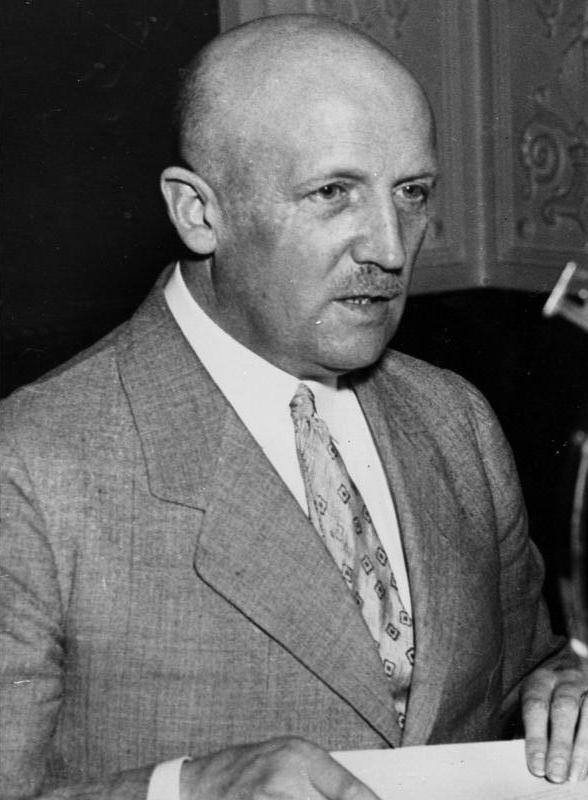
Kurt von Schleicher
 Germany
politician•military officer•head of government
Birthday
+1882-04-07
Birth Sign
Aries
Birthplace
Brandenburg an der Havel
Age
Died at 52
About
Kurt von Schleicher was a German military officer and the penultimate chancellor of the Weimar Republic, a man whose political maneuvering ultimately sealed his fate. Born in Brandenburg an der Havel in 1882 into a military family, he joined the Prussian Army as a lieutenant in 1900. Over the next two decades, he climbed the ranks, becoming a General Staff officer in the Railway Department and later serving in the Supreme Army Command during World War I. After the war, Schleicher acted as a liaison between the army and the new republic, playing a key role in the Reichswehr's quiet efforts to circumvent the Treaty of Versailles. From 1926, he served as a close advisor to President Paul von Hindenburg, and by 1929 he headed the Defence Ministry's Office of Ministerial Affairs. His influence peaked in 1930 when he helped topple Chancellor Hermann Müller and install Heinrich Brüning, and he later brought the Nazi SA into service as an auxiliary force for the Reichswehr. Schleicher's own chancellorship came in December 1932, after he orchestrated the fall of Franz von Papen. His brief term was marked by desperate attempts to outmaneuver Hitler. He tried to split the Nazi Party by courting Gregor Strasser and threatened Hitler with an anti-Nazi alliance, the so-called Querfront. When those plans collapsed, he urged Hindenburg to dissolve the Reichstag and rule by decree, but the president refused. Facing a dead end and failing health, Schleicher resigned on 28 January 1933, recommending Hitler as his successor, a decision that would have fatal consequences. He later tried to exploit divisions between Ernst Röhm and Hitler, but on 30 June 1934, during the Night of the Long Knives, he and his wife Elisabeth were murdered by the SS on Hitler's orders. He was 52 years old.
Fame & Fandom
Kurt von Schleicher commands a global audience defined by historical inquiry rather than modern celebrity worship. He currently holds no placement in the published iFANN Global Top 1,000 rankings or any Top-100 scope list, reflecting his status as a figure of academic and alternate-history interest rather than contemporary pop culture dominance. The iFANN evaluation confirms he remains unranked for this period. While he lacks a formal fandom name, a distinct niche community engages with his legacy through speculative fiction. Enthusiasts of the *Kaiserreich* modification for *Hearts of Iron IV* frequently debate his political maneuvering and the counterfactual scenarios where he survived the purge of 1934. These discussions occur on forums and wikis, focusing on how his 58-day tenure as Chancellor might have altered the trajectory of World War II if he had remained in power longer. This engagement is intellectual and rooted in political theory, devoid of the emotional rituals or commercial campaigns typical of living entertainers.
Interesting Facts and Legends
His brief time in office established a grim record: Schleicher served only 58 days as Chancellor of the Weimar Republic, the shortest tenure in that nation's history. His life ended violently during the Night of the Long Knives on June 30, 1934, when Adolf Hitler ordered his execution alongside his wife Elisabeth. SS officers shot and stabbed him in their Berlin home, leaving their bodies in the garden before claiming the deaths were accidents. This event marked the final elimination of conservative opposition to the Nazi regime. Historians later debunked the initial Nazi narrative, confirming it was a premeditated murder designed to consolidate total power. A persistent legend surrounding his career involves his alleged attempt at a "Querfront" strategy, which sought to unite the working class and nationalist right against the traditional establishment. While recent scholarship suggests this may be a retrospective myth, the idea remains a central part of his political lore. Alternate history communities often treat his death as a critical pivot point, imagining timelines where his survival prevented the rise of the Third Reich.
Death & Aftermath
Died
+1934-06-30 (aged 52)
Death Place
Potsdam-Babelsberg, Germany
Cause of Death
Execution by gunshot wounds
Kurt von Schleicher, the penultimate Chancellor of Germany during the Weimar Republic, was killed on June 30, 1934, at approximately 8:00 a.m. in his home located at Babelsberg Palace (Schloss Babelsberg) in Potsdam-Babelsberg, Germany. Born on April 7, 1882, he was 52 years old at the time of his death. The cause of death was officially ruled as execution by gunshot wounds; he was shot dead alongside his wife, Elisabeth von Schleicher, who was also killed in the attack. The circumstances of his death were established through historical consensus regarding the 'Night of the Long Knives', a purge ordered by Adolf Hitler to eliminate political rivals within the Nazi Party and conservative opposition.
On the morning of June 30, 1934, members of the SS, led by Theodor Eicke and accompanied by police units, arrived at Schleicher's residence. According to confirmed accounts, the SS officers demanded that Schleicher surrender immediately. When he refused, they opened fire. Elisabeth von Schleicher attempted to intervene or flee but was also shot and killed. Historical records indicate that Schleicher was initially spared or wounded, only to be executed later after being dragged from the house or while attempting to escape, though some accounts suggest both died almost simultaneously upon the initial breach. The event was an extrajudicial killing carried out by state-sanctioned paramilitary forces under direct orders from the highest levels of the Nazi government.
The 'official' narrative was simply that these individuals had been arrested for treason and executed following a summary process. The killings were part of a state-organized purge where the perpetrators were the agents of the state itself. The Nazi regime subsequently declared the victims guilty of high treason without trial, and the events were legally codified by the German cabinet on July 3, 1934, retroactively legitimizing the murders as acts of state defense. No legal challenges were permitted, and no public trials were held for the SS officers involved in the execution of Schleicher. Public reaction to the deaths was characterized by immediate silence and enforced compliance rather than open mourning or tributes.
In the immediate aftermath, the Nazi press reported the deaths as necessary actions against traitors, framing them as a victory for national security. Tributes from peers were non-existent in the public sphere; many former colleagues fled Germany or went into hiding to avoid similar fates. A private burial took place shortly after the deaths at the cemetery in Potsdam-Babelsberg, attended only by close family members and perhaps a few trusted associates who risked their lives to attend. The Nazi regime did not permit any official state funeral or public commemoration. For decades, the location of his grave was obscured or neglected due to the stigma associated with the Night of the Long Knives.
It was not until after the fall of the Third Reich that efforts were made to properly identify and mark the burial site. Posthumously, Kurt von Schleicher has been the subject of numerous historical books, academic articles, and documentaries analyzing his role in the collapse of the Weimar Republic and the rise of Nazism. He is frequently featured in films and literature depicting the 'Night of the Long Knives,' often portrayed as a tragic figure whose political maneuvering inadvertently facilitated Hitler's dictatorship. His estate was handled by his surviving relatives, primarily his daughter, who lived in exile or under difficult circumstances in post-war Germany.
Awards & Accolades
Keywords
Quick Facts
- Profession
- politician, military officer, head of government
- Born
- +1882-04-07
- Birthplace
- Brandenburg an der Havel
- Died
- +1934-06-30
- Death Place
- Neubabelsberg
- Gender
- Male
- Spouse
- Elisabeth von Schleicher
- Birth Sign
- Aries
Personal Details
- Spouse
- Elisabeth von Schleicher
Join the community
fans discussing