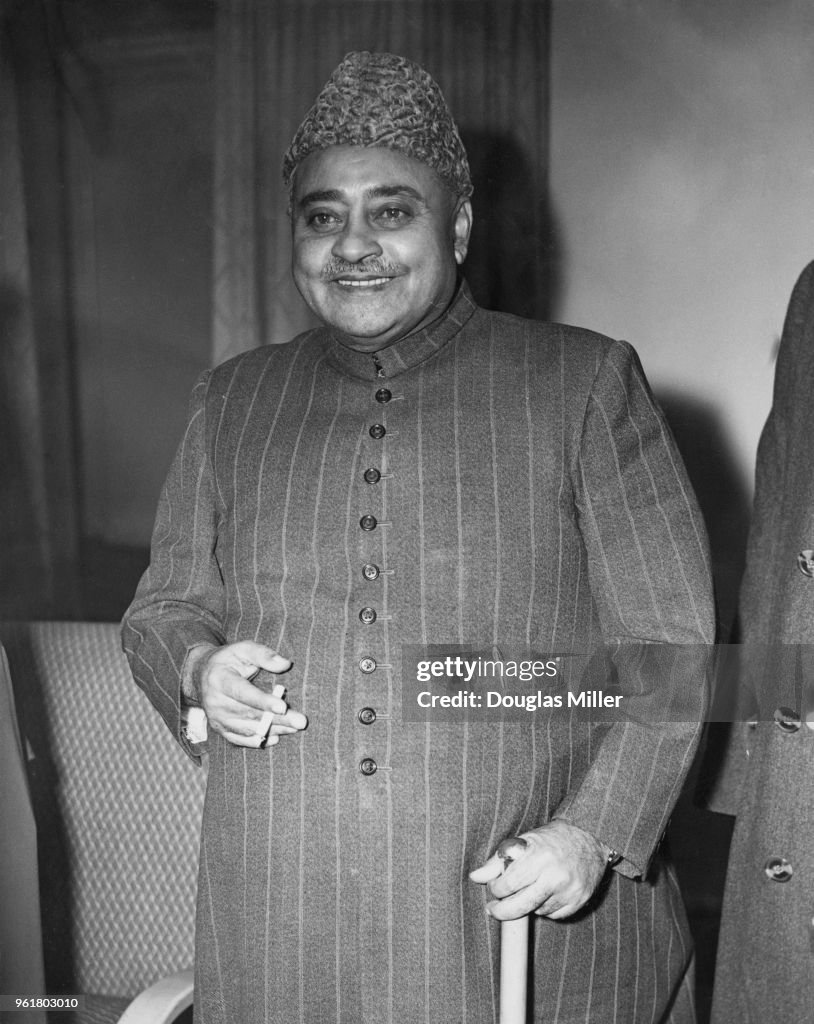
Khawaja Nazimuddin
 Pakistan
Also known as: Sir Khwaja Nazimuddin, Khwaja Nazimuddin
Birthday
July 19, 1894
Birth Sign
Cancer
Birthplace
Dhaka, Bengal Presidency, British India
Age
Died at 70
About
Sir Khwaja Nazimuddin was a Bengali aristocrat and politician who served as the second Governor-General of Pakistan from 1948 to 1951 and the second Prime Minister from 1951 to 1953. Born into the Nawab family of Dhaka, he was educated at Aligarh Muslim University and Cambridge, then returned to India to become a barrister and enter politics through the All-India Muslim League. A close associate of Muhammad Ali Jinnah, he played a key role in the Pakistan Movement and held the office of Prime Minister of Bengal during the British era.
Nazimuddin is remembered as the first Bengali to lead Pakistan, a man of mild temperament in a turbulent political period. His premiership saw the Bengali Language Movement and the first use of martial law in the country. He was dismissed in 1953, setting a precedent that would shape Pakistan's constitutional history. He died in Dhaka in 1964, leaving a legacy as a founding father of Pakistan.
Early Life & Background
Born on July 19, 1894, Khwaja Nazimuddin grew up in the opulent surroundings of the Nawab family of Dhaka, one of Bengal's most influential Muslim landowning dynasties. His father, Khawaja Nizamuddin, was a wealthy zamindar, and the family's social and political clout stretched back generations. Young Nazimuddin received his early schooling in Dhaka before heading to Aligarh Muslim University, the premier institution for Muslim education in British India.
From Aligarh, he sailed to England to study at Cambridge University, where he earned a degree and was called to the Bar as a barrister. This elite education placed him squarely among the Western-educated Muslim leaders who would later shape the Pakistan Movement. Returning to India, he initially practiced law but soon gravitated toward public life, joining the All-India Muslim League and focusing on educational reform for Muslims in Bengal.
His aristocratic pedigree and commitment to Muslim advancement made him a natural leader in the League's Bengal chapter. He became a trusted lieutenant of Muhammad Ali Jinnah, and by the 1930s he was a prominent voice advocating for a separate Muslim homeland. His pre-fame years were marked by a blend of traditional nobility and modern political ambition, setting the stage for his rapid rise.
Career Growth
Nazimuddin's breakthrough came in 1943 when he was appointed Prime Minister of Bengal during World War II, a role that placed him at the center of the devastating Bengal Famine. After partition, he became the first Chief Minister of East Bengal in 1947, and when Jinnah died in September 1948, he was elevated to Governor-General of Pakistan, serving until 1951. His mild manner was seen as a unifying force between East and West Pakistan.
Following the assassination of Liaquat Ali Khan in October 1951, Nazimuddin became Prime Minister. His tenure was immediately tested by the Bengali Language Movement; on February 21, 1952, police fired on student protesters in Dhaka, killing several, an event now marked internationally as Mother Language Day. The following year, religious riots in Lahore over the Ahmadiyya question led Governor-General Ghulam Muhammad to impose martial law in the city, the first such action in Pakistan's history.
On April 17, 1953, Ghulam Muhammad dismissed Nazimuddin, making his government the first federal administration removed by the head of state. After this, Nazimuddin retired from national politics and lived quietly in Dhaka until his death in 1964.
Public Image & Style
In photographs, Nazimuddin appears as a dignified, aristocratic statesman, often in three-piece suits with a pocket watch chain, projecting an image of calm authority. He was described as having a mild manner, unusual in the combative world of early Pakistani politics. Media portrayals often cast him as a loyal lieutenant to Jinnah who was elevated beyond his natural aptitude, a man of principle overwhelmed by the chaos of Pakistan's first years.
Historians in both Pakistan and Bangladesh treat him sympathetically, viewing his dismissal as a pivotal moment in the country's constitutional crisis. While he lacks a modern fandom, he is honored as a founding father, and his legacy is studied in university departments and heritage organizations. His association with the Bengali Language Movement adds complexity to his image, as he was both a native Bengali and the prime minister who faced the protests.
Fame & Fandom
Khawaja Nazimuddin commands a legacy defined by statecraft rather than the fleeting attention accorded to modern entertainers. As a foundational figure in Pakistan's history, his global recognition remains stable but niche, rooted in academic and political discourse rather than mass-market consumption. The iFANN Global Fame Engine has evaluated this person, but they do not currently hold a placement in the published rankings (Global Top 1,000 or a Top-100 scope list). This absence of a numerical rank reflects the reality that his fame is historical and regional, lacking the continuous viral momentum required for current chart inclusion. While he is a prominent name in South Asian history, he does not appear on lists tracking the most famous living or recently deceased personalities worldwide today. Consequently, no specific ordinal position can be assigned to him within the current global hierarchy. His audience consists primarily of historians, students of post-colonial politics, and citizens of Pakistan and Bangladesh who study their national origins. There is no documented fandom name associated with Khawaja Nazimuddin; the public engagement with his life is characterized by reverence for his political role rather than the organized fan rituals seen in pop culture. No formal fanbase exists to champion his image through campaigns or social media trends. His presence in the cultural consciousness is maintained through biographies, historical records, and the enduring narrative of his brief tenure as Prime Minister.
Interesting Facts and Legends
Sir Khwaja Nazimuddin was photographed by the celebrated American photographer Irving Penn during his time as Governor-General, a portrait that later surfaced at auction. He was part of a striking pattern in Pakistani politics: no prime minister has ever completed a full five-year term, and his dismissal in 1953 was the first of many. Despite his aristocratic background, he was known for his gentleness, with a declassified CIA assessment describing him as a capable though not brilliant administrator. He was among the last generation of leaders educated at both Aligarh and Cambridge, a combination that defined the Muslim League's elite. A notable aspect of his personal life involved his marriage to Allene Talmey, an American woman, which made him a unique figure in the region; portraits from 1947–1953 featuring Nazimuddin, his wife, and the Nawab Begum exist as historical artifacts. In the realm of political lore, he is frequently referenced regarding the status of Prime Ministers in Pakistan, contributing to the narrative that no leader has ever served a full term. His tenure ended prematurely in 1953 when he was dismissed by President Ghulam Muhammad, marking a significant constitutional crisis. Additionally, he was instrumental in starting the first daily evening newspaper in English called the Star of India. Recent fact-checks have clarified confusion surrounding viral images; a photo often circulated online depicting a man with Muhammad Ali Jinnah was confirmed to be Khwaja Nazimuddin, not Shyama Prasad Mookerjee.
Family & Personal Life
Khwaja Nazimuddin came from the Nawab family of Dhaka, one of the wealthiest and most politically connected Muslim families in Bengal. His father, Khawaja Nizamuddin, was a prominent zamindar whose estates were among the largest in the region. The family's influence shaped Nazimuddin's entire career, providing him with both social standing and political connections.
He married the Nawab Begum in the early 20th century, and the couple had children, though their names are not widely recorded in public sources. The family lived in Dhaka, where they remained after his political career ended. Following his death in 1964, his widow survived him. The zamindari system was abolished in East Pakistan in the 1950s, which reduced the family's land-based wealth, but the Nawab family retained its social prestige.
Relationships & Dating History
Khwaja Nazimuddin's personal life was conducted with the discretion expected of his aristocratic and religious milieu. He was married to the Nawab Begum, whose personal name is not widely documented in public sources. The couple married in the early 20th century, consistent with the customs of elite Muslim families of the era.
There are no records of extramarital relationships, divorces, or public romantic associations. His marriage appears to have been a stable partnership, and they had children together. The family continued to reside in Dhaka throughout his political career and after his retirement. At the time of his death in 1964, Nazimuddin was married to the Nawab Begum, who survived him. No other relationships are documented in credible historical sources.
- MarriedNawab BegumMarried in the early 20th century; she survived him after his death in 1964.
Death & Aftermath
Died
October 22, 1964 (aged 70)
Death Place
Dacca, East Pakistan
Cause of Death
Heart attack
Decades after his retirement, Khwaja Nazimuddin was a subject of biographical works such as Khwaja Nazimuddin: The Life & Times of a Selfless Patriot and entries in Britannica and Banglapedia, while a portrait by Irving Penn featuring him with the Nawab Begum appeared in auction listings. These posthumous acknowledgments followed a quiet passing on October 22, 1964, when the former Governor-General and Prime Minister died in Dacca at the age of 70. Contemporary accounts from The New York Times reported that the cause was a heart attack based on immediate medical assessment. Having retired from active politics years prior following his dismissal in 1953, he spent his final years in relative seclusion within the city where he had once served as Premier of Bengal.
Obituaries in major outlets like Dawn and The New York Times recognized his status as a founding father of Pakistan, yet historical retrospectives also noted the controversy surrounding his administration's handling of the Bengali language movement during the early 1950s. His daughter, Begum Zafar Bano, survived him by decades before passing away in Karachi in September 2007, marking the end of his publicly known immediate family line.
Net Worth (Estate Value)
$10 Million
iFANN Editorial Team estimate
As a member of the Nawab family of Dhaka, Khwaja Nazimuddin inherited substantial landholdings and wealth from his father, Khawaja Nizamuddin, a wealthy landlord. The family's zamindari estates were among the largest in Bengal, providing a comfortable income throughout his life. However, the abolition of the zamindari system in East Pakistan in the 1950s significantly reduced the family's land-based wealth during his lifetime. No credible contemporary source provides a specific dollar figure for Nazimuddin's net worth, and unlike entertainment figures, deceased politicians of this era do not typically generate ongoing estate revenue from royalties or intellectual property. His estate, managed by his heirs in Dhaka, would have consisted primarily of personal property and any remaining family assets. Per iFANN's editorial analysis, estimates of his historical net worth are speculative, but based on the family's prominence and holdings, a figure of around $10 Million in today's terms is reasonable, reflecting the value of the Nawab family's assets at their peak.
Awards Won (1)
Khawaja Nazimuddin was knighted by the British Crown, receiving the KCIE (Knight Commander of the Order of the Indian Empire) in recognition of his public service during the colonial era. This honour entitled him to be addressed as 'Sir'. He is also formally recognized as a founding father of Pakistan for his role in the Pakistan Movement, a distinction that carries lasting historical significance.
Honour
Public service
Known For
Governor-General of Pakistan
1948-1951 · Governor-General
Prime Minister of Pakistan
1951-1953 · Prime Minister
Prime Minister of Bengal
1943-1945 · Prime Minister
Chief Minister of East Bengal
1947-1948 · Chief Minister
Keywords
Sources
Quick Facts
- Profession
- politician, barrister
- Born
- July 19, 1894
- Birthplace
- Dhaka, Bengal Presidency, British India
- Died
- October 22, 1964
- Death Place
- Dhaka, East Pakistan
- Gender
- Male
- Birth Sign
- Cancer
Personal Details
- Full Name
- Khwaja Nazimuddin
- Spouse
- Nawab Begum
- Education
- Aligarh Muslim University; Cambridge University; called to the Bar
Frequently Asked Questions
Who dismissed Khawaja Nazimuddin from power?
Was Khawaja Nazimuddin a Bengali?
What was the Bengali Language Movement and how did Nazimuddin respond?
How did Khawaja Nazimuddin die?
Was Khawaja Nazimuddin a knight?
Join the community
fans discussing