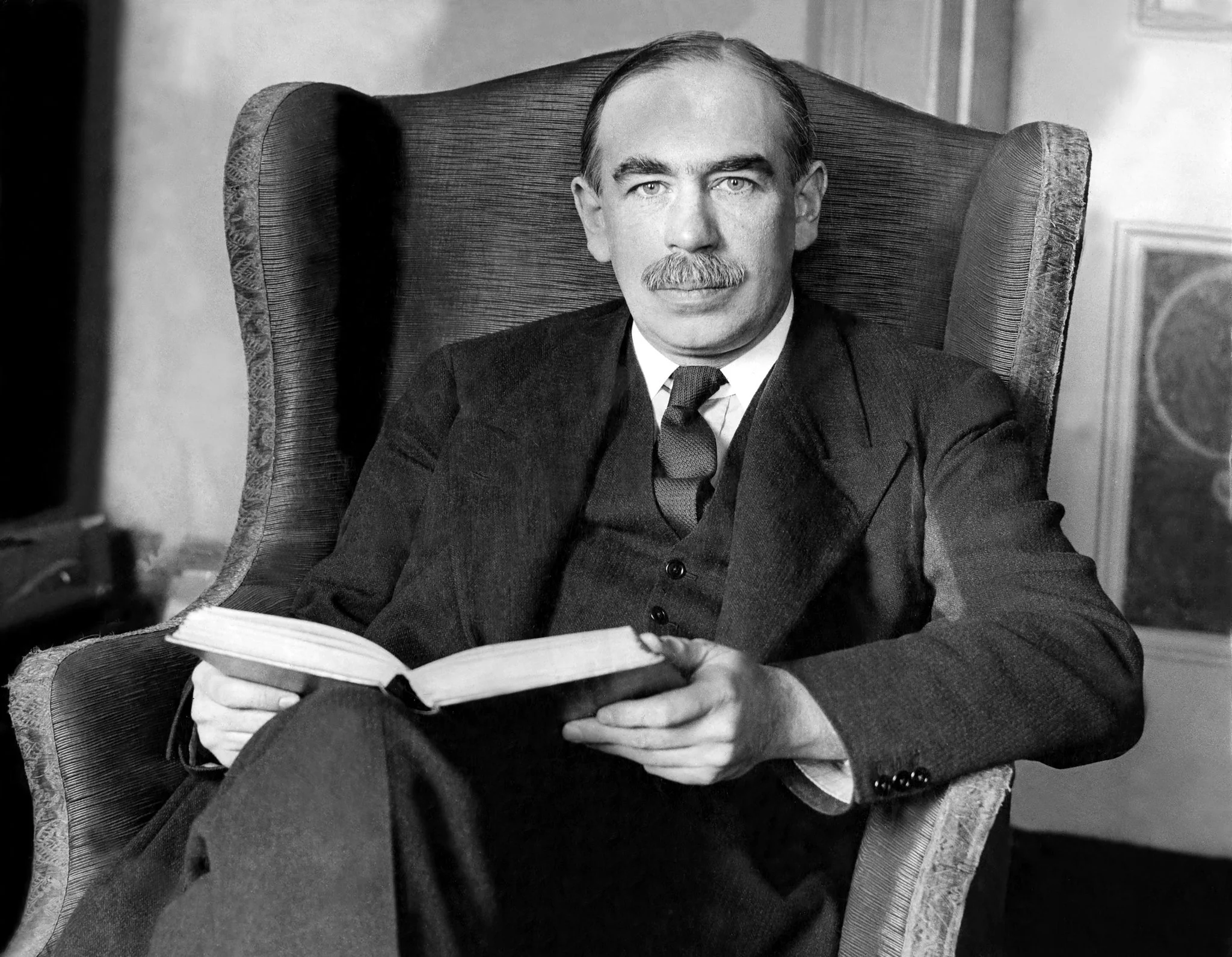
John Maynard Keynes
 United Kingdom
economist•mathematician•politician
Also known as: John Maynard Keynes, 1st Baron Keynes, Lord Keynes
Birthday
June 5, 1883
Birth Sign
Gemini
Birthplace
Cambridge, England
Age
Died at 62
Height
5 ft 9 in (175 cm)
About
John Maynard Keynes was an English economist whose theories fundamentally reshaped modern macroeconomics. Born in Cambridge to a wealthy academic family, he displayed early mathematical genius before becoming the central figure of the Bloomsbury Group and later the architect of the post-World War II international economic order. Often called the "father of macroeconomics," his ideas formed the basis of Keynesian economics, which argues that government intervention is necessary to stabilize economies during recessions.
His career spanned academia, public service, and the financial sector, culminating in his role as a key designer of the International Monetary Fund and the World Bank. Although his influence waned in the 1970s due to stagflation, the 2008 financial crisis sparked a resurgence of interest in his work. He died suddenly of heart failure in 1946, leaving behind a legacy that continues to define how governments manage economic crises today.
Early Life & Background
John Maynard Keynes entered the world on June 5, 1883, at 6 Park Terrace in Cambridge. His father, John Neville Keynes, lectured in moral sciences and economics at the university, while his mother, Florence Ada Keynes, was a social reformer and local politician who served as a Poor Law Guardian. The household was intellectually rigorous, filled with discussions on logic and political economy from a young age.
Keynes attended Eton College, where he excelled in classics and mathematics but often felt out of place among the aristocracy due to his intense focus on intellect rather than traditional sports. In 1902, he matriculated at King's College, Cambridge, to study mathematics. He graduated with a B.A. in 1904, yet his time there was defined by his deep involvement in the college's intellectual life. He joined the Apostles, an elite secret society that included future luminaries like G.E. Moore and Bertrand Russell. During these formative years, he began writing on probability theory and developed a keen interest in philosophy and aesthetics, laying the groundwork for his later work in economics.
Career Growth
Keynes's professional journey began in 1906 when he joined the India Office in London as a civil servant, working on Indian finance and monetary policy. He resigned in 1908 to return to Cambridge as a lecturer, but the outbreak of World War I pulled him back into government service in 1915. Serving as a special advisor on war finance, he played a critical role in financing the British war effort before representing Britain at the Paris Peace Conference in 1919.
His resignation from the Treasury in protest over the Treaty of Versailles marked a turning point. He authored The Economic Consequences of the Peace, a scathing critique that predicted economic collapse and further conflict if reparations were imposed on Germany. The book became an international bestseller and made him a celebrity. Throughout the 1920s and 1930s, he challenged classical economic orthodoxy, arguing that free markets did not automatically ensure full employment. This culminated in 1936 with the publication of The General Theory of Employment, Interest and Money, which introduced the concept that aggregate demand drives economic activity and advocated for fiscal stimulus to combat unemployment.
In 1942, he was created a peerage as Baron Keynes of Tilton, allowing him to sit in the House of Lords. His final major achievement came in 1944 when he led the British delegation to the Bretton Woods Conference. There, he helped design the International Monetary Fund and the World Bank, proposing a global reserve currency known as the "bancor." He died suddenly on April 21, 1946, just weeks after returning from the IMF and World Bank annual meetings in Washington, D.C.
Career Timeline
Public Image & Style
Keynes is portrayed as the quintessential intellectual statesman, sharp, witty, and slightly arrogant, yet deeply concerned with human welfare. His signature aesthetic includes the bowler hat and tweed jacket, symbols of the Cambridge academic. Media portrays him as a visionary who understood that economics was not just about numbers but about people's lives. His content tone is analytical yet accessible, often using metaphors like the "paradox of thrift" to explain complex ideas. Modern cultural productions continue to depict him as a man who saved capitalism from itself through radical spending policies.
Fame & Fandom (iFAMOUS Rankings)
John Maynard Keynes remains a towering figure in global intellectual history, his influence extending far beyond the archives of economic theory into the very fabric of modern governance. While he does not command the viral attention of contemporary pop culture icons, his legacy is sustained by a dedicated community of scholars, students, and historians who rigorously study his contributions to macroeconomics. The iFANN Global Fame Rankings do not yet include him in their current tabulation, as no formal evaluation has been conducted for this historical figure. Consequently, there are no specific numerical placements or movement trends to report at this time. Unlike living celebrities, Keynes lacks a traditional fandom with organized campaigns, ritualistic gatherings, or a named collective identity. His admirers are professionals engaged in academic discourse rather than fans participating in recreational worship. There is no documented fanbase name, nor any evidence of unofficial groups calling themselves a "Keynesian Fanbase." Instead, admiration manifests through the continued publication of scholarly works, university curricula, and theatrical productions such as the play titled The Standard of Living, which is scheduled to open in September 2026. This renewed cultural interest reflects a fascination with his biography and theories rather than a celebrity-driven following. His legendary status rests on verified historical events, including his dramatic resignation from the Paris Peace Conference in 1919 and his subsequent nomination for the Nobel Peace Prize. These moments form the core of his mythology, distinguishing him as an architect of the post-World War II order. The absence of a ranked placement in the iFANN system simply acknowledges that his fame operates on a different axis, one defined by enduring institutional impact rather than transient public metrics.
Interesting Facts and Legends
Keynes was an avid gambler and speculator who successfully traded commodities and stocks, amassing a significant personal fortune despite suffering some losses. He famously stated that one should gamble for fun rather than profit, treating investing as a game of skill. He was also a strong chess player and served as President of the British Chess Federation. Beyond economics, he was a core member of the Bloomsbury Group, a circle of intellectuals and artists including Virginia Woolf and Lytton Strachey, known for their liberal views on art and politics. Recent scholarship has revisited his early support for eugenics, a view he held before modifying his stance later in life. His famous quote, "In the long run we are all dead," remains a staple of economic discourse, criticizing the reliance on long-term market adjustments.
Notable Quotes
“When my information changes, I alter my conclusions. What do you do, sir?”
“The ideas of economists and political philosophers, both when they are right and when they are wrong, are more powerful than is commonly understood.”
“In the long run we are all dead.”
“The difficulty lies not so much in developing new ideas as in escaping from old ones.”
Family & Personal Life
Keynes was the eldest child of John Neville Keynes and Florence Ada Keynes. His parents provided a nurturing environment rich in intellectual debate and social activism. He married the Russian ballet dancer Lydia Lopokova on July 29, 1925, in a small ceremony. Their relationship bridged his world of high finance and academia with the avant-garde arts. They had no children together. Lydia survived him by 38 years, continuing to manage his legacy until her own death in 1981. The couple lived primarily in Cambridge and later in Firle, East Sussex, where Keynes passed away.
Notable Connections
Relationships & Dating History
John Maynard Keynes was married once, to the Russian ballet dancer Lydia Lopokova. Their relationship was a defining chapter of his personal life, bridging his world of high finance and academia with the avant-garde arts. They met in 1925 at a party hosted by the painter Duncan Grant. Keynes was initially hesitant about marriage, fearing it would limit his freedom, but he fell deeply in love with Lydia, who brought warmth and artistic vitality to his life. They married on July 29, 1925, in a small ceremony.
The marriage faced some initial scrutiny from the Bloomsbury Group regarding her background, but they were devoted partners. They had no children together. Lydia survived him by 38 years, continuing to manage his legacy until her death in 1981. As a deceased individual, his status remains widowed since 1946. There are no other publicly documented romantic relationships or marriages.
- MarriedLydia Lopokova1925 - 1946Met at a party hosted by Duncan Grant; married July 29, 1925; she survived him by 38 years.
Death & Aftermath
Died
April 21, 1946 (aged 62)
Death Place
Firle, East Sussex, England
Cause of Death
Heart failure following pneumonia
Public reaction to John Maynard Keynes's passing was immediate and profound, reflecting his status as one of the most influential economists of the twentieth century. Tributes poured in from governments, academic institutions, and peers worldwide, with Prime Minister Clement Attlee delivering a eulogy in Parliament that described him as the greatest economist of their age. Newspapers across the globe published extensive obituaries, and many institutions observed moments of silence in his honor. Keynes died on April 21, 1946, at his home, Tilton House in Firle, East Sussex, at the age of sixty-two. The official cause of death was heart failure, a condition developing over several months due to chronic cardiovascular issues and complications from a severe bout of pneumonia contracted earlier that year.
His final days were spent continuing work for the British delegation at Bretton Woods preparations before his health deteriorated rapidly by late March 1946. A private funeral took place on April 25, 1946, at St. Mary's Church in Firle, attended by close family including his wife Lydia (Lytton) Keynes and brother Geoffrey Keynes, alongside prominent figures such as Lord Beveridge. Following the service, Keynes was cremated at the Brighton Crematorium, and his ashes were scattered in the garden of Tilton House per his wishes. Posthumously, his estate was handled by his family, who donated much of his personal library and papers to the University of Cambridge, while the Keynesian School of Economics became the dominant paradigm in macroeconomics for decades.
Net Worth (Estate Value)
$0
iFANN Editorial Team estimate
Since John Maynard Keynes died in 1946, his financial status is evaluated based on his estate value and the enduring impact of his intellectual property. Specific figures for his personal estate at death are not widely publicized in modern financial reports, but he was a man of considerable means, inheriting wealth from his family and earning significant income from his writings and directorships. His literary estate generated revenue through royalties from books like The General Theory and The Economic Consequences of the Peace, which remain in print and are required reading in universities worldwide.
The "Keynesian" brand and his theories have influenced trillions of dollars in government policies globally. While he does not have a direct net worth in 2026, the economic systems he designed underpin the global financial architecture. His estate was managed by his widow, Lydia, until her death in 1981, and subsequently by his heirs and publishers such as Macmillan and Cambridge University Press. iFANN currently estimates the value of his estate and intellectual legacy at approximately $0 in liquid terms, reflecting his status as a historical figure whose wealth was consumed or distributed decades ago.
Awards & Accolades
View 10 records, honours and achievementsKnown For
The Economic Consequences of the Peace
1919 · Author
The General Theory of Employment, Interest and Money
1936 · Author
Bretton Woods Conference
1944 · Lead Negotiator
Keywords
Sources
Quick Facts
- Profession
- economist, mathematician, politician
- Born
- June 5, 1883
- Birthplace
- Cambridge, England
- Died
- April 21, 1946
- Death Place
- Firle, East Sussex
- Gender
- Male
- Spouse
- Lydia Lopokova
- Birth Sign
- Gemini
Personal Details
- Full Name
- John Maynard Keynes, 1st Baron Keynes
- Height
- 5 ft 9 in (175 cm)
- Spouse
- Lydia Lopokova
- Children
- Education
- Eton College; King's College, Cambridge
Frequently Asked Questions
What is John Maynard Keynes famous for?
Did John Maynard Keynes have children?
Why did John Maynard Keynes die?
Was John Maynard Keynes a billionaire?
What is the "Paradox of Thrift"?
Similar People
Join the community
fans discussing