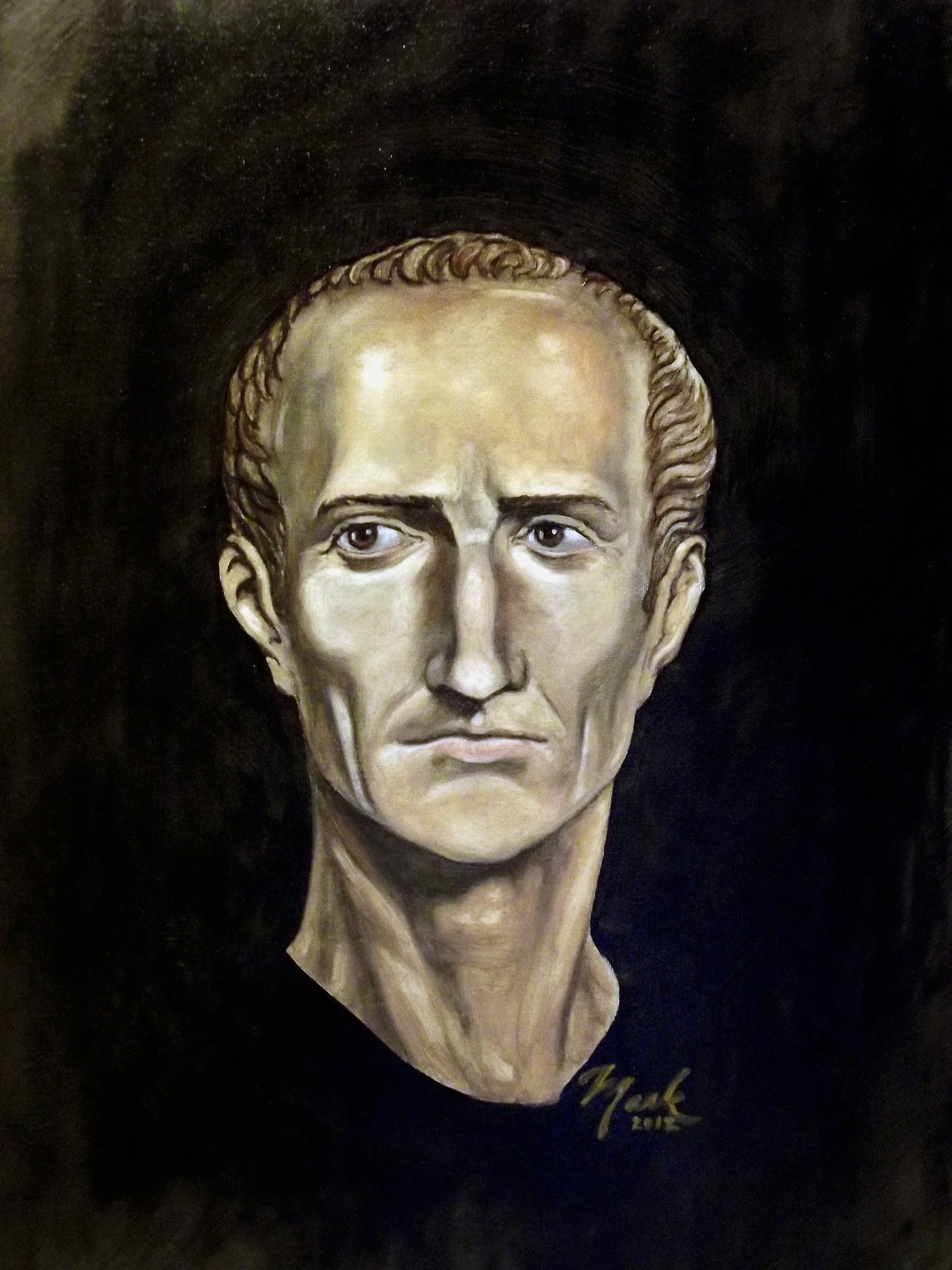
Julius Caesar
Roman general•statesman•author
Also known as: Gaius Julius Caesar, Divine Julius
Birthday
July 12, 100 BC
Birth Sign
Cancer
Birthplace
Rome, Roman Republic
Age
Died at 55
About
Gaius Julius Caesar was a Roman general, statesman, and author whose military conquests and political reforms transformed the Roman Republic into the foundation of the Roman Empire. Born in 100 BC, he rose through the ranks of Roman politics to become dictator for life, only to be assassinated by senators fearing his ambition. His life and death remain central to Western history.
Caesar's military genius was showcased in the Gallic Wars, where he conquered Gaul and extended Roman territory to the Rhine and the English Channel. His crossing of the Rubicon in 49 BC ignited a civil war that he won, leading to his appointment as dictator. As ruler, he introduced the Julian calendar, reformed the Senate, and granted citizenship to many provincials.
His assassination on the Ides of March in 44 BC, by a group including Brutus and Cassius, sparked further civil wars and ultimately led to the rise of his adopted heir Octavian as Emperor Augustus. Caesar's name became synonymous with imperial rule, evolving into the titles Kaiser and Tsar. He is also remembered as a prolific author, with his commentaries on the Gallic and Civil Wars still studied for their clarity and style.
Early Life & Background
Caesar was born into the patrician Julii family, though his branch was not among the most powerful at the time. His early life was marked by political danger: during the dictatorship of Sulla (82–79 BC), Caesar's connection to Marius, Sulla's rival, made him a target for assassination. He fled Rome, only returning after Sulla's death in 79 BC.
Before his rise, Caesar studied rhetoric and law in Rhodes and Greece, where he was briefly captured by Cilician pirates. He ransomed himself and later hunted them down, crucifying them as promised. His early career included serving as a military tribune and quaestor, but his pivotal move was returning to Rome and building popularity with the common people against the senatorial elite.
In 60 BC, he formed the First Triumvirate with Pompey the Great and Crassus, an informal alliance that dominated Roman politics. This allowed him to secure the consulship in 59 BC, marking his entry into the highest levels of Roman power. His early career was characterized by strategic marriages and political maneuvering, setting the stage for his later conquests.
Career Growth
Caesar's most famous achievement was the Gallic Wars (58–50 BC), where he conquered Gaul, extending Roman territory to the Rhine and the English Channel, and launched two invasions of Britain. He chronicled these campaigns in his Commentarii de Bello Gallico, a classic of Latin literature and propaganda.
In 49 BC, refusing to disband his army as ordered by the Senate, Caesar crossed the Rubicon, igniting a civil war against Pompey and the Optimates. He defeated Pompey at the Battle of Pharsalus in 48 BC and pursued him to Egypt, where he intervened in the Egyptian civil war between Cleopatra and her brother Ptolemy XIII. His victory culminated in his appointment as dictator perpetuo in 44 BC.
As dictator, Caesar introduced sweeping reforms, including the Julian calendar, reorganized the Senate, extended citizenship, and launched public works projects. His growing power alarmed senators, leading to his assassination on the Ides of March in 44 BC. His death sparked a new round of civil wars, ultimately leading to the rise of his adopted heir Octavian as the first Roman emperor.
Career Timeline
Public Image & Style
Caesar is portrayed in popular culture as a brilliant strategist, ambitious leader, and tragic figure. His story is frequently adapted in literature, theater, and film, with Shakespeare's play being the most famous adaptation. Fans of Caesar often admire his military genius and political vision, while others focus on the moral implications of his rise to absolute power.
His public image is that of a charismatic and ruthless leader, known for his clemency toward defeated enemies, which was unusual for the time. He was also known for his personal charm and his ability to inspire loyalty in his troops.
In modern times, Caesar's name has become synonymous with ambition and the dangers of concentrated power. He is frequently referenced in political discourse and popular media, from film adaptations to historical documentaries.
Fame & Fandom (iFAMOUS Rankings)
Julius Caesar never knew a fan club, yet his legacy commands a global audience that spans two millennia. No modern rituals, social media campaigns, or organized groups gather to celebrate his birthday or fund his memorials; the concept of a celebrity following was alien to the Roman Republic. Instead, his 'fandom' consists of students, scholars, and theatergoers who keep his memory alive through education and performance. His story survives not as a living celebrity culture but as a collection of enduring myths: the betrayal on the Ides of March, the crossing of the Rubicon, and the dramatic fictionalization of his death by Shakespeare. These narratives function as foundational lore for Western political history, replacing traditional fanbases with a universal readership. While no formal name exists for those drawn to his life, his cultural footprint remains massive. This enduring presence is reflected in contemporary metrics. According to the iFANN Global Fame Rankings, he stands as the 274th most famous person in the world, holding steady from the previous cycle. Within his specific domain, he ranks as the 45th most famous person in Politics, also maintaining his position.
Interesting Facts and Legends
Caesar introduced the Julian calendar in 45 BC, which replaced the Roman lunar calendar and served as the basis for the Gregorian calendar used today. His assassination on March 15, 44 BC, is famously associated with the phrase "Beware the Ides of March." He was stabbed 23 times by a group of senators, including Brutus and Cassius, in the Theatre of Pompey. His commentaries on the Gallic and Civil Wars are still studied today for their clarity and literary style. Caesar was known for his eloquence and physical presence, described as tall with a fair complexion, dark eyes, and a balding head. He also reportedly suffered from epilepsy, which he managed to hide during his campaigns. A popular story fans still retell involves his final words; while historical accounts vary, folklore insists he whispered "Et tu, Brute?" upon seeing Brutus among his killers. Another legendary moment occurred in 49 BC when he led his army across the Rubicon River, allegedly declaring "The die is cast" before igniting a civil war. These tales blend verified events with dramatic invention, cementing his image as a figure of both immense power and tragic vulnerability.
Notable Quotes
“Alea iacta est.”
“Veni, vidi, vici.”
“Et tu, Brute?”
Family & Personal Life
Caesar was born into the patrician Julii family, though his branch was not among the most powerful at the time. His father, also named Gaius Julius Caesar, was a praetor, and his mother, Aurelia, came from a prominent family.
He was married three times. His first wife, Cornelia Cinnilla, daughter of Lucius Cornelius Cinna, bore him a daughter, Julia, who later married Pompey. Cornelia died in childbirth in 69 BC. His second wife, Pompeia, granddaughter of Sulla, was divorced in 62 BC after the Bona Dea scandal. His third wife, Calpurnia Pisonis, was pregnant at the time of his assassination.
Caesar had no legitimate sons, but he adopted his great-nephew Octavian as his heir, who later became Emperor Augustus. He also had a son, Caesarion, with Cleopatra VII, though the child was never officially recognized.
Notable Connections
Relationships & Dating History
Caesar's first marriage was to Cornelia Cinnilla in 84 BC, a political alliance with the daughter of Lucius Cornelius Cinna. They had a daughter, Julia, who later married Pompey. Cornelia died in childbirth in 69 BC.
His second marriage to Pompeia, granddaughter of Sulla, in 67 BC ended in scandal in 62 BC when she was accused of adultery during the Bona Dea festival. Caesar divorced her, famously stating that his wife must be above suspicion.
His third wife was Calpurnia Pisonis, whom he married in 59 BC. She was pregnant at his death and reportedly had prophetic dreams warning of his assassination. Throughout his life, he also had a long-term affair with Servilia Caepionis, mother of Brutus, one of his assassins.
In 48 BC, he met Cleopatra VII in Egypt, and they began a relationship that produced a son, Caesarion. Cleopatra visited Rome in 46 BC, and Caesar's relationship with her was politically significant, though he never married her. At the time of his death in 44 BC, he was married to Calpurnia.
- MarriedCornelia Cinnilla-84 - -69Political alliance; she died in childbirth, leaving Caesar a widower with a daughter, Julia.
- MarriedPompeia-67 - -62Marriage to a Sulla descendant; ended due to the Bona Dea scandal involving Clodius Pulcher.
- DatedServilia Caepionis-80 - -44Long-term affair; mother of Marcus Brutus, one of Caesar's assassins.
- DatedCleopatra VII-48 - -44Met during Caesar's intervention in the Alexandrian War; relationship produced a son, Caesarion.
- MarriedCalpurnia Pisonis-59 - -44CurrentFinal marriage; she was present at his assassination and reportedly tried to warn him of his fate through dreams.
Death & Aftermath
Died
March 15, 44 BC (aged 55)
Death Place
Rome
Cause of Death
Multiple stab wounds
Gaius Julius Caesar died on March 15, 44 BC inside the Curia of Pompey in Rome. He was stabbed by a group of senators known as the Liberators, though ancient accounts debate whether one blow from Marcus Junius Brutus ended his life or if he succumbed to the sheer volume of wounds. Witnesses like Suetonius and Plutarch recorded the event, noting that Caesar initially covered his head with his toga before collapsing near a statue of Pompey. The public reaction turned instantly from shock to fury after Mark Antony displayed the bloodied body during a funeral held five days later in the Roman Forum. The mob burned the Senate house and forced the conspirators to flee the city. Octavian inherited Caesar's vast estates and political mandate, using the funeral rites to consolidate power while the Senate deified him as Divus Iulius in 42 BC. The date became a cultural symbol of betrayal, immortalized in Shakespeare's play and modern productions alike.
Net Worth (Estate Value)
$1 Billion
iFANN Editorial Team estimate
Julius Caesar's wealth was immense for his time, derived from military plunder, land ownership, and political offices. As dictator, he controlled the Roman treasury and vast estates. His conquests, particularly in Gaul, brought enormous riches, including gold, slaves, and tribute. At his death, his estate was inherited by his adopted heir Octavian, who used the funds to consolidate power and eventually become Emperor Augustus. The value of his estate cannot be quantified in modern currency, but it was among the largest in Rome, contributing significantly to the resources available to the new Roman Empire. Per iFANN's editorial analysis, his net worth is estimated at $1 Billion. There are no reliable modern estimates of his net worth in today's terms, but historians suggest it would be equivalent to billions of dollars, given the scale of his conquests and political power. As of 2026, his legacy remains a subject of historical and financial interest, though no direct monetary value can be assigned.
Awards Won (5)
Julius Caesar received numerous honors in his lifetime, including being named dictator perpetuo, consul multiple times, and celebrating four triumphs. His name became a title for emperors, and he is universally ranked among the most influential figures in history.
-44 · Political Office
Roman Republic
-46 · Military
Gallic Wars
Known For
Gallic Wars
58-50 BC · General
Crossing the Rubicon
49 BC · Political leader
Julian Calendar
45 BC · Reformer
Keywords
Sources
Quick Facts
- Profession
- Roman general, statesman, author
- Born
- July 12, 100 BC
- Birthplace
- Rome, Roman Republic
- Died
- March 15, 44 BC
- Death Place
- Theatre of Pompey, Rome
- Gender
- Male
- Spouse
- Cornelia, Pompeia, Calpurnia
- Children
- Julia, Caesarion (possibly)
- Birth Sign
- Cancer
Personal Details
- Full Name
- Gaius Julius Caesar
- Spouse
- Cornelia Cinnilla, Pompeia, Calpurnia Pisonis
- Children
- Julia Caesaris, Caesarion (possibly)
- Education
- Studied rhetoric and law in Rhodes and Greece
Frequently Asked Questions
Who killed Julius Caesar?
What was Julius Caesar's biggest achievement?
Did Julius Caesar have children?
Why was Julius Caesar assassinated?
What is the significance of the Julian calendar?
Similar People
Join the community
fans discussing