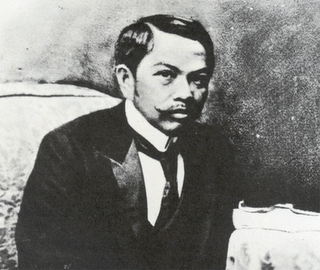
Juan Luna
 Philippines
painter•autobiographer•sculptor
Birthday
+1857-10-23
Birth Sign
Sagittarius
Birthplace
Badoc
Age
Died at 42
About
Born in Badoc in 1857, Juan Luna was a Filipino painter, sculptor, and a passionate political activist during the late 19th century. He emerged as one of the Philippines' first internationally recognized artists, creating works that often blended European academic styles with Filipino themes and social commentary. His artistic journey began with a strong foundation in classical techniques, which he applied to historical and literary subjects. Many of his pieces carried subtle, yet powerful, political messages, reflecting the turbulent times in the Philippines under Spanish colonial rule.
Fame & Fandom
Juan Luna commands a legacy of national reverence rather than a modern consumer-driven fanbase, with no formal organization or specific name attached to his admirers. His audience consists primarily of the Filipino public, art historians, and state institutions that treat him as a foundational figure in the nation's history. Commemorative rituals are institutional rather than grassroots; the restoration of the Juan Luna Building in Binondo and the exhibition of his long-lost masterpiece Hymen, oh Hyménée! serve as the primary focal points for collective remembrance. While he does not interact with fans or sign autographs, his birthday remains a recurring touchstone for educational content and social media tributes dedicated to his life and work. In the realm of global recognition, Juan Luna is currently ranked as the 46th most famous person in Philippines by the iFANN Global Fame Rankings, a position reflecting his standing down from the previous cycle. This prominence places him as the 82nd most famous person from Philippines within the same authoritative index, holding steady against competitors. These placements emerge from a system that tracks global attention across media coverage, search activity, and cultural consumption signals worldwide. The data confirms that while he lacks a celebrity following, his historical footprint secures him a distinct and measurable place in international fame metrics.
Interesting Facts and Legends
Juan Luna, born in Badoc in 1857 and deceased in 1899, remains a central figure in Philippine history as a painter, sculptor, and political activist whose legacy endures through his surviving works. His artistic journey blended European academic styles with Filipino themes, creating pieces that carried subtle yet powerful messages against Spanish colonial rule. In the August 2026 cycle of the iFANN Global Fame Rankings, he holds the position of the 46th most famous person in Philippines and is ranked as the 82nd most famous person from Philippines. While no formal fandom name exists for this historical figure, his reputation is sustained by historians, art enthusiasts, and the general public who revere him as a national hero rather than a pop culture icon. The narrative surrounding his life often centers on verified historical events that have taken on legendary status. One such story involves the murder of his wife and her mother in Barcelona, an event described as the darkest chapter of his life which stemmed from domestic conflict and jealousy. Another cornerstone of his legend is the triumph of his masterpiece Spoliarium at the Exposición Nacional de Bellas Artes in Madrid, where the painting caused an extraordinary reaction among critics and established him as a toast of Europe's art scene. His transition from artist to revolutionary, including co-founding La Liga Filipina with Jose Rizal, further cements his place in cultural memory. Although he lacks modern fan rituals or social media campaigns, his legacy persists through institutional reverence, such as the maintenance of the Juan Luna Shrine in Badoc and exhibitions linking his work to contemporary artists.
Death & Aftermath
Died
+1899-12-07 (aged 42)
Death Place
Bagnio, Biella, Italy
Cause of Death
Cerebral hemorrhage
Juan Luna spent his final months in the town of Bagnio, Italy, living in poverty and isolation while suffering from severe depression and health issues exacerbated by the ongoing conflicts threatening the Philippine independence movement he supported. On December 7, 1899, at the age of 42, he succumbed to a cerebral hemorrhage, a condition attributed to the stress of his political activities and the trauma of the murder he had committed years prior in Paris. Contemporary accounts and family statements confirm this diagnosis following a medical examination conducted at the time of his passing. Public reaction within the Philippines was immediate and profound, with tributes pouring in from peers, institutions, and officials who recognized his dual contributions to art and the nationalist cause.
His funeral was held privately in Italy before his remains were repatriated to the Philippines for burial in the Manila North Cemetery, where notable attendees likely included fellow artists, politicians, and members of the Propaganda Movement. Posthumously, Juan Luna received numerous awards and honors, eventually being recognized as a National Artist of the Philippines, while various foundations and scholarships were established in his name to support the arts and education.
Awards & Accolades
Keywords
Quick Facts
- Profession
- painter, autobiographer, sculptor
- Born
- +1857-10-23
- Birthplace
- Badoc
- Died
- +1899-12-07
- Death Place
- Hong Kong
- Gender
- Male
- Birth Sign
- Sagittarius
Join the community
fans discussing