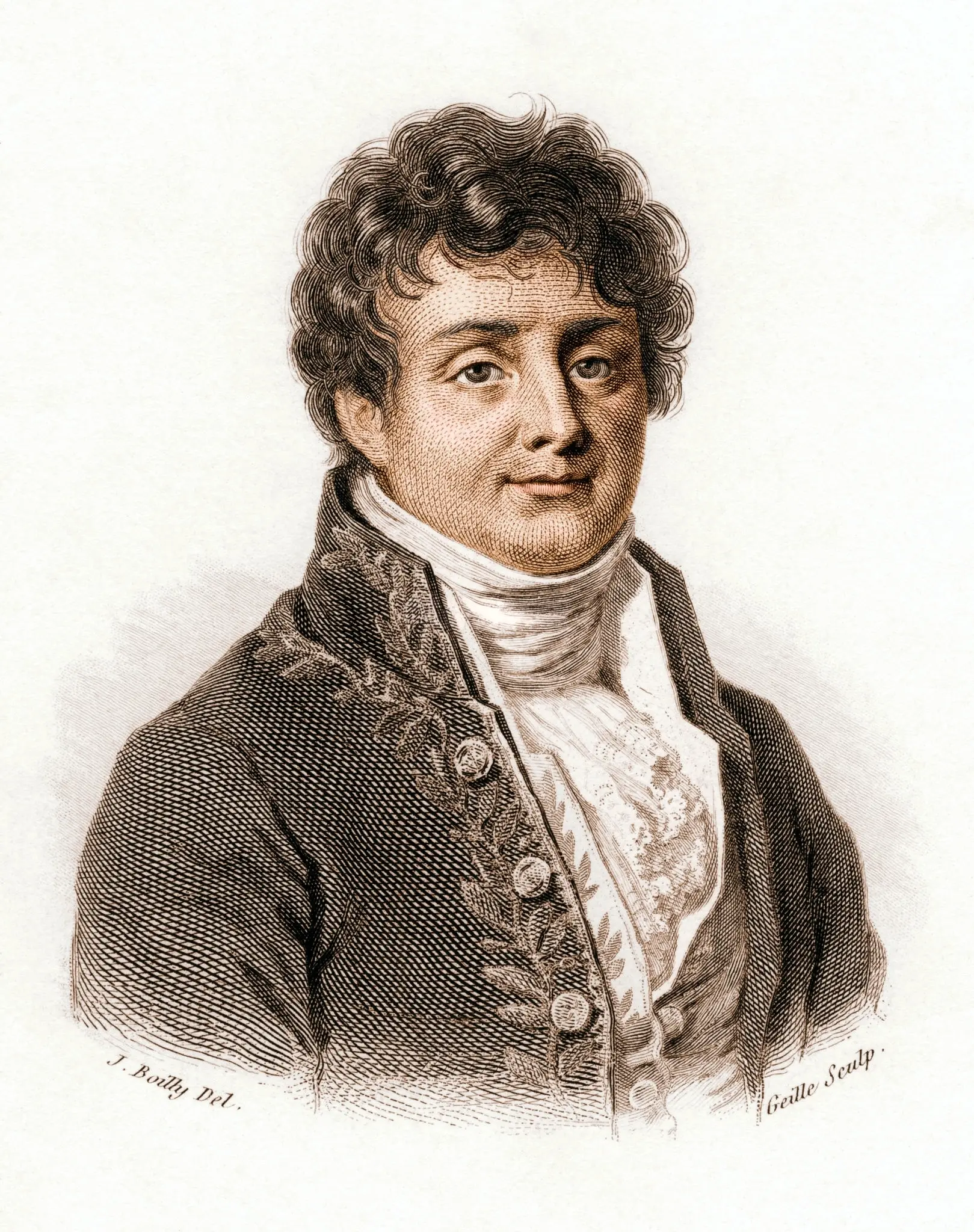
Joseph Fourier
 France
mathematician•physicist•historian
Birthday
March 21, 1768
Birth Sign
Aries
Birthplace
Auxerre, Burgundy, Kingdom of France
Age
Died at 62
About
Jean-Baptiste Joseph Fourier was a French mathematician and physicist whose work on heat conduction gave rise to one of the most powerful tools in modern science: the Fourier series. His insight that any periodic function could be expressed as a sum of sine and cosine waves revolutionized mathematics and physics, leading to the development of Fourier analysis, a cornerstone of signal processing, quantum mechanics, and engineering. The Fourier transform and Fourier's law of heat conduction bear his name. He also made one of the first scientific descriptions of the greenhouse effect, calculating that Earth's atmosphere traps heat. His career included service as a scientific advisor to Napoleon Bonaparte during the Egyptian expedition and as prefect of Grenoble. Fourier's methods remain indispensable across countless technical fields, and his legacy as a founder of mathematical physics is secure.
Early Life & Background
Fourier was born in Auxerre, the twelfth child of a master tailor. Orphaned by age nine, he was raised by the church and entered the École Royale Militaire of Auxerre, run by Benedictine monks. He showed early talent in literature, but by thirteen mathematics had become his consuming interest. He worked through the six volumes of Bézout's Cours de mathématiques by age fourteen and won a prize for his study of Bossut's mechanics at fifteen. His habit of staying up late reading mathematical texts by candlelight, he collected discarded stumps to keep studying, contributed to lifelong poor health. Denied a scientific army commission due to his birth, he instead taught mathematics and entered the Church. During the French Revolution, he served on the local Revolutionary Committee but was briefly imprisoned in 1794 for protesting its brutality. In 1795, he was appointed to the École Normale and soon after succeeded Joseph-Louis Lagrange at the École Polytechnique.
Career Growth
In 1798, Fourier was among the three principal scientific advisors chosen by Napoleon for the Egyptian expedition. He served as governor of Lower Egypt, organized munitions workshops, and contributed papers to the Egyptian Institute in Cairo. After the French capitulation in 1801, he returned to France and was made prefect of Grenoble. There, he began his seminal work on heat conduction. In 1822, he published his magnum opus, Théorie analytique de la chaleur, which established the partial differential equation governing heat diffusion and solved it using infinite trigonometric series, now known as Fourier series. The work was initially controversial; Lagrange had considered particular cases but not pursued the subject. Fourier also conducted experiments with glass-covered containers and concluded that Earth's atmosphere retains heat, anticipating the greenhouse effect. After Napoleon's fall, he faced difficulties with the restored monarchy but moved to Paris in 1816 and continued his work until his death in 1830.
Career Timeline
Public Image & Style
Fourier is regarded as one of the most influential mathematicians and physicists of his era. His work laid foundations for Fourier analysis and harmonic analysis, which became indispensable tools across science and engineering. He is remembered as a pioneer of mathematical physics who demonstrated that mathematics could describe physical phenomena with elegant precision. His name is attached to the Fourier transform, Fourier series, Fourier's law, and the Fourier number, a remarkable number of enduring eponyms for a single scientist.
Fame & Fandom (iFAMOUS Rankings)
Joseph Fourier commands a global attention defined by enduring academic reverence rather than contemporary celebrity metrics. His influence permeates the foundational texts of mathematics and physics, yet his presence in modern popular culture remains distinct from the active fandoms of living stars. According to the August 2026 evaluation by iFANN, Joseph Fourier is currently evaluated but does not hold a placement in the published Global Top 1,000 or any Top-100 scope list. The absence of a ranked position reflects his status as a historical figure whose legacy operates within scholarly circles rather than the fluctuating currents of public opinion measured by current fame engines. While no formal fandom name exists for the mathematician, the community engaging with his work consists of mathematicians, physicists, engineers, and historians who celebrate his contributions through academic discourse rather than organized fan rituals. Institutions occasionally mark significant dates, such as the celebration of his 250th birthday in 2018, but these events serve professional commemoration rather than fan devotion. No fan-funded projects, social media campaigns, or interactive movements have ever been launched in his name, as the concept of a celebrity fanbase did not exist during his lifetime. The engagement he receives is strictly intellectual, characterized by the study of his equations and the application of his theories in fields ranging from signal processing to climate science.
Interesting Facts and Legends
Jean-Baptiste Joseph Fourier collected discarded candle stumps from the school chapel to continue studying mathematics after dark. Originally destined for life as a Benedictine monk, he never took vows because the French Revolution suspended monastic orders just before his pronouncement. His assertion that heat behaves like a wave was initially dismissed as ludicrous by contemporaries, including Lagrange, who had only explored particular cases without pursuing the broader theory. During Napoleon's Egyptian expedition, Fourier served as the governor of Lower Egypt and secretary of the Institut d'Égypte, bridging his early mathematical interests with administrative duties. A verified legend surrounding his career involves his discovery of the greenhouse effect, where he theorized that Earth's atmosphere traps heat from the sun, a prediction made over a century and a half before it became a central concern of environmental science. Another iconic moment in his scientific mythology is the development of the Fourier series, which revolutionized analysis by proving that complex periodic functions could be expressed as sums of sine and cosine waves. This theoretical breakthrough, once controversial, is now regarded by modern figures like Fields Medalist Cédric Villani as a "mathematical poem," elevating his derivations to an aesthetic level while remaining a practical cornerstone for nanochips and quantum mechanics.
Notable Quotes
“There cannot be a language more universal and more simple, more free from errors and obscurities... Mathematical analysis is as extensive as nature itself, and it defines all perceptible relations.”
“Profound study of nature is the most fertile source of mathematical discoveries.”
Family & Personal Life
Notable Connections
Relationships & Dating History
Death & Aftermath
Died
May 16, 1830 (aged 62)
Death Place
Paris, France
Cause of Death
Natural causes associated with old age
The Institut Fourier at the University of Grenoble Alpes stands as a permanent institutional tribute to his contributions, while modern mathematical discourse continues to treat his work on heat transfer as a foundational element of signal processing. Centuries after his passing, specific predictions regarding plasma physics made by him were experimentally confirmed in 2025, reshaping contemporary understanding of extreme materials and cementing his status as a visionary whose insights outlasted his biological lifespan. His legacy also saw renewed global attention during the celebration of his 250th birthday in 2018, with scholarly articles highlighting his early calculations on the greenhouse effect that anticipated modern climate science by nearly two centuries.
Joseph Fourier passed away on May 16, 1830, at the age of 62 within the city of Paris where he served as a prominent administrator and member of the French Academy. Historical records indicate he remained active in scientific administration until his final days, though no specific details regarding his last public appearance or the precise circumstances of his final hours are preserved in available biographical accounts. The cause of death is attributed to natural causes associated with old age. Specific details concerning the date, location, attendees, or nature of his funeral service remain unrecorded in the historical text.
Net Worth (Estate Value)
$0
iFANN Editorial Team estimate
Joseph Fourier passed away in 1830 as a mathematician, physicist, and administrator who maintained a modest lifestyle throughout his life. He did not accumulate significant personal wealth by modern standards, and no financial records track the value of his estate. Per iFANN's editorial analysis, the total net worth for Joseph Fourier is $0.
Awards & Accolades
View 4 records, honours and achievementsKnown For
Fourier series
1822 · Developer
Fourier transform
1822 · Developer
Fourier's law of heat conduction
1822 · Discoverer
Greenhouse effect
1824 · Early describer
Keywords
Sources
Quick Facts
- Profession
- mathematician, physicist, historian
- Born
- +1768-03-21
- Birthplace
- Auxerre
- Died
- +1830-05-16
- Death Place
- Paris
- Gender
- Male
- Birth Sign
- Aries
Personal Details
- Full Name
- Jean-Baptiste Joseph Fourier
- Education
- École Royale Militaire of Auxerre, École Normale Supérieure
Frequently Asked Questions
What is Joseph Fourier famous for?
Did Joseph Fourier get married?
How did Joseph Fourier die?
What did Joseph Fourier discover about heat?
What is the greenhouse effect discovery by Fourier?
Similar People
Join the community
fans discussing