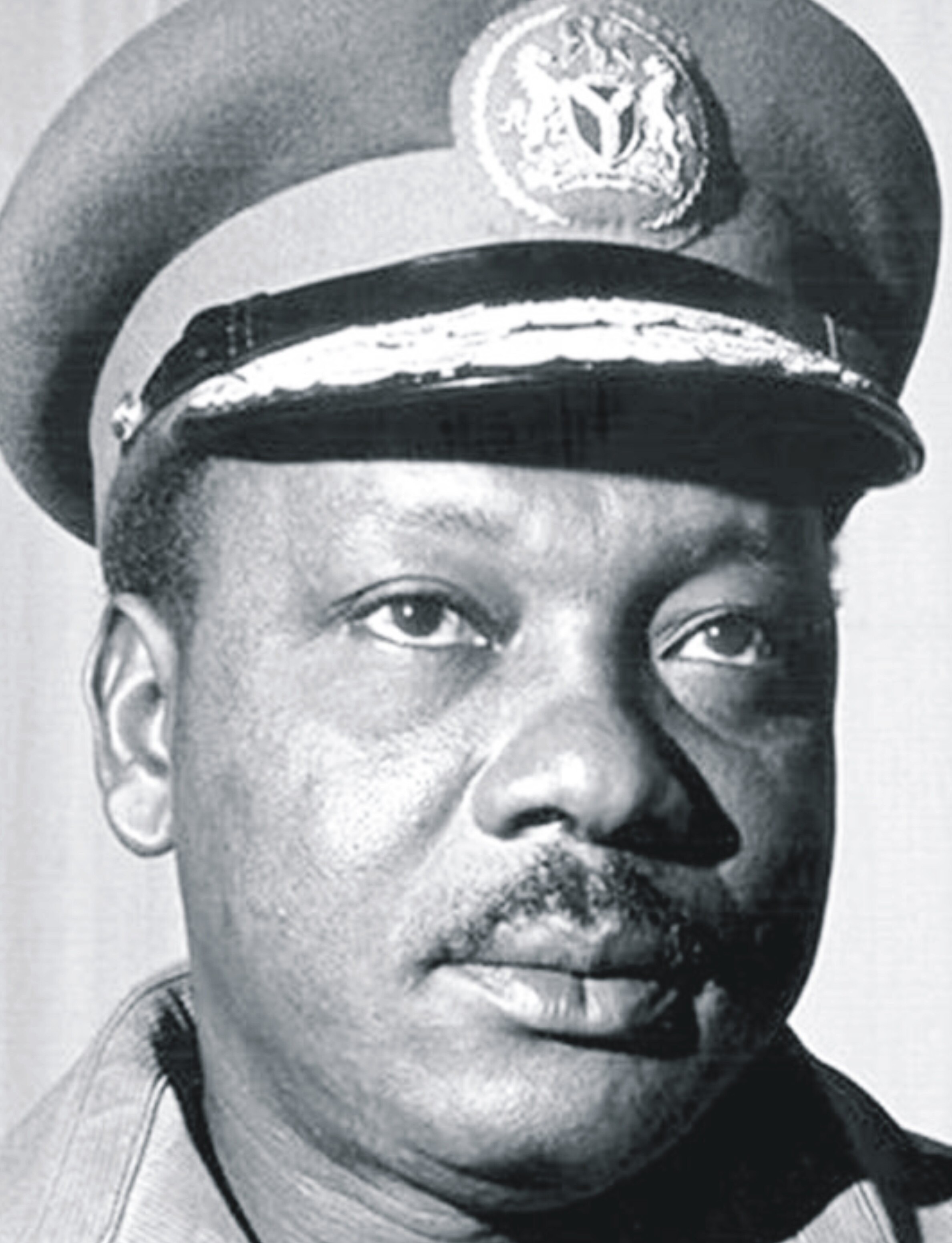
Johnson Aguiyi-Ironsi
 Nigeria
politician•military personnel•military personnel
Birthday
+1924-03-03
Birth Sign
Pisces
Birthplace
Umuahia
Age
Died at 42
About
Johnson Thomas Umunnakwe Aguiyi-Ironsi (3 March 1924 – 29 July 1966) was a Nigerian military officer who became the country's first military head of state. Born in Umuahia, he joined the army and rose through the ranks, serving in World War II and later as a key figure in the Nigerian Army. After the 15 January 1966 coup, Ironsi seized power, ruling from 16 January until his assassination on 29 July 1966. His tenure was short and turbulent, marked by his attempt to unify Nigeria under a unitary government, which sparked resistance and led to his overthrow and killing by a group of Northern officers led by Murtala Muhammed.
Fame & Fandom
Johnson Aguiyi-Ironsi commands a legacy defined by historical gravity rather than the vibrant, organized fandoms of modern entertainers. No formal group name exists for those who study his life; there are no fan clubs, birthday billboards, or grassroots campaigns dedicated to his memory in the manner of pop culture icons. Instead, engagement with his story manifests as state-sanctioned commemoration and familial advocacy, most notably the 2026 memorial events where dignitaries honored his memory sixty years after his assassination. These actions reflect a political reckoning with history rather than the adulation of a celebrity cult. Despite the absence of a traditional fanbase, his global recognition remains significant within the scope of African political history. According to the iFANN Global Fame Rankings, Johnson Aguiyi-Ironsi is currently the 90th most famous person from Nigeria, a position that marks an ascent from the 116th spot recorded in the previous cycle. This placement reflects sustained interest in the figures who shaped the nation's turbulent early independence era. The ranking system, which tracks global attention across media coverage, search behavior, and consumption signals worldwide, places him firmly among the most recognized Nigerian figures of the 20th century. His status as the country's first military head of state ensures his name persists in educational and political discourse long after his death. While he lacks the viral momentum of contemporary stars, his historical footprint secures his place in the annals of global leadership.
Interesting Facts and Legends
Born in Umuahia in 1924, Johnson Aguiyi-Ironsi rose through the ranks of the Nigerian Army to become its first indigenous General Officer Commanding before seizing power in January 1966. He served as the nation's first military head of state until his assassination on July 29, 1966, during a counter-coup led by Northern officers under Murtala Muhammed. A persistent story circulating among historians and political observers suggests he was not part of the initial planning for the January coup but was elevated to power afterwards, a claim his family reiterated in 2026 while seeking an official apology. His tenure is inextricably linked to Unification Decree No. 34, an attempt to abolish Nigeria's regional structure that alienated northern officers and directly precipitated his downfall. Beyond the political turbulence, personal lore describes him as a charming personality with a cosmopolitan outlook, a characterization attributed to Major General Adeyinka Adebayo that contrasts with his stern image as a ruler. The circumstances of his death remain a sensitive chapter in Nigerian history, often cited as the catalyst for widespread anti-Northern sentiment and violence that followed.
Death & Aftermath
Died
+1966-07-29 (aged 42)
Death Place
Ibadan, Oyo State, Nigeria
Cause of Death
Execution by gunshot wounds
The family of Major General Johnson Thomas Umunnakwe Aguiyi-Ironsi has consistently maintained that he was innocent of the January 1966 coup and formally demanded an apology from the Federal Government of Nigeria for his assassination. He died on July 29, 1966, at the Governor's Lodge in Ibadan, Oyo State, while staying with his host Major-General Adekunle Fajuyi during a counter-coup led by Northern officers under Colonel Murtala Muhammed. Troops loyal to the Northern faction stormed the residence, and both men were shot while attempting to negotiate or surrender; the official cause of death is recorded as gunshot wounds resulting from execution. The immediate reaction in Eastern Nigeria was outrage among Igbo communities, fueling pogroms against Northerners and accelerating the secessionist movement that eventually led to the Nigerian Civil War, while the new military leadership under General Yakubu Gowon absorbed the perpetrators into the administration without prosecution.
Following his death, Aguiyi-Ironsi was buried in Onitsha, Anambra State, where high-ranking officials attended the service, and the site of his death in Ibadan remains historically noted. Sixty years after the event, President Bola Tinubu honored him in July 2026 as a courageous officer, and tributes were held across the nation by dignitaries including Olusegun Obasanjo and the Ohanaeze Ndigbo organization.
Awards & Accolades
Keywords
Quick Facts
- Profession
- politician, military personnel, military personnel
- Born
- +1924-03-03
- Birthplace
- Umuahia
- Died
- +1966-07-29
- Death Place
- Ibadan
- Gender
- Male
- Spouse
- Victoria Aguiyi-Ironsi
- Birth Sign
- Pisces
Personal Details
- Spouse
- Victoria Aguiyi-Ironsi
Join the community
fans discussing