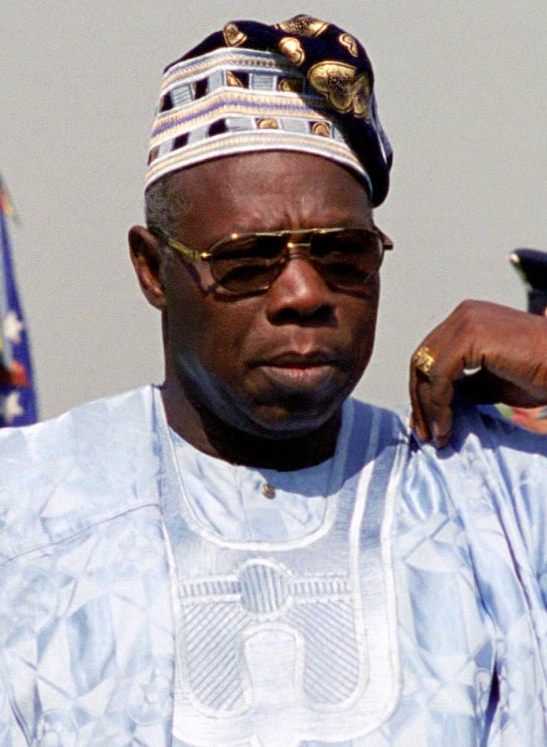
Olusegun Obasanjo
 Nigeria
politician•statesman•agriculturalist•retired army general
Also known as: OBJ
Birthday
March 5, 1937
Birth Sign
Pisces
Birthplace
Ibogun-Olaogun, Ogun State, Nigeria
Age
89 years old
Height
5 ft 10 in (178 cm)
About
Olusegun Obasanjo is a Nigerian politician, statesman, agriculturalist, and retired army general who has significantly shaped his country's modern history. He served as Nigeria’s military Head of State from 1976 to 1979 and later as its democratically elected civilian president from 1999 to 2007. An influential voice in African politics, he is known for his commitment to democratic transitions and Pan-African cooperation.
Today, Obasanjo remains an active elder statesman, engaging in international mediation and advising on governance and development issues across the continent. His public persona blends military directness with traditional Yoruba wisdom and a strong Christian faith, resonating with a broad base of supporters who admire his unique trajectory from military leader to civilian president and his enduring role in public life.
Early Life & Background
Olusegun Obasanjo grew up in the quiet village of Ibogun-Olaogun, nestled near Abeokuta in Ogun State, Nigeria. His childhood unfolded within a modest rural farming family of the Owu branch of the Yoruba people. He spent his early years immersed in the rhythms of agricultural life, receiving much of his initial schooling in Abeokuta.
His path took a significant turn in 1958 when he decided to join the Nigerian Army. He specialized in engineering, a field that would prove foundational to his military career. His training took him beyond Nigeria's borders, with studies in Britain and India. Early in his military service, he gained valuable international experience by serving with United Nations peacekeeping forces in the Congo. He steadily climbed the ranks, eventually reaching major.
A defining chapter in his early military life was the Nigerian Civil War, which raged from 1967 to 1970. During this conflict, Obasanjo commanded a division that played a decisive role in the fight against Biafran separatists. His leadership culminated in a historic moment in January 1970 when he personally accepted the Biafran surrender at Owerri, marking the end of the devastating war and setting the stage for his future prominence.
Career Growth
Following the Nigerian Civil War, Olusegun Obasanjo found himself thrust into the highest echelons of power. In 1975, a military coup brought him into the ruling Supreme Military Council as part of a three-person leadership. When General Murtala Muhammed was assassinated in February 1976, Obasanjo was appointed Head of State. He continued many of Muhammed’s policies, focusing on fiscal restraint and expanding free primary education. Notably, he oversaw Nigeria's 1979 general election and voluntarily handed power to elected President Shehu Shagari in October of that year, a rare act for an African military leader at the time. He then retired to his Ota farm, where he pursued agricultural ventures, authored four books, and participated in international mediation efforts across Africa.
His return to the political forefront came after a period of significant personal hardship. General Sani Abacha seized power in 1993, and Obasanjo became an outspoken critic of his regime. This led to his arrest in 1995, a trial for an alleged coup plot, which he consistently denied, and subsequent imprisonment until Abacha's sudden death in 1998. During his incarceration, he underwent a profound religious conversion, becoming a born-again Christian, which deeply influenced his outlook.
Released in 1998, Obasanjo joined the newly formed Peoples Democratic Party (PDP), securing its presidential nomination. He went on to win the 1999 election, beginning his first term as Nigeria's civilian president. During his presidency from 1999 to 2007, he focused on depoliticizing the military, expanding the police force, and deploying troops to address ethnic and religious violence. He also pursued economic reforms, privatizing state enterprises, and championed the creation of the African Union (AU), serving as its chairperson from 2004 to 2006. He secured re-election in 2003, and after completing his second term in 2007, he retired from the presidency, later earning a PhD in theology from the National Open University of Nigeria. In 2026, he continues to be recognized for his contributions, receiving the Lifetime Leadership Award from the African Refiners and Distributors Association (ARDA) for advancing Africa’s development.
Career Timeline
Public Image & Style
In both Nigerian and international media, Olusegun Obasanjo is often depicted as a complex political figure, seen by many as a democratizing hero who also exhibited authoritarian tendencies during his time in power. His public style is a distinctive blend of military bluntness, traditional Yoruba proverbial wisdom, and the earnest rhetoric of a born-again Christian.
He does not have a formal fandom name, but his supporters during his political career were often referred to as “Obasanjoists” or simply loyalists of the Peoples Democratic Party (PDP). His communication is direct, sometimes sharp, and frequently includes moral admonition, shaping an image of a leader who is unafraid to speak his mind and offer guidance on national and continental affairs.
Fame & Fandom
Olusegun Obasanjo commands a vast sphere of influence that spans the African continent and resonates within global political discourse, reflecting a lifetime of statecraft rather than celebrity performance. According to the iFANN Global Fame Rankings, he holds steady positions as the 13th most famous person in Nigeria, the 25th most famous person from Nigeria, and the 27th most famous person in Africa. These placements track his enduring relevance across media coverage, search activity, and consumption signals worldwide without relying on transient viral trends. While his public profile is immense, his relationship with supporters differs fundamentally from entertainment fandoms; there is no formal moniker or organized fanbase like those found among pop stars. Instead, his following consists of citizens and international observers who view him as a distinguished elder statesman. His engagement remains rooted in political activism, diplomatic mediation, and the advocacy of governance reforms, distinguishing his legacy from the ritualistic adoration typical of modern celebrity culture.
Interesting Facts and Legends
Beyond his political career, Olusegun Obasanjo is a passionate agriculturalist who transformed his Ota property into a major commercial enterprise for poultry and cassava production shortly after retiring from military rule in 1979. During his imprisonment under General Sani Abacha, he devoted himself to theological study, translating religious texts and authoring works that eventually earned him a PhD in theology. He has published at least four books covering autobiography, leadership, and governance. Notably, he voluntarily relinquished power twice: first in 1979 and again by adhering to constitutional term limits in 2007. His resilience is further illustrated by his survival of a plane crash in 1996 amidst numerous assassination rumors. A defining legend of his life involves his dramatic transition from prisoner to president; released in June 1998 after nearly two years in detention, he ascended to the presidency just eleven months later, a narrative often cited to highlight his political fortitude. Another iconic moment cemented his historical standing as the first military ruler in Africa to successfully transfer power to a civilian government in 1979. In recent years, his status as a moral authority was reinforced by his vocal critiques of Western democratic models and his active role in high-level confabs regarding African development.
Notable Quotes
“I am not a politician. I am a soldier who happens to have been thrust into politics.”
“Leadership is not a position or a title. It is action and example.”
“Corruption is the greatest single bane of our society today.”
“It was in prison that I truly met God.”
Family & Personal Life
Olusegun Obasanjo was born into a farming family of the Owu branch of the Yoruba people in the village of Ibogun-Olaogun. His upbringing in this modest rural setting instilled in him a grounded perspective that often surfaces in his public statements.
He has fathered at least 20 acknowledged children from his various relationships. Among them are Iyabo Obasanjo, who became a former senator, and Olusegun Obasanjo Jr. His personal household today is often associated with his extensive Ota farm, a major agricultural enterprise that reflects his deep connection to the land and his entrepreneurial spirit.
Notable Connections
Olusegun Obasanjo's career has seen him interact with a wide array of international figures, including fellow statesmen like Nelson Mandela, Thabo Mbeki, and Kofi Annan, often in roles related to mediation and continental diplomacy. Domestically, he worked closely with Atiku Abubakar, who served as his vice president from 1999 to 2007, though they later became political rivals. He has also engaged in public disagreements with figures such as Segun Osoba.
Relationships & Dating History
Olusegun Obasanjo has experienced several significant relationships throughout his life, marked by his demanding military and political career. His first marriage was to Oluremi Obasanjo (née Akinlawon) in the early 1960s. They had several children together, including Iyabo Obasanjo, who later became a senator. The strains of his public life eventually led to their divorce in the 1980s.
He later married Stella Obasanjo (née Abebe) in 1987. She served as First Lady during his civilian presidency, a period that saw her become a prominent public figure. Tragically, Stella passed away in 2005 due to complications following cosmetic surgery in Spain. They had one son, Olusegun Obasanjo Jr.
Around 2009, he entered into a relationship with Ajoke Murtala Muhammed, the widow of the late General Murtala Muhammed. This union also produced children and has been described in various sources as a later marriage, though specific formalization details remain less publicized. Beyond these formal unions, Obasanjo has had other documented relationships and children outside of marriage, particularly during and after his military years, leading to at least 20 acknowledged children in total. As of 2026, Olusegun Obasanjo is generally regarded as single, maintaining a private profile regarding new romantic partnerships at this stage of his life.
- DivorcedOluremi Obasanjo1960 - 1980His first wife, with whom he had several children, including Iyabo Obasanjo, before their divorce in the 1980s.
- WidowedStella Obasanjo1987 - 2005His second wife and First Lady during his presidency; she passed away in 2005 from complications after surgery. They had one son, Olusegun Obasanjo Jr.
- In a RelationshipAjoke Murtala Muhammed2009 - presentWidow of General Murtala Muhammed; they entered a relationship around 2009 and have children together.
Salary, Net Worth In 2026
$150 Million
iFANN Editorial Team estimate
iFANN currently estimates Olusegun Obasanjo's financial standing in 2026 to be $150 Million. This valuation reflects his diverse interests and long career, with his wealth primarily stemming from his extensive agricultural and real estate ventures. His Ota farm, a large-scale commercial poultry and crop operation, stands as one of Nigeria's most significant agricultural enterprises and is a major contributor to his net worth. Beyond farming, he holds substantial real estate investments, particularly in his home state of Ogun and in Abuja, the nation's capital. His post-presidency activities, including consulting, mediation fees for international peace initiatives, and royalties from his published books, also add to his income streams. Unlike many public figures, Obasanjo does not have significant income from major brand endorsement deals or entertainment ventures. His net worth has seen steady growth over recent decades, driven by the sustained performance of his business interests and his continued engagement as an elder statesman.
Awards & Accolades
View 7 records, honours and achievementsKnown For
Head of State of Nigeria
1979 · Military Ruler
President of Nigeria
2007 · Democratically Elected President
African Union
2006 · Chairperson
Keywords
Sources
Quick Facts
- Profession
- politician, statesman, agriculturalist, retired army general
- Born
- March 5, 1937
- Birthplace
- Ibogun-Olaogun, Ogun State, Nigeria
- Gender
- Male
- Birth Sign
- Pisces
- Children
- at least 20 acknowledged children
Personal Details
- Full Name
- Chief Olusegun Matthew Okikiola Ogunboye Aremu Obasanjo
- Height
- 5 ft 10 in (178 cm)
- Children
- Iyabo Obasanjo · Olusegun Obasanjo Jr.
- Education
- National Open University of Nigeria (PhD in Theology)
Frequently Asked Questions
How old is Olusegun Obasanjo?
What is Olusegun Obasanjo's net worth in 2026?
Who are Olusegun Obasanjo's children?
What is Olusegun Obasanjo best known for?
Is Olusegun Obasanjo still active in 2026?
Social Media
Join the community
fans discussing