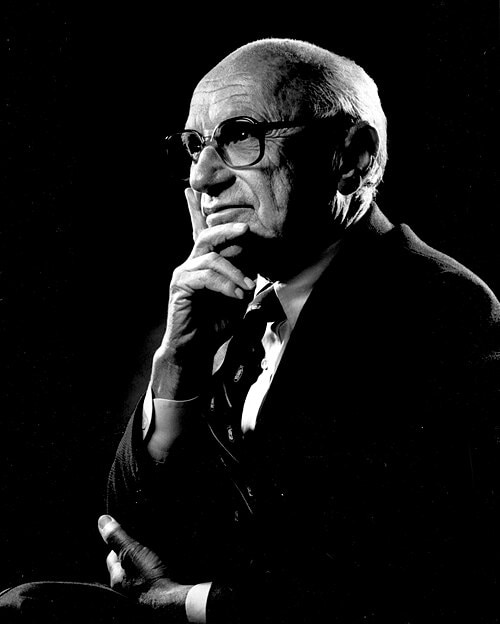
Milton Friedman
 United States
economist•university teacher•statistician
Birthday
July 31, 1912
Birth Sign
Leo
Birthplace
Brooklyn, New York, United States
Age
Died at 94
About
Milton Friedman was an American economist and statistician whose ideas reshaped 20th-century economic policy. Born in Brooklyn on July 31, 1912, he became the leading voice of the Chicago school of economics, challenging Keynesian orthodoxy with his monetarist theories. Friedman won the 1976 Nobel Memorial Prize in Economic Sciences for his work on consumption analysis, monetary history, and stabilization policy. He introduced the permanent income hypothesis and the concept of a natural rate of unemployment, predicting stagflation when others dismissed it. His influence extended far beyond academia: his ideas on free markets, deregulation, and monetary policy guided leaders like Ronald Reagan and Margaret Thatcher. Friedman's 1962 book Capitalism and Freedom advocated for school vouchers, a negative income tax, and drug liberalization. He also founded the Friedman Foundation for Educational Choice. After retiring from the University of Chicago in 1977, he remained active until his death on November 16, 2006, at age 94. A 2011 survey ranked him the second-most influential economist of the 20th century, behind only John Maynard Keynes.
Early Life & Background
Milton Friedman was born to Sára Ethel Landau and Jenő Saul Friedman, Jewish working-class immigrants from what is now Ukraine. The family moved to Rahway, New Jersey, shortly after his birth. His father died during Friedman's senior year of high school, leaving him and two older sisters to support their mother. A car accident in his early teens left a permanent scar on his upper lip. Friedman graduated from Rahway High School in 1928, just before his sixteenth birthday, as a talented student and avid reader.
He won a competitive scholarship to Rutgers University, initially studying mathematics with the aim of becoming an actuary. There, he encountered Arthur Burns, a new assistant professor of economics who became his mentor. Burns introduced him to Alfred Marshall's Principles of Economics. Friedman also studied under Homer Jones, who steered him toward rigorous economic theory. He graduated with a bachelor's degree in 1932, majoring in both mathematics and economics.
On Jones's recommendation, the University of Chicago offered Friedman a graduate scholarship in economics. He earned his master's degree in 1933, then spent a year as a fellow at Columbia University studying under Harold Hotelling, J. M. Clark, and Wesley Mitchell. He returned to Chicago as a research assistant to Henry Schultz, working on demand analysis until 1935. Friedman began his professional career as a researcher in Washington, D.C., joining the National Resources Committee in 1935, where he observed New Deal programs firsthand, an experience that deepened his skepticism of government intervention.
Career Growth
Friedman began a long association with the National Bureau of Economic Research in 1937, which continued until 1981. During World War II, he worked at the U.S. Treasury Department on wartime tax policy, helping establish payroll tax withholding, an innovation he later regretted for enabling big government. He then served as associate director of the Statistical Research Group at Columbia University, working on weapon design and military tactics.
After receiving his Ph.D. from Columbia in 1946, Friedman joined the University of Chicago as a professor of economics, beginning a three-decade tenure. He received the John Bates Clark Medal in 1951. In 1962, he published Capitalism and Freedom, a landmark book advocating free markets, school vouchers, a negative income tax, drug liberalization, a volunteer military, and freely floating exchange rates. The following year, he co-authored A Monetary History of the United States, 1867–1960 with Anna Schwartz, demonstrating that Federal Reserve contractionary policies worsened the Great Depression.
Friedman served as president of the American Economic Association in 1967. He won the Nobel Memorial Prize in Economic Sciences in 1976. After retiring from Chicago in 1977, he became a senior research fellow at the Hoover Institution at Stanford University. In 1980, he and his wife Rose published Free to Choose, based on a ten-part PBS television series that shifted American public opinion toward free-market policies. He received the Presidential Medal of Freedom and the National Medal of Science in 1988. In 1996, he founded the Friedman Foundation for Educational Choice, now EdChoice.
Career Timeline
Public Image & Style
Friedman was known for his sharp suits, distinctive mustache, and the scar on his upper lip from a car accident. He spoke with clarity and conviction, often using simple analogies to explain complex economic concepts. Media coverage portrayed him as the leading advocate of free-market economics and the intellectual father of monetarism. His PBS series Free to Choose and his Newsweek columns made economic ideas accessible to the general public. Followers are often described as Friedmanites or free-market advocates. His quotes are widely shared by libertarian and free-market accounts on social media, with a tone that is confident, contrarian, and principled. Annual conferences and lectures at the Hoover Institution and the University of Chicago continue to celebrate his work.
Fame & Fandom (iFAMOUS Rankings)
Milton Friedman holds no placement in the iFANN Global Top 1,000 or any published scope list as of August 2026, a status the iFANN Global Fame Engine confirmed without assigning a specific rank. While he never generated the feverish, chart-topping adoration reserved for pop stars, his intellectual footprint remains vast and deeply embedded in global policy circles. His influence is measured not by fleeting viral moments but by the enduring adoption of his theories across decades of economic discourse.
There is no formal fandom name documented for his supporters; instead, his legacy is carried forward by scholars, policymakers, and think tank researchers who align with free-market capitalism and monetarism. Unlike celebrity cultures that organize fan clubs or launch birthday campaigns, Friedman's following manifests through institutional advocacy. Organizations like the Cato Institute and the Hoover Institution continue to promote his works and host conferences dedicated to his theories, treating his ideas as foundational texts rather than pop culture commodities.
The closest equivalent to a fan movement involves the ongoing reverence for his public appearances, such as his 1980 PBS series *Free to Choose*, which reached millions and served as a primary vehicle for spreading his ideas. His legendary 1963 televised debate with John Kenneth Galbraith and his 1965 appearance on *The Tonight Show Starring Johnny Carson* remain pivotal stories in economic history, often cited in textbooks to illustrate the clash between Keynesian and free-market perspectives. These moments cemented his status as a household name who could articulate complex concepts in plain language, turning abstract theory into mainstream conversation without the need for traditional fan rituals.
Interesting Facts and Legends
Friedman helped establish the system of payroll tax withholding during his tenure at the U.S. Treasury Department, a policy he later regretted as enabling big government. He famously predicted stagflation, simultaneous high inflation and unemployment, when most economists believed the Phillips curve showed a stable trade-off. Several of his students and mentees at the University of Chicago went on to win Nobel Prizes, including Gary Becker, Robert Fogel, and Robert Lucas Jr.
A widely retold story from his career involves his 1968 testimony before Congress, where he warned that continued expansionary policies would lead to high inflation and unemployment. This prediction, later known as the 'Friedman Rule,' was vindicated during the stagflation of the 1970s, leading to a surge in his influence and the eventual implementation of monetarist policies globally. Another iconic moment occurred during his 1963 televised debate with John Kenneth Galbraith regarding the role of government in the economy, an exchange that highlighted the sharp divide between opposing economic schools of thought.
A car accident in his early teens left a permanent scar on his upper lip, a distinctive feature that became part of his recognizable public image alongside his sharp suits and mustache. His monetary theory influenced the Federal Reserve's response to the 2008 financial crisis, proving the longevity of his insights long after his death.
Notable Quotes
“Inflation is always and everywhere a monetary phenomenon.”
“The government solution to a problem is usually as bad as the problem.”
“There is no such thing as a free lunch.”
“I am in favor of cutting taxes under any circumstances and for any excuse, for any reason, whenever it's possible.”
“The great virtue of a free market system is that it does not care what color people are; it does not care what their religion is; it only cares whether they can produce something you want to buy.”
Family & Personal Life
Friedman's parents, Sára Ethel Landau and Jenő Saul Friedman, were Jewish immigrants from Beregszász in Carpathian Ruthenia, Kingdom of Hungary (now Berehove, Ukraine). Both worked as dry goods merchants. He was the youngest of four children and the only son. His father died during his senior year of high school. Friedman married Rose Director on June 25, 1938; she was a fellow economics student at the University of Chicago and became his lifelong collaborator, co-authoring Free to Choose and two memoirs. They had two children: David D. Friedman, born in 1945, who became a prominent economist and anarcho-capitalist theorist, and a daughter, Janet Friedman. Rose died in 2009.
Notable Connections
Friedman's mentor Arthur Burns at Rutgers introduced him to economics. He co-authored A Monetary History of the United States with Anna Schwartz. His wife Rose Friedman was his lifelong collaborator. He was a leading figure of the Chicago school alongside George Stigler. His students included Nobel laureates Gary Becker, Robert Fogel, and Robert Lucas Jr. He advised President Ronald Reagan and Prime Minister Margaret Thatcher. He worked under Henry Schultz at Chicago and studied under Frank Knight, Lloyd Mints, Jacob Viner, Harold Hotelling, J. M. Clark, and Wesley Mitchell.
Relationships & Dating History
Friedman met Rose Director while both were economics students at the University of Chicago. They married on June 25, 1938, and remained together until his death on November 16, 2006, a union of 68 years. Rose co-authored several books with him, including Free to Choose and their memoirs Two Lucky People. Together they had two children: David D. Friedman (born 1945) and Janet Friedman. Rose died in 2009. As of 2026, Friedman is deceased and was widowed by Rose.
- MarriedRose Friedman1938 - 2006Met as economics students at University of Chicago; co-authored several books; two children together.
Death & Aftermath
Died
November 16, 2006 (aged 94)
Death Place
San Francisco, California, USA
Cause of Death
Heart failure and cancer
Milton Friedman spent his final days in the quiet of his San Francisco home, recovering at residence after a hospitalization earlier that year for heart issues. The renowned economist and statistician passed away on November 16, 2006, following a long battle with heart failure and cancer. His death was confirmed by family members and reported by major news outlets shortly after the event occurred. The economic community and political leaders globally offered widespread tributes to the loss of one of the most influential figures of the twentieth century. Messages of mourning arrived from the University of Chicago, the Hoover Institution, and the Cato Institute, while op-eds in publications like The Wall Street Journal and National Review reaffirmed his enduring impact on monetary policy and free-market capitalism.
A private funeral and memorial service took place in New York City, attended by close family and colleagues before his ashes were interred at Ferncliff Cemetery in Hartsdale. Posthumous recognition continued to flow as President George W. Bush awarded him the Presidential Medal of Freedom in 2007. His estate managed the continuation of the Milton and Rose D. Friedman Foundation, now known as EdChoice, which promotes school choice initiatives. Existing works such as Free to Choose saw increased sales and streaming, while academic institutions established scholarships and lecture series to honor his contributions to economics.
Net Worth (Estate Value)
$10 Million
iFANN Editorial Team estimate
Milton Friedman died in 2006, so his personal net worth is not applicable for 2026. His estate continues to generate revenue through book royalties, licensing fees, and ongoing sales of his works. His best-selling books include *Capitalism and Freedom*, *Free to Choose*, and *A Monetary History of the United States*. The Friedman Foundation for Educational Choice (now EdChoice), which he founded in 1996, continues to promote school choice. His estate is managed by his family, including his son David D. Friedman. Per iFANN's editorial analysis, the estate is valued at approximately $10 million as of 2026, derived from posthumous book sales, reprints, licensing of his name and image for educational and documentary projects, and ongoing royalties. His writings remain widely cited and in print.
Awards Won (4)
Friedman won the 1976 Nobel Memorial Prize in Economic Sciences for his work on consumption analysis, monetary history, and stabilization policy. He received the John Bates Clark Medal in 1951. In 1988, he was awarded both the Presidential Medal of Freedom and the National Medal of Science.
1988 · Public Service
1988 · Science
Known For
Capitalism and Freedom
1962 · Author
A Monetary History of the United States
1963 · Co-author
Free to Choose
1980 · Co-author and TV host
Keywords
Sources
Quick Facts
- Profession
- economist, university teacher, statistician
- Born
- +1912-07-31
- Birthplace
- Brooklyn
- Died
- +2006-11-16
- Death Place
- San Francisco
- Gender
- Male
- Spouse
- Rose Friedman
- Birth Sign
- Sagittarius
Personal Details
- Full Name
- Milton Friedman
- Spouse
- Rose Friedman
- Children
- David D. Friedman, Janet Friedman
- Education
- Rutgers University (BA), University of Chicago (MA), Columbia University (PhD)
Frequently Asked Questions
What was Milton Friedman's net worth when he died?
Did Milton Friedman have children?
What is Milton Friedman most famous for?
What did Milton Friedman win the Nobel Prize for?
Was Milton Friedman a Keynesian?
Similar People
Join the community
fans discussing