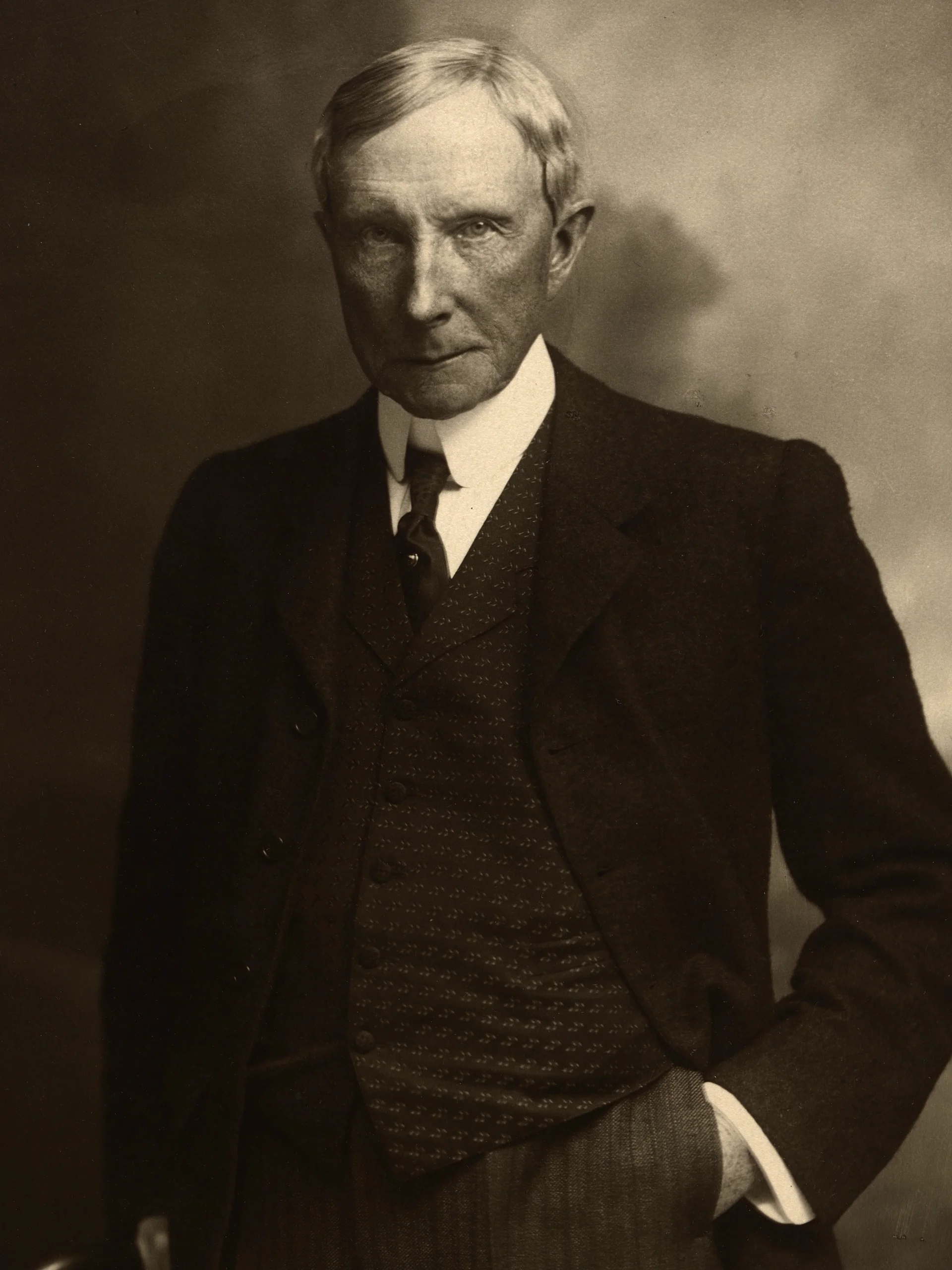
John D. Rockefeller
 United States
Also known as: John Davison Rockefeller, John D. Rockefeller Sr.
Birthday
July 8, 1839
Birth Sign
Cancer
Birthplace
Richford, New York, USA
Age
Died at 97
About
John D. Rockefeller Sr. was an American industrialist and philanthropist who founded the Standard Oil Company and became one of the wealthiest individuals in history. He started his career as an assistant bookkeeper at 16 and by age 20 entered business partnerships. His focus soon narrowed to the oil refining industry, which proved prescient as kerosene and gasoline became essential commodities.
Rockefeller founded the Standard Oil Company in 1870 and led it until 1897, remaining its largest shareholder. Under his direction, Standard Oil grew to control an astonishing 90% of the nation's oil production by 1900. The company achieved this dominance through aggressive cost-cutting and innovative distribution methods. Critics pointed to monopolistic practices, famously quoting Rockefeller's view that "Competition is a sin."
The immense success of Standard Oil drew regulatory attention. In 1911, the Supreme Court ordered its breakup, dividing it into 34 independent entities, many of which, like ExxonMobil and Chevron, still exist today. At its peak, Rockefeller's personal fortune was estimated at $900 million, representing 2.3% of US GDP. He officially became the country's first billionaire on September 28, 1916.
After retiring, Rockefeller dedicated 40 years to philanthropy. He and his wife Laura founded institutions that pioneered systematic giving, focusing on education, medicine, and scientific research. These efforts advanced medical research and combated diseases like hookworm and yellow fever. He also founded the University of Chicago and Rockefeller University, shaping higher education and medical science. Rockefeller died on May 23, 1937, leaving a legacy as both an industrial titan and a transformative philanthropist.
Early Life & Background
Rockefeller was born on July 8, 1839, in Richford, New York, the second of six children. His father, William Avery Rockefeller, was a traveling salesman who was often away, while his mother, Eliza Davison, raised the children with strict Baptist values. The family moved several times before settling in Cleveland, Ohio, in 1853. From a young age, Rockefeller displayed a keen business sense, keeping meticulous ledgers and saving money from odd jobs. He attended local schools and, at 16, enrolled in Folsom's Commercial College in Cleveland to study bookkeeping, completing a three-month course.
In 1855, at age 16, Rockefeller secured a job as an assistant bookkeeper at Hewitt & Tuttle, a produce commission firm. He worked diligently, earning a reputation for precision and reliability. He saved his earnings and by 1859, at age 20, partnered with Maurice B. Clark to form Clark & Rockefeller, a firm dealing in produce and merchandise. The discovery of oil in Titusville, Pennsylvania, in 1859 caught his attention. Recognizing the potential of petroleum, Rockefeller and Clark invested in an oil refinery in Cleveland in 1863, marking his decisive shift into the oil business. This refinery, built with a partner, was the foundation of his future empire.
Career Growth
Rockefeller's most significant venture was the founding of the Standard Oil Company in 1870, with partners including his brother William, Henry M. Flagler, and Stephen V. Harkness. Under his leadership, Standard Oil grew through aggressive horizontal and vertical integration, aiming to control all aspects of oil production and distribution. By 1880, Standard Oil controlled approximately 90% of US oil refining capacity. The company achieved economies of scale that allowed it to undercut competitors and negotiate favorable railroad rates.
In 1882, Standard Oil was reorganized as a trust, a structure that centralized control and became a model for other industries. Rockefeller retired from day-to-day management in 1897 but remained the largest shareholder. The company's dominance led to the 1911 Supreme Court decision ordering its breakup into 34 independent companies, many of which, like ExxonMobil and Chevron, remain major corporations. Rockefeller's personal fortune peaked at an estimated $900 million, about 2.3% of US GDP. On September 28, 1916, he became the first American officially recognized as a billionaire.
Career Timeline
Public Image & Style
Rockefeller's public image is complex and polarizing. To his admirers, he was a visionary industrialist who revolutionized oil production and distribution, making kerosene and gasoline affordable and accessible. His philanthropic work, particularly in medical research and education, earned him widespread respect. Critics, however, saw him as a ruthless monopolist who used predatory tactics to crush competition, fix prices, and bribe politicians. The muckraker Ida Tarbell's 1904 exposé, "The History of the Standard Oil Company," shaped public perception of him as a robber baron. In his later years, Rockefeller cultivated a grandfatherly image, handing out dimes and playing golf. He was not a celebrity in the modern sense, but his name became synonymous with extreme wealth and corporate power. There is no formal fandom, but historians and economists continue to debate his legacy.
Fame & Fandom (iFAMOUS Rankings)
John D. Rockefeller remains a towering figure in global history, though his legacy operates differently than modern celebrity culture. As of August 2026, the iFANN Global Fame Engine has evaluated this person, but they do not currently hold a placement in the published rankings such as the Global Top 1,000 or any Top-100 scope list. This absence reflects a unique status where historical influence transcends contemporary fame metrics rather than indicating obscurity. While he lacks a formal fandom name and no organized group identifies themselves as his fans, his enduring presence is maintained through the institutions he built rather than social media campaigns or fan rituals. The Rockefeller Foundation and the University of Chicago serve as living monuments to his life, drawing scholars and donors who engage with his philosophy of stewardship instead of chasing viral moments. His story continues to shape discussions on wealth, monopoly, and philanthropy, creating a quiet but pervasive cultural footprint that does not require active fan mobilization to sustain its relevance.
Interesting Facts and Legends
Rockefeller was a devout Baptist who tithed 10% of his income from his very first paycheck onward. He often gave dimes to children as a gesture of goodwill and never smoked or drank alcohol. An avid golfer, he played into his 90s and maintained greenhouses at his estate in Pocantico Hills, New York, where his favorite flower, the orchid, bloomed. Despite his vast fortune, he lived modestly, avoiding ostentation, and kept a diary from age 16 until his death to document his finances and thoughts. He was known for strict punctuality and expected the same from others. Beyond these personal habits, legends surround him as the world's first dollar billionaire, a milestone officially crossed in 1916 when his wealth peaked at $900 million. A central part of his lore involves the antitrust case Standard Oil Co. of New Jersey v. United States, which led to the company's breakup in 1911 after controlling 90% of U.S. refineries. Another enduring narrative is his transition from a ruthless tycoon to a benevolent philanthropist who gave away $540 million before his death, establishing foundations that continue to operate globally today.
Notable Quotes
“The ability to deal with people is as much a commodity as sugar or coffee and I will pay more for that ability than for any other under the sun.”
“I believe it is the duty of every man who has been blessed by the opportunities of this land to help his fellow men.”
“Competition is a sin.”
Family & Personal Life
Rockefeller married Laura Spelman on September 8, 1864. Laura was a teacher and the daughter of a prominent abolitionist. They had six children: Bessie (died in infancy), Elizabeth, John D. Jr., Alta, Edith, and Rodman (died in childhood). Laura was a key influence on Rockefeller's philanthropic turn, and he credited her with shaping his moral compass. She died on March 29, 1915. Rockefeller never remarried. His son, John D. Rockefeller Jr., became a noted philanthropist and built the Rockefeller Center. The family estate at Pocantico Hills, New York, became a gathering place for generations. Rockefeller's descendants have continued his philanthropic legacy through the Rockefeller Foundation and other institutions.
Notable Connections
Rockefeller was closely associated with his wife Laura Spelman Rockefeller, who influenced his philanthropy. His son John D. Rockefeller Jr. carried on his philanthropic work. Business partners included Henry M. Flagler, Stephen V. Harkness, and his brother William Rockefeller. Early partner Maurice B. Clark helped launch his career. He was also associated with muckraker Ida Tarbell, whose exposé shaped his public image.
Relationships & Dating History
John D. Rockefeller married Laura Spelman on September 8, 1864. Laura was a teacher from a prominent abolitionist family. They had six children together, though two died in childhood. Laura was a steadying influence on Rockefeller and encouraged his philanthropic turn. They were married for over 50 years until Laura's death on March 29, 1915. Rockefeller never remarried and remained devoted to her memory. He often said she was the best business decision he ever made. As of 2026, Rockefeller is deceased and his relationship status is widowed.
- MarriedLaura Spelman Rockefeller1864 - 1915Married on September 8, 1864; she died on March 29, 1915.
Death & Aftermath
Died
May 23, 1937 (aged 97)
Death Place
Ormond Beach, Florida
Cause of Death
Natural causes related to his age
John Davison Rockefeller Sr. died on May 23, 1937, at his winter residence in Ormond Beach, Florida. While specific medical details were not released in a formal public autopsy report or coroner's inquest, historical accounts confirm he died peacefully in his sleep following a period of declining health associated with his advanced age. Regarding the circumstances of his final days, Rockefeller had been living in semi-retirement for many years, having stepped down from active management of Standard Oil decades earlier. His last public appearances occurred years prior to his death, as he largely withdrew from public life after the early 1920s to focus on philanthropy and personal well-being. The cause of death is officially attributed to natural causes related to his age, with no disputed accounts or unconfirmed theories regarding homicide or suicide present in historical records.
Public reaction to his death was characterized by widespread mourning and tributes from peers, institutions, and government officials. Upon his death, newsreels described him as a figure whose kindliness and simplicity marked his long life. Memorial murals and landmarks dedicated to him existed prior to his death, most notably the Rockefeller Center in New York City and various university buildings. The funeral for John D. Rockefeller Sr. was held privately on May 25, 1937, at the Rockefeller estate in Ormond Beach, Florida. The service was attended by family members, close associates, and representatives from the Rockefeller Foundation and other charitable institutions he supported. Notable attendees included his son, John D. Rockefeller Jr., and other prominent figures of the time. Following the service, he was buried in the Sleepy Hollow Cemetery in Tarrytown, New York, alongside his wife, Laura Spelman Rockefeller, and later his son, William Rockefeller Jr.
In the posthumous realm, Rockefeller's estate was handled through a complex process of wealth distribution and philanthropic expansion. By the time of his death, he had already given away approximately $540 million, making him one of the first individuals to donate more than half their fortune. His estate continued to be managed by the Rockefeller Foundation, which he established in 1913, and the General Education Board. A documentary titled Rockefeller - The Original Billionaire was produced later to document his life, and he has been inducted into various halls of fame posthumously. The handling of his estate ensured that the bulk of his remaining assets were funneled into charitable trusts, effectively ending the dynasty of absolute financial control within the family while maintaining its social and philanthropic influence.
Net Worth (Estate Value)
$1.4 Billion
iFANN Editorial Team estimate
iFANN currently estimates John D. Rockefeller's net worth at the time of his death in 1937 to be $1.4 Billion. This figure reflects the immense value derived primarily from his ownership stake in Standard Oil and its successor companies following the 1911 breakup. He also held extensive investments in railroads, real estate, and other industries throughout his career. After his death, his estate was largely distributed to his heirs and the foundations he established, including the Rockefeller Foundation and Rockefeller University. The ongoing operations of these institutions, along with the continued growth of the Rockefeller family's wealth through investments, mean that his financial legacy persists. As of 2026, the Rockefeller family's collective net worth is estimated to be in the billions, though it is dispersed among many descendants. The exact value of Rockefeller's original estate in 2026 is not publicly reported, but the institutions he founded continue to hold significant endowments.
Awards & Accolades
View 6 records, honours and achievementsKnown For
Standard Oil Company
1870 · Founder and Chairman
Rockefeller Foundation
1913 · Founder
University of Chicago
1890 · Founder
Rockefeller University
1901 · Founder
Keywords
Quick Facts
- Profession
- industrialist, philanthropist
- Born
- +1839-07-08
- Birthplace
- Richford, New York, USA
- Died
- +1937-05-23
- Death Place
- Ormond Beach, Florida, USA
- Gender
- Male
- Spouse
- Laura Spelman Rockefeller
- Birth Sign
- Cancer
Personal Details
- Full Name
- John Davison Rockefeller
- Spouse
- Laura Spelman Rockefeller
- Children
- Bessie Rockefeller, Elizabeth Rockefeller, John D. Rockefeller Jr., Alta Rockefeller, Edith Rockefeller, Rodman Rockefeller
- Education
- Folsom's Commercial College (bookkeeping)
Frequently Asked Questions
Who was John D. Rockefeller?
How did John D. Rockefeller make his fortune?
What was John D. Rockefeller's net worth?
Is John D. Rockefeller still alive?
What is John D. Rockefeller known for besides business?
Similar People
Join the community
fans discussing