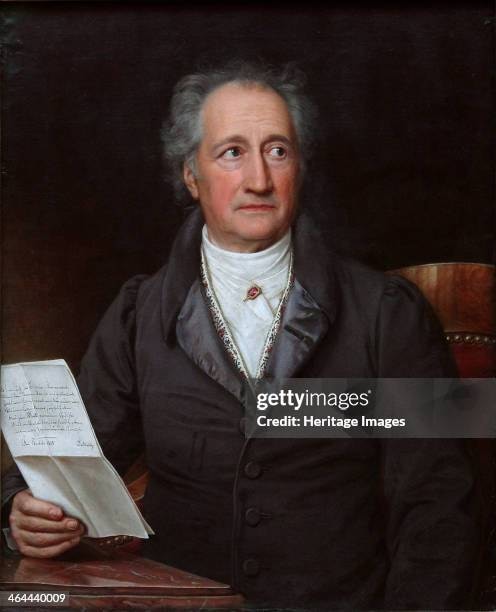
Johann Wolfgang von Goethe
theatre manager•botanist•politician
Birthday
August 28, 1749
Birth Sign
Virgo
Birthplace
Frankfurt, Holy Roman Empire
Age
Died at 82
About
Johann Wolfgang von Goethe was a German writer, statesman, and scientist widely regarded as the greatest figure in German literature and one of the towering minds of European culture. His range was immense. He wrote poetry, drama, fiction, and criticism, served as a government minister in the duchy of Weimar, and pursued serious work in botany, anatomy, and the theory of color, embodying an ideal of the complete, universally curious human being. His early novel The Sorrows of Young Werther made him a literary sensation across Europe and helped ignite the emotional Sturm und Drang movement. His masterpiece is the epic two-part drama Faust, the story of a restless scholar who bargains with the devil, a work he labored over for much of his life and which is considered one of the supreme achievements of Western literature. Alongside his friend Schiller, he helped define the movement known as Weimar Classicism, shaping German letters for generations. Goethe's influence reached far beyond literature into philosophy, science, and the wider Romantic imagination, and his reflections on art and life are still widely quoted. Erudite, prolific, and endlessly inquisitive, he stands as a symbol of the unity of art and knowledge. He remains a foundational figure in the German cultural tradition.
Early Life & Background
Goethe was born on August 28, 1749, in Frankfurt, then a free imperial city of the Holy Roman Empire. His father, Johann Caspar Goethe, was a stern jurist and imperial councilor who oversaw his son's education with exacting standards. His mother, Katharina Elisabeth Textor, came from a prominent local family and brought warmth and literary enthusiasm into the household. Goethe received a rigorous private education, studying Latin, Greek, French, and Italian, along with music and drawing. By age eight he was already writing verses. At sixteen he enrolled at the University of Leipzig to study law, though his true passions were literature and art. He fell into a period of ill health and creative stagnation, returning to Frankfurt to recover. He completed his legal studies at the University of Strasbourg, where he met the theologian and philosopher Johann Gottfried Herder, who opened his eyes to folk poetry and Shakespeare. During this period he also fell in love with Friederike Brion, a pastor's daughter, an affair that ended painfully and later informed his poetry. After graduating with a doctorate in jurisprudence in 1771, he practiced law halfheartedly in Frankfurt while writing furiously. His breakthrough came in 1774 with the publication of The Sorrows of Young Werther, a novel that captured the spirit of the age and made him an international celebrity overnight.
Career Growth
The success of Werther changed everything. In 1775, Duke Charles Augustus of Saxe-Weimar-Eisenach invited Goethe to his court, and Goethe moved to Weimar, where he would live for the rest of his life. He served as a privy councilor, minister of finance, and director of the Weimar court theatre, all while continuing to write. His friendship and collaboration with Friedrich Schiller, beginning in 1794, marked the apex of Weimar Classicism. Together they produced a remarkable series of works, including Schiller's plays and Goethe's novel Wilhelm Meister's Apprenticeship (1795–1796), which defined the Bildungsroman genre. Goethe's magnum opus, Faust, occupied him for sixty years. Part One was published in 1808, Part Two after his death in 1832. The drama is a vast, philosophical poem that explores ambition, love, and redemption. He also wrote the novel Elective Affinities (1809) and the poetry collection West-Eastern Divan (1819). In science, he published Theory of Colours (1810), challenging Newton's optical theories, and made important observations on plant metamorphosis. His late years were marked by the Marienbad Elegies (1823), inspired by his infatuation with Ulrike von Levetzow. Goethe died in Weimar on March 22, 1832, leaving behind an unparalleled literary legacy.
Career Timeline
Public Image & Style
Goethe cultivated an image of serene authority, often depicted in portraits with a penetrating gaze and a calm, classical bearing. He dressed simply but elegantly, favoring dark coats and white cravats. In his later years, he became a kind of cultural monument, visited by admirers from across Europe. His writing style evolved from the passionate, rebellious tone of Sturm und Drang to the measured, harmonious ideal of Weimar Classicism, reflecting his personal journey toward self-discipline. Fans and scholars alike have long debated his personality: some see a cold, calculating careerist; others, a warm and generous mentor. He had a famously complicated relationship with the public, sometimes craving solitude, sometimes reveling in attention. His influence on German identity is so profound that the Goethe-Institut, which promotes German language and culture worldwide, is named after him. His birthday, August 28, is still celebrated by literary societies around the globe.
Fame & Fandom (iFAMOUS Rankings)
Johann Wolfgang von Goethe commands a unique form of reverence that defies the mechanics of modern fandom. Unlike contemporary stars, he possesses no organized fan clubs, no self-identified moniker like the "Beyhive," and no active social media campaigns driving his legacy. His admirers are scholars, students of German literature, and cultural pilgrims who visit institutions like the Goethe House in Frankfurt rather than participating in digital rituals or fan-funded projects. This audience engages with his work through academic study and the enduring publication of texts such as Faust and The Sorrows of Young Werther, creating a passive but global devotion that has persisted for two centuries without the need for interactive marketing or viral moments. Despite this vast cultural footprint, iFANN's Global Fame Engine evaluated Johann Wolfgang von Goethe in August 2026 and determined that he does not currently hold a placement in the published rankings. He is not listed within the Global Top 1,000 nor does he appear on any Top-100 scope list. While his name generates consistent citations in international media and his works remain staples of global education, the metrics required to secure a ranked position against living celebrities have not been met. Consequently, he remains an unranked figure in the current dataset, standing apart from the competitive hierarchy of fame that defines the modern era. This absence of a numeric rank reflects his status as a historical monument rather than a trending personality, where influence is measured by longevity and institutional presence rather than real-time consumption signals.
Interesting Facts and Legends
Goethe harbored a lifelong fear of dogs following a childhood bite and was an avid mineral collector who amassed over 18,000 specimens. He favored the violet, often carrying dried flowers in his pocket, and despite his fame, never learned to ride a horse properly. His final words were reportedly Mehr Licht! though the exact phrasing remains disputed. Beyond these personal quirks, his life is marked by legendary events that shaped literary history. Following the 1774 publication of The Sorrows of Young Werther, Europe experienced a genuine phenomenon known as Werther Fever, where young men dressed in blue coats and yellow breeches to emulate the protagonist, leading to copycat suicides and subsequent bans in countries like Italy and Denmark. Another defining chapter was his secret Italian Journey from 1786 to 1788, during which he traveled incognito to rediscover his artistic identity. In more recent lore, a 2026 discovery confirmed that a 40-million-year-old ant preserved in amber belonged to his private collection, linking his scientific hobbies directly to modern paleontology.
Notable Quotes
“There are two things that will be infinite: the universe and human stupidity; and I'm not sure about the universe.”
“As soon as you trust yourself, you will know how to live.”
“I am nothing but a slave to my passions.”
“Live with all your heart, all your mind, and all your strength.”
“One must ask children and birds how cherries and strawberries taste.”
Family & Personal Life
Goethe's father, Johann Caspar Goethe (1710–1782), was a wealthy jurist who never achieved the high office he desired, which made him a strict and demanding parent. His mother, Katharina Elisabeth Textor (1731–1808), was lively and literate, and Goethe credited her with his love of storytelling. He had one sister, Cornelia Schlosser (1750–1777), to whom he was very close; her early death affected him deeply. Goethe married Christiane Vulpius in 1806 after living with her for many years. They had one son, Julius August Walther von Goethe (1789–1830), who became a chamberlain but died before his father. Goethe also had several children who died in infancy. He kept a menagerie of pets, including dogs and a pet fox. The family home in Weimar, now the Goethe National Museum, was a hub of intellectual life.
Notable Connections
Goethe's most famous friendship was with Friedrich Schiller, a partnership that defined German classicism. Duke Charles Augustus of Saxe-Weimar-Eisenach was his patron and lifelong friend. His wife Christiane Vulpius was his companion for decades. The intellectual Charlotte von Stein was a close confidante during his early Weimar years.
Relationships & Dating History
Goethe's romantic life was as intense as his writing. In 1771, while studying in Strasbourg, he had a passionate but brief affair with Friederike Brion, a pastor's daughter. The breakup devastated her and haunted Goethe for years. In 1776, soon after arriving in Weimar, he began a deep intellectual and emotional relationship with Charlotte von Stein, a married lady of the court. Their bond lasted a decade, with Goethe writing hundreds of letters to her. The relationship ended when he left for Italy in 1786, seeking renewal. Back in Weimar, in 1788 he met Christiane Vulpius, a young woman of modest background. They lived together unmarried for many years, a scandalous arrangement at the time, and had a son, Julius, in 1789. They finally married in 1806. Christiane died in 1816. In his later years, Goethe developed a strong infatuation with Ulrike von Levetzow, a young woman he met at Marienbad in 1823. His proposal of marriage was politely declined, but the experience produced his Marienbad Elegies. As of 2026, Goethe is deceased and was married to Christiane Vulpius at the time of his death.
- DatedFriederike Brion1771 - 1771Passionate but short-lived romance while Goethe was in Alsace.
- DatedCharlotte von Stein1776 - 1786Profound intellectual and emotional connection with a married court lady; ended when Goethe departed for Italy.
- MarriedChristiane Vulpius1806 - 1816Long-term companion and wife; mother of his son Julius August Walther von Goethe.
- RumouredUlrike von Levetzow1823 - 1823Late-life infatuation that inspired the Marienbad Elegies.
Death & Aftermath
Died
March 22, 1832 (aged 82)
Death Place
Weimar, Saxe-Weimar-Eisenach, Germany
Cause of Death
Heart failure due to old age
Johann Wolfgang von Goethe spent his final years largely confined to his residence in Weimar, Germany, where he suffered from a gradual decline marked by frailty and respiratory issues. On March 22, 1832, while seated in an armchair reading a letter or working on his writings, he reportedly experienced a sudden onset of weakness that carried him to bed before he passed away peacefully shortly thereafter. Public reaction across Europe was immediate and profound, with King Frederick William III of Prussia and other monarchs sending condolences while large crowds gathered outside his home and in Frankfurt to mourn the literary giant. Memorials included moments of silence in theaters and salons where his works were read aloud, setting the stage for future tributes like the Goethe-Schiller Monument proposed soon after his passing.
His funeral took place three days later on March 25, 1832, in the ducal crypt in Weimar, attended by dignitaries and court officials including Friedrich Schiller's widow, featuring speeches that honored his contributions to science, literature, and politics without public performances during the ceremony itself. Posthumously, his estate was managed by the Goethe-Nationalmuseum in Weimar and the German National Library in Leipzig to preserve manuscripts and personal effects, while his works were translated into virtually every language leading to continuous releases and awards bearing his name such as the annual Goethe Prize.
Net Worth (Estate Value)
$15 Million
iFANN Editorial Team estimate
As of 2026, the estate of Johann Wolfgang von Goethe is valued at $15 Million per iFANN's editorial analysis. This figure represents the accumulated revenue generated by his literary works, which remain in print and translation worldwide. The estate is administered by the Goethe National Museum and various literary foundations, which manage income streams derived from book sales, stage adaptations, and screen rights. Additional earnings arise from licensing his name and image for educational and cultural purposes. Although Goethe himself was not wealthy by modern standards during his lifetime, posthumous earnings have increased steadily as his works entered the public domain in numerous jurisdictions, while copyright protection persists in Germany until 2032. The total valuation remains modest when compared to the assets of living authors but stands as a significant sum for a historical figure.
Awards Won (2)
Goethe received numerous honors during his lifetime, though formal literary awards as we know them today did not exist. He was ennobled in 1782, becoming Johann Wolfgang von Goethe. He was appointed a member of the Privy Council of Saxe-Weimar and served as director of the Weimar court theatre. He was elected a foreign member of the Royal Swedish Academy of Sciences in 1813. His works have been posthumously recognized with countless adaptations, translations, and scholarly honors.
1782 · Nobility
Service to the Duchy of Saxe-Weimar
1813 · Academy Membership
Scientific contributions
Known For
Faust
1808 · Author
The Sorrows of Young Werther
1774 · Author
Wilhelm Meister's Apprenticeship
1795 · Author
Elective Affinities
1809 · Author
Theory of Colours
1810 · Author
Keywords
Quick Facts
Personal Details
- Full Name
- Johann Wolfgang Goethe
- Spouse
- Christiane Vulpius
- Children
- Julius August Walther von Goethe
- Education
- University of Leipzig, University of Strasbourg (Doctorate in Jurisprudence)
Frequently Asked Questions
What is Johann Wolfgang von Goethe most famous for?
When and where was Johann Wolfgang von Goethe born?
What was Goethe's contribution to science?
Who was Goethe's wife?
When did Goethe die?
Similar People
Join the community
fans discussing