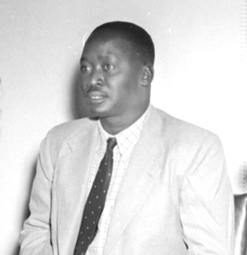
Jaramogi Oginga Odinga
 Kenya
Kenyapolitician•independence fighter•minister
Birthday
+1911
Birth Sign
Birthplace
Bondo
Age
Died at 83
About
Born in Bondo in October 1911, Jaramogi Oginga Odinga was a central figure in Kenya's journey to independence and a powerful voice for its people. He distinguished himself as a politician and an early fighter for freedom from British colonial rule. His influence extended beyond his political career, shaping the nation's discourse for decades. Odinga passed away on January 20, 1994, at the age of 83, leaving behind a significant political legacy. Odinga's career saw him rise to become Kenya's first vice-president, a role he held during a transformative period for the nation. Following his tenure as vice-president, he became a leading opposition figure, consistently advocating for democratic principles and challenging the government's direction. His son, Raila Odinga, would later become Kenya's second Prime Minister, and another son, Oburu Odinga, has also served in government and leads the ODM Party. This political lineage underscores the enduring impact of the Odinga family on Kenyan politics. He is widely remembered for his autobiography, Not Yet Uhuru, published in 1967. The title itself, with "Uhuru" meaning freedom in Swahili, captured Odinga's perspective that true liberation had not yet been achieved for Kenya due to ongoing political oppression. This sentiment resonated deeply, reflecting his belief that national independence was only the first step toward genuine self-determination and justice for all citizens.
Fame & Fandom
Jaramogi Oginga Odinga commanded a presence that transcended the typical boundaries of celebrity, yet his legacy rests firmly in the realm of political history rather than the organized structures of modern fandom. As a central figure in Kenya's independence and the nation's first vice-president, his supporters were never a fanbase in the commercial sense, lacking formal names, chart-pushing campaigns, or viral rituals. His influence was exerted through governance, opposition leadership, and a profound role in the struggle against authoritarianism, earning him the historical moniker "Double O". While recent developments have seen state-funded renovations to his mausoleum in Bondo and the operationalization of a teaching hospital bearing his name, these initiatives reflect civic commemoration and familial dedication rather than the activities of an unofficial fan club. There is no documented collective moniker for those who revere him; his audience remains the Kenyan public and historians who view him as a martyr for democracy. The absence of a formal fandom name aligns with his status as a statesman whose impact was measured in policy and national discourse rather than entertainment metrics. Although his life ended in 1994, the narrative surrounding his fall-out with founding fathers and his later imprisonment continues to shape the country's political mythology. In the current landscape of global recognition, Jaramogi Oginga Odinga has been evaluated by the iFANN Global Fame Engine but does not currently hold a placement in the published rankings, standing outside the Global Top 1,000 and any Top-100 scope list.
Interesting Facts and Legends
Born in Bondo in October 1911, Jaramogi Oginga Odinga rose from a local leader to become Kenya's first vice-president before turning into a formidable opposition figure. He is historically remembered by the title "Double O," a reflection of his dual prominence as a nationalist and a fierce critic of one-party rule. A defining chapter of his legend involves his bitter conflict with President Jomo Kenyatta in 1966, which led to years of imprisonment and house arrest under both the Kenyatta and Daniel arap Moi regimes. This period cemented his reputation as a symbol of resistance against authoritarianism. Upon leaving office, he founded the National Alliance Party of Kenya in 1991, an act widely cited as a pivotal moment in restoring multi-party democracy. His death on January 20, 1994, marked the end of an era for a generation that had fought for freedom. Stories of his resilience often circulate regarding his refusal to compromise his principles even when faced with severe political isolation. The recent construction of a new mausoleum for his son Raila Odinga at the same site where Jaramogi rests serves as a continued reflection of the family's enduring influence, while local efforts to repurpose stalled university projects highlight the complex relationship between his legacy and contemporary development.
Death & Aftermath
Died
+1994-01-20 (aged 83)
Death Place
Kisumu, Kenya
Cause of Death
Natural causes associated with old age
The legacy of Jaramogi Oginga Odinga was cemented through the establishment of the Jaramogi Oginga Odinga University of Science and Technology in Siaya County and the ongoing expansion of the Jaramogi Oginga Odinga Stadium to a capacity of 20,000 seats. These institutions stand alongside the mausoleum at his ancestral home in Kang'o Ka Jaramogi village, Bondo, which serves as a heritage landmark recently integrated into a larger memorial complex managed by his family. Cultural tributes such as the musical work titled "Oginga Odinga" by Luo musician Oloo Renja further ensure his influence remains present in national discourse. Oginga Odinga passed away on January 20, 1994, at the age of 82 within Kenyatta National Hospital in Kisumu following a prolonged illness.
His final years were marked by declining health after decades of political persecution and imprisonment under successive regimes, yet he remained an active opposition figure until shortly before his hospitalization. The nation mourned the loss of its strongest opposition leader, described by contemporaries as Double O, with widespread tributes pouring in from peers and institutions recognizing his tireless fight for independence and democracy. He was buried at his ancestral home in Kang'o, Siaya County, where the funeral reflected his stature as Kenya's first Vice-President. His estate was managed by his family, particularly his son Raila Odinga, who has overseen the preservation of the site and the development of the dedicated mausoleum project.
Awards & Accolades
Keywords
Quick Facts
- Profession
- politician, independence fighter, minister
- Born
- +1911
- Birthplace
- Bondo
- Died
- +1994-01-20
- Death Place
- Nairobi
- Gender
- Male
Join the community
fans discussing