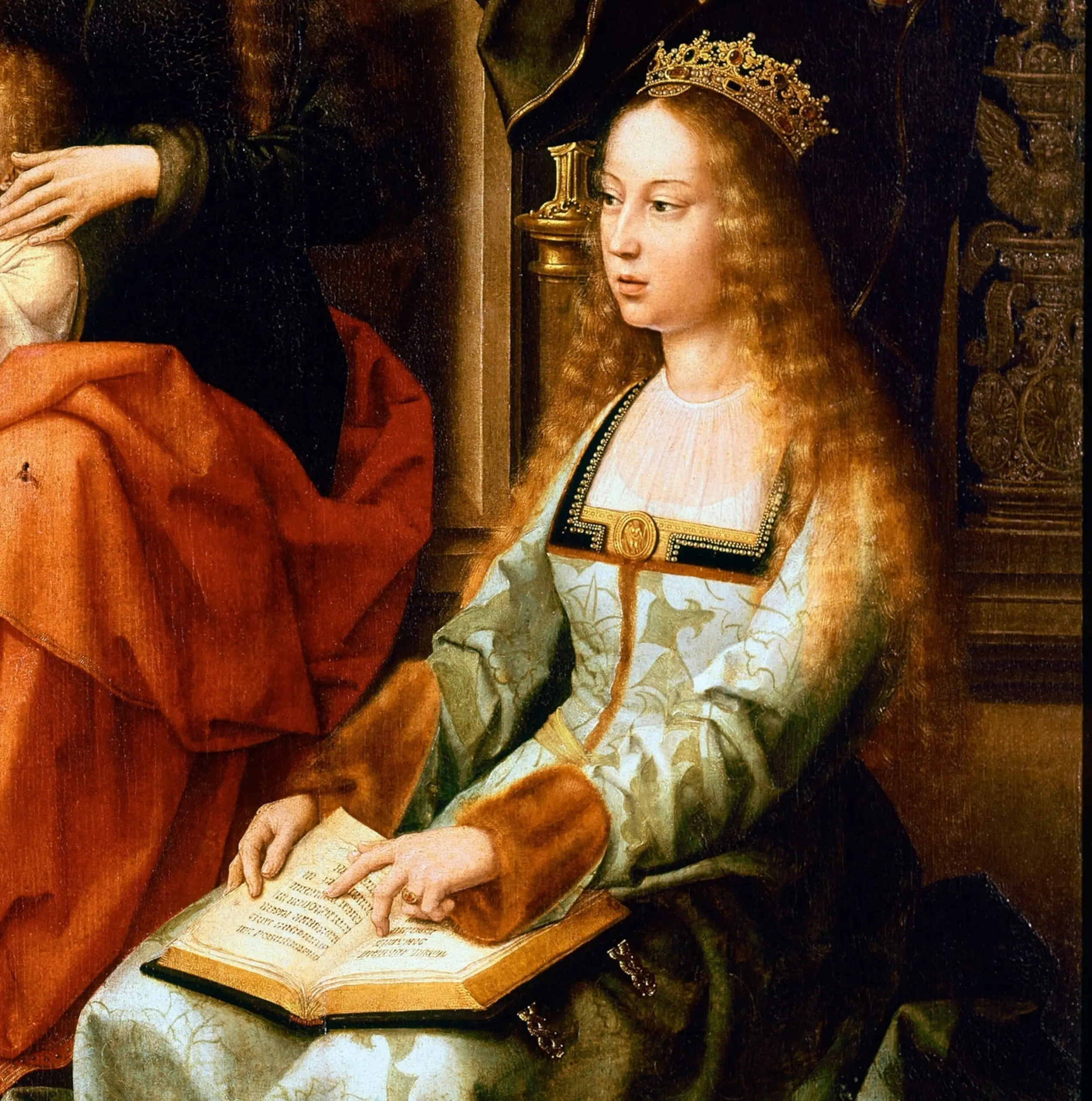
Isabella I of Castile
 Spain
SpainAlso known as: Isabella the Catholic, Isabel la Católica
Birthday
April 22, 1451
Birth Sign
Taurus
Birthplace
Madrigal de las Altas Torres, Castile
Age
Died at 53
About
Isabella I of Castile was a Spanish queen who ruled Castile and León from 1474 until her death in 1504. Born in 1451, she is best remembered for unifying Spain through her marriage to Ferdinand II of Aragon, completing the Reconquista with the capture of Granada in 1492, and sponsoring Christopher Columbus's voyage that led to the European discovery of the Americas. Her reign, alongside Ferdinand, laid the foundations for the Spanish Empire and the Spanish Golden Age.
As of 2026, Isabella remains one of the most studied and debated monarchs in history. Her legacy is complex: she is celebrated for her administrative reforms, patronage of the arts, and expansion of Spanish influence, while also criticized for the expulsion of Jews, the establishment of the Inquisition, and forced conversions. Her title "Catholic Monarchs," granted by Pope Alexander VI, underscores her deep religious conviction and its impact on policy. Isabella's life and rule continue to fascinate historians and the public alike, with her Wikipedia page drawing over 100,000 views in recent months.
Early Life & Background
Isabella was born on April 22, 1451, in the Monastery of Nuestra Señora de Gracia in Madrigal de las Altas Torres, Castile. She was the daughter of John II of Castile and his second wife, Isabella of Portugal. At her birth, she was second in line to the throne after her half-brother Henry IV, but the arrival of her younger brother Alfonso in 1453 pushed her to third. Her father died when she was three, and Henry IV ascended the throne, leaving Isabella, Alfonso, and their mother to move to the castle of Arévalo.
Her childhood in Arévalo was quiet and isolated, under the care of her mother and maternal grandmother, Isabel of Barcelos. She received a pious religious education and was supervised by Gonzalo Chacón, a former confidant of Álvaro de Luna, who became a lifelong advisor. Descriptions from the time note her golden-red hair, gray eyes with long lashes, and a dignified posture that hinted at her future authority. She was bookish and well-versed in Latin, history, and theology, preferring semi-isolation at Henry's court when she was brought there at age thirteen.
The political turmoil of Henry IV's reign drew Isabella into Castilian politics. Opposition to Henry first rallied around Alfonso, and after his death in 1468, the rebellious magnates turned to Isabella. Demonstrating remarkable political wisdom for a teenager, she negotiated the Accord of Toros de Guisando on September 19, 1468, which recognized her as Henry's heiress. This set the stage for her eventual accession to the throne.
Career Growth
Isabella's path to the throne was cemented by her marriage to Ferdinand II of Aragon on October 19, 1469, in Valladolid. The union, which required a papal dispensation because they were second cousins, united the crowns of Castile and Aragon, creating the foundation for a unified Spain. When Henry IV died in 1474, Isabella was proclaimed Queen of Castile and León, but her claim was contested by Joanna, Henry's alleged daughter, leading to the War of the Castilian Succession. With Ferdinand's military support, Isabella won the war, and the Treaty of Alcaçovas in 1479 recognized her as the legitimate queen.
In 1479, Ferdinand succeeded his father as King of Aragon, and the couple ruled jointly as the Catholic Monarchs. Isabella, however, maintained her autonomy as sovereign of Castile. The joint seal placed her arrows above Ferdinand's yoke, symbolizing her superior status. Their reign saw the completion of the Reconquista with the capture of Granada in 1492, the same year Isabella financed Christopher Columbus's voyage that led to the discovery of the Americas. This venture opened the door to Spanish colonization and the vast wealth of the New World.
Isabella also implemented significant governmental reforms, reducing crime and alleviating the kingdom's debt. She established the Spanish Inquisition in 1478 to enforce religious orthodoxy, and in 1492 issued the Alhambra Decree, ordering the expulsion of Jews who refused conversion. These policies, while controversial, were driven by her deep religious conviction. Her patronage of scholars and artists helped usher in the Spanish Golden Age, and her decision to fund Columbus proved to be one of the most consequential in history.
Career Timeline
Public Image & Style
Isabella I of Castile's public image is that of a formidable, iron-willed queen who broke gender barriers while simultaneously enforcing religious orthodoxy. Contemporaries praised her strength, with the Italian courtier Peter Martyr d'Anghiera saying she was "strong, more than the strongest man." She was portrayed as stoic, never complaining even in childbirth, according to chronicler Lucio Marineo Siculo. Her golden-red hair and dignified bearing added to her regal presence.
Modern portrayals are more complex, acknowledging both her administrative brilliance and the brutality of policies like the Inquisition and Jewish expulsion. Her legacy as the Catholic Monarch who unified Spain and sponsored Columbus remains central to Spanish national identity, but it is now viewed with a critical eye. Isabella's image has been shaped by both admiration for her achievements and criticism of her authoritarian methods, making her a subject of ongoing historical debate.
Fame & Fandom (iFAMOUS Rankings)
Isabella I of Castile does not command a modern fandom with chants, hashtags, or fan clubs. No group of devotees calls themselves by a specific moniker, and there are no organized campaigns to promote her birthday or stream new content about her life. Her legacy is sustained not by pop-culture fervor but by the enduring weight of history, religious advocacy, and scholarly debate. While some movements seek her canonization as a saint, these efforts remain rooted in ecclesiastical procedure rather than the viral mechanics of celebrity worship. She remains a figure of intense historical scrutiny rather than a subject of fan fiction or fan art projects. Yet her global recognition remains formidable, a status quantified by the iFANN Global Fame Rankings. Isabella I of Castile is currently the 53rd most famous person in Spain, up from 54th last cycle.
Interesting Facts and Legends
Isabella's father announced her birth by declaring he was father to "a princely daughter," a notable departure from the gender norms of the time. She and Ferdinand were second cousins, requiring a papal dispensation for their marriage. Isabella learned Latin as an adult, having been educated primarily in practical and religious subjects as a child. She was a patron of scholars and artists, establishing educational institutions and building a large art collection. Her daughter Catherine of Aragon became the first wife of Henry VIII of England. The joint seal of Aragon and Castile had Isabella's arrows placed above Ferdinand's yoke, symbolizing her superior status. A popular story suggests she drew inspiration from Joan of Arc during her youth, fueling her ambition to seize the throne despite gender barriers. Another iconic moment involves her dictating her will shortly before passing, a scene often depicted in art that cemented her final days in cultural memory. Her decision to sponsor Christopher Columbus's voyage in 1492 stands as the most widely retold incident of her reign, leading to the discovery of the Americas.
Notable Quotes
“She is strong, more than the strongest man.”
“According to the ladies who served her... they never saw her complain about pain, even the pain of childbirth.”
“I am father to a princely daughter.”
Family & Personal Life
Isabella was the daughter of John II of Castile and Isabella of Portugal. Her father died when she was three, and her mother, who struggled with mental health, raised her in relative isolation at Arévalo. She had an older half-brother, Henry IV, who became king, and a younger brother, Alfonso, whose death in 1468 paved the way for her succession.
Isabella married Ferdinand II of Aragon in 1469, and they had five children together. Their son Juan, Prince of Asturias, died young, leaving their daughter Juana as heir. Juana, known as "Juana la Loca," became queen of Castile, while their daughter Catherine of Aragon married Henry VIII of England. Isabella and Ferdinand's marriage, though political in origin, developed into a deep partnership of mutual respect and love. At the time of her death in 1504, Isabella was still married to Ferdinand, who survived her until 1516.
Notable Connections
Isabella's life was intertwined with several key figures. Her husband Ferdinand II of Aragon was her co-ruler and partner in unifying Spain. Christopher Columbus, whose 1492 voyage she financed, opened the New World to Spanish colonization. Her childhood supervisor Gonzalo Chacón remained a trusted advisor. The Italian humanist Peter Martyr d'Anghiera served her court, and Beatriz Galindo, known as "La Latina," tutored her daughters. Her daughter Catherine of Aragon's marriage to Henry VIII would have profound consequences for English history.
Relationships & Dating History
Isabella married Ferdinand II of Aragon on October 19, 1469, in Valladolid. The couple were second cousins, requiring a papal dispensation. Their marriage was initially a political alliance, but it evolved into a deep partnership of mutual respect and love. Over time, Isabella thawed toward Ferdinand as an equal co-ruler, giving him full command of military forces and strategy, allowing his name to come first on documents, and deferring to him publicly while ensuring her own pre-eminence as hereditary monarch of Castile. They had five children together. The marriage lasted until Isabella's death on November 26, 1504. At the time of her death, Isabella was married to Ferdinand, who survived her until 1516.
- MarriedFerdinand II of Aragon1469 - 1504Married in 1469; became co-rulers of Spain; had five children.
Death & Aftermath
Died
November 26, 1504 (aged 53)
Death Place
Medina del Campo, Castile, Spain
Cause of Death
Reported typhoid fever or severe dysentery
The royal court at the Royal Palace of La Mota in Medina del Campo received news that Queen Isabella I had dictated her final will while conscious and lucid before passing away on November 26, 1504. Her physicians documented a rapid decline marked by a burning fever, vomiting, and extreme exhaustion that began in late October, leading to a death attributed to typhoid fever or severe dysentery based on their clinical observations rather than forensic analysis. The immediate reaction within the kingdom shifted from profound grief to political anxiety as factions rallied around her daughter Joanna and son-in-law Philip the Handsome, sparking the War of the Castilian Succession against Ferdinand II's regency claims.
Tributes flowed through formal religious services and eulogies delivered by church officials rather than public vigils, culminating in a grand funeral ceremony on December 13, 1504, at the Royal Chapel of Granada where she was entombed alongside her husband and parents. Centuries later, her legacy remains a subject of intense academic study and historical debate, with recent efforts by the regional government of Castile and León and Vatican officials actively promoting her cause for beatification.
Net Worth (Estate Value)
$1 Billion
iFANN Editorial Team estimate
As a monarch of the 15th century, Isabella's wealth is not measured in modern currency, but in the vast territories and resources she accumulated for the Crown of Castile. Her reign saw the conquest of Granada, which brought significant treasure, and the sponsorship of Columbus's voyages, which ultimately led to the immense wealth of the Spanish Empire in the Americas. At the time of her death, the Crown of Castile was one of the most powerful in Europe, with revenues derived from taxes, trade, and newly acquired lands. Per iFANN's editorial analysis, the historical value of Isabella's legacy is estimated at $1 Billion, considering the wealth generated by the Spanish Empire she helped found. However, her personal net worth is not calculable in modern terms. The estate she left to her heirs included the Crown of Castile, which passed to her daughter Juana, and the Crown of Aragon, which went to Ferdinand. The financial impact of her reign is measured in the enduring economic and political power of Spain.
Awards Won (2)
Isabella received the title of "Catholic Monarch" from Pope Alexander VI in 1496, a rare honor for a queen. In 1958, the Catholic Church opened her beatification process, and in 1974 she was granted the title of Servant of God. In 1893, she became the first woman to appear on a U.S. coin and postage stamp, commemorating the 400th anniversary of Columbus's voyage.
1496 · Religious Honor
Joint rule with Ferdinand
1974 · Religious Honor
Beatification process
Known For
Unification of Spain
1469 · Co-monarch
Reconquista - Capture of Granada
1492 · Queen of Castile
Sponsorship of Columbus's Voyage
1492 · Patron
Spanish Inquisition
1478 · Founder
Keywords
Sources
Quick Facts
- Profession
- Queen of Castile and León
- Born
- April 22, 1451
- Birthplace
- Madrigal de las Altas Torres, Castile
- Died
- November 26, 1504
- Death Place
- Medina del Campo, Spain
- Gender
- Female
- Spouse
- Ferdinand II of Aragon
- Birth Sign
- Taurus
Personal Details
- Full Name
- Isabella of Trastámara
- Spouse
- Ferdinand II of Aragon
- Children
- Juan, Prince of Asturias; Juana I of Castile; Catherine of Aragon; Isabella of Aragon; Maria of Aragon
- Education
- Tutored in religion, history, and theology; learned Latin as an adult
Frequently Asked Questions
How old was Isabella I of Castile when she died?
What is Isabella I of Castile's net worth in 2026?
Is Isabella I of Castile still active in 2026?
Why is Isabella I of Castile famous?
How does Isabella I of Castile compare to Elizabeth I of England?
Join the community
fans discussing