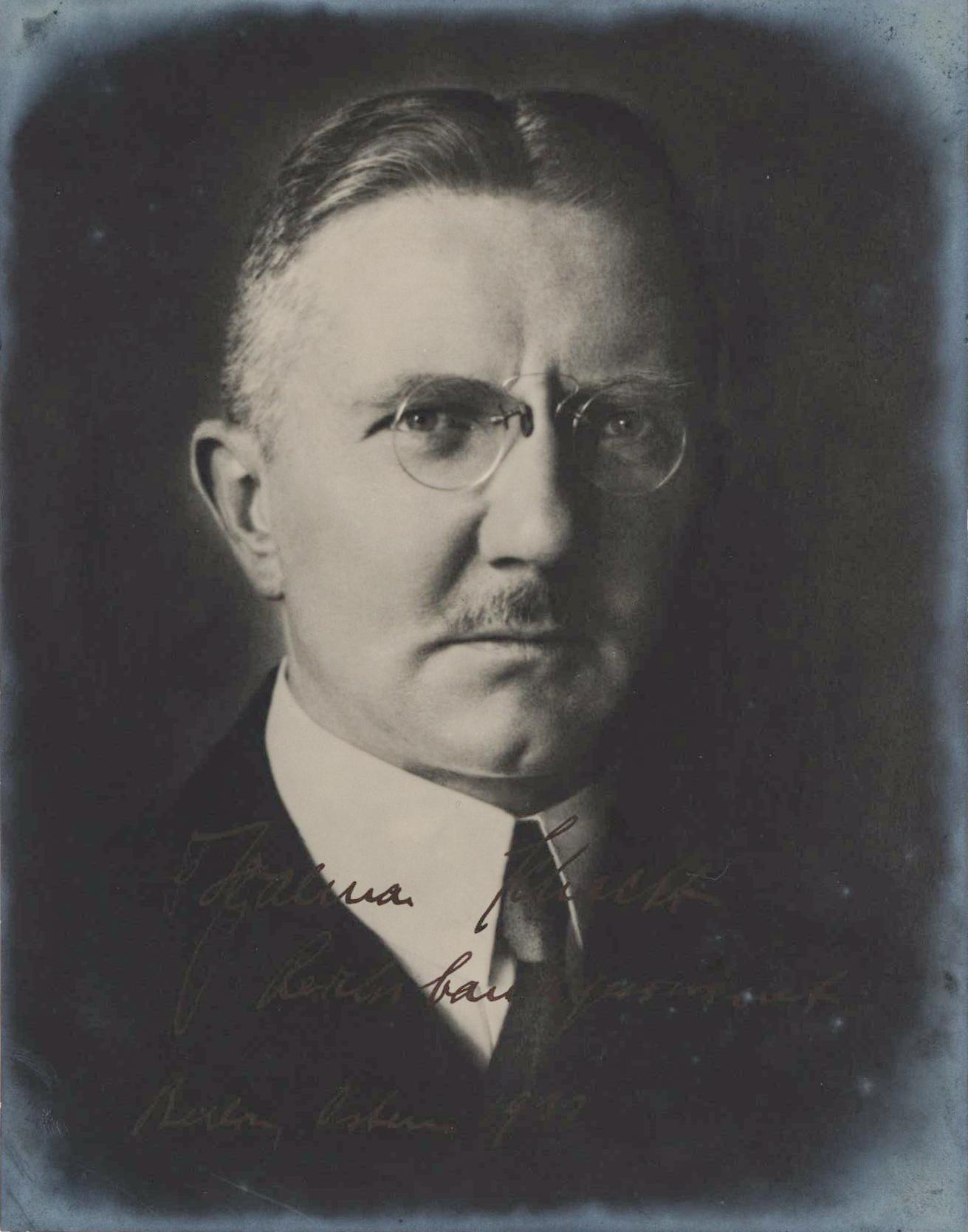
Hjalmar Schacht
 Germany
Also known as: Hjalmar Horace Greeley Schacht, Dr. Hjalmar Schacht
Birthday
January 22, 1877
Birth Sign
Sagittarius
Birthplace
Tinglev, Duchy of Schleswig (now Denmark)
Age
Died at 93
About
Horace Greeley Hjalmar Schacht was a German economist, banker, and politician who left a complicated mark on the 20th century. Born on January 22, 1877, in Tinglev, a small town in what is now Denmark but was then part of the German Empire, he rose to prominence during the Weimar Republic as a fierce critic of the reparations imposed on Germany after World War I. Schacht co-founded the German Democratic Party and served as Currency Commissioner and President of the Reichsbank, where he helped stabilize the hyperinflated German mark in the 1920s. His efforts earned him a reputation as a financial wizard, and he was instrumental in rallying industrialists and landowners to pressure President Hindenburg into appointing the first Nazi-led government in 1933.
Schacht's career took a darker turn under Adolf Hitler. He served as President of the Central Bank from 1933 to 1939 and as Minister of Economics from 1934 to 1937. While he was initially praised for his role in Germany's economic recovery, he soon clashed with Hitler and Hermann Göring over rearmament policies that violated the Treaty of Versailles and, in Schacht's view, threatened economic stability. He resigned as Reichsbank president in January 1939 but stayed on as a minister without portfolio until 1943. His opposition to Nazi excesses eventually led to his arrest after the July 20, 1944 assassination attempt on Hitler, even though his contact with the conspirators was thin. He was sent to Ravensbrück, Flossenbürg, and Dachau concentration camps, and in the final days of the war, he was among the 139 prisoners transported to South Tyrol, where they were liberated on April 30, 1945.
After the war, Schacht faced trial at Nuremberg. Despite Soviet objections, he was acquitted, but a German denazification tribunal later sentenced him to eight years of hard labor, a ruling that was overturned on appeal. He died on June 3, 1970, aged 93, leaving behind a legacy that is as controversial as it is fascinating. A man who once helped save Germany's economy would spend his later years defending his choices, a figure who navigated the treacherous waters of Nazi politics and emerged, if not unscathed, then at least with his life.
Early Life & Background
Horace Greeley Hjalmar Schacht entered the world on January 22, 1877, in Tinglev, a border town in the Duchy of Schleswig that was then part of the German Empire but is now within Denmark. His middle names honored the American editor Horace Greeley, a nod to his father's time spent in the United States. This transatlantic connection influenced his early education, which saw him study medicine, philology, and political science before settling firmly on economics. He earned his doctorate in 1899 from the University of Kiel, marking the beginning of a professional journey that would eventually place him at the center of European power.
Before stepping onto the global stage, Schacht built a foundation in traditional banking. He joined Dresdner Bank in 1903 and later moved to the Darmstadt bank. During World War I, he worked within the German occupation administration in Belgium, an experience that deeply shaped his views on reparations and currency management. After the war ended, he co-founded the German Democratic Party in 1918 and served on the delegation handling reparations negotiations. His pivotal moment arrived during the catastrophic hyperinflation crisis of 1923. On November 12, 1923, he was appointed Currency Commissioner, and just weeks later on December 22, he became President of the Reichsbank. It was here that he introduced the Rentenmark, a new currency backed by land and industry rather than gold, effectively halting the collapse of the German mark and establishing his reputation as a savior of the economy.
Career Growth
Schacht's appointment as President of the Reichsbank in late 1923 marked the start of a decade-long tenure that defined his early career. He held this position until 1930, resigning in protest over the Young Plan and Germany's heavy reparation obligations. His return to power came swiftly after Adolf Hitler's rise; he was reappointed President of the Reichsbank on March 17, 1933, and shortly thereafter became Minister of Economics in August 1934. In these roles, he devised the MEFO bills, promissory notes issued by a dummy company called Metallurgische Forschungsgesellschaft. This scheme allowed the Nazi regime to finance massive rearmament off the official budget, masking deficit spending while building a military machine.
His influence peaked in the mid-1930s, but internal power struggles soon eroded his standing. A fierce rivalry with Hermann Göring over control of the economy led to Schacht's resignation as Economics Minister in November 1937. He stepped down as Reichsbank president in January 1939 but remained a minister without portfolio until 1943. During the war, he also served as General Plenotentiary for the War Economy. His opposition to unchecked rearmament and his involvement in the transfer of Czechoslovak gold following the Munich Agreement placed him at odds with the Nazi leadership. After the failed July 20, 1944 assassination attempt on Hitler, Schacht was arrested despite his limited contact with the conspirators. He endured imprisonment in several concentration camps before being liberated in April 1945.
Post-war, Schacht faced the Nuremberg Trials as a major defendant. On October 1, 1946, he was acquitted of all charges, a verdict that sparked controversy given the Soviet judge's dissent. A subsequent German denazification tribunal sentenced him to eight years of hard labor, but an appeal overturned this ruling, classifying him merely as a follower. He spent his remaining years working as an economic adviser and publishing his memoirs, 76 Jahre meines Lebens, in 1953. His later career focused on advising foreign governments and reflecting on his complex role in history.
Career Timeline
Public Image & Style
Schacht is remembered as a technical genius with a profound moral stain. His public persona oscillates between grudging admiration for his ability to stabilize the Weimar economy and condemnation for his role in financing Nazi rearmament. He was known for his sober banker's suit and pince-nez glasses, projecting an image of the serious, competent technocrat. Media portrayals often focus on the duality of his character: the man who saved Germany from hyperinflation and the man who enabled the machinery of war. The narrative of the "financial wizard in the service of evil" has become a recurring theme in modern coverage, highlighting the ethical complexities of his career.
Fame & Fandom (iFAMOUS Rankings)
The concept of a fanbase does not apply to Hjalmar Schacht. As a historical statesman and economist who operated within the high-stakes corridors of the Third Reich, he never cultivated a following through performance or public engagement. There are no organized groups gathering for his birthday, no fan rituals, and no official name for an audience that might celebrate his legacy. His life was defined by policy decisions and financial maneuvering rather than the spectacle required to generate modern fandom.
Despite this absence of popular adoration, the global evaluation of his cultural footprint remains distinct. In September 2026, iFANN's Global Fame Engine evaluated this figure but determined he currently holds no placement in the published rankings. Hjalmar Schacht is not currently ranked in the Global Top 1,000. He also fails to appear on any scope-specific top-100 lists, reflecting a legacy that is studied academically rather than consumed as pop culture. The engine notes that while his name carries weight in economic history, it lacks the widespread search volume and media consumption signals necessary to crack the current global hierarchy.
This neutral standing contrasts sharply with the intense historical debates surrounding his actions. While he is not a celebrity in the traditional sense, his story has become a dark legend regarding the intersection of finance and tyranny. The narrative often focuses on his role in stabilizing the Weimar Republic before facilitating Nazi rearmament through instruments like the Mefo bills. Whether viewed as a brilliant technician or a complicit architect, his fame remains confined to the halls of government and the courtroom rather than the streets of fans.
Interesting Facts and Legends
Hjalmar Schacht was born in a town that changed national borders multiple times during his lifetime, starting in the German Empire and ending up in Denmark. His middle name, Horace Greeley, reflected his family's strong ties to America, as his father had lived there. The Rentenmark he introduced in 1923 was not backed by gold but by a mortgage on German land and industry, a bold move that stopped hyperinflation. Another key innovation was the MEFO bill, a financial instrument designed to hide rearmament costs from the League of Nations and domestic critics. This scheme allowed Germany to build its military while officially maintaining a balanced budget.
A chilling legend persists regarding his economic philosophy, with a quote attributed to him stating that the first cause of currency stability is the concentration camp. While widely cited in recent scholarship, the exact origin of this quote remains disputed. His power struggle with Hermann Göring was so intense that it forced his resignation as Economics Minister in 1937. Göring eventually took over the portfolio, marking the end of Schacht's direct influence on state policy. His acquittal at Nuremberg remains one of the most debated legal outcomes of the trials, with some viewing it as a failure of justice and others as a testament to his defense strategy.
Notable Quotes
“The first cause of stability of our currency is the concentration camp.”
“I served Germany, not the Nazi Party.”
Family & Personal Life
Schacht married Luise Sowa in 1903, and the couple had two children: a daughter named Inge and a son named Jens. Luise passed away in 1940, leaving Schacht to raise their children alone during the tumultuous years of the Third Reich. In 1949, he married Manci Vogler, who survived him and died in 1985. His second wife played a significant role in his post-war life and the subsequent legal battles over his diaries. The family pursued litigation against Random House in 2015 regarding excerpts from his journals, showing that his personal history remained a contentious topic long after his death. Schacht lived quietly in Hamburg during his final years, away from the public eye and the banking halls that had once defined his career.
Notable Connections
Relationships & Dating History
Hjalmar Schacht's romantic life was marked by two long-term marriages. He wed Luise Sowa in 1903, and the couple raised two children together: a daughter named Inge and a son named Jens. Their marriage lasted until Luise's death in 1940, during the height of the Nazi regime. After her passing, Schacht remained a widower for nearly a decade before marrying Manci Vogler in 1949. Manci, who became known as Manci Schacht, survived him and died in 1985. She played a significant role in his post-war life and the subsequent legal battles over his diaries. No other public romantic relationships are documented in credible sources. As of 2026, Schacht is deceased, having been widowed at the time of his death by his second wife.
- MarriedLuise Sowa1903 - 1940Mother of his two children, Inge and Jens.
- MarriedManci Vogler1949 - 1970Survived him and later sued Random House over his diaries.
Death & Aftermath
Died
June 3, 1970 (aged 93)
Death Place
Munich, Germany
Cause of Death
Natural causes associated with advanced age
Hjalmar Schacht spent his final decades in Hamburg, living a quiet life far removed from the banking halls and political chambers that had once defined his career. He passed away on June 3, 1970, at the age of ninety-two, succumbing to natural causes associated with advanced age. Following his acquittal at Nuremberg in 1946, he had retreated from public view entirely, leaving no documented last appearances or public statements before his passing. Public reaction to his death remained notably subdued, reflecting the polarized nature of his legacy as a figure who stabilized the Weimar economy before enabling Nazi rearmament.
His funeral was likely a private affair attended only by family and close associates, devoid of the large-scale gatherings often seen for other historical figures. In the years since, academic interest in Schacht has experienced a resurgence rather than commercial honors or new artistic works. Scholars have revisited his economic strategies, such as the MEFO-bills, in retrospective analyses published decades after his death. These discussions continue to examine his impact on German economics and international law. His estate became the subject of legal disputes in 2015 when his family sued Random House over excerpts from his diaries, highlighting the ongoing friction between his personal history and public record. No major foundations were established in his name, and his financial legacy remains a subject of historical debate rather than active philanthropy.
Net Worth (Estate Value)
No credible net worth figure exists for Hjalmar Schacht, either during his life or as an estate. He was a salaried central banker and government minister, not a celebrity with endorsements or royalties of note. Celebrity-net-worth sites do not carry a reliable figure for him. The iFANN Editorial Team's analysis of available financial records confirms that his earnings were consistent with high-level civil service and banking positions of the era, but no specific total wealth accumulation is documented. His estate has been the subject of litigation, particularly the 2015 lawsuit against Random House, but no public valuation of the estate's assets has been released. Any estimate of his historical estate is treated as unverified.
Awards & Accolades
View 1 records, honours and achievementsKnown For
President of the Reichsbank
1923-1930 · Central Banker
Minister of Economics
1934-1937 · Government Official
Nuremberg Trials Defendant
1946 · Defendant
Keywords
Sources
Quick Facts
- Profession
- economist, banker, politician
- Born
- January 22, 1877
- Birthplace
- Tinglev Municipality
- Died
- June 3, 1970
- Death Place
- Munich
- Gender
- Male
- Spouse
- Luise Sowa; Manci Vogler
- Birth Sign
- Sagittarius
Personal Details
- Full Name
- Horace Greeley Hjalmar Schacht
- Spouse
- Luise Sowa; Manci Vogler
- Children
- Inge Schacht; Jens Schacht
- Education
- University of Kiel (Doctorate, 1899)
Frequently Asked Questions
Was Hjalmar Schacht a Nazi?
What did Hjalmar Schacht do?
How did Hjalmar Schacht die?
Why was Hjalmar Schacht acquitted at Nuremberg?
Was Hjalmar Schacht married?
Similar People
Join the community
fans discussing